Archive
03/11/2022 – Ephemeris – Looking at the northern part of the Moon and the crater Plato
This is Ephemeris for Friday, March 11th. Today the Sun will be up for 11 hours and 41 minutes, setting at 6:43, and it will rise tomorrow at 7:00. The Moon, 1 day past first quarter, will set at 4:18 tomorrow morning.
As the Moon moves around the Earth, now one day past first quarter, more of it is revealed in sunlight. The top or north part of the moon is of interest now. The second-largest lunar sea, Mare Imbrium, or Sea of Showers, is now half illuminated by the advancing terminator, the sunrise line. That can be seen with the naked eye. With binoculars, in the mountains north or above Imbrium can be found the flat floored crater or walled plain called Plato. This crater is situated in the lunar Alps. Mountains on the Moon are named after their earthly counterparts. Visible in telescopes now will be the Alpine Valley cutting through the Alps just to the right of Plato. Each night from new to full, more of the Moon’s features are revealed near the terminator.
The astronomical event times given are for the Traverse City/Interlochen area of Michigan (EST, UT – 5 hours). They may be different for your location.
Addendum
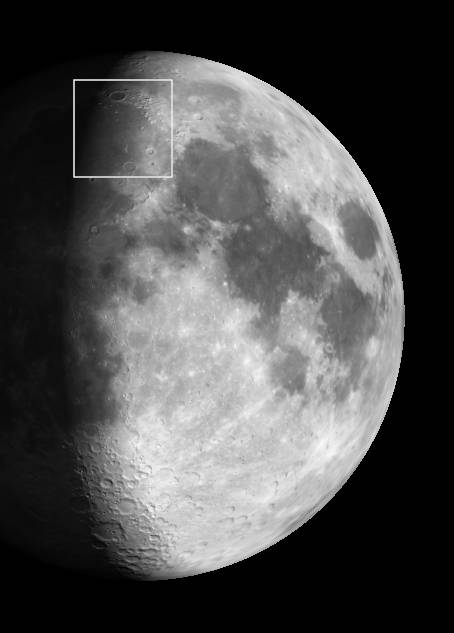
The Moon tonight, a day past first quarter, March 11, 2022, outlining the Mare Imbrium, crater Plato area, which is seen in detail below. Created using Virtual Lunar Atlas.
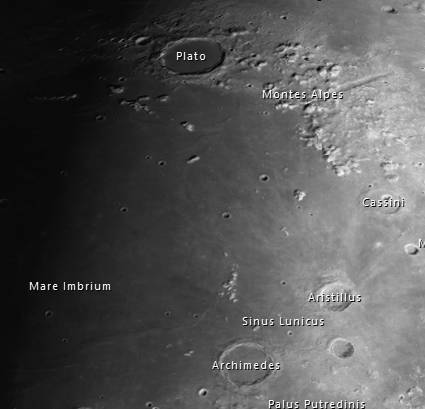
The Moon tonight, March 11, 2022, highlighting the crater Plato and lunar Alps. The Alpine Valley (Vallis Alpes), lies under the caption “Alpes” for the mountains. One of cool things to watch when the terminator is situated just right is to watch the shadows of the mountains retreat across Plato’s crater floor as the Sun rises. The shadows of the peaks appear very jagged as they retreat. Created using Virtual Lunar Atlas.
01/27/2015 – Ephemeris – Looking at a valley on the Moon
Ephemeris for Tuesday, January 27th. The sun will rise at 8:07. It’ll be up for 9 hours and 36 minutes, setting at 5:44. The moon, 1 day past first quarter, will set at 2:36 tomorrow morning.
If it’s clear tonight drag out that telescope to look at the Moon. Your telescope may flip the moon around, viewing the Moon in different orientations. What I’m describing will be north is up, south is down. Your telescope may flop the image, so check your telescopic view with how it appears to the naked eye. I will use the north-south terminology. And we’ll stick close to the terminator, the sunrise line on the Moon. One of the striking linear features of the moon is the Alpine Valley, about 2/3rds the way from the center of the moon to the north pole. It is a fault valley through the lunar Alps. About half way from the center of the Moon to the north pole. It’s the largest of three craters in a nearly right triangle. It’s named after Archimedes.
Times are for the Traverse City/Interlochen area of Michigan. They may be different for your location.
Addendum
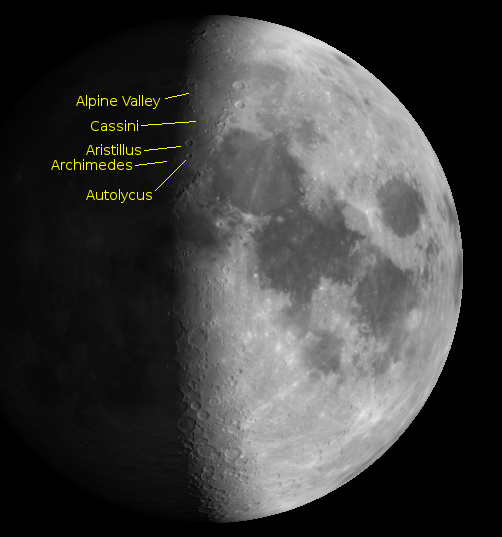
The Moon at 9 p.m. EST (UT -5h) January 27, 2015. Created using Virtual Moon Atlas.
I notice that I have quite a few followers to this blog from the UK. Unfortunately for you folks the crater Archimedes will not yet be visible tonight. I’ve labeled some extra craters that I didn’t discuss in the program, plus I’m adding the Lunar Reconnaissance Orbiter mosaic that’s mapped onto the Virtual Moon Atlas globe.
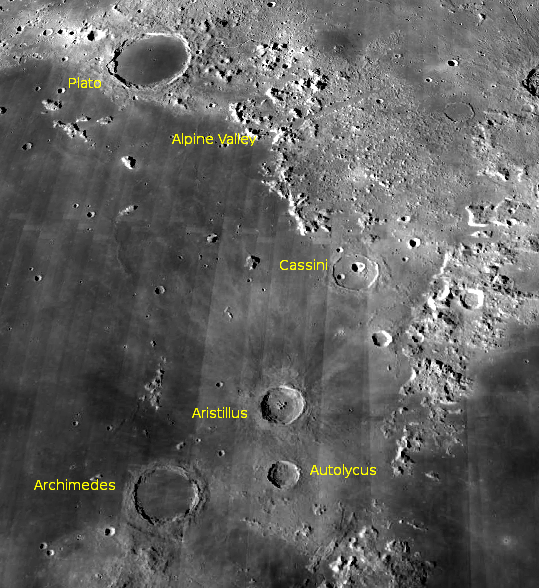
Lunar Reconnaissance Orbiter mosaic of the region at the eastern shore of Mare Imbrium. Credit NASA/GSFC/LRO, Virtual Moon Atlas
10/02/2014 – Ephemeris – The gibbous Moon tonight
Ephemeris for Thursday, October 2nd. The sun will rise at 7:41. It’ll be up for 11 hours and 39 minutes, setting at 7:21. The moon, 1 day past first quarter, will set at 1:50 tomorrow morning.
Tonight the moon will be featuring some of my favorite lunar landmarks, and if you spend any time looking at the moon with a small telescope, they become yours. The place to look is at the terminator, the sunrise line on the moon. In the north not far from the terminator is the walled plain called Plato. A bit farther away is a gash in the lunar Alps mountains caller the Alpine Valley. Near the center of the terminator and split by it is the fabulous crater Copernicus with a triple central peak which should poke into sunlight. Near the south pole is the large crater Clavius with an arc of decreasingly smaller craterlets on its floor. A bit north of that is the crater Tycho, which is more prominent when the moon is full than it is now.
Times are for the Traverse City/Interlochen area of Michigan. They may be different for your location.
Addendum
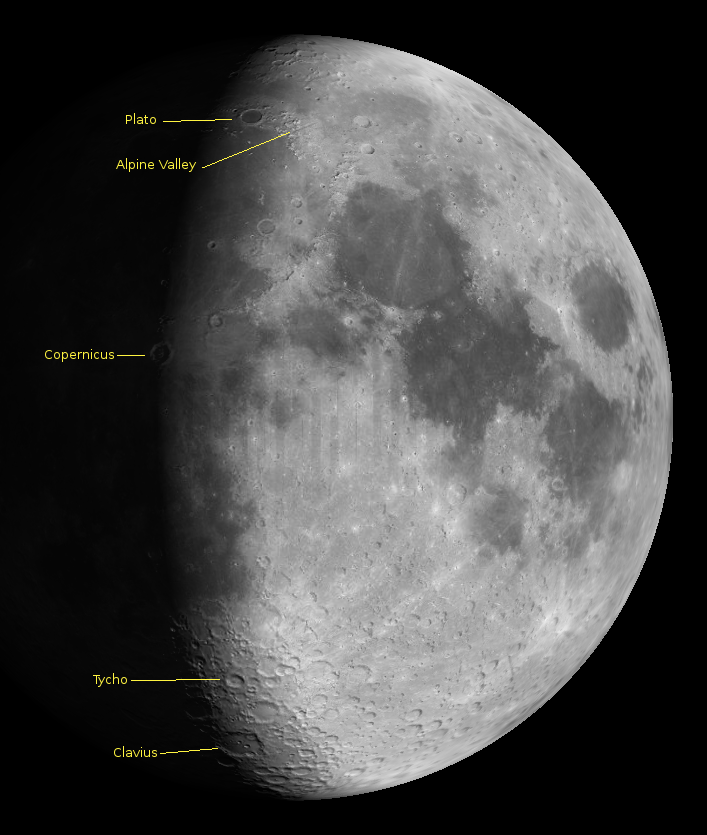
The gibbous Moon one day after first quarter at 9 p.m. October 2, 2014. Created using Virtual Moon Atlas.
09/12/2013 – Ephemeris – A look at the first quarter moon
Ephemeris for Thursday, September 12th. The sun will rise at 7:18. It’ll be up for 12 hours and 40 minutes, setting at 7:58. The moon, at first quarter today, will set at 12:36 tomorrow morning.
By this evening the moon will be just past first quarter and the terminator will bulge a bit to the east. Through binoculars or the naked eye the scallop shell shaped sea will be visible at the upper right part of the moon, the man in the moon’s left eye. In telescopes the moon will be inverted and even also reversed, so Serenity could appear in any other quadrant depending on what your telescope does to the image. Toward the terminator from Serenity are two mountain ranges The south part is the Apennines, and the northern part is the Alps. The Alps is cut by a gash called the Alpine Valley. There’s also a triangle of distinctive craters also visible near the terminator.
Times are for the Traverse City/Interlochen area of Michigan. They may be different for your location.
Addendum
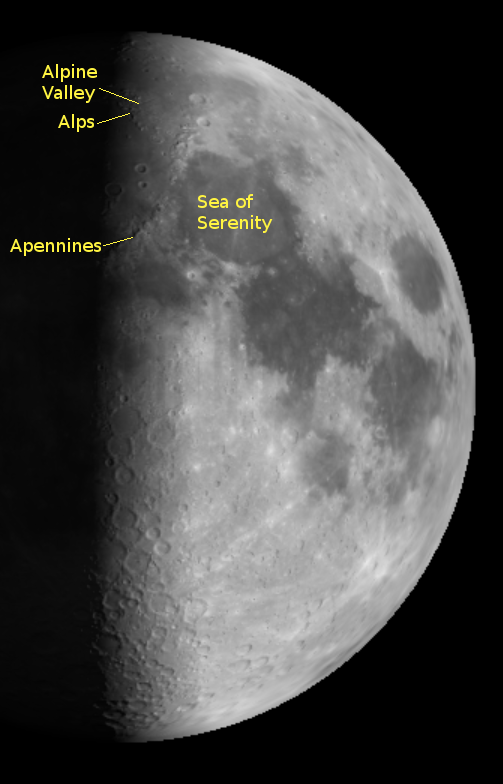
First quarter Moon with some of the features on its northern hemisphere. Created using Virtual Moon Atlas.
11/03/11 – Ephemeris – The moon tonight
Thursday, November 3rd. The sun will rise at 8:22. It’ll be up for 10 hours and 6 minutes, setting at 6:28. The moon, 1 day past first quarter, will set at 2:21 tomorrow morning.
In a telescope the moon will present some interesting features and craters. They will be seen near the terminator, the sunrise edge of the moon, where the shadows are longest. The moon is gray on gray, so the best way to see detail is by shadow. At the top or north end of the moon is a mountainous arc called the Alps. Mountain ranges on the moon are names after earthly mountain ranges. Cutting through the range is a fault called the Alpine Valley. Along the Alps at the terminator a crater will be coming into view this evening. It is the crater Plato. It is sometimes called a walled plain, since its floor is flat, or rather is slightly convex conforming to the shape of the lunar sphere. It’s cool watching the shadows of the walls recede as the sun rises.
* Times are for the Traverse City/Interlochen area of Michigan. They may be different for your location.
Addendum
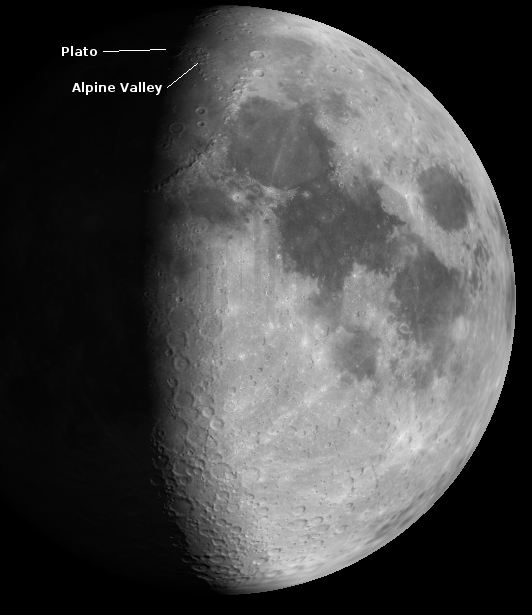
Moon 1 day after first quarter. Created using Virtual Moon Atlas
 Bob Moler's Ephemeris Blog