Archive
Ephemeris: 09/29/2025 – First attempts to measure the distance to the Sun
This is Ephemeris for Monday, September 29th. Today the Sun will be up for 11 hours and 47 minutes, setting at 7:26, and it will rise tomorrow at 7:39. The Moon, at first quarter today, will set at 11:38 this evening.
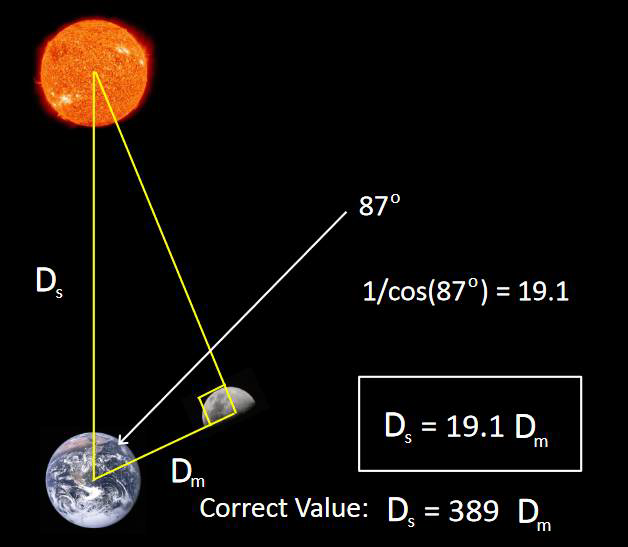
The first quarter Moon tonight reminds me of how the Greeks used the quarter Moon to attempt to determine the distance to the Sun. The idea was to determine when the Moon was exactly at first or last quarter, so the angle of the Sun-Moon-Earth was exactly 90°. The next thing to do was to measure the actual angle between the Sun and the Moon at that instant. It’s a difficult observation. Aristarchus tried and got a result that the Sun was about 19 times the distance of the Moon. The Sun-Earth-Moon angle he got was 87°. Hipparchus measured the Moon to be 60 earth radii away which is near the Moon’s actual distance from the Earth. In actuality the Sun is about 400 times the distance to the Moon.
The astronomical event times given in this blog are for the Traverse City/Interlochen area of Michigan (Lat 44.7° N, Long 85.7° W; EDT, UT – 4 hours) unless stated otherwise. Times will be different for other locations.
Addendum
Ephemeris: 04/15/2024 – How the Ancient Greeks tried to measure the distance to the Sun
This is Bob Moler with Ephemeris for Monday, April 15th. Today the Sun will be up for 13 hours and 31 minutes, setting at 8:28, and it will rise tomorrow at 6:55. The Moon, at first quarter today, will set at 4:15 tomorrow morning.
The first quarter Moon tonight reminds me of how the Greeks used the quarter Moon to attempt to determine the distance to the Sun. The idea was to determine when the Moon was exactly at first or last quarter, so the angle of the Sun-Moon-Earth was exactly 90°. The next thing to do was to measure the actual angle between the Sun and the Moon at that instant. It’s a difficult observation. Aristarchus tried and got a result that the Sun was about 19 times the distance of the Moon. The Sun-Earth-Moon angle he got was 87°. Hipparchus measured the Moon to be 60 earth radii away which is near the Moon’s actual distance from the Earth. In actuality the Sun is about 400 times the distance to the Moon.
The astronomical event times given are for the Traverse City/Interlochen area of Michigan (EDT, UT–4 hours). They may be different for your location.
Addendum
Ephemeris: 03/21/2024 – Three lunar craters named for heliocentrists by a geocentrist
This is Ephemeris for Thursday, March 21st. Today the Sun will be up for 12 hours and 14 minutes, setting at 7:57, and it will rise tomorrow at 7:41. The Moon, halfway from first quarter to full, will set at 6:59 tomorrow morning.
The gibbous moon tonight is exhibiting, over the last three days, three craters named for those who promoted the heliocentric or Sun centered solar system. The largest crater of the three, Copernicus, can be seen to the lower left of the center of the Moon. The asteroid that hit it made a big splash, which can be seen in its rays of ejecta being round and full. Then about halfway between it and the terminator is a small crater named for Johannes Kepler, and then nearby and on the terminator tonight is the crater named for the Greek philosopher who first proposed the Sun centered solar system, or in his case the universe, Aristarchus. He was a contemporary of and overshadowed by Aristotle, so his ideas were never adopted.
The astronomical event times given are for the Traverse City/Interlochen area of Michigan (EDT, UT–4 hours). They may be different for your location.
Addendum
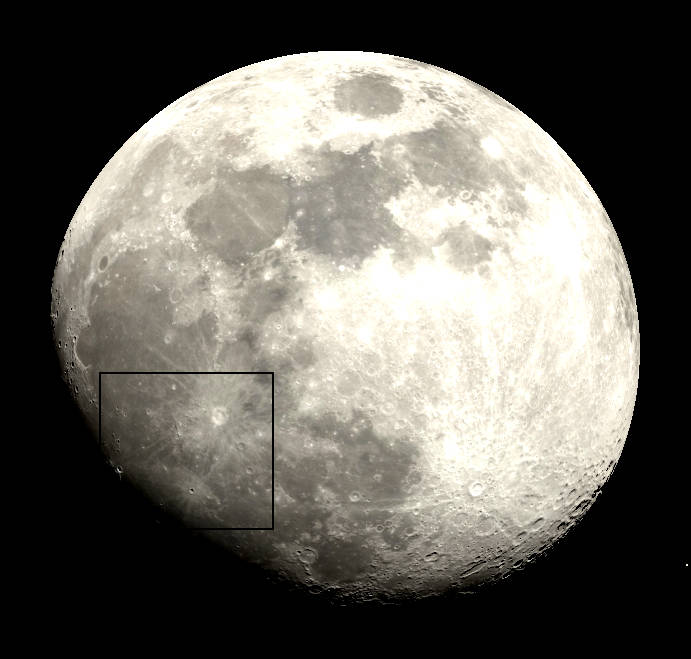
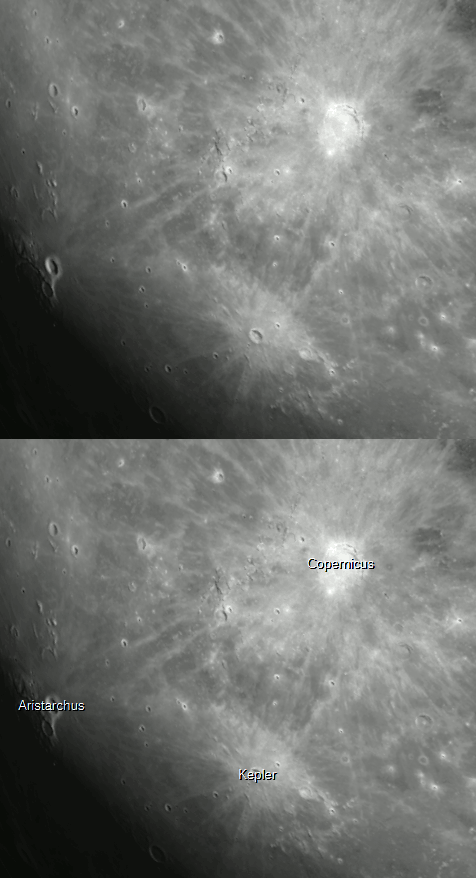
These craters were named by Giovanni Battista Riccioli, an astronomer and Jesuit priest. He established the lunar nomenclature we have today and named many of the largest craters. Being a 17th century Catholic, he bought the Roman Catholic line that the universe was geocentric, that is earth centered, yet he honored these heliocentrists with their own craters. He tended to group crater names by their relationship in life or their ideas, so the three proponents of the Sun centered solar system were given craters near each other in one section of the Moon.

Aristarchus of Samos was a Greek philosopher who lived between 310 and 230 BCE. He proposed a heliocentric solar system or universe, where Earth and all the planets revolved about the Sun. However, the work that he proposed it in has been lost. We know of his idea only referenced in the writings of others who attempted to debunk it.
Copernicus (Mikola Kopernik 1473-1543), was a Polish Catholic Canon, who was a mathematician, astronomer and translator, among other talents. He came up with the theory of the Sun centered or heliocentric solar system or in his day, universe.
Johannes Kepler (1571–1630) was an astronomer, astrologer and mathematician who discovered the laws of planetary motion. While Copernicus kept the circular orbits of the planets, they still didn’t match the motions of the planets in the sky. So he had to add some epicycles to make it all work. He actually had more epicycles than Ptolemy had. Kepler was able to figure out that he didn’t need epicycles if he assumed that the orbits were elliptical. He developed his Three Laws of Planetary Motion.
Galileo also has a crater there (Galilaei). It’s a tiny crater right on the terminator, below Kepler in the images above, and not visible. The Virtual Moon Atlas does not give an origin of the naming of the crater. Back in 1651, when Riccioli was giving craters names, Galileo was still on the outs with the Vatican, and the church.
05/17/2016 – Ephemeris – Three heliocentrists memorialized on the Moon tonight
Ephemeris for Tuesday, May 17th. Today the Sun will be up for 14 hours and 55 minutes, setting at 9:07. The Moon, half way from first quarter to full, will set at 4:50 tomorrow morning. Tomorrow the Sun will rise at 6:10.
Tonight the gibbous Moon boasts the uncovering of three craters from lunar night whose namesakes were pioneers in putting forth the heliocentric theory. That is that the Earth and the other planets revolved about the Sun. Out the longest, and making the biggest splash is the crater Copernicus, named for the Polish cleric whose book On the Revolution of the Heavenly Spheres gave a new meaning to the word revolution, that is upheaval. The crater Kepler is about two-thirds the way from Copernicus and the terminator, named after the astronomer who discovered that the plants orbit the Sun in elliptical paths. Finally just catching sunlight is Aristarchus who in the 4th century BC first proposed a heliocentric solar system.
Times are for the Traverse City/Interlochen area of Michigan. They may be different for your location.
Addendum
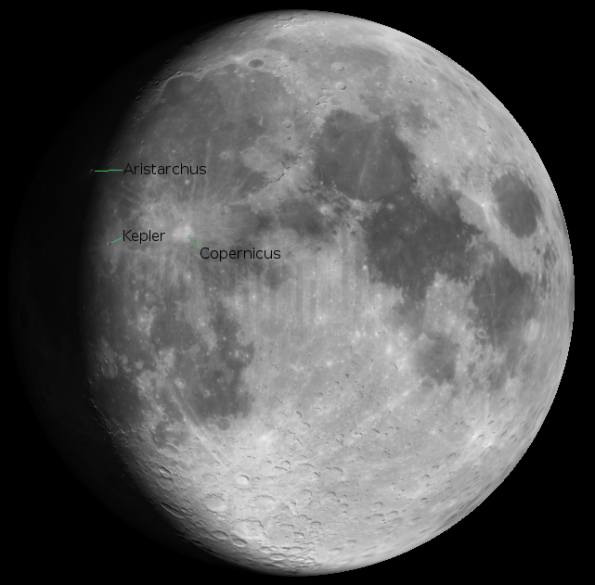
Three heliocentrists on the Moon at 10 p.m., May 17, 2016. Created using Virtual Moon Atlas.
04/18/2016 – Ephemeris – A lunar crater that celebrates the first known proponent of a Sun centered solar system
Ephemeris for Monday, April 18th. The Sun rises at 6:52. It’ll be up for 13 hours and 39 minutes, setting at 8:32. The Moon, 4 days before full, will set at 5:52 tomorrow morning.
The Moon slipped past Jupiter at 1:30 this morning so this evening the planet is to the right of the Moon. The brightest spot on the Moon will appear to the upper left of it tonight in binoculars or a small telescope. It is the crater Aristarchus, named after the Greek philosopher who first proposed a Sun centered solar system in the 3rd century BC. Nobody else bought the idea until 19 centuries later. The crater Aristarchus is a relatively new crater, which on the Moon means it was formed probably less than 1.1 billion years ago, after most cratering had subsided. Mysteriously there have been reports over the years from amateur astronomers and even professionals of seeing transient bright spots or glows emanating from the crater.
Times are for the Traverse City/Interlochen area of Michigan. They may be different for your location.
Addendum
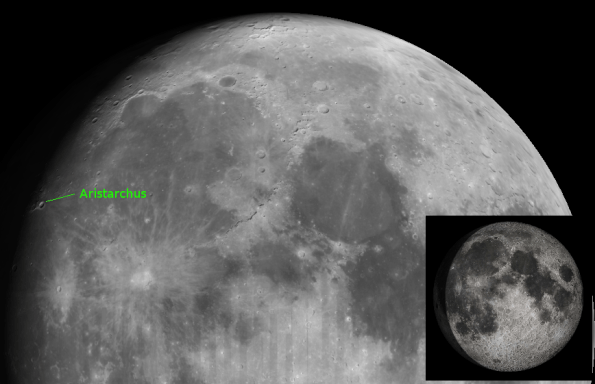
The sun rose on Aristarchus at the upper left side fo the Moon . Image from 10 p.m. April 18, 2016.
06/13/11 – Ephemeris – The lunar crater Aristarchus
Monday, June 13th. Today the sun will be up for 15 hours and 31 minutes, setting at 9:28. The moon, 2 days before full, will set at 4:39 tomorrow morning. Tomorrow the sun will rise at 5:56.
The moon tonight is bright. The sunrise line or terminator on the moon is crossing the large gray plain called Oceanus Procellarum, the largest of the moon’s seas. These seas were figments of the first telescopic observers imagination. They are really huge impact basins into which interior lava flowed. On the upper left edge of the moon near the terminator is a bright spot on the moon visible in binoculars. In a telescope it is a crater called Aristarchus. It is a fairly new crater, probably less than a billion years old. As a rule the brighter the crater the newer it is. Aristarchus is the brightest spot on the moon. Over the years visual astronomers have seen hazes and bright spots from time to time in and near Aristarchus.
* Times are for the Traverse City/Interlochen area of Michigan. They may be different for your location.
Addendum
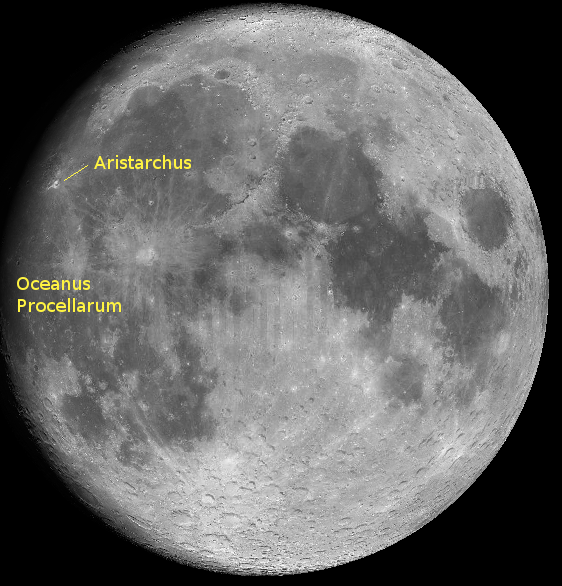
The moon with Aristarchus. Created with Virtual Moon Atlas.
04/14/11 – Ephemeris – The gibbous moon
Thursday, April 14th. The sun will rise at 7:00. It’ll be up for 13 hours and 25 minutes, setting at 8:25. The moon, half way from first quarter to full, will set at 5:13 tomorrow morning.
The moon tonight is in its gibbous phase. The word gibbous means hump backed. At this phase the moon is severely interfering with the dimmer stars. So looking at the moon with a telescope becomes a good option. The moon will be bright and ruin any dark adaption your eye had before looking at it. Remember the sun shines on the moon with the same strength that it does on the earth, since it’s at roughly the same distance from the sun as the earth. The brightest spot on the earth facing side of the moon will be emerging into the lunar morning light this evening. It will be showing that brightness in a few days, but now it is the crater at the upper left edge of the moon, just coming into light. It is the crater Aristarchus.
* Times are for the Traverse City/Interlochen area of Michigan. They may be different for your location.
Addendum
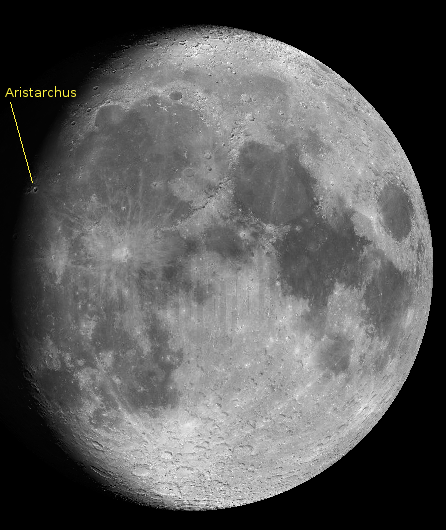
The gibbous moon for April 14, 2011. Created using Virtual Moon Atlas.
The crater Aristarchus is moving into the morning lunar daylight.
 Bob Moler's Ephemeris Blog