Archive
Ephemeris: 01/29/2026 – After Artemis 2 comes Artemis 3 and the landing
This is Ephemeris for Thursday, January 29th. Today the Sun will be up for 9 hours and 42 minutes, setting at 5:47, and it will rise tomorrow at 8:04. The Moon, 3 days before full, will set at 6:44 tomorrow morning.
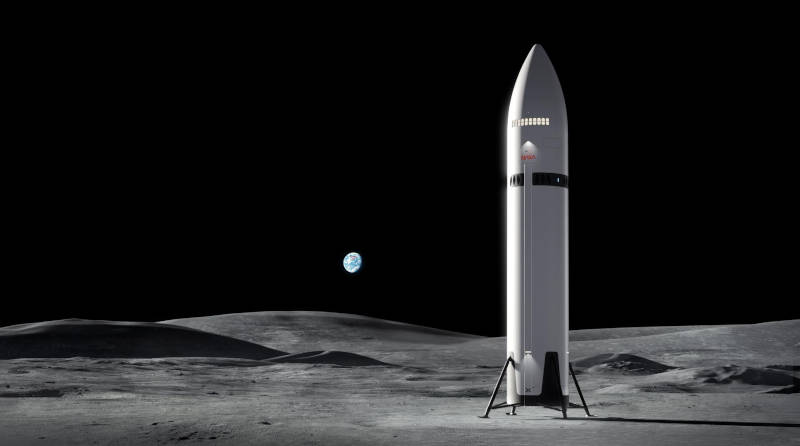
If Artemis 2 is successful in the late winter and early spring of this year, the next mission will be Artemis 3, a mission to land near the South Pole of the Moon. In order for that to happen a lunar Lander will have to be ready and tested. The Starship HLS or human landing system is currently being built by SpaceX. It’s delivery to the Moon, via Superheavy, Starship’s big booster, will require multiple launches and refueling in orbit, which has yet to be tested. There has been some question as to how many refueling trips will be necessary. NASA and SpaceX seem to differ. However, an uncrewed successful landing will have to be made to prove out the system before the Artemis 3 landing will be attempted.
The astronomical event times given in this blog are for the Traverse City/Interlochen area of Michigan (Lat 44.7° N, Long 85.7° W; EST, UT – 5 hours) unless stated otherwise. Times will be different for other locations.
Addendum
08/29/2022 – Ephemeris – On the day of the first Artemis I launch opportunity, a look at possible landing sites for Artemis III
As usual, the Ephemeris radio programs are recorded prior to them being aired. Monday’s programs have the longest lead times, being written and recorded eight days earlier, Sunday of the previous week. This blog post was created on the 28th. So I have no idea if Artemis I launches today or not. All three times this program will be sent out on-air will be before the scheduled launch.
This is Bob Moler with Ephemeris for Monday, August 29th. Today the Sun will be up for 13 hours and 23 minutes, setting at 8:24, and it will rise tomorrow at 7:02. The Moon, 2 days past new, will set at 9:43 this evening.
Earlier this month, NASA announced the selection of 13 possible landing areas near the South Pole of the Moon. The South Pole of the Moon was selected as the Artemis target since ice was found at the bottom of some of the craters there. Back in the Apollo days, landing sites were selected by being smooth, and the first were in the broad lava plains called lunar seas. The Moon’s South Pole is the opposite. It’s in the rugged lunar highlands. The landing areas turn out to be crater rims and ridges or small plateaus that catch the Sun, just above the lunar horizon. NASA is developing autonomous landing systems that can cope with landing on such difficult terrain, with deep shadows illuminated by a very low Sun. These are not ideal landing conditions.
The astronomical event times given are for the Traverse City/Interlochen area of Michigan (EDT, UT – 4 hours). They may be different for your location.
Addendum
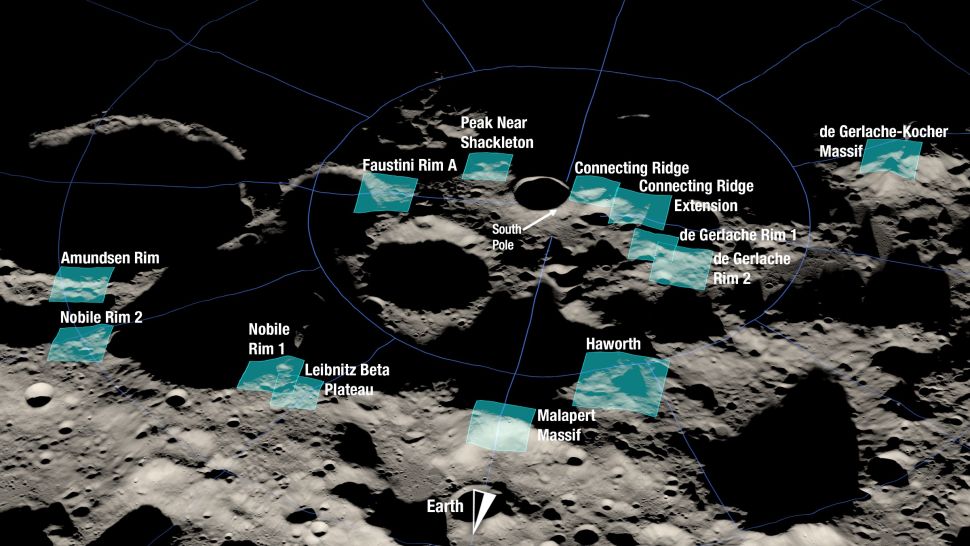
On August 19, 2022, NASA released the candidate lunar landing sites for Artemis III near the Moon’s South Pole. Click on the image to enlarge it. Credit: NASA, Lunar Reconnaissance Orbiter.
 Bob Moler's Ephemeris Blog