This is Bob Moler with Ephemeris for Monday, November 27th. Today the Sun will be up for 9 hours and 10 minutes, setting at 5:05, and it will rise tomorrow at 7:56. The Moon, at full today, will rise at 5:01 this evening.
Today’s full moon is called the Beaver full moon actually the moon was exactly full at 4:16 this morning, so last night it was actually closer to full moon than it will be tonight. The bright full moon fills the sky with light so most of the fainter stars disappear. The sky looks gray when the moon is full, but it is just as blue as the daytime sky. It’s just that our eyes cannot discern color at low light levels. We sacrifice our color vision for night vision. Other animals can see in the dark much better than we can, though some of them do not have quite the color vision we have so viewing the skies and viewing the world around us is a compromise. We were evolved from creatures that were most active in the daytime and hid at night. My cats can see much better in the dark than I can. However, the other animals do not have the abilities we have to create tools and instruments to allow us to see better in the dark than they can.
The astronomical event times given are for the Traverse City/Interlochen area of Michigan (EST, UT –5 hours). They may be different for your location.
Addendum
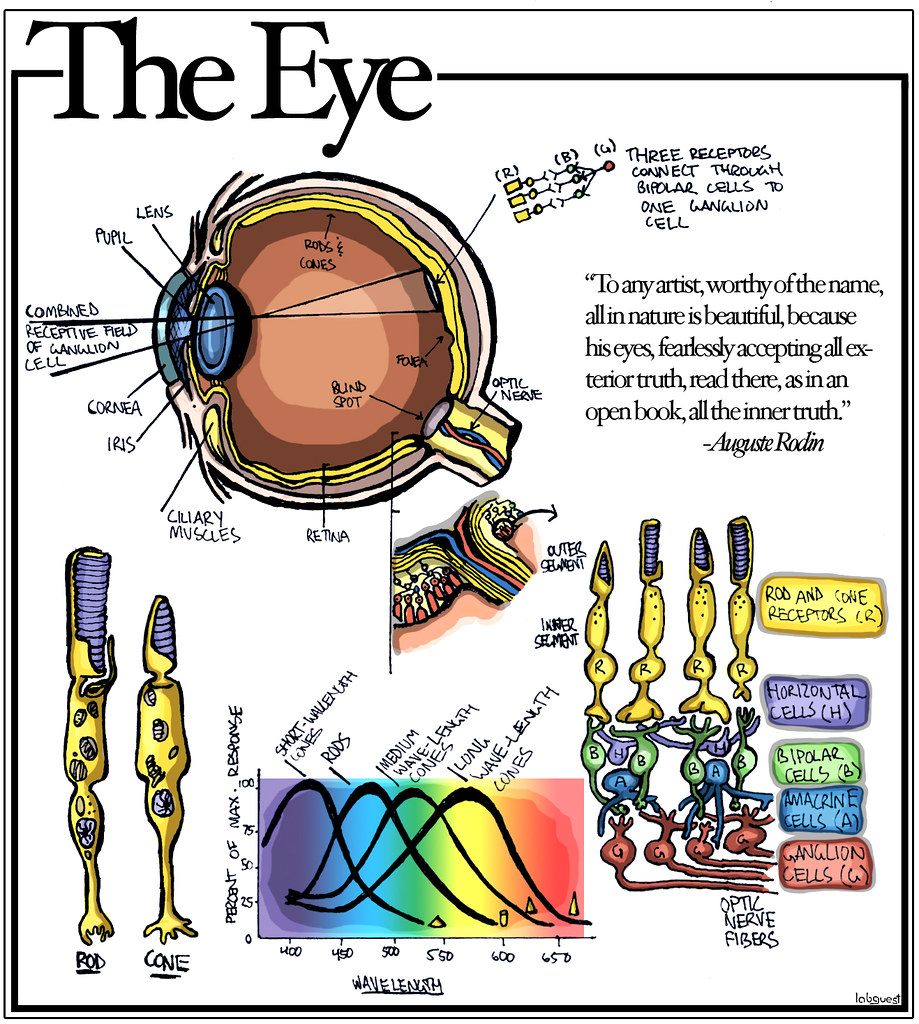
Here is a diagram of the eye. The fovea, the little dent in the retina, is where the best visual acuity is. It is directly behind the lens and the farther you get from that spot the more rods and fewer cones there are, so the best color vision is in the center. And the best night vision is on the periphery of the visual field. . The rods are about 100 times more sensitive to light than the cones. Also, from the bottom, there is a graph showing that the rods are more sensitive to blue and green light than they are to red light. It turns out that the nebulae that we look at in our telescopes are mostly red due to the emission of hydrogen at the red end of the spectrum. We cannot see that. What we can see is the emission of hydrogen and doubly ionized oxygen in the blue-green, which the rods are most sensitive to. Click or tap on the image to enlarge it. Source: http://spacer.pamhoffman.com/diagrams-of-rods-cones-and-parts-of-the-eye/
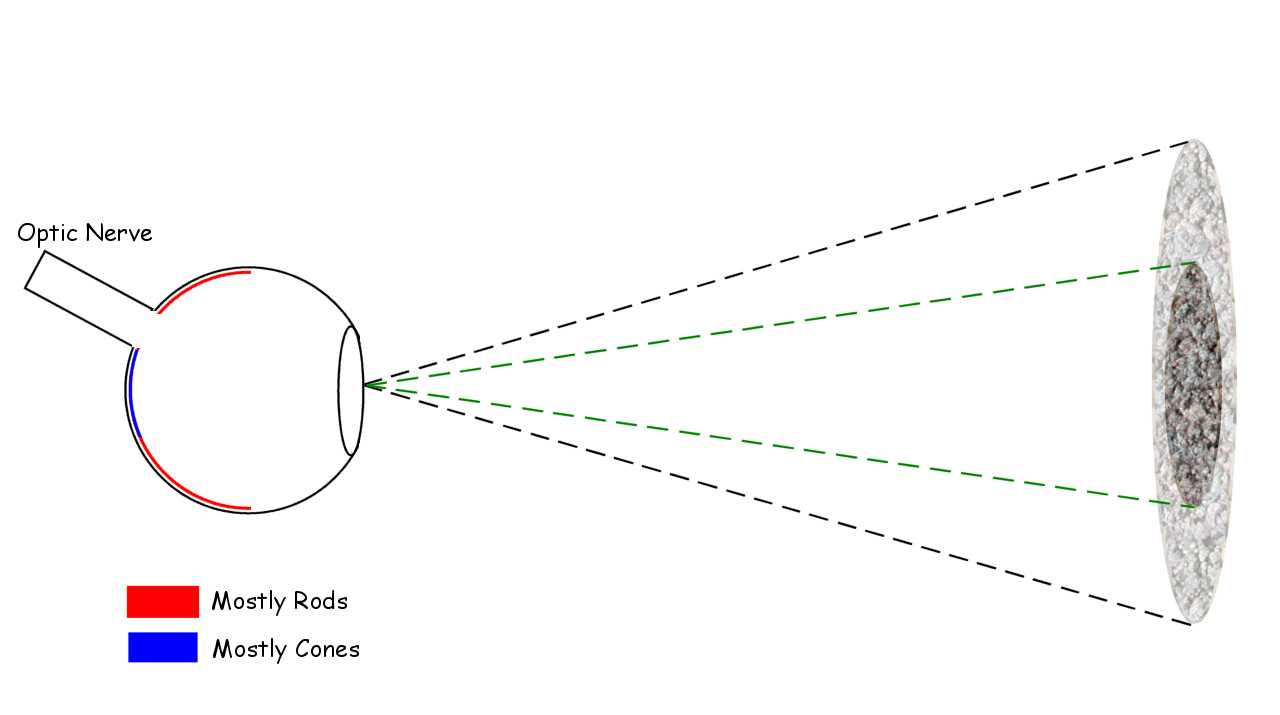
We astronomers soon learn that very faint objects can be picked up by not looking directly at them, by looking out of the corner of the eye. That is because that part of the eye is where the rods mostly are. Rods are more sensitive than the cones, but color vision is lost, hence the gray sky of a full moon. But you actually can see what you’re looking for, but the visual acuity isn’t there. Though faint objects like nebulae and galaxies aren’t that well defined, being relatively fuzzy anyway. It is a technique called inverted vision. Click or tap on the image to enlarge it. Source: http://spacer.pamhoffman.com/diagrams-of-rods-cones-and-parts-of-the-eye/
 Bob Moler's Ephemeris Blog