Archive
02/11/2022 – Ephemeris – The Sun Rises on the Moon’s Bay of Rainbows
This is Ephemeris for Friday, February 11th. Today the Sun will be up for 10 hours and 16 minutes, setting at 6:05, and it will rise tomorrow at 7:47. The Moon, 3 days past first quarter, will set at 5:34 tomorrow morning.
On the moon tonight, the gibbous phase and the terminator on the left side of the moon is revealing a large semicircular mountain range called the Jura Mountains that encloses a flat lava plain that looks like a bay in the margin of the Sea of Showers or Mare Imbrium. It is easily visible in binoculars this evening, when the sunrise line is crossing the bay. The Jura Mountains will appear as a hook out of the upper left edge of the moon. That’s about the coolest sight that’s visible on the moon that can be seen with binoculars. It’s especially striking if seen in a small telescope.
Also, related to the Moon: The Artemis-1 uncrewed mission to orbit the Moon has been pushed off at least one month or more, to this April or even May.
Addendum
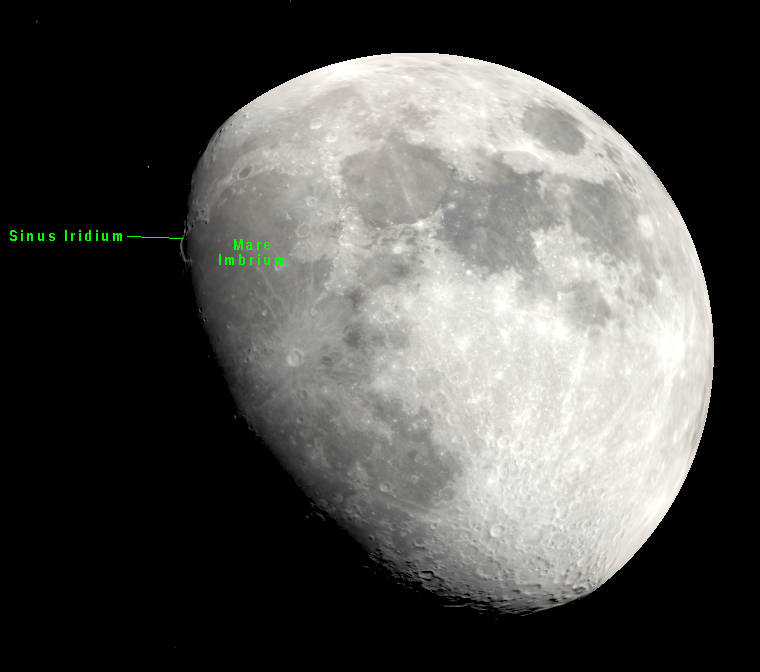
Sunrise at Sinus Iridium, full Moon disc with annotations. Click on the image to enlarge it. Moon image created using Stellarium.
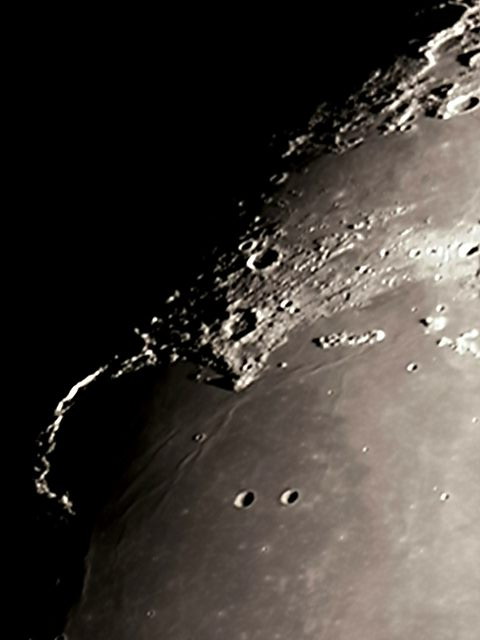
Sinus Iridium at sunrise. Photo by “Seb2003” on http://forums.futura-sciences.com/materiel-astronomique-photos-damateurs/5809-images-de-lune.html.
01/26/2018 – Ephemeris – The Moon tonight: The Bay of Rainbows
Ephemeris for Friday, January 26th. The Sun will rise at 8:08. It’ll be up for 9 hours and 34 minutes, setting at 5:43. The Moon, 2 days past first quarter, will set at 3:59 tomorrow morning.
A look at the Moon tonight will reveal that the sunrise line, or terminator has almost completely revealed the large sea of Showers or Mare Imbrium to the upper left of center of the gibbous disk. At the extreme upper left straddling the terminator is one of my favorite features, the Bay of Rainbows or Sinus Iridium. It’s a colorful name for something that’s as gray as the rest of the Moon. It looks like a bay off of Imbrium, and has an arch like a rainbow. It’s arch is the Jura Mountains, which jut into Mare Imbrium at Cape Heraclide, just catching sunlight, and Cape Laplace farther into morning. What’s cool is catching it as the sunlight is hitting the mountains while the convex floor, following the Moon’s curvature is only partially illuminated.
The times given are for the Traverse City/Interlochen area of Michigan. They may be different for your location.
Addendum
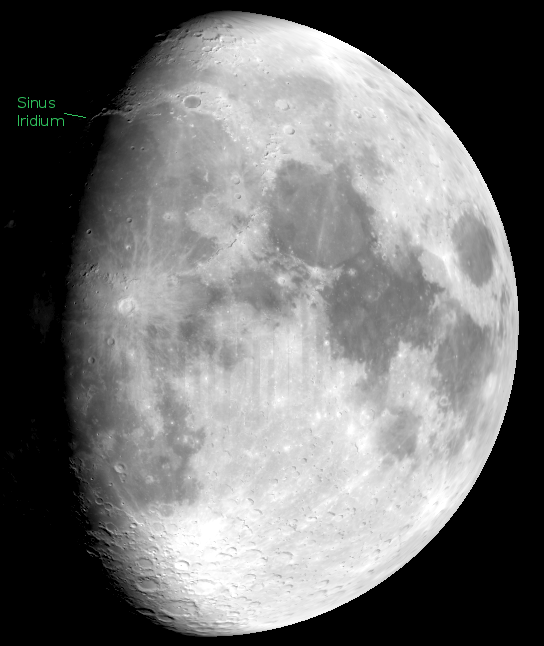
The Moon at 8 p.m. January 26, 2018 highlighting Sinus Iridium. Created using Virtual Moon Atlas.
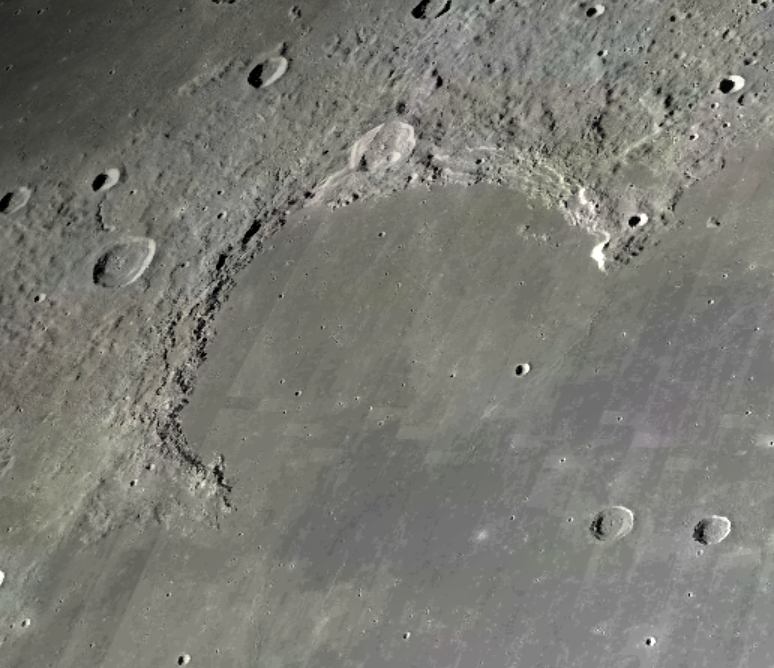
Sinus Iridium photographed by the Lunar Reconnaissance Orbiter as texture mapped on the globe of the Virtual Moon Atlas.
Sinus Iridium at sunrise. Photo by “Seb2003” on http://forums.futura-sciences.com/materiel-astronomique-photos-damateurs/5809-images-de-lune.html.
05/16/2016 – Ephemeris – The Sun rises on the Bay of Rainbows
Ephemeris for Monday, May 16th. Today the Sun will be up for 14 hours and 53 minutes, setting at 9:06. The Moon, 3 days past first quarter, will set at 4:23 tomorrow morning. Tomorrow the Sun will rise at 6:11.
One of my favorite lunar formations is creeping into sunlight on the Moon this evening. Look to the upper left edge of the moon tonight. The large sea or dark area of the Moon, the Man in the Moon’s right eye as he’s looking at us is Mare Imbrium, the Sea of Showers. At the top left edge of that sea is a large notch. And keeping with of seas these of the first telescopic astronomers its name is Sinus Iridium, or Bay of Rainbows, a colorful name for something as colorless as the rest of the Moon. The terminator which is the sunrise line will be cutting across that bay, illuminating the semicircular mountain ring that surrounds it before all of the floor is illuminated. It can be seen in binoculars or a small telescope.
Times are for the Traverse City/Interlochen area of Michigan. They may be different for your location.
Addendum
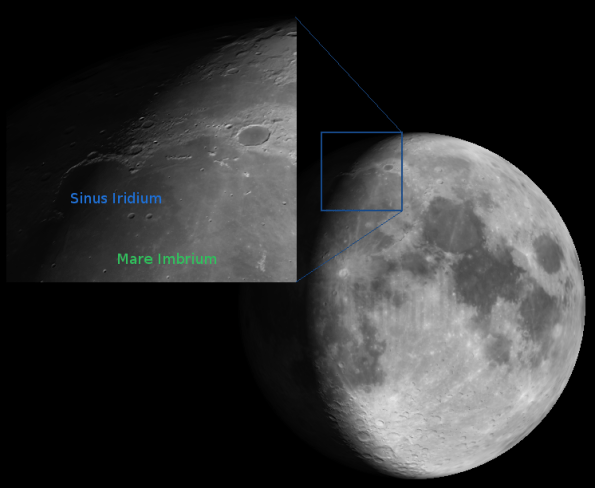
Image showing the Moon tonight at 10 p.m., May 16, 2016 (2 hr, May 17, 2016 UT) with Sinus Iridium (Bay of Rainbows) just coming into sunlight. Created using the Virtual Moon Atlas.
03/11/2014 – Ephemeris – Observing the moon tonight: Bay of Rainbows and more
Ephemeris for Tuesday, March 11th. The sun will rise at 8:02. It’ll be up for 11 hours and 41 minutes, setting at 7:43. The moon, 4 days past first quarter, will set at 5:39 tomorrow morning.
The moon tonight is a pretty fat gibbous shape, with the sunrise line or terminator revealing the Bay of Rainbows, Sinus Iridium, that large half crater at the moon’s upper left edge, and the edge of the Sea of Showers, Mare Imbrium. In the figure of the man in the moon Imbrium is his big eye, kind of like the cartoon “Bill the Cat”. To the right of it, looking like a hole in a mountain chain, is Plato, whose dark floor is unmistakable even at full moon, when shadows are absent. The crater Copernicus is now beginning to be washed out as the morning shadows shrink. To the left of Copernicus, just catching the sun’s rays on the terminator, is the smaller crater Kepler. When the moon is full Kepler will show a fine ray system.
Times are for the Traverse City/Interlochen area of Michigan. They may be different for your location.
Addendum
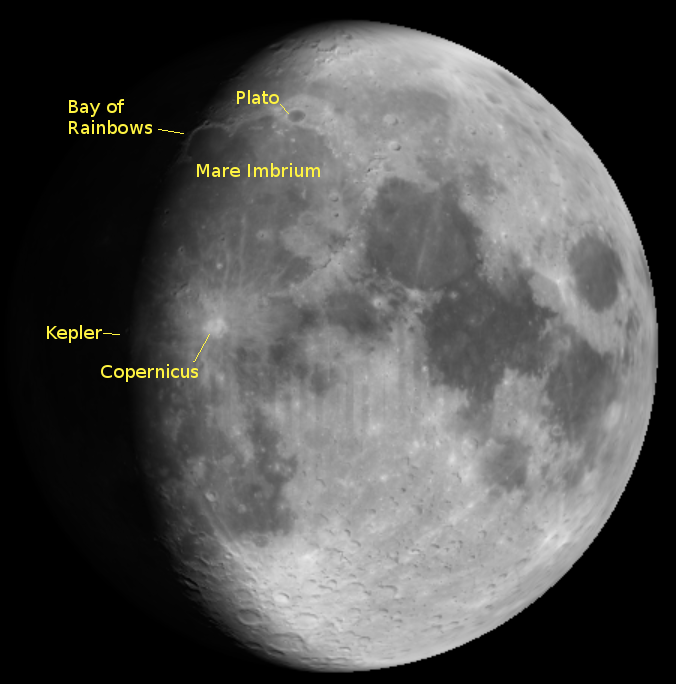
The Moon at 10 p.m. on March 11, 2014. Created using Virtual Moon Atlas.
Note for those not in the Eastern Daylight time zone. 10 p.m. is 2 hours March 12, 2014. If viewing before that time the terminator will be shifted to the right. After the terminator will be shifted to the left.
06/18/2013 – Ephemeris – The moon’s most striking feature, the Jura Mountains and the Bay of Rainbows
Ephemeris for Tuesday, June 18th. Today the sun will be up for 15 hours and 33 minutes, setting at 9:30. The moon, 2 days past first quarter, will set at 2:48 tomorrow morning. Tomorrow the sun will rise at 5:56.
On the moon tonight the gibbous phase and the terminator on the left side of the moon is revealing a large semi circular mountain range called the Jura Mountains that encloses a flat lava plain that looks like a bay in the margin of the Sea of Showers or Mare Imbrium. The bay is Sinus Iridium, or Bay of Rainbows. It is easily visible in binoculars this evening when the sunrise line is crossing the bay. The Jura Mountains will appear as a hook at the upper left edge of the moon. That’s about the coolest sight that’s visible on the moon that can be seen with binoculars. It’s especially striking if seen in a small telescope. Though the bay is the same gray as the rest of the moon, at least its name is colorful.
Times are for the Traverse City/Interlochen area of Michigan. They may be different for your location.
Addendum
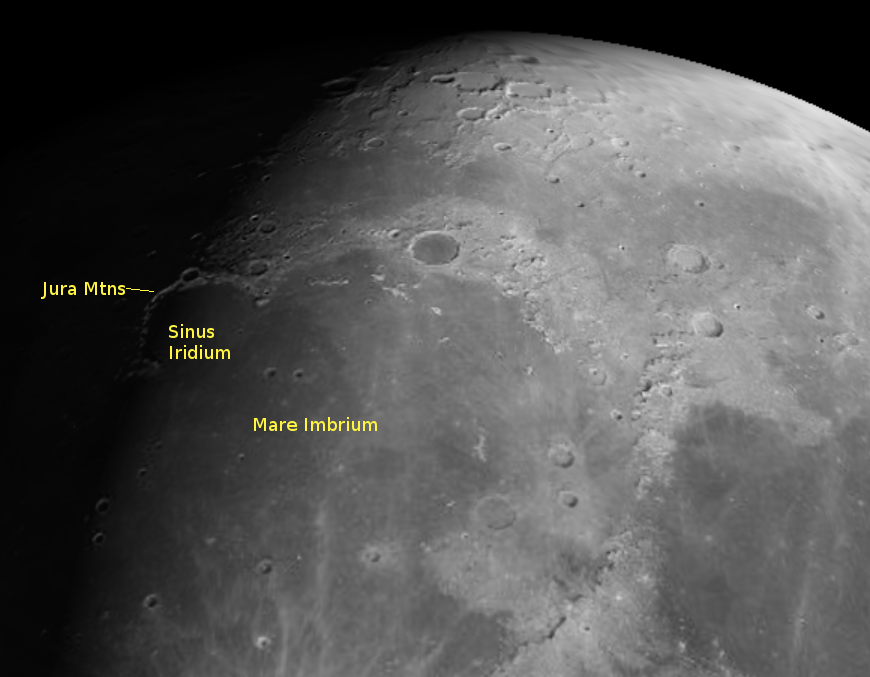
Bay of Rainbows (Sinus Iridium) within the Jura Mountains on the moon. Created using Virtual Moon Atlas.
09/25/2012 – Ephemeris – Sinus Iridium greets the sun
Ephemeris for Tuesday, September 25th. The sun will rise at 7:33. It’ll be up for 11 hours and 59 minutes, setting at 7:33. The moon, 3 days past first quarter, will set at 3:53 tomorrow morning.
Lets look at the moon again tonight. One of my favorite formations is coming into light it is called Sinus Iridium or Bay of Rainbows. Sorry there’s no color here. But if caught at right time this ruined crater will appear as a hook out into night off the upper left edge of the moon. Officially its a bay to the Sea of Showers or Mare Imbrium. The north edge of the bay are mountains called the Jura Mountains. The south edge disappears into Mare Imbrium. The floor of the Sinus Iridium is about twelve hundred feet lower than Imbrium. The transition is gradual because it isn’t very noticeable. The formation is large enough to be seen in binoculars. Sinus Iridium is 242 miles wide, a good tenth the diameter of the moon itself.
Times are for the Traverse City/Interlochen area of Michigan. They may be different for your location.
Addendum
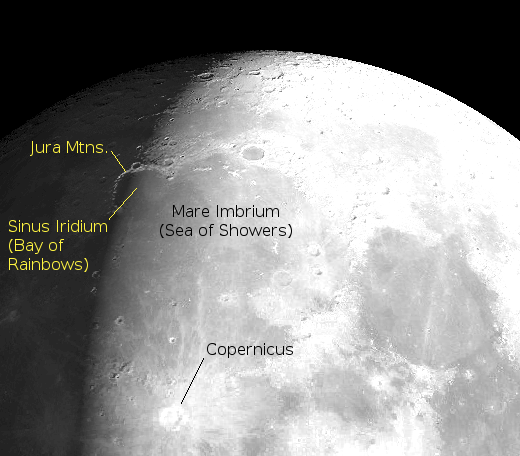
Bay of Rainbows and the crater Copernicus. Created using Virtual Moon Atlas.
05/12/11 – Ephemeris – Lunar telescopic wonders: Bay of Rainbows and the crater Copernicus
Thursday, May 12th. Today the sun will be up for 14 hours and 41 minutes, setting at 8:59. The moon, 2 days past first quarter, will set at 3:40 tomorrow morning. Tomorrow the sun will rise at 6:17.
Tonight the moon will again show a hook out into the darkness at the upper left edge of the moon for observers using binoculars or a telescope. That’s the Jura mountains cupping the Bay of Rainbows, a rather gray lava expanse on the edge of the Sea of Showers. At the other edge of the that sea is the great crater Copernicus, center left on the moon. Its halo of rays will show up better when the moon is full, but now the crater itself can be appreciated. In a telescope its is quite a sight. It has a complex triple central peak, and terraced walls. The small asteroid that hit it less than a billion years ago, struck the moon, gouging out the 56 mile diameter crater we see today. Rebound created the central peaks.
* Times are for the Traverse City/Interlochen area of Michigan. They may be different for your location.
Addendum
Bay of Rainbows and the crater Copernicus. Created using Virtual Moon Atlas.
I have more on Sinus Iridium and the Jura Mountains back in March.
 Bob Moler's Ephemeris Blog