Archive
Ephemeris: 05/06/2024 – The star Arcturus: Not from around here
This is Ephemeris for Monday, May 6th. Today the Sun will be up for 14 hours and 29 minutes, setting at 8:54, and it will rise tomorrow at 6:23. The Moon, 1 day before new, will rise at 5:53 tomorrow morning.
Arcturus, a red giant star in the constellation of Boötes the herdsman, is about two thirds the way up the sky in the east-southeast at 10 pm. It’s one of the earliest stars to appear in twilight, being nearly tied in brightness with Vega, a white star low in the northeast. A pointer to Arcturus is the handle of the Big Dipper, following the arc of the handle to Arcturus. Though only 37 light years away, it’s not from around here. It’s passing through the galactic disk from north to south. Arcturus is about 7 billion years old, and is about 8% more massive than our Sun. It appears to be starting its red giant phase, after running out of hydrogen to fuse into helium in its core, and is beginning to fuse the helium. It’s 25 times the size of the Sun and 170 times brighter, and a preview of our Sun when it gets that old.
The astronomical event times given are for the Traverse City/Interlochen area of Michigan (EDT, UT–4 hours). They may be different for your location.
Addendum

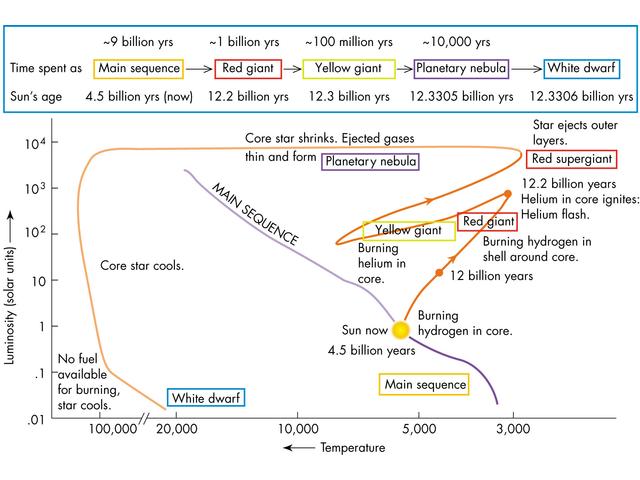
* Hertzsprung-Russell Diagram of a star’s surface (photosphere) temperature vs luminosity. The Main Sequence is where a star lives when it is burning hydrogen, and spends most of its life.
 Bob Moler's Ephemeris Blog