Archive
Ephemeris: 02/06/2025 – The Moon tonight, two days after first quarter
This is Ephemeris for Thursday, February 6th. Today the Sun will be up for 10 hours and 3 minutes, setting at 5:59, and it will rise tomorrow at 7:54. The Moon, 1 day past first quarter, will set at 4:30 tomorrow morning.
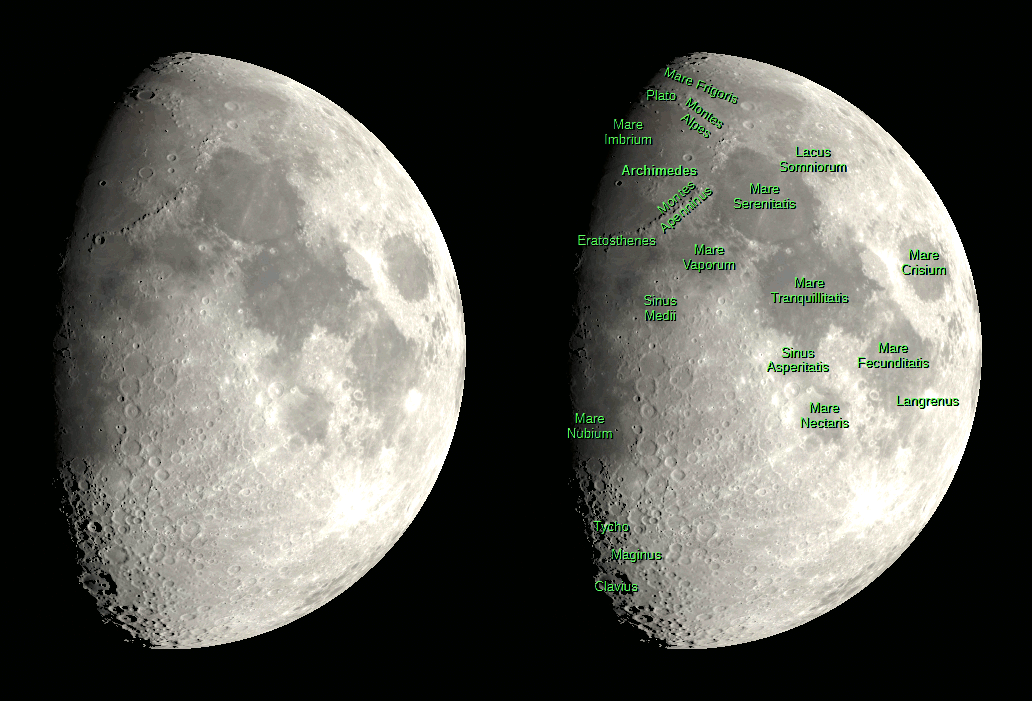
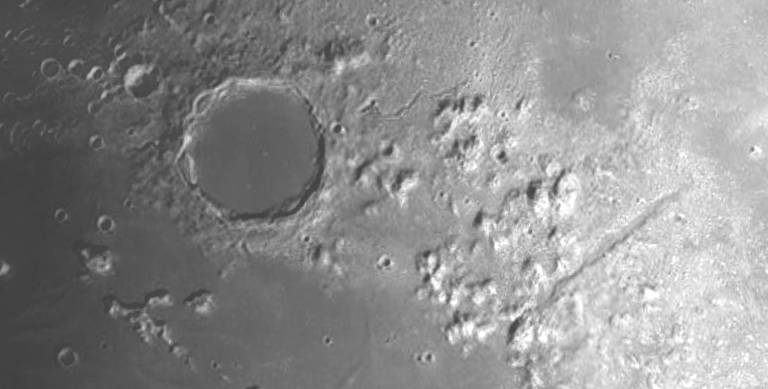
Tonight the moon will be about a day and a half past first quarter it is showing some very nice craters for the binoculars or small telescope. Near the south end of the moon near the terminator, the sunrise line, is the crater called Clavius which has an arc of several craters within it, each of decreasing size. North or above that is the sharp-edged crater called Tycho which, during a full moon, shows several long ejecta rays across the face of the Moon, but are almost invisible now. Near the top edge of the Moon the flat floored crater called Plato is seen by the edge of the large sea Mare Imbrium or Sea of Showers. A mountain range at the opposite side of Imbrium is called the Apennines Mountains.
The astronomical event times given are for the Traverse City/Interlochen area of Michigan (EST, UT – 5 hours). Times will be different for other locations.
Addendum
11/05/2020 – Ephemeris – Water found on the daylit side of the Moon
This is Ephemeris for Thursday, November 5th. Today the Sun will be up for 9 hours and 58 minutes, setting at 5:25, and it will rise tomorrow at 7:28. The Moon, 3 days before last quarter, will rise at 8:55 this evening.
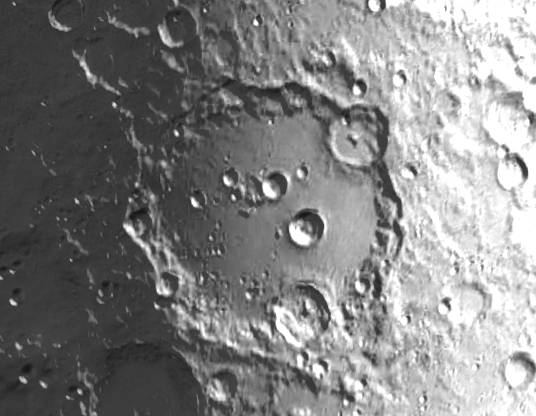
Last week NASA announced some results from their SOFIA airborne observatory. They had detected the spectral signature of water in a large crater on the Moon named Clavius. This was a high latitude crater, 58.6 degrees south. Supposedly one could process a cubic meter of the regolith to extract a half liter of water. Clavius, which science fiction fans will note was the location of the American base on the Moon in 2001 a Space Odyssey. It is also one of my favorite lunar craters, one of the largest with a distinctive arc of diminishingly sized craters in its floor. As far as resources go, we’ve just literally scratched the surface of the Moon in its equatorial regions with our Apollo and other country’s robotic missions.
The event times given are for the Traverse City/Interlochen area of Michigan. They may be different for your location.
Addendum
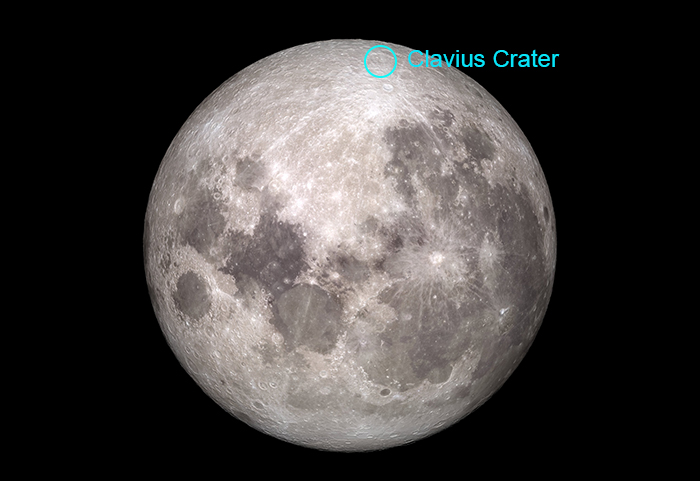
The Moon as seen from Australia (south up) with the crater Clavius circled. This is the same view of the Moon that users of a Newtonian reflector telescope in the northern hemisphere see, and how I first explored the Moon with my reflecting telescope. Source abc.net.au.
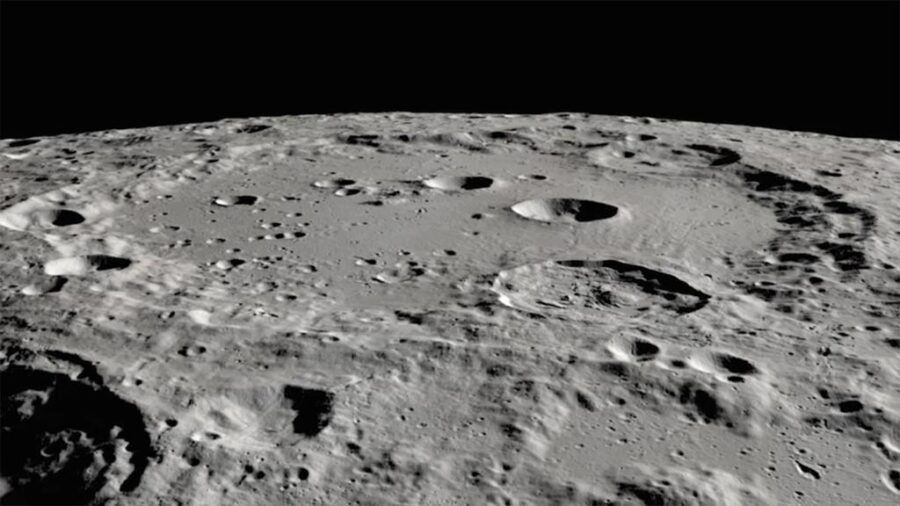
Closeup of Clavius from the Lunar Reconnaissance Orbiter. Credit: NASA/LRO.

The SOFIA Airborne Observatory. A modified Boeing 747 with a 106 inch (2.7 meter) telescope mounted crosswise in its fuselage. It is a joint project between NASA and the German Aerospace Center (DLR) and for some reason always on the verge of being canceled. Credit: NASA.
SOFIA is of course an acronym for Stratospheric Observatory for Infrared Astronomy. For more on SOFIA click here: https://www.nasa.gov/mission_pages/SOFIA/index.html.
04/02/2020 – Ephemeris – Let’s look at the Moon tonight
This is Ephemeris for Thursday, April 2nd. Today the Sun will be up for 12 hours and 51 minutes, setting at 8:12, and it will rise tomorrow at 7:18. The Moon, 1 day past first quarter, will set at 5:09 tomorrow morning.
Tonight’s gibbous Moon is a bright fixture in the evening sky it’s in the constellation of Cancer the crab which its brightness obliterates, between the stars Castor and Pollux of Gemini on the right and Regulus of Leo on the left. The Beehive star cluster in Cancer can be spotted in binoculars to the left of the Moon by about 7 to 8 of its diameters. On the Moon itself are the gray, so-called seas and two spectacular craters near the terminator. The first is near the bottom limb of the Moon, the very large crater Clavius with an interesting arc of small craters of decreasing size within. The other remarkable crater is Copernicus about half way up and left, near the terminator, the Moon’s sunrise line.
The event times given are for the Traverse City/Interlochen area of Michigan. They may be different for your location.
Addendum
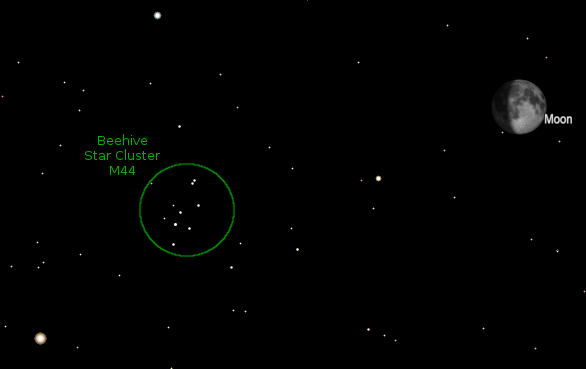
The Moon and Beehive Star Cluster at 10 p.m. tonight April 2, 2020. If you are not in the eastern daylight time the Moon will be in a different position if you are in a different time zone.
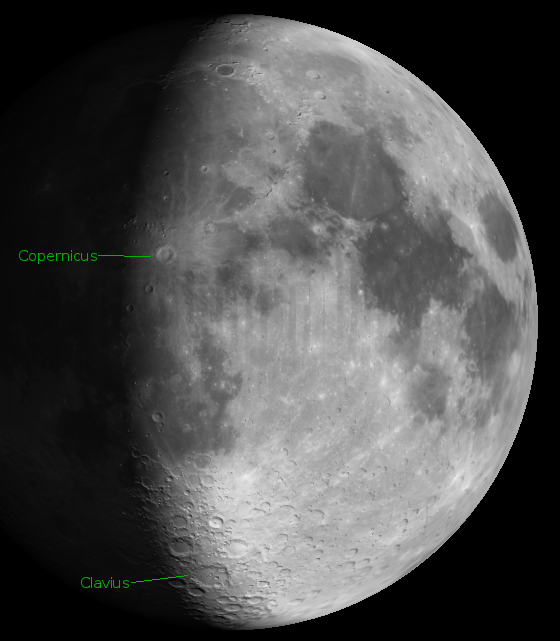
The Mon as it might appear in a low power telescope tonight at 10 p.m. April 2, 2020. Created using Virtual Moon Atlas (software).
11/07/2019 – Ephemeris – The gibbous Moon tonight
Ephemeris for Thursday, November 7th. Today the Sun will be up for 9 hours and 55 minutes, setting at 5:23, and it will rise tomorrow at 7:30. The Moon, 3 days past first quarter, will set at 3:13 tomorrow morning.
Every night when we look at the Moon the sunrise terminator has moved farther west on the Moon which is to our east uncovering more landscape. The Moon rotates once in about 29 ½ days in relation with the Sun. This is the same time it orbits the Earth from new Moon to the next. We call that a lunation or lunar month. Near the upper left corner of the Moon is what looks like a half crater. It’s called Sinus Iridium, the Bay of Rainbows. It’s at the edge of Mare Imbrium or Sea of Showers. To the south cut by the terminator is Oceanus Procellarum, the flat Ocean of Storms. South of that is the small Mare Humorum, the Sea of Vapors. South of all that is the odd shaped crater Schiller.
10-11-2016 has images
The times given are for the Traverse City/Interlochen area of Michigan. They may be different for your location.
Addendum
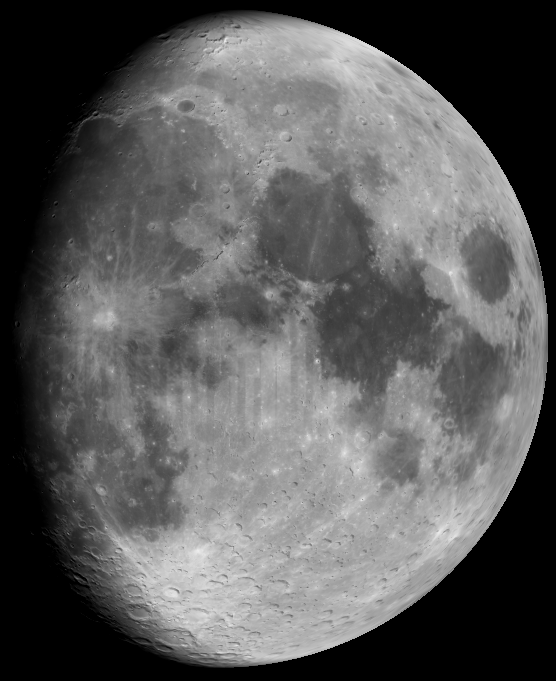
The gibbous Moon tonight at 8 p.m., November 7, 2019. Click on the image to enlarge. Created using Virtual Moon Atlas.
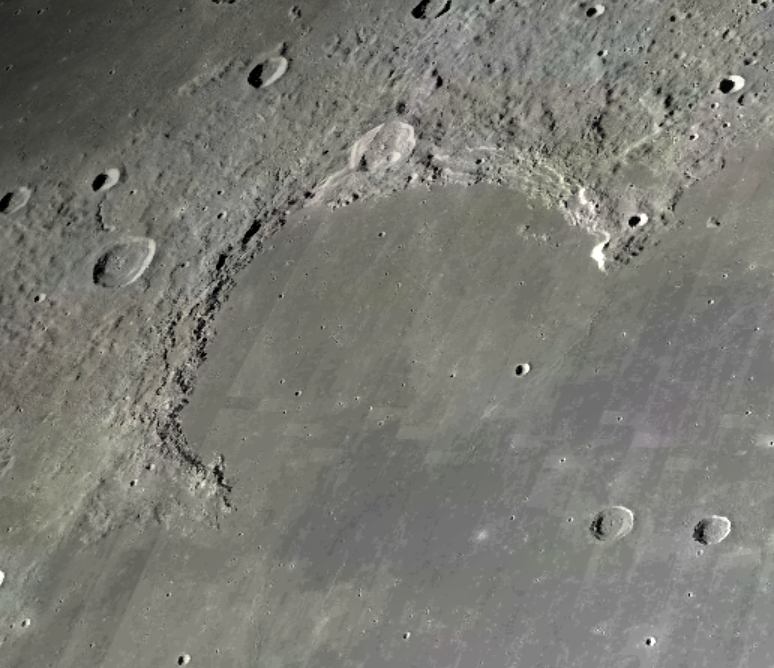
Sinus Iridium photographed by the Lunar Reconnaissance Orbiter as texture mapped on the globe of the Virtual Moon Atlas.
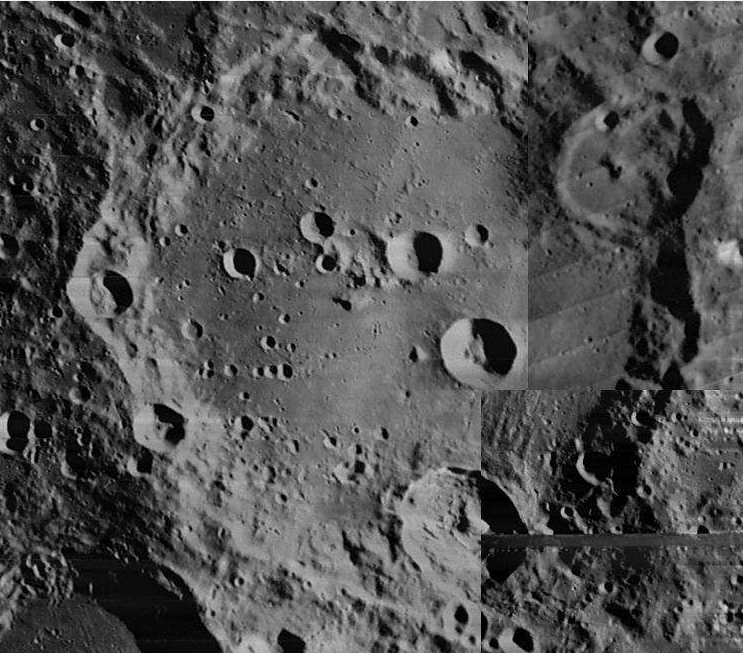
Clavius as photographed by one of the Lunar Orbiter spacecraft in the 1960s From Digital Lunar Orbital Photographic Atlas. This is photographed from overhead. On tonight’s moon it’s near the bottom or south end and is foreshortened.Credit Jeff Gillis, Lunar and Planetary Institute.
01/25/2018 – Ephemeris – The Moon tonight: Copernicus on the terminator
Ephemeris for Thursday, January 25th. The Sun will rise at 8:09. It’ll be up for 9 hours and 32 minutes, setting at 5:41. The Moon, 1 day past first quarter, will set at 2:48 tomorrow morning.
Let’s take a look at our slightly gibbous moon, just a day past first quarter with binoculars or a small telescope. The terminator, in this case the sunrise line will appear to cross the crater Copernicus to the right of the Moon’s center if you’re viewing it right side up. To the North across the Sea of Showers, or Mare Imbrium is the large flat floored crater Plato. South of Copernicus is a recently named sea, Mare Cognitum, the Known Sea, after the first successful close photography by the Ranger 7 spacecraft in 1964. South of the is Mare Nubium, the Sea of Clouds. South of that are the lunar highlands with the stark crater Tycho and the huge crater Clavius with an arc of craters of decreasing size within it.
The times given are for the Traverse City/Interlochen area of Michigan. They may be different for your location.
Addendum
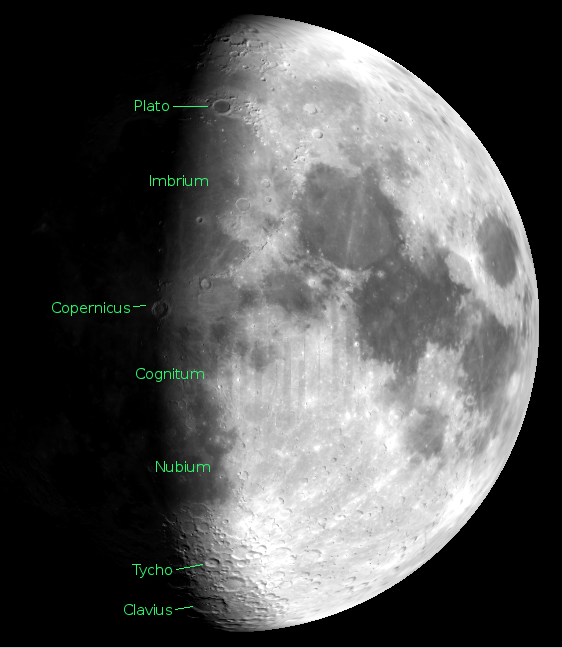
The waxing gibbous Moon tonight at 8 p.m., January 25, 2018. Created using Virtual Moon Atlas.
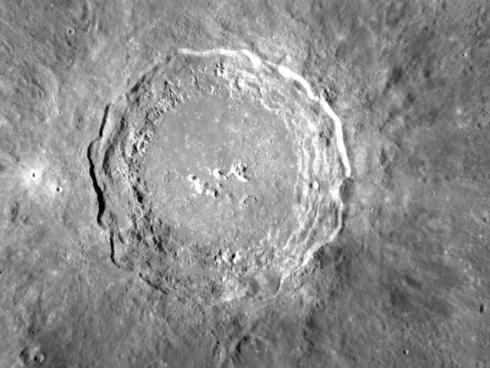
The crater Copernicus. Credit: NASA/GSFC/Arizona State University.
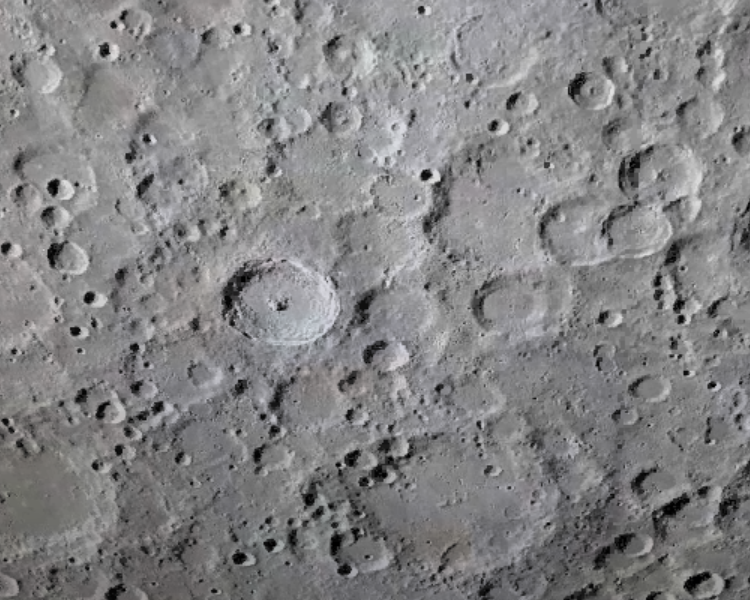
The Lunar highlands near the crater Tycho showing a surface saturated with craters. Credit: Virtual Moon Atlas with the texture from NASA’s Lunar Reconnaissance Orbiter. The lunar phase was omitted.
Clavius as photographed by one of the Lunar Orbiter spacecraft in the 1960s From Digital Lunar Orbital Photographic Atlas. Credit Jeff Gillis, Lunar and Planetary Institute.
04/27/2015 – Ephemeris – Two large craters on the Moon for binoculars or a small telescope
Ephemeris for Monday, April 27th. Today the Sun will be up for 14 hours and 3 minutes, setting at 8:42. The Moon, 2 days past first quarter, will set at 4:04 tomorrow morning. Tomorrow the Sun will rise at 6:37.
After taking a look, last week, at some early results from the two spacecraft approaching dwarf planets now, Dawn at Ceres and New Horizons nearing Pluto, let’s get back to our sky and our Moon. Time to get out that telescope or powerful binoculars. The terminator which now is the sunrise line will be cutting through the middle of the crater Copernicus at 10 in the evening. Copernicus, near the Moon’s equator hit a flat lunar sea, so it’s quite conspicuous. Another crater near the Moon’s southern pole is conspicuous because it’s so big. It’s Clavius, with an arc of diminishing sized craters within. It will be completely in sunlight being uncovered slowly now by the terminator.
Times are for the Traverse City/Interlochen area of Michigan. They may be different for your location.
Addendum
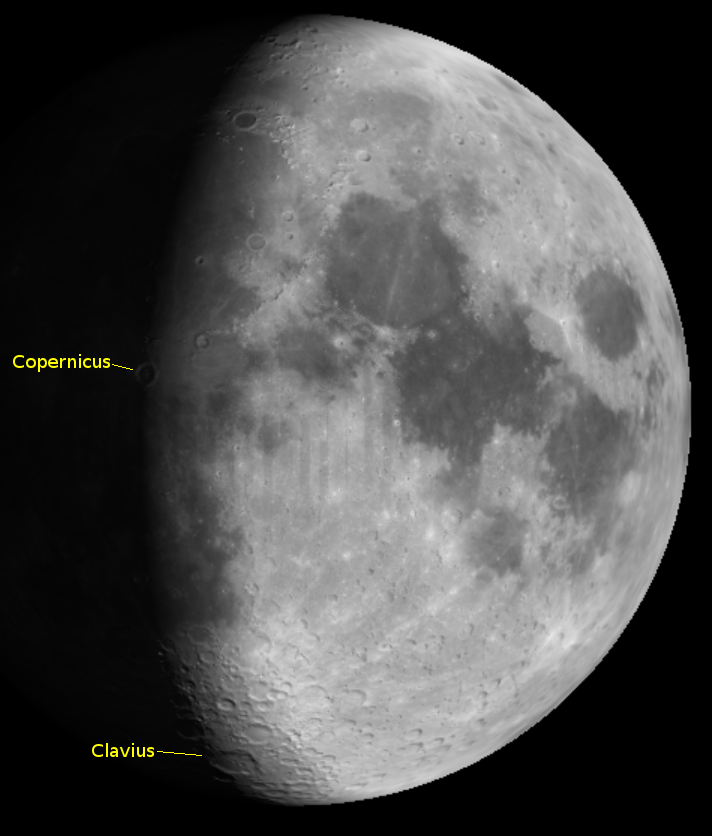
The Moon at 10 p.m. April 27, 2015 EDT (2:00 UT, April 28). Created using Virtual Moon Atlas.
10/02/2014 – Ephemeris – The gibbous Moon tonight
Ephemeris for Thursday, October 2nd. The sun will rise at 7:41. It’ll be up for 11 hours and 39 minutes, setting at 7:21. The moon, 1 day past first quarter, will set at 1:50 tomorrow morning.
Tonight the moon will be featuring some of my favorite lunar landmarks, and if you spend any time looking at the moon with a small telescope, they become yours. The place to look is at the terminator, the sunrise line on the moon. In the north not far from the terminator is the walled plain called Plato. A bit farther away is a gash in the lunar Alps mountains caller the Alpine Valley. Near the center of the terminator and split by it is the fabulous crater Copernicus with a triple central peak which should poke into sunlight. Near the south pole is the large crater Clavius with an arc of decreasingly smaller craterlets on its floor. A bit north of that is the crater Tycho, which is more prominent when the moon is full than it is now.
Times are for the Traverse City/Interlochen area of Michigan. They may be different for your location.
Addendum
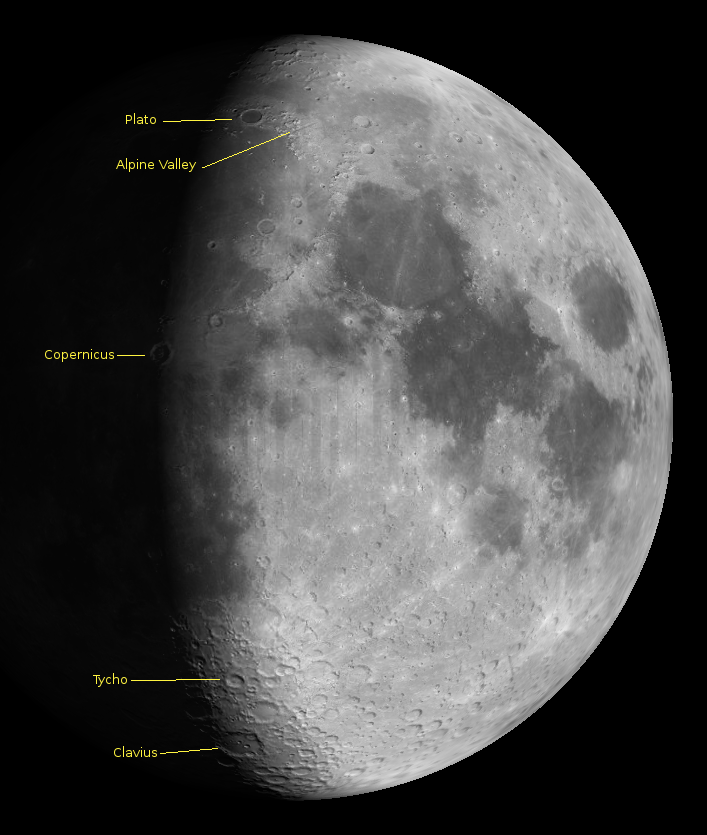
The gibbous Moon one day after first quarter at 9 p.m. October 2, 2014. Created using Virtual Moon Atlas.
05/29/2012 – Ephemeris – The moon tonight
Ephemeris for Tuesday, May 29th. Today the sun will be up for 15 hours and 16 minutes, setting at 9:18. The moon, 1 day past first quarter, will set at 2:38 tomorrow morning. Tomorrow the sun will rise at 6:01.
The moon tonight is a wonderful sight for binoculars or a small telescope. There are some very nice craters now revealed near the terminator, the line between day and night on the moon. The terminator in the two weeks between new and full is the sunrise line on the moon. From the top or north on the moon is the flat floored crater Plato Then about midway down the moon and right on the terminator is the beautiful crater Copernicus. Then to the south end of the moon is the bright and crisp crater Tycho. Its splash marks called rays will be better revealed at full moon. At the bottom of the moon, just coming into light is the huge crater Clavius. A telescope will reveal smaller craters within.
Times are for the Traverse City/Interlochen area of Michigan. They may be different for your location.
Addendum
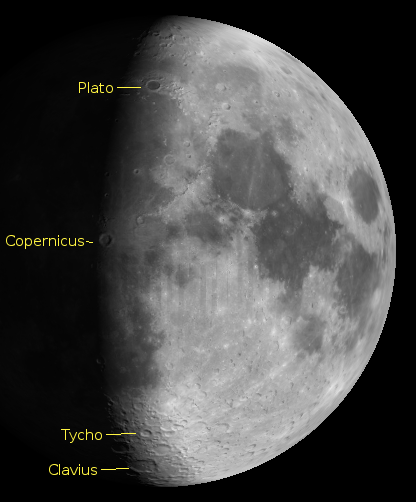
The moon on 5/29/2012 showing large craters on the terminator. Created using Virtual Moon Atlas.
 Bob Moler's Ephemeris Blog