Archive
Ephemeris: 03/21/2024 – Three lunar craters named for heliocentrists by a geocentrist
This is Ephemeris for Thursday, March 21st. Today the Sun will be up for 12 hours and 14 minutes, setting at 7:57, and it will rise tomorrow at 7:41. The Moon, halfway from first quarter to full, will set at 6:59 tomorrow morning.
The gibbous moon tonight is exhibiting, over the last three days, three craters named for those who promoted the heliocentric or Sun centered solar system. The largest crater of the three, Copernicus, can be seen to the lower left of the center of the Moon. The asteroid that hit it made a big splash, which can be seen in its rays of ejecta being round and full. Then about halfway between it and the terminator is a small crater named for Johannes Kepler, and then nearby and on the terminator tonight is the crater named for the Greek philosopher who first proposed the Sun centered solar system, or in his case the universe, Aristarchus. He was a contemporary of and overshadowed by Aristotle, so his ideas were never adopted.
The astronomical event times given are for the Traverse City/Interlochen area of Michigan (EDT, UT–4 hours). They may be different for your location.
Addendum
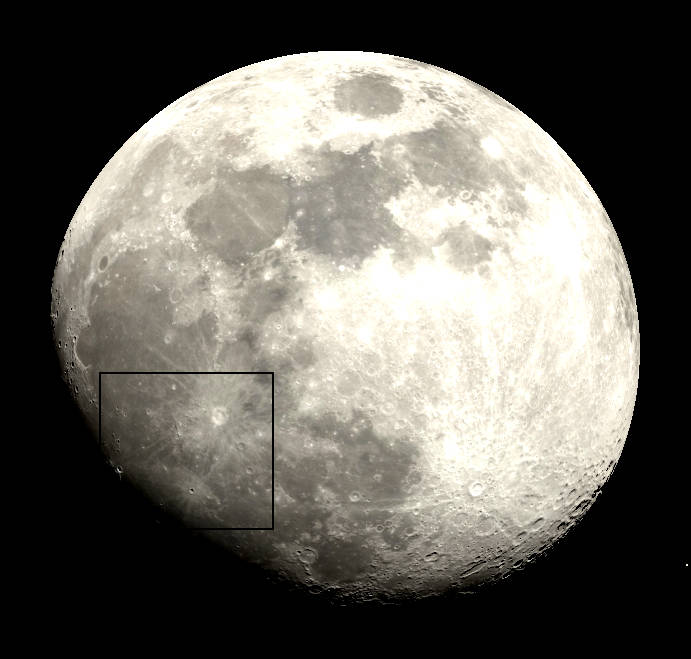
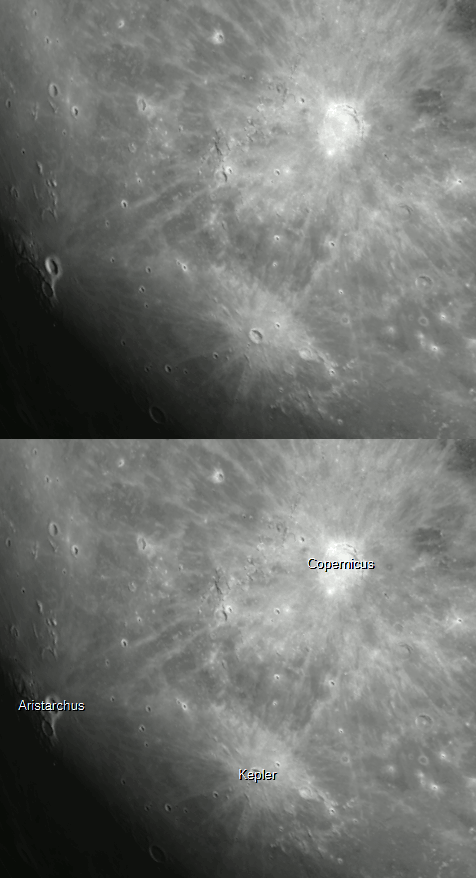
These craters were named by Giovanni Battista Riccioli, an astronomer and Jesuit priest. He established the lunar nomenclature we have today and named many of the largest craters. Being a 17th century Catholic, he bought the Roman Catholic line that the universe was geocentric, that is earth centered, yet he honored these heliocentrists with their own craters. He tended to group crater names by their relationship in life or their ideas, so the three proponents of the Sun centered solar system were given craters near each other in one section of the Moon.

Aristarchus of Samos was a Greek philosopher who lived between 310 and 230 BCE. He proposed a heliocentric solar system or universe, where Earth and all the planets revolved about the Sun. However, the work that he proposed it in has been lost. We know of his idea only referenced in the writings of others who attempted to debunk it.
Copernicus (Mikola Kopernik 1473-1543), was a Polish Catholic Canon, who was a mathematician, astronomer and translator, among other talents. He came up with the theory of the Sun centered or heliocentric solar system or in his day, universe.
Johannes Kepler (1571–1630) was an astronomer, astrologer and mathematician who discovered the laws of planetary motion. While Copernicus kept the circular orbits of the planets, they still didn’t match the motions of the planets in the sky. So he had to add some epicycles to make it all work. He actually had more epicycles than Ptolemy had. Kepler was able to figure out that he didn’t need epicycles if he assumed that the orbits were elliptical. He developed his Three Laws of Planetary Motion.
Galileo also has a crater there (Galilaei). It’s a tiny crater right on the terminator, below Kepler in the images above, and not visible. The Virtual Moon Atlas does not give an origin of the naming of the crater. Back in 1651, when Riccioli was giving craters names, Galileo was still on the outs with the Vatican, and the church.
06/11/2019 – Ephemeris – The crater Copernicus on the Moon
Ephemeris for Tuesday, June 11th. Today the Sun will be up for 15 hours and 31 minutes, setting at 9:28, and it will rise tomorrow at 5:56. The Moon, 1 day past first quarter, will set at 3:26 tomorrow morning.
Tonight, visible on the waxing gibbous Moon in binoculars or a small telescope the terminator, the sunrise line crosses the prominent crater Copernicus. This crater is nearly half way from the top to the bottom of the Moon. It is 56 miles (93 km) in diameter and 2 miles (3.5 k m) deep. The low Sun angle accentuates the depth of the crater. As large craters goes, Copernicus is rather new, being somewhat younger than 1.1 billion years old, a quarter of the Moon’s age. A dramatic image taken by the Lunar Orbiter spacecraft in 1966, in preparation for the Apollo lunar landings of an oblique view of the crater peeking over a crater wall was, at that time, dubbed the Picture of the Century”.
The times given are for the Traverse City/Interlochen area of Michigan. They may be different for your location.
Addendum
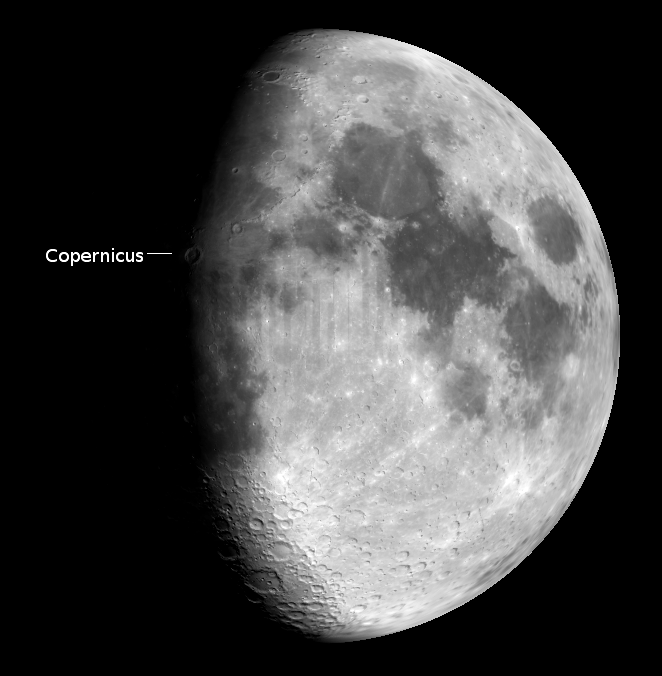
The Moon tonight, June 11, 2019 showing the crater Copernicus. Created using Virtual Moon Atlas.
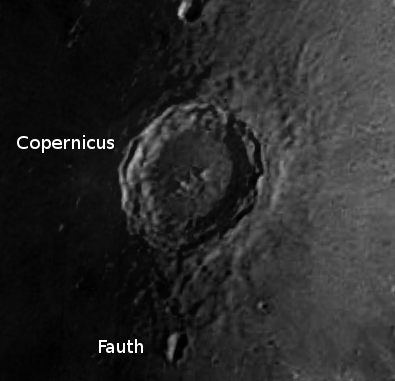
Closeup of Copernicus with the small double crater Fauth south of it. Created using Virtual Moon Atlas.
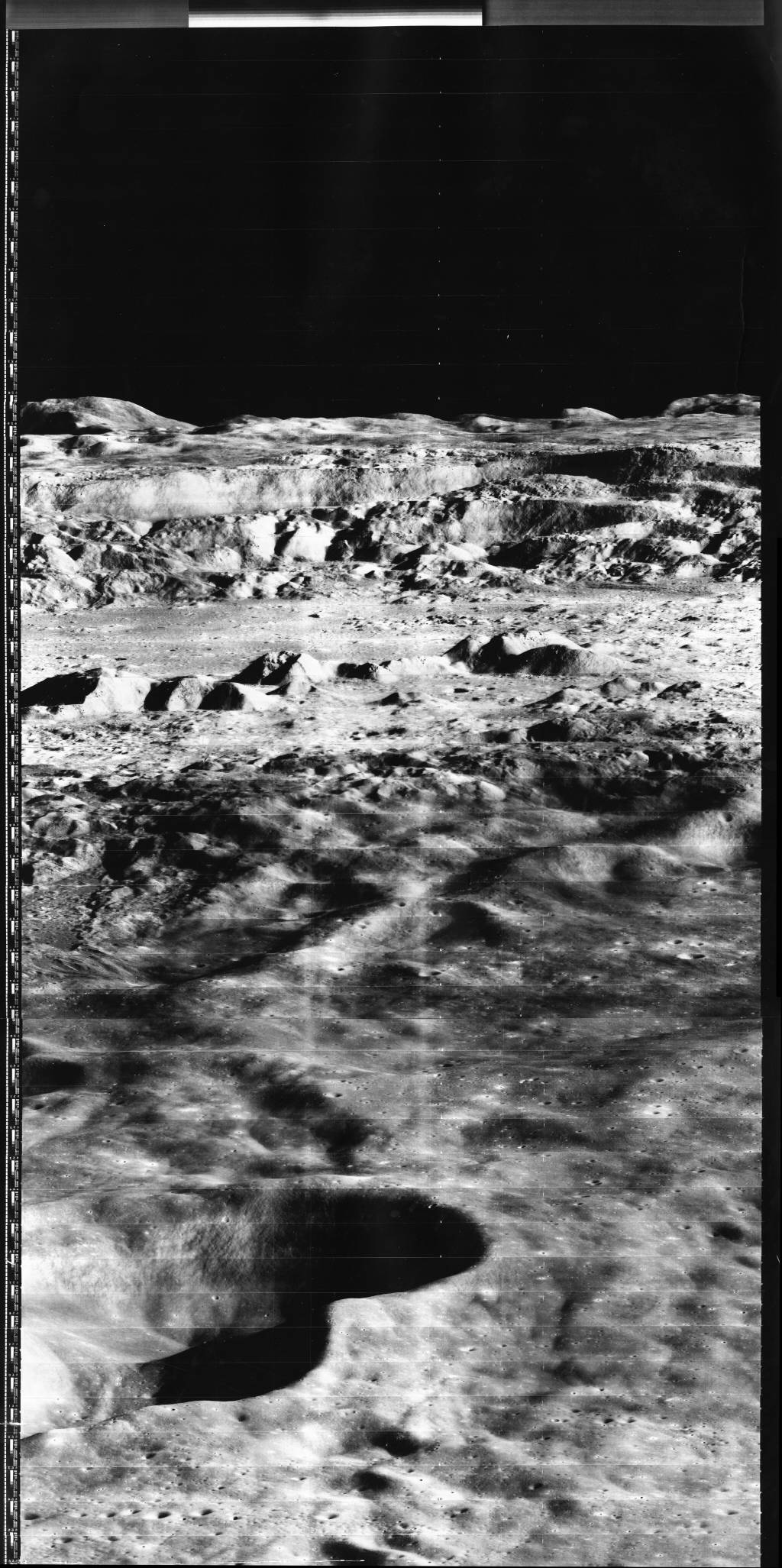
Picture of the Century taken by the lunar Orbiter 2. Copernicus in an oblique photo from the south. Not the double crater Fauth at the bottom of the Image. Credit: NASA/Lunar Orbiter Image Recovery Project (LOIRP).
03/07/2017 – Ephemeris – The Moon tonight – the crater Copernicus
Ephemeris for Tuesday, March 7th. The Sun will rise at 7:08. It’ll be up for 11 hours and 29 minutes, setting at 6:38. The Moon, 2 days past first quarter, will set at 4:39 tomorrow morning.
Looking at the Moon tonight the brightest feature on the left side of the moon is the big splash mark left by the impact that created the crater Copernicus. The proper term is ejecta blanket that can be noticed by the naked eye or binoculars. Although it is most visible during full moon, because it is really made of small craters that are most visible when we see them from the direction of the Sun, so they are not shadow filled and brighter than normal. Copernicus is on the south edge of a great lava plain called Mare Imbrium, the Sea of Showers. There’s a large crater on the north edge named after the Greek philosopher Plato. At the upper left edge is the Laplace promontory the point of the Bay of Rainbows to be revealed tomorrow night.
Times are for the Traverse City/Interlochen area of Michigan. They may be different for your location.
Addendum
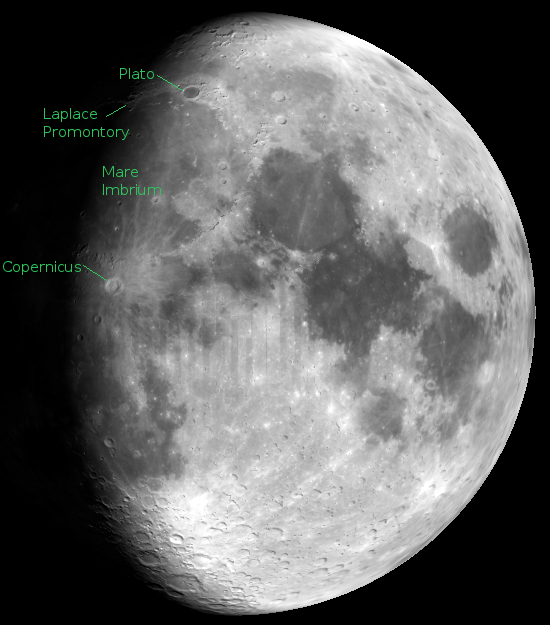
The Moon featuring Copernicus, Plato, Laplace Promontory and Mare Imbrium at 9 p.m., March 7, 2017. Created using Virtual Moon Atlas.
10/10/2016 – Ephemeris – Checking out the gibbous Moon tonight
Ephemeris for Indigenous Peoples Day*, Monday, October 10th. The Sun will rise at 7:52. It’ll be up for 11 hours and 13 minutes, setting at 7:06. The Moon, 1 day past first quarter, will set at 2:20 tomorrow morning.
The Moon is beginning to dominate the evening sky. So it’s time to get out that telescope or powerful binoculars. The terminator which now is the sunrise line will be cutting through the Sea of Showers, also known as Mare Imbrium. Just south of it is the large crater Copernicus, 56 miles (93 km) in diameter. Copernicus, near the Moon’s equator hit a flat lunar sea, so it’s quite conspicuous. Another crater near the Moon’s south pole is conspicuous because it’s so big. It’s Clavius, with an arc of diminishing sized craters within. It is 136 miles (225 km) in diameter. In the book and movie 2001: A Space Odyssey, it is the location of the US Moon Base, with the monolith in the distinctive crater Tycho north of it.
Times are for the Traverse City/Interlochen area of Michigan. They may be different for your location.
Addendum
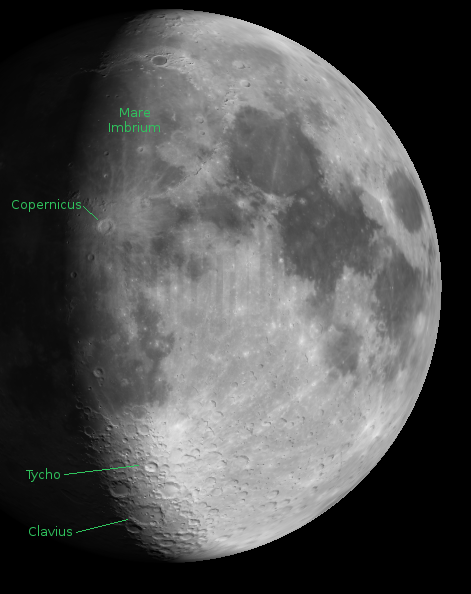
The Moon at 9 p.m. October 10, 2016, with the landmarks described in the text above,
* Indigenous Peoples Day – This is officially the Columbus Day holiday in the United States, which commemorates the landing of Christopher Columbus possibly on Plana Cay, which he named San Salvador. While in his four voyages he visited some Caribbean islands, Central and South America. He never made it to North America. Columbus was appointed the Viceroy and Governor of the Indies. He was accused of torture and other crimes. And the treatment of the Indigenous peoples as been horrific then and ever since, so pardon them if they don’t celebrate Columbus Day. This person of European ancestry tends to agree with them.
05/17/2016 – Ephemeris – Three heliocentrists memorialized on the Moon tonight
Ephemeris for Tuesday, May 17th. Today the Sun will be up for 14 hours and 55 minutes, setting at 9:07. The Moon, half way from first quarter to full, will set at 4:50 tomorrow morning. Tomorrow the Sun will rise at 6:10.
Tonight the gibbous Moon boasts the uncovering of three craters from lunar night whose namesakes were pioneers in putting forth the heliocentric theory. That is that the Earth and the other planets revolved about the Sun. Out the longest, and making the biggest splash is the crater Copernicus, named for the Polish cleric whose book On the Revolution of the Heavenly Spheres gave a new meaning to the word revolution, that is upheaval. The crater Kepler is about two-thirds the way from Copernicus and the terminator, named after the astronomer who discovered that the plants orbit the Sun in elliptical paths. Finally just catching sunlight is Aristarchus who in the 4th century BC first proposed a heliocentric solar system.
Times are for the Traverse City/Interlochen area of Michigan. They may be different for your location.
Addendum
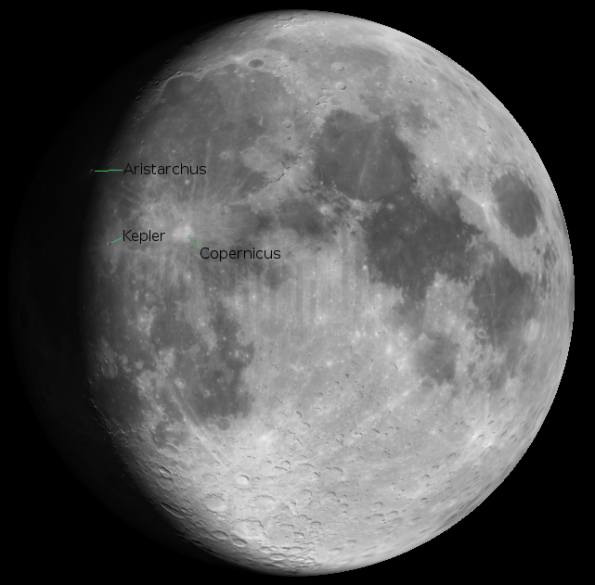
Three heliocentrists on the Moon at 10 p.m., May 17, 2016. Created using Virtual Moon Atlas.
08/15/2013 – Ephemeris – Plato and Copernicus (the craters)
Ephemeris for Thursday, August 15th. The sun rises at 6:45. It’ll be up for 14 hours and 2 minutes, setting at 8:47. The moon, 1 day past first quarter, will set at 1:43 tomorrow morning.
The moon now is slightly gibbous. The term gibbous comes from Latin meaning having a hump or humpbacked. In binoculars or a small telescope look to the upper left where the great Sea of Showers or Mare Imbrium is being revealed by the advance of sunrise. The flat walled plain, actually a crater called Plato is off the top of Imbrium. It is circular and 61 miles in diameter. It looks oval to us because of the curvature of the moon. Below or south at the other edge of Imbrium, just coming into sunlight is the marvelous crater Copernicus with it’s triple central peaks. It’s 56 miles in diameter. In a good enough telescope one can see that the crater walls appear terraced. Copernicus is 2 miles deep.
Times are for the Traverse City/Interlochen area of Michigan. They may be different for your location.
Addendum
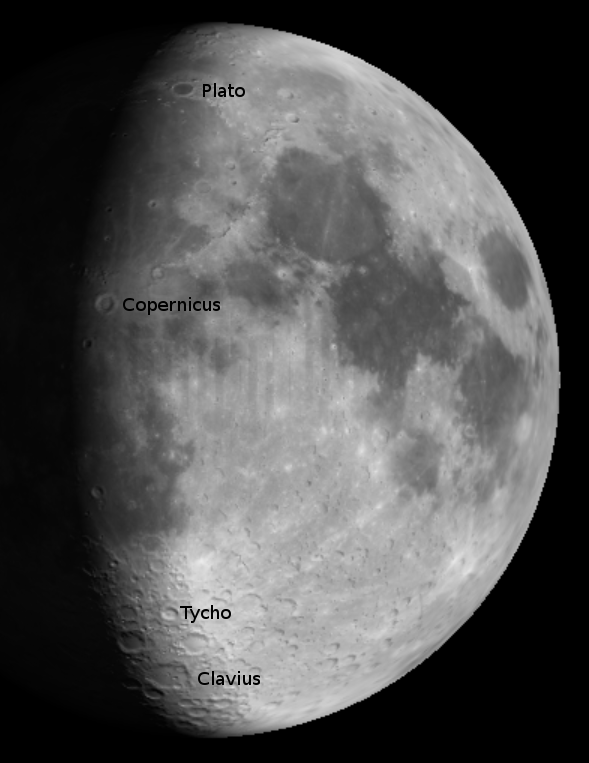
The moon a day after first quarter on August 15, 2013. Created using Virtual Moon Atlas.
The image also includs the craters Tycho and Clavius craters in the southern highlands.
07/05/11 – Ephemeris – The ancient’s perfect moon
Tuesday, July 5th. Today the sun will be up for 15 hours and 26 minutes, setting at 9:30. The moon, 3 days before first quarter, will set at 11:49 this evening. Tomorrow the sun will rise at 6:04.
As we look at the moon tonight we can see dark areas and bright areas. To western philosophers and astronomers from Aristotle to Copernicus objects in the heavens were thought to be perfect and changeless and moved in uniform circular motion around the earth. However the moon doesn’t appear perfect and spotless. It has light and dark areas on it. The supposed explanation for that was that it was a perfect mirror and reflected the earth. It might make sense if you didn’t think about it too much. For a very long time nobody did, at least nobody that made a difference until Copernicus came along. With Copernicus, Galileo and his telescope, Tycho Brahe’s observations, Kepler and Newton, the heavens were changed forever.
* Times are for the Traverse City/Interlochen area of Michigan. They may be different for your location.
 Bob Moler's Ephemeris Blog