Archive
07/15/2016 – Ephemeris – The Moon tonight
Ephemeris for Friday, July 15th. Today the Sun will be up for 15 hours and 13 minutes, setting at 9:25, and it will rise tomorrow at 6:12. The Moon, half way from first quarter to full, will set at 3:35 tomorrow morning.
The Moon is bright as it moves toward full. In binoculars, the brightest spot on the Moon is visible on the left edge of the Moon at 10 p.m. In telescopes it becomes a crater named Aristarchus. The sea below Aristarchus where the terminator, the sunrise line cuts across is Oceanus Procellarum, the Ocean of Storms. Below that is the small circular sea called Mare Humorum, the Sea of Moisture. North of Humorum is a large crater with low walls and a multiple central peak called Gassendi. Below that we’re back in the lunar highlands with lots of large craters. One of those craters, near the terminator is oddly elongated. It’s Schiller, 108 by 43 miles (174 X 69 km) in size.
Times are for the Traverse City/Interlochen area of Michigan. They may be different for your location.
Addendum
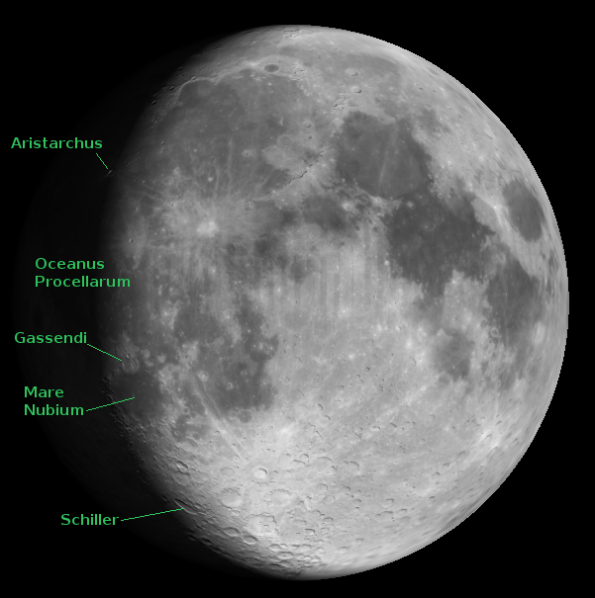
The gibbous Moo at 10 p.m. July 15, 2016 showing some interesting features near the terminator. Created using Virtual Moon Atlas.
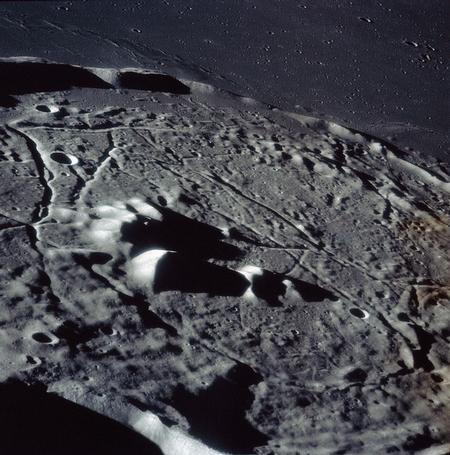
The crater Gassendi from Apollo 16 – NASA
06/09/2014 – Ephemeris – The brightest spot on the moon
Ephemeris for Monday, June 9th. Today the sun will be up for 15 hours and 28 minutes, setting at 9:26. The moon, half way from first quarter to full, will set at 4:09 tomorrow morning. Tomorrow the sun will rise at 5:57.
For all you Moon lovers out there we have a chance to study with telescopes the brightest spot on the Moon. It is at the upper left corner of the Moon and can easily be seen in binoculars. It’s the crater Aristarchus. However a telescope is what’s needed to see the crater in detail. Like the crater Alphonsus we looked at last Thursday, occasional hazes have been seen in this crater. Aristarchus isn’t really large, only 24 miles (40 km) in diameter. It is a young crater, which is why it’s bright. The asteroid that hit these penetrated the dark gray regolith into the lighter bedrock. Young in this case is somewhere younger than 1.1 billion years old. There’s an interesting valley near it called Schroter’s Valley.
Times are for the Traverse City/Interlochen area of Michigan. They may be different for your location.
Addendum
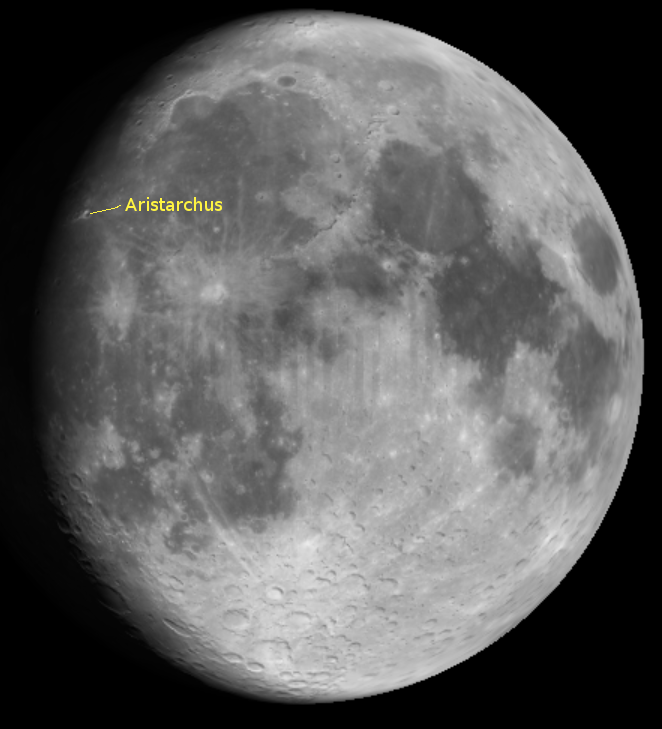
The crater Aristarchus at 11 p.m., June 9, 2014. It will brighten as we move to full moon. Created using Stellarium.
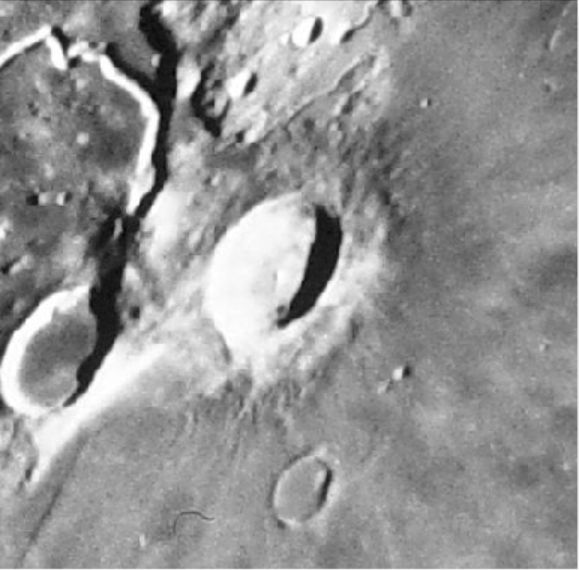
The crater Aristarchus. Credit: Lunar and Planetary Institute.
02/11/2014 – Ephemeris – The brightest spot on the moon is visible tonight
Ephemeris for Tuesday, February 11th. The sun will rise at 7:48. It’ll be up for 10 hours and 17 minutes, setting at 6:05. The Moon, 3 days before full, will set at 6:06 tomorrow morning.
The moon tonight is very bright. It will be full on Friday. Using binoculars the brightest object on the moon is a spot at the left edge of the moon that rotates to the upper left as the moon rises. It is the young crater Aristarchus. The age is less than 1.1 billion years. How much younger is unknown. It’s in the same age range as Copernicus to the lower right of it with the big round splash marks. In a telescope Aristarchus is a crater 24 miles (40 kilometers) in diameter. Generally, the fresher the crater the brighter it is. The Lunar Reconnaissance Orbiter has been in orbit of the moon for nearly four years. In that time it has discovered small craters that were formed after it arrived in orbit. The initial impacts drill into the moon’s lighter subsurface.
Times are for the Traverse City/Interlochen area of Michigan. They may be different for your location.
Addendum
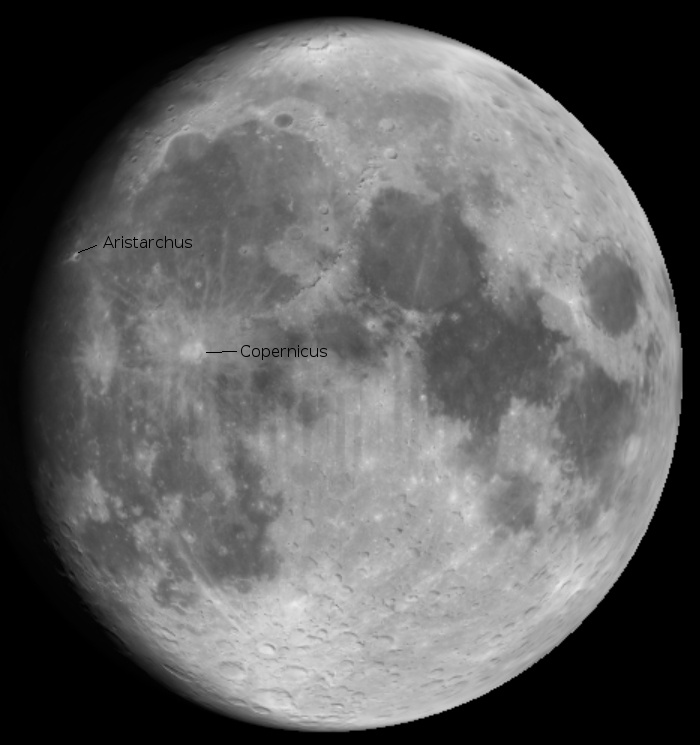
The Moon at 9 p.m. February 11, 2014 showing the craters Aristarchus and Copernicus. Created using Virtual Moon Atlas.
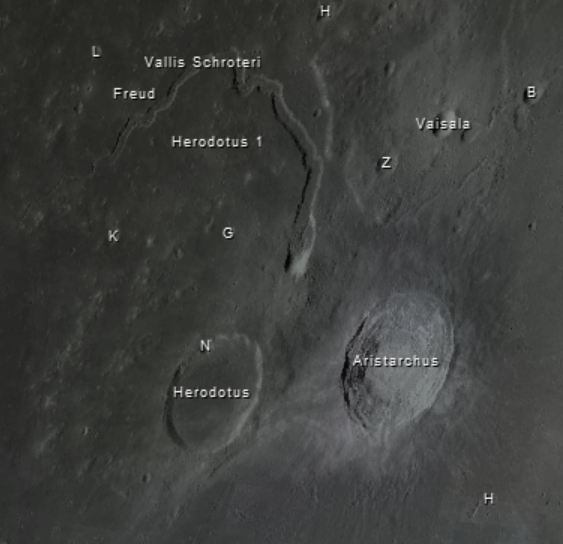
The crater Aristarchus and its environs via the Lunar Reconnaissance Orbiter as a texture in the Virtual Moon Atlas. Credit NASA.
Note the valley that borders Aristarchus, Vallis Schroteri, or Schroter’s Valley. It’s head is called the Cobra’s Head. It is up to a kilometer or 3,000 feet deep.
09/16/2013 – Ephemeris – The brightest spot on the moon
Ephemeris for Monday, September 16th. The sun will rise at 7:22. It’ll be up for 12 hours and 27 minutes, setting at 7:50. The moon, 3 days before full, will set at 5:15 tomorrow morning.
The moon is very bright tonight and almost painful to view through a telescope. Remember that’s the full strength of the sun shining on it. Be thankful that it reflects only about 11 percent of the sunlight that hits it. Just thing how much brighter it would be if it was covered by Lake Michigan beach sand. There is a bright spot on the moon now visible. It just became visible today. It’s a crater at the upper left of the moon that’s called Aristarchus after the ancient Greek Philosopher who came up with the sun centered solar system in the 3rd century BC. Unfortunately all his writings have been lost. We only have the comments from others of what he wrote. The crater is the brightest spot on the moon.
Times are for the Traverse City/Interlochen area of Michigan. They may be different for your location.
Addendum
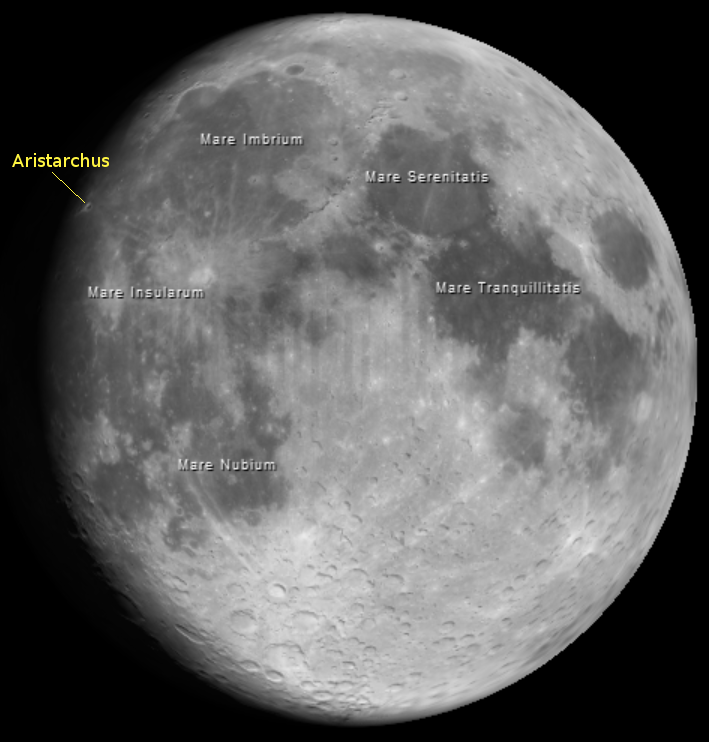
The location of Aristarchus on the moon at 9 p.m. September 16, 2013. Created using Virtual Moon Atlas.
The crater Aristarchus. Credit: Lunar and Planetary Institute.
09/08/11 – Ephemeris – The moon tonight
Thursday, September 8th. The sun will rise at 7:12. It’ll be up for 12 hours and 53 minutes, setting at 8:06. The moon, half way from first quarter to full, will set at 4:28 tomorrow morning.
The moon tonight is very bright, so looking at it with a telescope can be almost painful. There are moon filters sold at telescope stores for standard sized eyepieces that will alleviate that problem. Remember it’s daytime on the moon and the sunlight is as strong on the moon as it is on the earth. Concentrate the telescope on the left edge of the moon, the sunrise line where the shadows are. The bright crater Aristarchus is just coming into sunlight now on the upper left. It’s the brightest spot on the moon when the moon is full. The Crater Gassendi to the lower left is a ringed plain with low walls and a flat floor that has a rille or crack in it. Another distinctive crater is Schiller lower to the south and distinctively elongated.
* Times are for the Traverse City/Interlochen area of Michigan. They may be different for your location.
Addendum
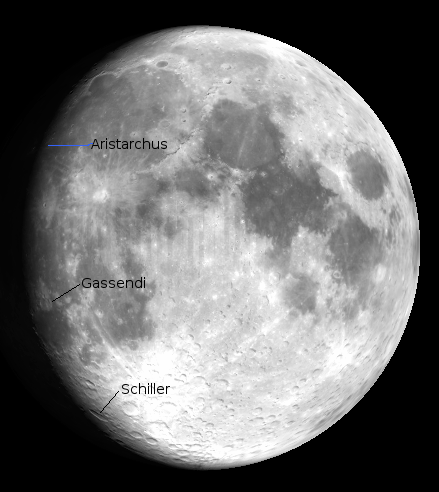
The moon with craters Aristarchus, Gassendi and Schiller. Image from Virtual Moon Atlas.
Closeup of the crater Gassendi
The crater Gassendi from Apollo 16 - NASA
 Bob Moler's Ephemeris Blog