Archive
06/09/2022 – Ephemeris – Looking at the gibbous Moon tonight
This is Bob Moler with Ephemeris for Thursday, June 9th. Today the Sun will be up for 15 hours and 29 minutes, setting at 9:27, and it will rise tomorrow at 5:57. The Moon, 2 days past first quarter, will set at 3:29 tomorrow morning.
By tonight, the gibbous moon will be quite bright. At the moon’s left edge, just coming into sunlight, will be what looks like a large half crater at the edge of the lunar sea called Mare Imbrium, the Sea of Showers. That feature is Sinus Iridium, or Bay of Rainbows. The arc of its mountainous edge is rainbow shaped, but it is as colorless as the rest of the Moon. The crater Copernicus sports few shadows and appears mostly as a bright spot surrounded by its ray system of ejecta craters that appear bright when the sun is high in their sky. At the south end of the Moon are the lunar highlands, bright, rugged and covered by large, mostly very old craters. Largest of these craters is Clavius, named for Christophorus Clavius who, working for Pope Gregory XIII, devised the Gregorian Calendar we use today.
The astronomical event times given are for the Traverse City/Interlochen area of Michigan (EDT, UT – 4 hours). They may be different for your location.
Addendum
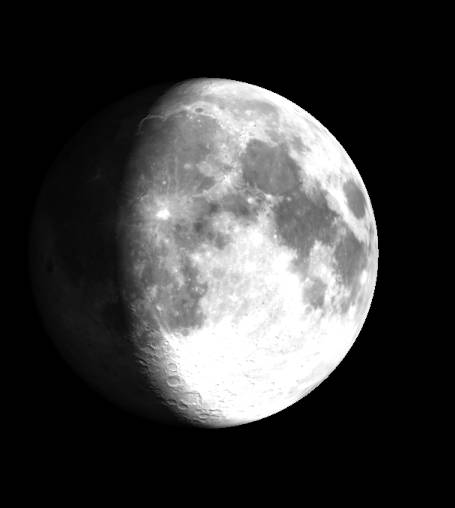
Binocular Moon as it might appear tonight, June 9, 2022. Below, we’ll look closer to the terminator area of the Moon. Created using Virtual Moon Atlas.
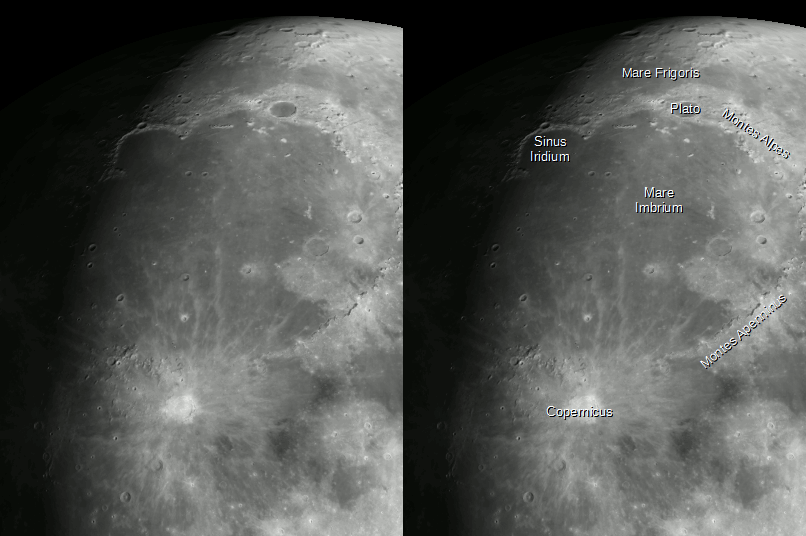
Northern gibbous Moon terminator area with labels for some prominent features. Created using Virtual Moon Atlas, LibreOffice and GIMP.
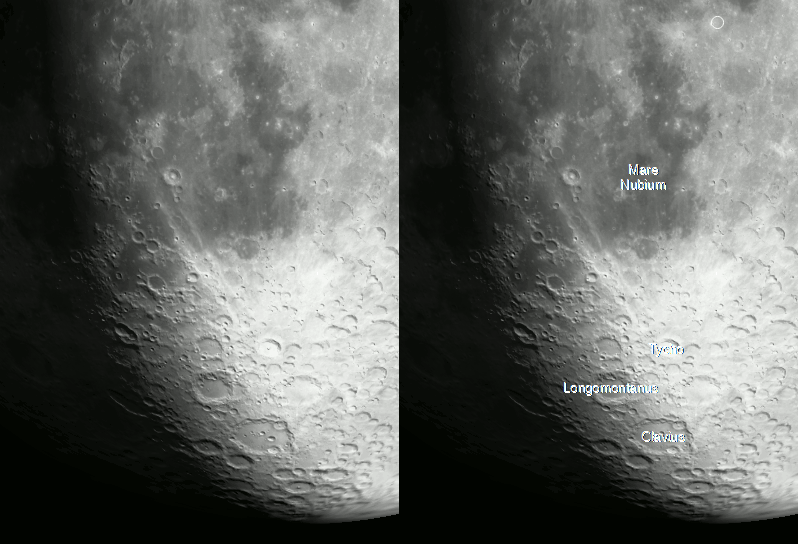
Southern gibbous Moon terminator area with labels for some prominent features. Created using Virtual Moon Atlas, LibreOffice and GIMP.
Translations
Mare Frigoris – Sea of Cold
Mare Imbrium – Sea of Showers
Mare Nubium – Sea of Clouds
Montes Alpes – Alps Mountains
Montes Appinenninus – Apennines Mountains
Sinus Iridium – Bay of Rainbows
09/02/2014 – Ephemeris – Viewing the first quarter Moon
Ephemeris for Tuesday, September 2nd. The sun will rise at 7:06. It’ll be up for 13 hours and 11 minutes, setting at 8:17. The moon, at first quarter today, will set at 12:52 tomorrow morning.
Tonight on the moon there are some very prominent craters on the terminator or sunrise line that’s cutting the moon in half. From the top or north of the moon there’s Plato, which is also called a ringed plain because it has a flat floor. South of there is Eratosthenes, at the end of the arc of the Apennines mountain chain. At the south or bottom end of the moon are two other of my favorite craters. First is the crater Tycho, that doesn’t look spectacular now, but will when the Moon is full with its rays of ejecta crossing a long way across the face of the moon. A little bit farther south, partially entering sunlight is the large crater Clavius. On my blog, bobmoler.wordpress.com, I’ll illustrate what the Moon’s image looks like in different types of telescopes.
Times are for the Traverse City/Interlochen area of Michigan. They may be different for your location.
Addenda
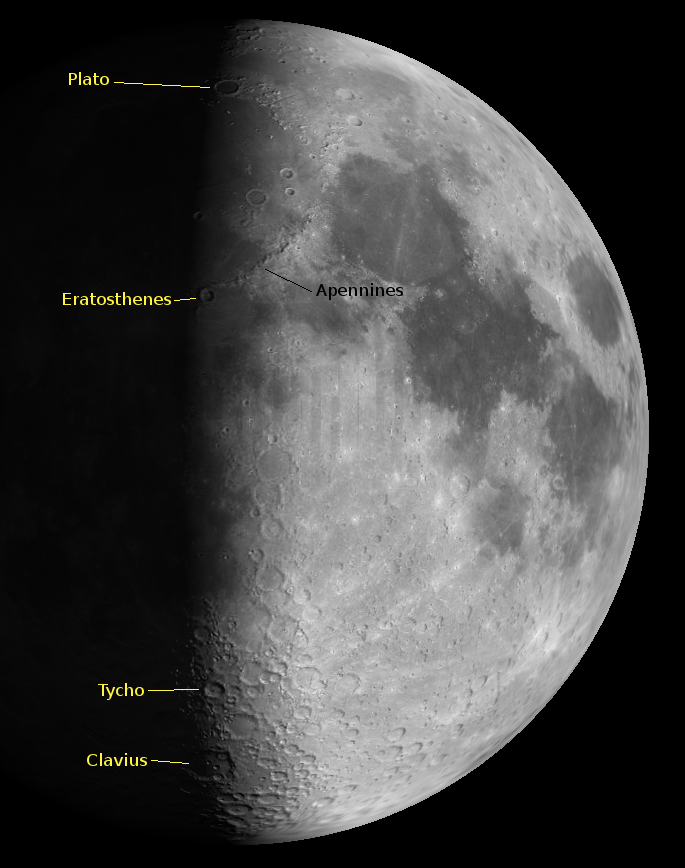
The Moon tonight at 9 p.m. (September, 2, 2014). Created using Virtual Moon Atlas.
Image orientation in telescopes
The orientation of what one sees in an astronomical telescope depends on the type of telescope and the placement of the eyepiece. The orientations shown are for observers in the northern hemisphere. For the images below the moon shown is due south.
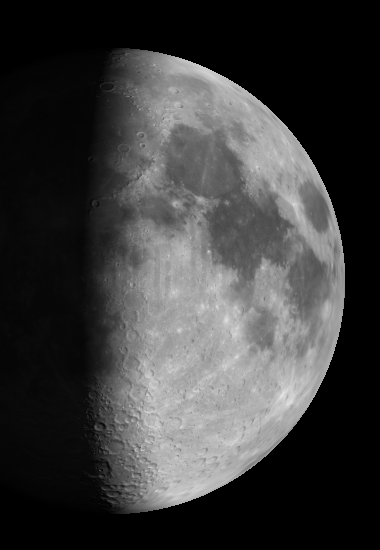
The orientation of the Moon as seen with the naked eye, binoculars, spotting scopes and telescopes with an erecting eyepiece.
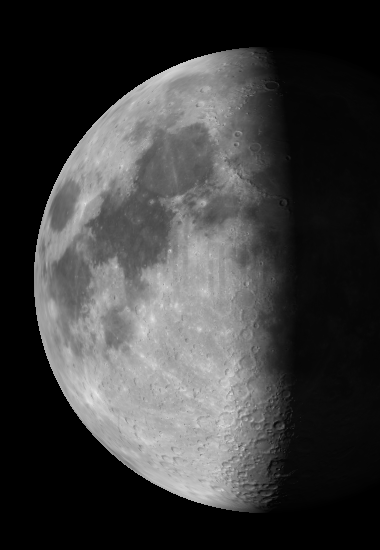
The orientation of the Moon as seen in a refractor or a Schmidt-Cassigrain or similar type reflector with a diagonal at the eyepiece end, and the eyepiece pointing up. This is a mirror image due to an odd number of mirror reflections in the telescope.
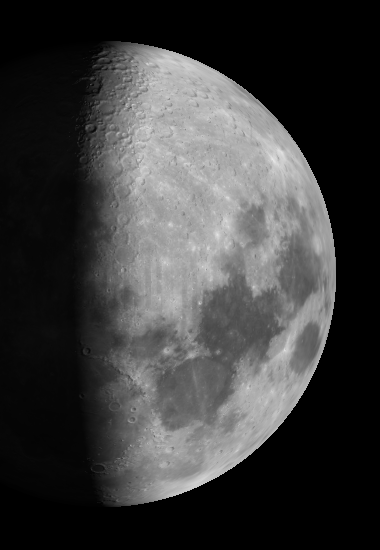
The orientation of the Moon as seen with a refractor or Schmidt-Cassigrain and diagonal with the eyepiece oriented horizontally. It is a n inverted mirror image.
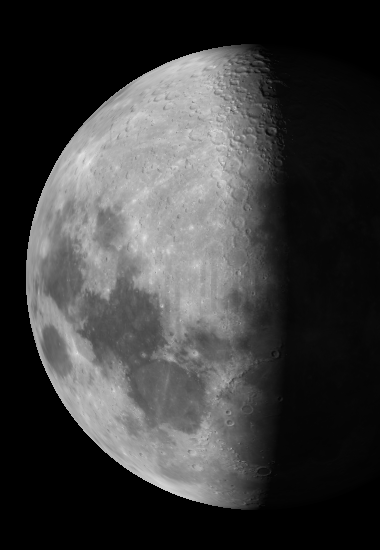
The orientation of the moon through a Newtonian reflector or a refractor without an eyepiece diagonal. It is an inverted image, an image rotated 180 degrees.
For southern hemisphere observers for these images to work the moon would be due north and all the images would have to be upside down.
Correction 09/02/2014 11:07 p.m.
All images created using Virtual Moon Atlas.
 Bob Moler's Ephemeris Blog