Archive
06/09/2022 – Ephemeris – Looking at the gibbous Moon tonight
This is Bob Moler with Ephemeris for Thursday, June 9th. Today the Sun will be up for 15 hours and 29 minutes, setting at 9:27, and it will rise tomorrow at 5:57. The Moon, 2 days past first quarter, will set at 3:29 tomorrow morning.
By tonight, the gibbous moon will be quite bright. At the moon’s left edge, just coming into sunlight, will be what looks like a large half crater at the edge of the lunar sea called Mare Imbrium, the Sea of Showers. That feature is Sinus Iridium, or Bay of Rainbows. The arc of its mountainous edge is rainbow shaped, but it is as colorless as the rest of the Moon. The crater Copernicus sports few shadows and appears mostly as a bright spot surrounded by its ray system of ejecta craters that appear bright when the sun is high in their sky. At the south end of the Moon are the lunar highlands, bright, rugged and covered by large, mostly very old craters. Largest of these craters is Clavius, named for Christophorus Clavius who, working for Pope Gregory XIII, devised the Gregorian Calendar we use today.
The astronomical event times given are for the Traverse City/Interlochen area of Michigan (EDT, UT – 4 hours). They may be different for your location.
Addendum
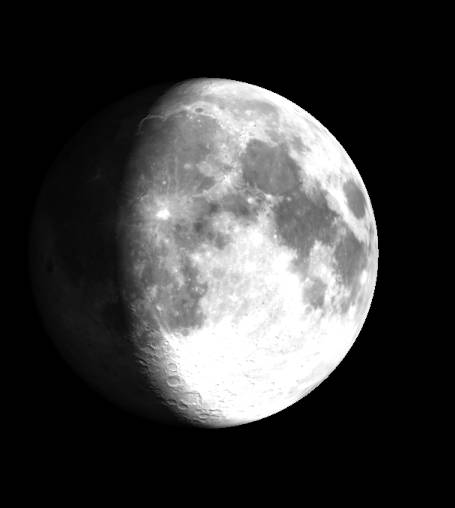
Binocular Moon as it might appear tonight, June 9, 2022. Below, we’ll look closer to the terminator area of the Moon. Created using Virtual Moon Atlas.
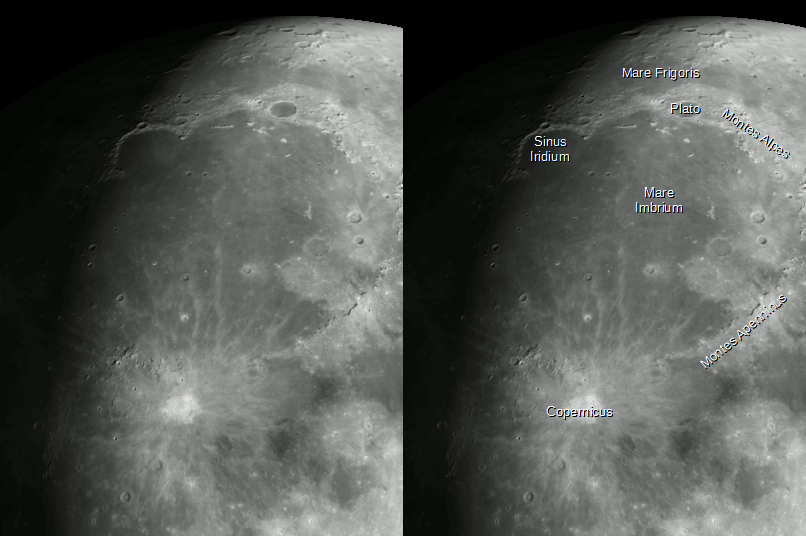
Northern gibbous Moon terminator area with labels for some prominent features. Created using Virtual Moon Atlas, LibreOffice and GIMP.
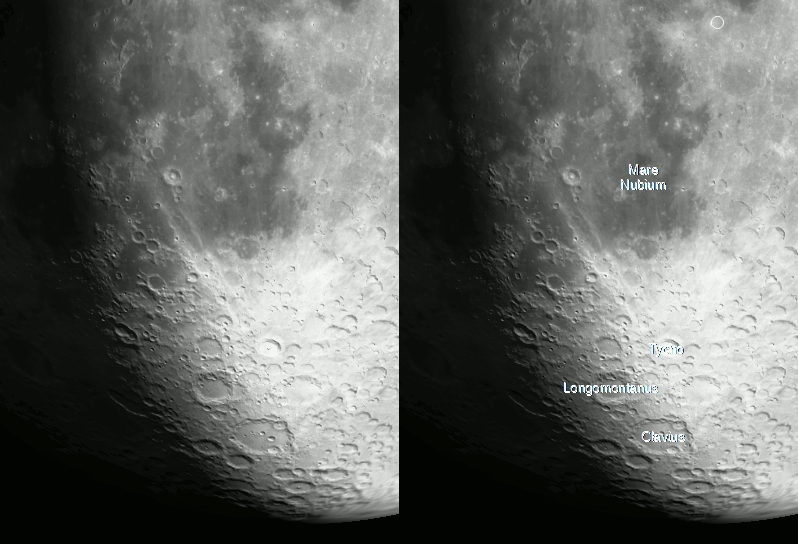
Southern gibbous Moon terminator area with labels for some prominent features. Created using Virtual Moon Atlas, LibreOffice and GIMP.
Translations
Mare Frigoris – Sea of Cold
Mare Imbrium – Sea of Showers
Mare Nubium – Sea of Clouds
Montes Alpes – Alps Mountains
Montes Appinenninus – Apennines Mountains
Sinus Iridium – Bay of Rainbows
03/11/2014 – Ephemeris – Observing the moon tonight: Bay of Rainbows and more
Ephemeris for Tuesday, March 11th. The sun will rise at 8:02. It’ll be up for 11 hours and 41 minutes, setting at 7:43. The moon, 4 days past first quarter, will set at 5:39 tomorrow morning.
The moon tonight is a pretty fat gibbous shape, with the sunrise line or terminator revealing the Bay of Rainbows, Sinus Iridium, that large half crater at the moon’s upper left edge, and the edge of the Sea of Showers, Mare Imbrium. In the figure of the man in the moon Imbrium is his big eye, kind of like the cartoon “Bill the Cat”. To the right of it, looking like a hole in a mountain chain, is Plato, whose dark floor is unmistakable even at full moon, when shadows are absent. The crater Copernicus is now beginning to be washed out as the morning shadows shrink. To the left of Copernicus, just catching the sun’s rays on the terminator, is the smaller crater Kepler. When the moon is full Kepler will show a fine ray system.
Times are for the Traverse City/Interlochen area of Michigan. They may be different for your location.
Addendum
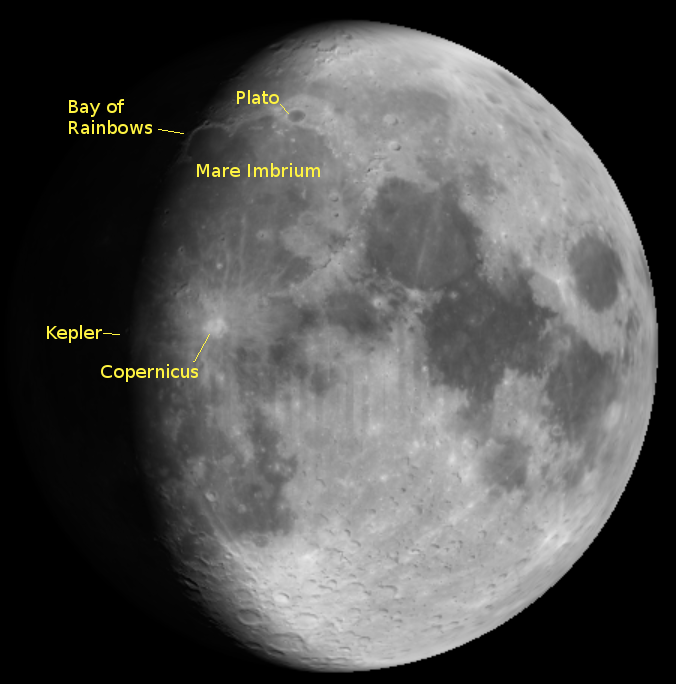
The Moon at 10 p.m. on March 11, 2014. Created using Virtual Moon Atlas.
Note for those not in the Eastern Daylight time zone. 10 p.m. is 2 hours March 12, 2014. If viewing before that time the terminator will be shifted to the right. After the terminator will be shifted to the left.
02/11/2014 – Ephemeris – The brightest spot on the moon is visible tonight
Ephemeris for Tuesday, February 11th. The sun will rise at 7:48. It’ll be up for 10 hours and 17 minutes, setting at 6:05. The Moon, 3 days before full, will set at 6:06 tomorrow morning.
The moon tonight is very bright. It will be full on Friday. Using binoculars the brightest object on the moon is a spot at the left edge of the moon that rotates to the upper left as the moon rises. It is the young crater Aristarchus. The age is less than 1.1 billion years. How much younger is unknown. It’s in the same age range as Copernicus to the lower right of it with the big round splash marks. In a telescope Aristarchus is a crater 24 miles (40 kilometers) in diameter. Generally, the fresher the crater the brighter it is. The Lunar Reconnaissance Orbiter has been in orbit of the moon for nearly four years. In that time it has discovered small craters that were formed after it arrived in orbit. The initial impacts drill into the moon’s lighter subsurface.
Times are for the Traverse City/Interlochen area of Michigan. They may be different for your location.
Addendum
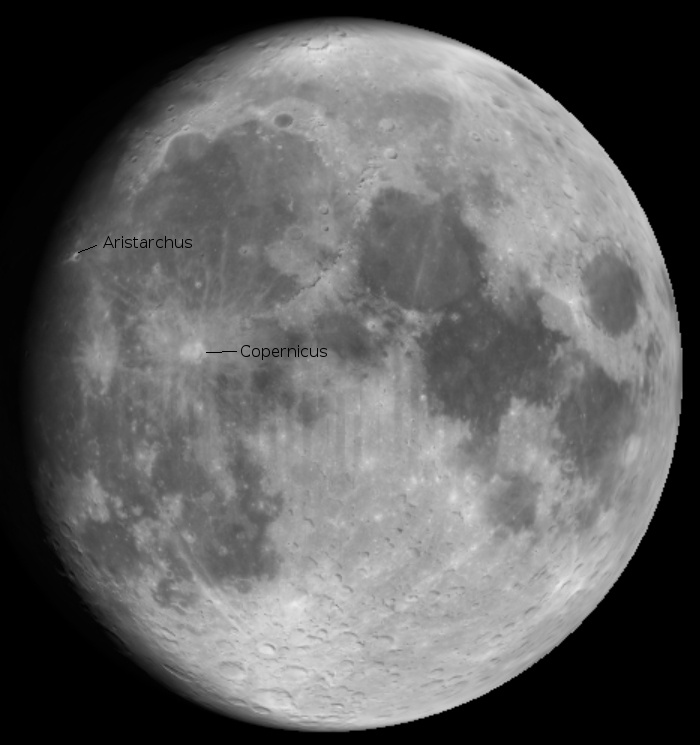
The Moon at 9 p.m. February 11, 2014 showing the craters Aristarchus and Copernicus. Created using Virtual Moon Atlas.
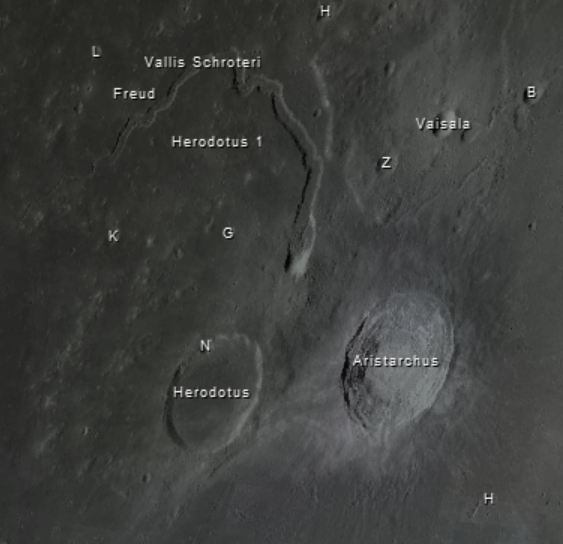
The crater Aristarchus and its environs via the Lunar Reconnaissance Orbiter as a texture in the Virtual Moon Atlas. Credit NASA.
Note the valley that borders Aristarchus, Vallis Schroteri, or Schroter’s Valley. It’s head is called the Cobra’s Head. It is up to a kilometer or 3,000 feet deep.
06/10/11 – Ephemeris – The moon tonight
Friday, June 10th. Today the sun will be up for 15 hours and 29 minutes, setting at 9:26. The moon, 2 days past first quarter, will set at 2:40 tomorrow morning. Tomorrow the sun will rise at 5:57.
Tonight the moon is in its gibbous phase. Gibbous means hump backed. One crater that came into light in the last 24 hours is the crater Copernicus, named for the Polish astronomer and cleric who removed the earth from the center of the universe. The crater Copernicus is on the center left on the moon. Its halo of rays will show up better when the moon is full, but now the crater itself can be appreciated. In a telescope its is quite a sight. It has a complex triple central peak, and terraced walls. The small asteroid that hit it less than a billion years ago, struck the moon, gouging out the 56 mile diameter crater we see today. Rebound created the central peaks. An oblique image of it by a Lunar Orbiter in the late 60s was a famous picture of the time.
* Times are for the Traverse City/Interlochen area of Michigan. They may be different for your location.
05/12/11 – Ephemeris – Lunar telescopic wonders: Bay of Rainbows and the crater Copernicus
Thursday, May 12th. Today the sun will be up for 14 hours and 41 minutes, setting at 8:59. The moon, 2 days past first quarter, will set at 3:40 tomorrow morning. Tomorrow the sun will rise at 6:17.
Tonight the moon will again show a hook out into the darkness at the upper left edge of the moon for observers using binoculars or a telescope. That’s the Jura mountains cupping the Bay of Rainbows, a rather gray lava expanse on the edge of the Sea of Showers. At the other edge of the that sea is the great crater Copernicus, center left on the moon. Its halo of rays will show up better when the moon is full, but now the crater itself can be appreciated. In a telescope its is quite a sight. It has a complex triple central peak, and terraced walls. The small asteroid that hit it less than a billion years ago, struck the moon, gouging out the 56 mile diameter crater we see today. Rebound created the central peaks.
* Times are for the Traverse City/Interlochen area of Michigan. They may be different for your location.
Addendum
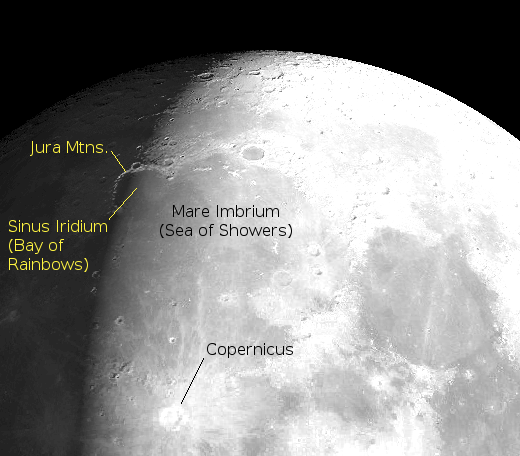
Bay of Rainbows and the crater Copernicus. Created using Virtual Moon Atlas.
I have more on Sinus Iridium and the Jura Mountains back in March.
 Bob Moler's Ephemeris Blog