Archive
03/10/2022 – Ephemeris – Viewing the Moon at first quarter tonight
This is Ephemeris for Thursday, March 10th. Today the Sun will be up for 11 hours and 38 minutes, setting at 6:42, and it will rise tomorrow at 7:02. The Moon, at first quarter today, will set at 3:26 tomorrow morning.
By the time we spot the moon this evening, it will be over half a day from being exactly first quarter phase. Looking at the brighter part of the Moon in binoculars, which is at the bottom or south end. We are looking at the lunar highlands of mostly very old craters that extend back to the formation of the Moon, nearly 4.5 billion years ago, that weren’t obliterated by the asteroid strikes that created the darker maria or lunar seas half a billion years later. In small telescopes there is a vertical line of three large craters whose names, from largest to smallest and top down, are Ptolemaeus, Alphonsus, and Arzachel. Alphonsus is a curious crater. In 1958 a Soviet astronomer recorded a possible volcanic eruption or outgassing from the crater floor.
The astronomical event times given are for the Traverse City/Interlochen area of Michigan (EST, UT – 5 hours). They may be different for your location.
Addendum
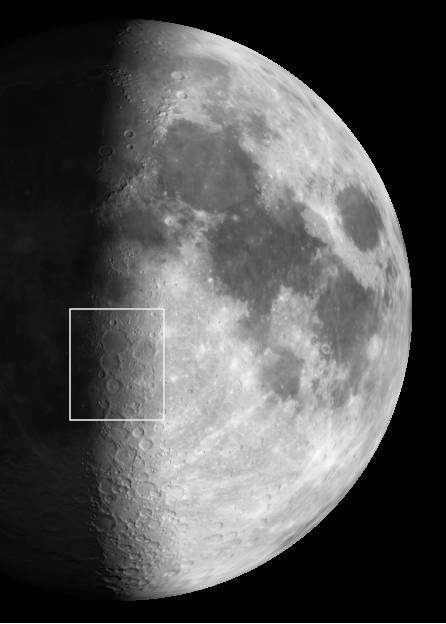
Lunar craters Ptolemaeus, Alphonsus and Arzachel outlined on the Moon’s disk, at first quarter, at 8 pm, March 10, 2022. Created using Virtual Moon Atlas.
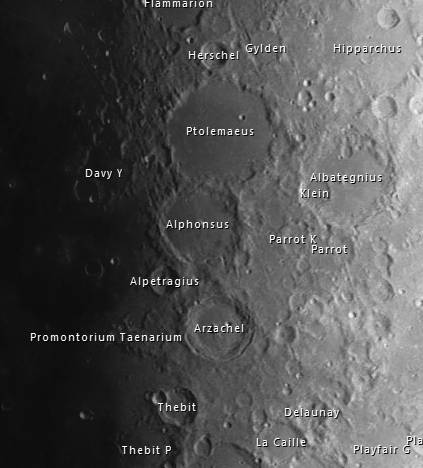
Closeup of lunar craters Ptolemaeus, Alphonsus and Arzachel, with other nearby craters, outlined above. Created using Virtual Moon Atlas.
04/07/2014 – Ephemeris – Why does the Moon have all those craters?
Ephemeris for Monday, April 7th. The sun will rise at 7:12. It’ll be up for 13 hours and 4 minutes, setting at 8:17. The Moon, at first quarter today, will set at 3:37 tomorrow morning.
Today the Moon is at first quarter. That moment in time actually occurred a couple of hours ago, so by tonight the Moon’s terminator, the sunrise line on the Moon will be slightly bowed to be a slight gibbous phase. With binoculars or small telescope it’s a fine time to spot craters and mountains near that terminator where the shadows are longest. On the Earth mountains are thrown up by the collision of tectonic plates or volcanoes. There are no tectonic plates as such on the Moon. Mountains that we recognize are the walls of the seas, which are really vast craters caused for the most part by collisions with small asteroids. The reason the Earth doesn’t carry those scars is that the Earth erodes and recycles its surface.
Times are for the Traverse City/Interlochen area of Michigan. They may be different for your location.
Addendum
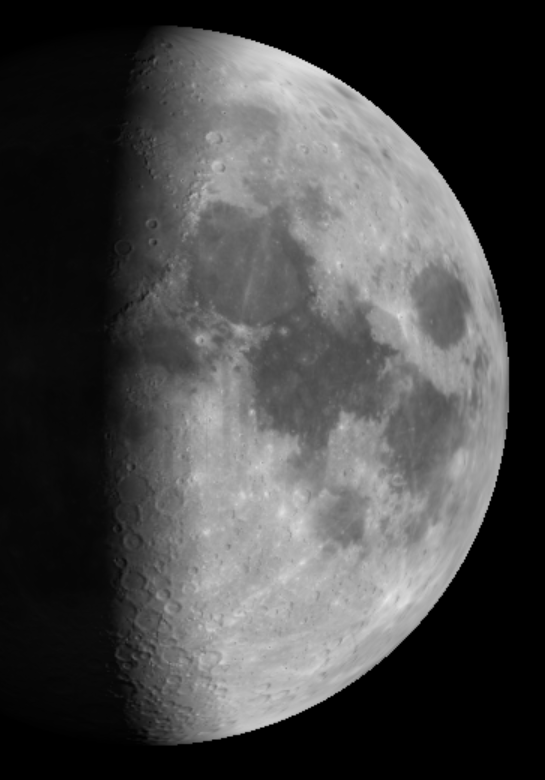
The Moon tonight (10 p.m. April 7, 2014). Created using Virtual Moon Atlas.
 Bob Moler's Ephemeris Blog