Archive
Ephemeris: 02/02/2024 – It’s Groundhog Day!
This is Bob Moler with Ephemeris for Groundhog Day, Friday, February 2nd. Today the Sun will be up for 9 hours and 51 minutes, setting at 5:52, and it will rise tomorrow at 8:00. The Moon, at last quarter today, will rise at 2:11 tomorrow morning.
I’m not sure if Punxsutawney Phil will see his shadow this morning or not, but February 2nd was a special day to the ancients. It is also Candlemas day for the Catholic Church, and it is celebrated as a cross-quarter day, the middle of the season of winter, though the exact date of the middle of winter is the 4th. And if Phil sees his shadow, and we do get 6 more weeks of winter, that’s OK too. By the calendar, it’s actually more like 6 ½ weeks to the vernal or spring equinox and the official end of winter. Of the other cross-quarter days, two others stand out. They are May 1st, May Day; and Halloween. The way this year has been going, winter has had a hard time getting started. The temperatures are above normal and the snowfall is below normal. A lot of grass is showing, and the bay isn’t even thinking of freezing over.
The astronomical event times given are for the Traverse City/Interlochen area of Michigan (EST, UT –5 hours). They may be different for your location.
Addendum


01/06/2020 – Ephemeris – The Earth was closest to the Sun in its orbit yesterday
Ephemeris for Monday, January 6th. Today the Sun will be up for 8 hours and 57 minutes, setting at 5:17, and it will rise tomorrow at 8:19. The Moon, half way from first quarter to full, will set at 5:02 tomorrow morning.
Yesterday’s perihelion, or closest point of the Earth to the Sun of roughly 91.4 million miles (147 million km) is only 1.7% closer to the Sun than average. It doesn’t do much to make our winters warmer, but it does make winter the shortest season. That’s because the Earth travels faster when near the Sun than when it’s farther away. Winter lasts only 89 ½ days. The Earth’s aphelion, when it’s farthest from the Sun will be on the 4th of July, in summer, making that the longest season at 93 ½ days. Of course being this far north it feels like winter is longer than summer, but astronomically it’s the other way around. Being a leap year, with February having 29 days, spring will arrive a calendar day early on the 19th of March.
The times given are for the Traverse City/Interlochen area of Michigan. They may be different for your location.
Addendum
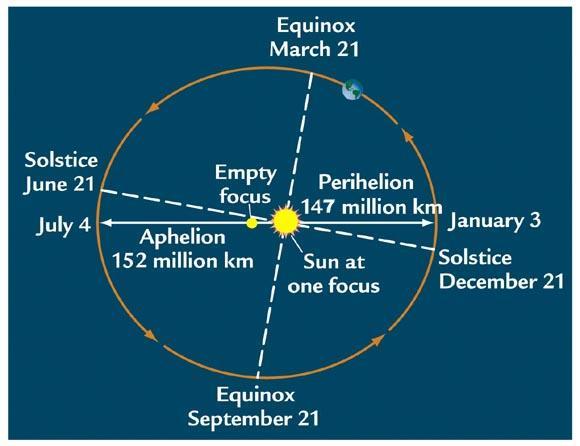
The Earth’s orbit, somewhat exaggerated, showing perihelion and the seasons. Credit “Starts with a Bang” blog by Ethan Siegel.

The Seasons for 2020 from data in Astronomical Tables of the Sun, Moon, and Planets Third Edition by Jean Meeus. Date and times are in TD, Dynamical Time. Subtract about 1 minutes to convert to Universal Time (UT). Also subtract 5 hours for Eastern Standard Time and 4 hours for Eastern Daylight Time.
For and explanation of the Cross-Quarter Days column, check out my Ground Hog Day post last year: https://bobmoler.wordpress.com/2019/02/02/02-02-2019-ephemeris-extra-groundhog-day-and-other-seasonal-days/
 Bob Moler's Ephemeris Blog