Archive
Ephemeris: 06/13/2024 – The Apollo 11 flag
This is Ephemeris for Thursday, June 13th. Today the Sun will be up for 15 hours and 32 minutes, setting at 9:29, and it will rise tomorrow at 5:56. The Moon, 1 day before first quarter, will set at 2:06 tomorrow morning.
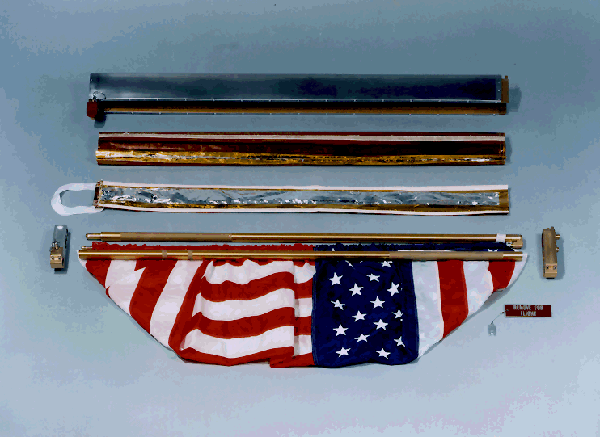
Tomorrow is Flag Day. That got me to thinking about the flags that the Apollo astronauts planted on the Moon and what state they are in. We know the Apollo 11 flag was blown down by the blast of the ascent stage engine when they left the Moon because it was planted too close to the lunar module. The other five flags are still standing. However, there’s some speculation as to what color they are. Are the colors bleached out by the ultraviolet of the sun’s light, which is unimpeded on the Moon? The flags may be bleached completely white. There was nothing really special about the flags that NASA used for the Apollo mission so they weren’t especially prepared to withstand the rigors of being out and undiluted sunlight.
The astronomical event times given are for the Traverse City/Interlochen area of Michigan (EDT, UT–4 hours). They may be different for your location.
Addendum

06/14/2012 – Ephemeris – Flag Day: Red, White and Blue Stars
Ephemeris for Flag Day, Thursday, June 14th. Today the sun will be up for 15 hours and 32 minutes, setting at 9:29. The moon, 3 days past last quarter, will rise at 3:16 tomorrow morning. Tomorrow the sun will rise at 5:56.
Since it’s Flag Day, lets look for some red white and blue stars. Red is easy, I talked about it Tuesday, It is Antares now low in the southeast in the evening in the heart of the constellation of Scorpius the scorpion. For the white star there is no purer white star than Vega, spectral type A0 (A zero), the astronomers definition of white. It is located midway up the sky in the east. It is the 5th brightest night time star, and is seen off a small parallelogram of stars that make up the body of Lyra the harp. For the blue star, the best is Spica, below Saturn this year and in the south in the evening. It is the bluest of the 21 brightest first magnitude stars. Color in stars is often subtle, so try to see these colors.
Times are for the Traverse City/Interlochen area of Michigan. They may be different for your location.
Addendum
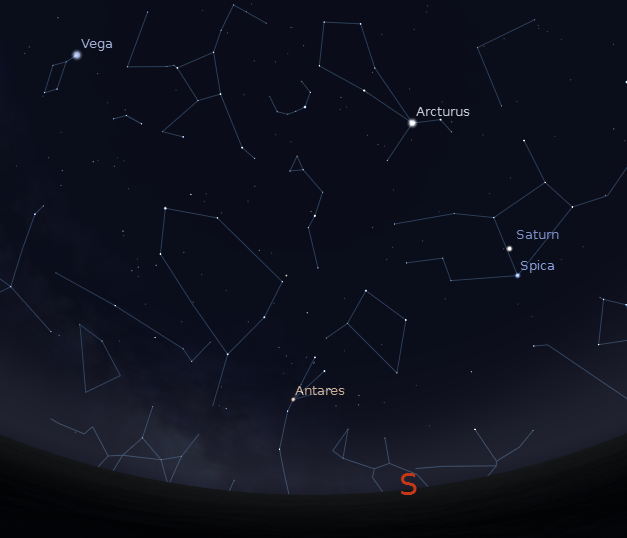
Red (Antares), White (Vega) and Blue (Spica) stars of spring. Created using Stellarium.
 Bob Moler's Ephemeris Blog