Archive
11/18/2022 – Ephemeris – Fomalhaut’s disappearing “planet”
This is Ephemeris for Friday, November 18th. Today the Sun will be up for 9 hours and 27 minutes, setting at 5:11, and it will rise tomorrow at 7:45. The Moon, 2 days past last quarter, will rise at 2:32 tomorrow morning.
The lonely bright star low in the south at 8 p.m. these evenings is Fomalhaut, the harbinger of autumn in my book, and about to leave as winter approaches. Fomalhaut is a young white star only about 400 million years old with a disk of dust surrounding it. Near an outer dust ring, in 2008 the Hubble Space Telescope discovered a spot. Four years later, astronomers discovered that the spot had moved along the dust lane and announced the first direct discovery of an exoplanet. In 2010 and 2012 the planet now dubbed Fomalhaut b or Dagon was observed again. However, it appears to be dissipating. It might be an expanding cloud of debris that’s the result of two asteroids colliding. We’ll keep watching.
The astronomical event times given are for the Traverse City/Interlochen area of Michigan (EST, UT -5 hours). They may be different for your location.
Addendum
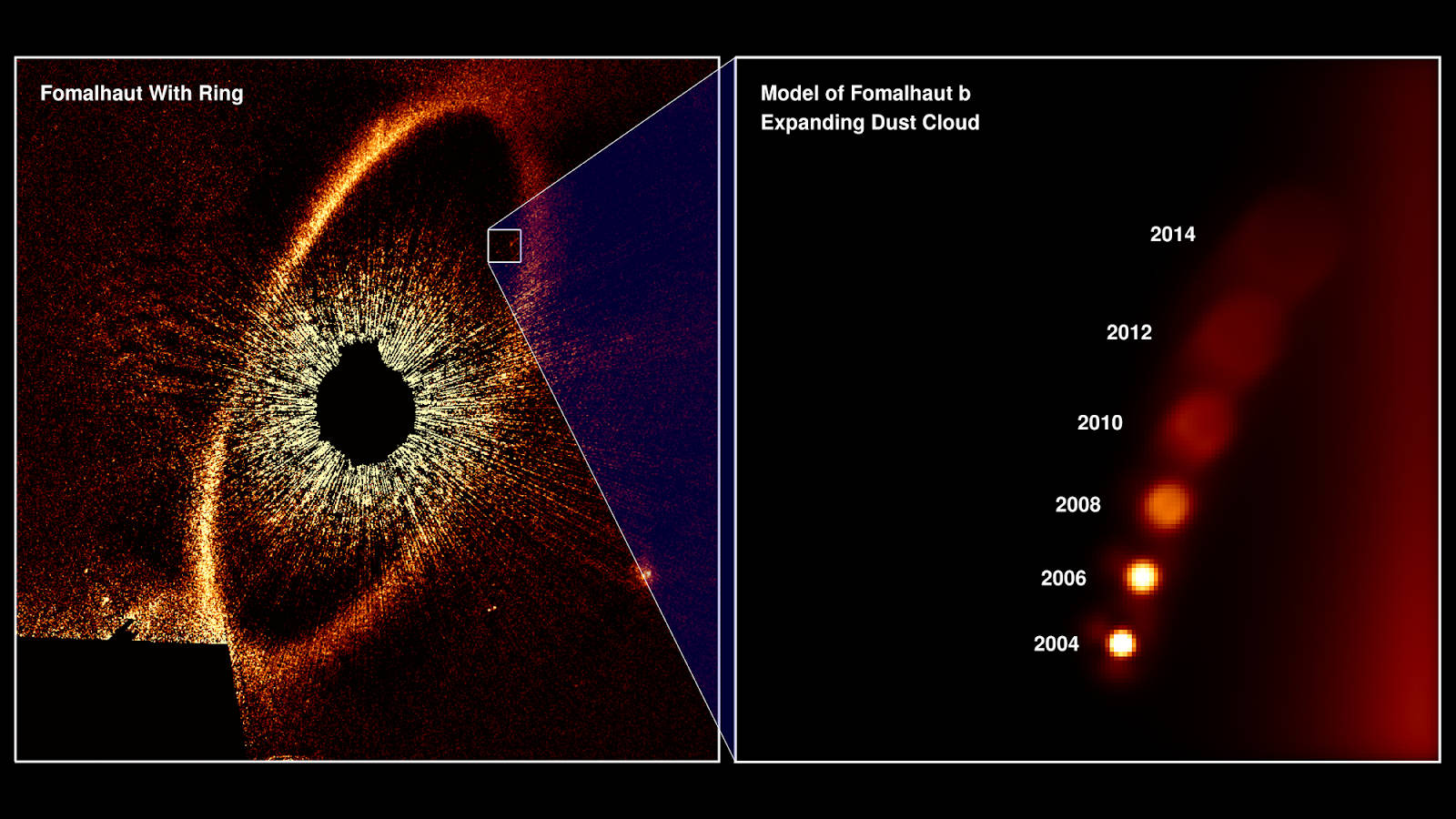
Hubble Space Telescope image of Fomalhaut’s ring and model of the disappearing dust cloud that was first thought to be a planet. Credit: Space Telescope Science Institute.
11/25/2019 – Ephemeris – Fomalhaut has a visible exoplanet
Ephemeris for Monday, November 25th. Today the Sun will be up for 9 hours and 14 minutes, setting at 5:06, and it will rise tomorrow at 7:53. The Moon, 1 day before new, will rise at 7:41 tomorrow morning.
The lonely bright star low in the south at 8 p.m. these evenings is Fomalhaut the harbinger of autumn in my book, and about to leave as winter approaches. Fomalhaut means fishes mouth and is located at the head of Piscis Austrinus, a very dim constellation. Fomalhaut is a young white star only about 400 million years old with a disk of dust surrounding it. Near an outer dust ring, 15 years ago the Hubble Space Telescope discovered a spot. Four years later astronomers discovered that the spot moved along the dust lane and announced the first direct discovery of an exoplanet. In 2010 and 2012 the planet now dubbed Fomalhaut b or Dagon was observed again and it really does orbit Fomalhaut in a very eccentric orbit.
The times given are for the Traverse City/Interlochen area of Michigan. They may be different for your location.
Addendum
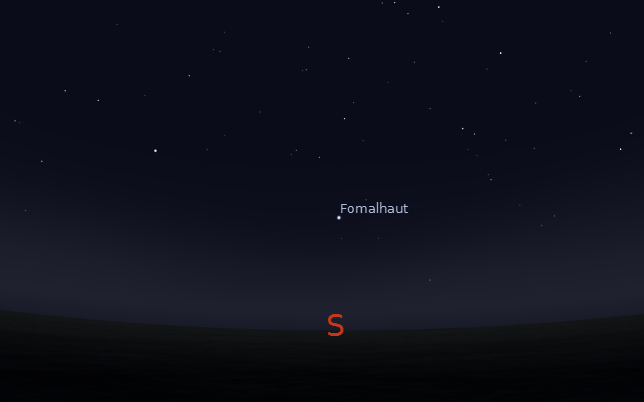
Fomalhaut in the south at 8 p.m. in November. Created using Stellarium.

The track of observations of Fomalhaut b or Dagon in 2004, 2006, 2010 and 2012. Credit: NASA and ESA – http://www.nasa.gov/images/content/717874main_p1301aw-orig_full.jpg, Public Domain, https://commons.wikimedia.org/w/index.php?curid=23735991
11/24/2017 – Ephemeris – Fomalhaut, the loneliest star, has a little buddy
Ephemeris for Friday, November 24th. The Sun will rise at 7:51. It’ll be up for 9 hours and 15 minutes, setting at 5:07. The Moon, 2 days before first quarter, will set at 10:30 this evening.
The lonely bright star low in the south at 8 p.m. these evenings is Fomalhaut the harbinger of autumn in my book, and about to leave as winter approaches. Fomalhaut means fishes mouth and is located at the head of Piscis Austrinus, a very dim constellation. Fomalhaut is a young white star only about 400 million years old with a disk of dust surrounding it. Near an outer dust ring, 15 years ago the Hubble Space Telescope discovered a spot. Four years later astronomers discovered that the spot moved along the dust lane and announced the first direct discovery of an exoplanet. In 2010 and 2012 the planet now dubbed Fomalhaut b or Dagon was observed again and it really does orbit Fomalhaut in a very eccentric orbit.
The times given are for the Traverse City/Interlochen area of Michigan. They may be different for your location.
Addendum
Fomalhaut in the south at 8 p.m. on November evenings. Created using Stellarium.
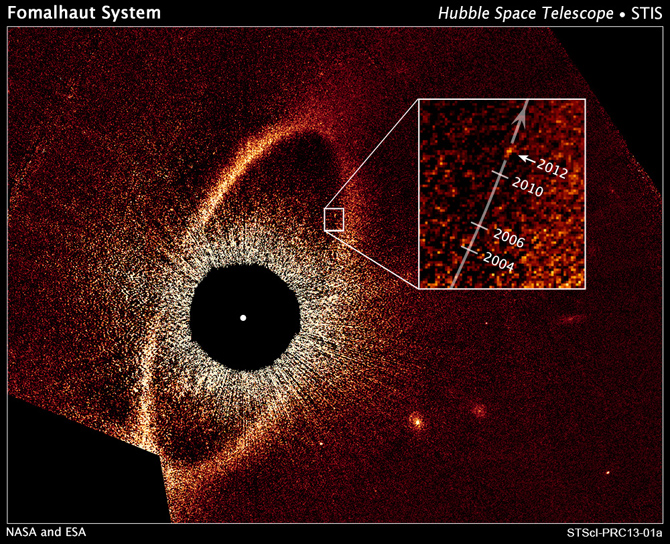
Fomalhaut b and it’s path around its star. Credit: NASA, ESA, and P. Kalas (University of California, Berkeley and SETI Institute)
10/05/2015 – Ephemeris – The loneliest star
Ephemeris for Monday, October 5th. The Sun will rise at 7:45. It’ll be up for 11 hours and 31 minutes, setting at 7:16. The Moon, 1 day past last quarter, will rise at 1:38 tomorrow morning.
There’s a bright and lonely star that appears low in the south for only seven and a half hours a night on autumn evenings. It’s appearance is a sign as sure as the falling leaves that autumn is here At 10 p.m. tonight it’s low in the south-southeast. The star’s name is Fomalhaut, which means fish’s mouth. This is appropriate because it’s in the constellation of Piscis Austrinus, the southern fish. At our latitude it’s the fish that got away, because Fomalhaut appears to be quite alone. The dimness of the constellation’s other stars and location close to the horizon make the fainter stars hard to spot. The earth’s thick atmosphere near the horizon reduces the stars brightness by a factor of two or more, so Fomalhaut appears to keep a lonely vigil in the south.
Times are for the Traverse City/Interlochen area of Michigan. They may be different for your location.
Addendum
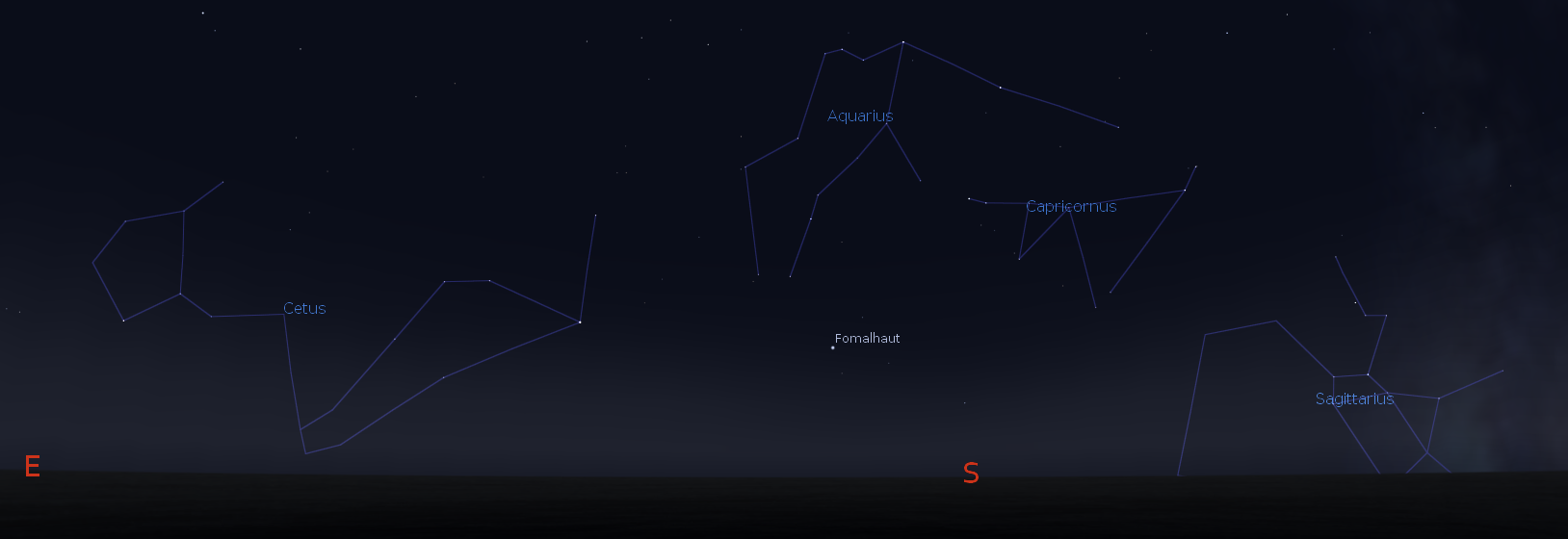
Fomalhaut appears quite alone in the south-southeast at about 10 p.m. Created using Stellarium.
Actually Fomalhaut isn’t all that alone, It apparently has a companion planet.
Fomalhaut b and it’s path around its star. Credit: NASA, ESA, and P. Kalas (University of California, Berkeley and SETI Institute)
11/15/2012 – Ephemeris – Fomalhaut the lonely star has a companion planet
Ephemeris for Thursday, November 15th. The sun will rise at 7:39. It’ll be up for 9 hours and 34 minutes, setting at 5:14. The moon, 2 days past new, will set at 7:03 this evening.
The lonely bright star low in the south at 8 p.m. these evenings is Fomalhaut the harbinger of autumn in my book. Fomalhaut means fishes mouth and is located at the head of Piscis Austrinus, a very dim constellation. Fomalhaut is a young white star only 400 million years old with a disk of dust surrounding it. In an outer dust ring, 10 years ago the Hubble Space Telescope discovered a spot. Four years later astronomers discovered that the spot moved along the dust lane and announced the first direct discovery of an exoplanet. There’s been some controversy ever since, about is it really a planet or just a clump of material. It seems at this time that there is a planet there but it is shrouded by a cloud of dust, so that the planet cannot be detected.
Times are for the Traverse City/Interlochen area of Michigan. They may be different for your location.
Addendum
Fomalhaut in the south at 8 p.m. on November 15, 2012. Created using Stellarium.
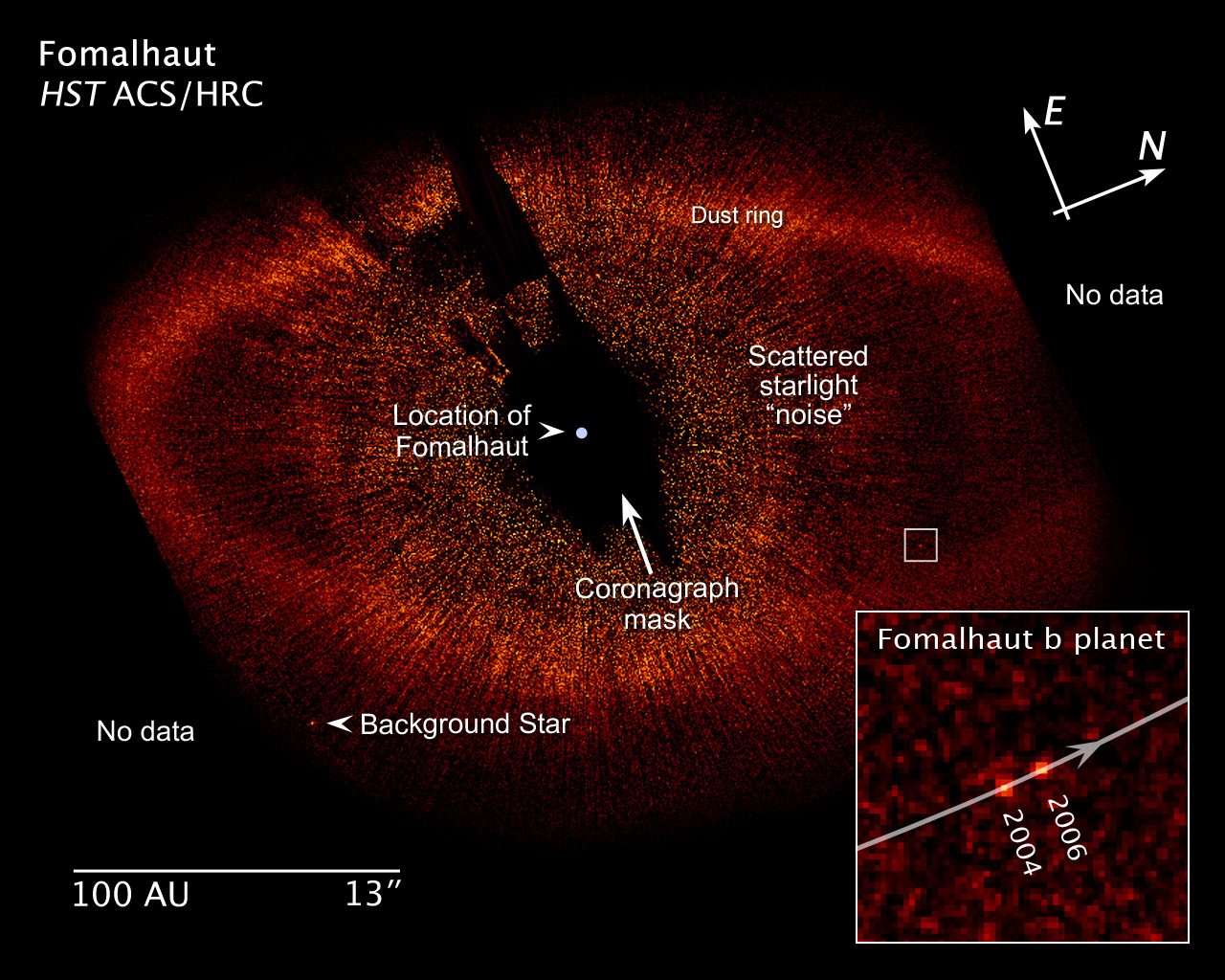
Fomalhaut and possible planet via the Hubble Space Telescope. Courtesy NASA
Click on above image to enlarge.
 Bob Moler's Ephemeris Blog
