Archive
Ephemeris: 12/10/2024 – Jupiter’s four bright moons
This is Ephemeris for Tuesday, December 10th. Today the Sun will be up for 8 hours and 52 minutes, setting at 5:02, and it will rise tomorrow at 8:10. The Moon, 2 days past first quarter, will set at 3:39 tomorrow morning.
The bright star like object in the east in the evenings is the planet Jupiter. If one were to look at Jupiter through binoculars it would appear somewhat larger than a star would look. It has several dimmer stars from one side to the other of it, and if one looked the next night those little stars would have moved. Those are not stars at all, but the four largest moons of Jupiter. This would be easily apparent in the telescope. These are the four Galilean moons. They were observed by Galileo in either late 1609 or early 1610. Another astronomer, Simon Marius discovered these moons at about the same time, but Galileo was first to publish. So he gets the honor. However, Simon Marius is the one who gave them the names we know them by today. Their names, in order of their distance from Jupiter, are: Io, Europa, Ganymede, and Callisto. Each is a fascinating world in its own right.
The astronomical event times given are for the Traverse City/Interlochen area of Michigan (EST, UT – 5 hours). Times will be different for other locations.
Addendum
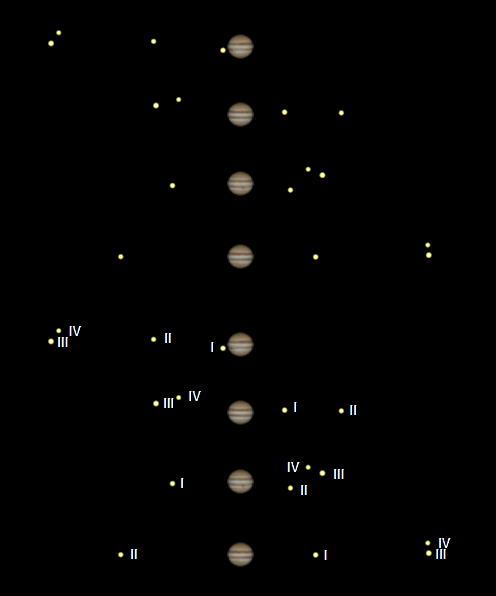
The periods of these satellites is interesting. Io orbits Jupiter in 1.8 days. Europa orbits in 3.6 days twice as long as Io. Ganymede orbits Jupiter in 7.2 days which is twice as long as Europa. Callisto takes 16.7 days to orbit Jupiter, and that is longer than twice Ganymede’s orbital period, and so is not in resonance with Ganymede. So the first three are in a 2:1orbital resonance with each other.
Ephemeris: 11/05/2024 – Bright Jupiter is now seen earlier in the evening
This is Ephemeris for Election Day, Tuesday, November 5th. Today the Sun will be up for 9 hours and 58 minutes, setting at 5:25, and it will rise tomorrow at 7:28. The Moon, 4 days before first quarter, will set at 7:51 this evening.
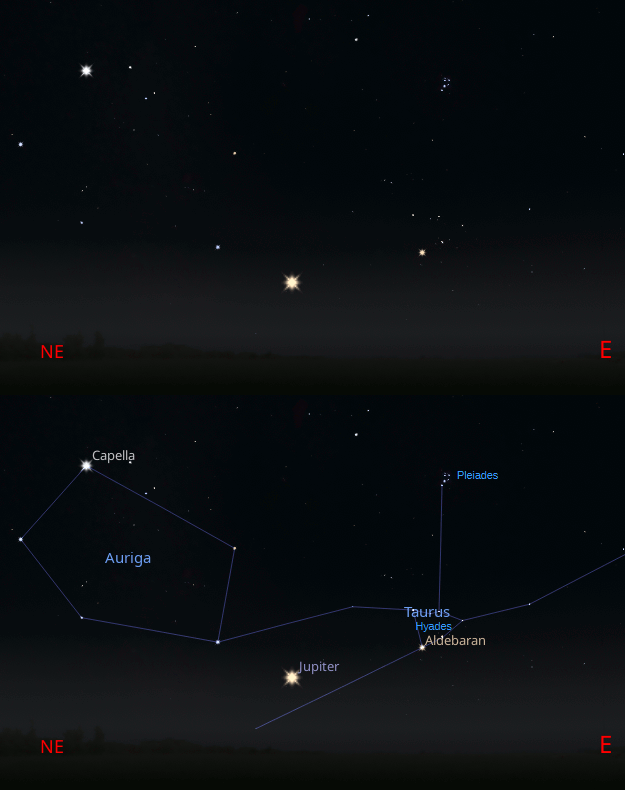
There’s a bright star in the east these evenings. It is extremely bright. If Venus wasn’t around in the evening in the southwest, one might mistake it for Venus. Well this bright star is not a star at all, but the planet Jupiter. Jupiter is the solar system’s largest planet. It is by and large the easiest planet to observe with a small telescope, which will also reveal four of its many moons, which I think is approaching 100 now. (It’s hard to keep track of them.) These four moons were the same ones discovered by Galileo over 400 years ago. Jupiter’s moons move quite rapidly compared to the Earth’s moon. From night to night Jupiter’s moons shift around. Their motions can also be detected over the period of an evening, or night.
The astronomical event times given are for the Traverse City/Interlochen area of Michigan (EST, UT – 5 hours). Times will be different for other locations.
Addendum
08/19/2021 – Ephemeris – Jupiter is at opposition today!
This is Ephemeris for Thursday, August 19th. Today the Sun will be up for 13 hours and 51 minutes, setting at 8:41, and it will rise tomorrow at 6:51. The Moon, 3 days before full, will set at 4:11 tomorrow morning.
Tonight, Jupiter will be at opposition. That’s a shortcut term for Jupiter being opposite the Sun in our sky. At that time, Jupiter rises at sunset and sets at sunrise. It is also at its closest to us. It also officially becomes an evening planet, available in the evening for those of us with daytime jobs. In even small telescopes, Jupiter shows two dark bands. There’s more, but those two are the most prominent. Its four largest moons will be visible before 9:50 pm tonight, after that the innermost of the four, Io, will start to cross the face of Jupiter. It will leave Ganymede on Jupiter’s east side. On the west side will be the moon Europa, and farther out, Callisto. At 12:08 am, Io will reappear on the west side of Jupiter, joining Europa and Callisto. The moons do put on a show.
The astronomical event times given are for the Traverse City/Interlochen area of Michigan (EDT, UT – 4 hr). They may be different for your location.
Addendum
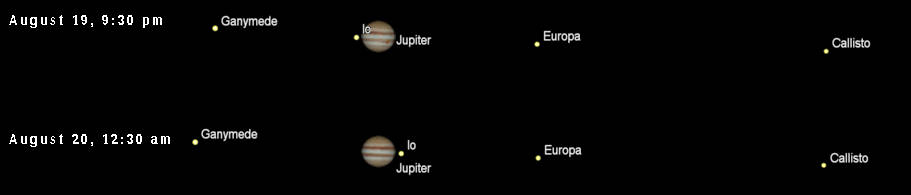
Jupiter’s Galilean moons at two times tonight, August 19th at 9:30 pm (01:30 on the 20th, UT) and 12:30 am (04:30 UT). From 9:50 pm to 12:08 am (01:50 – 04:08 UT), Io will pass in front of Jupiter and be practically invisible. Click on the image to enlarge it. Created using Cartes du Ciel (Sky Charts).
08/04/2020 – Ephemeris – Viewing Jupiter and its moons with binoculars or small telescope
This is Ephemeris for Tuesday, August 4th. Today the Sun will be up for 14 hours and 30 minutes, setting at 9:03, and it will rise tomorrow at 6:34. The Moon, 1 day past full, will rise at 10:06 this evening.
The planet Jupiter is a fine object to view with just about any optical aid be it a pair of binoculars, spotting scope or telescope. In binoculars, if held steady or mounted on a tripod Jupiter itself will no longer look star-like, but a tiny disk. Several of Jupiter’s moons can also be seen. With a telescope four of them can be seen, the same four Galileo discovered 410 years ago. At 10 pm they will be in the same order of distance from the planet that they actually are. The two nearest will be on the west side of the planet Io the closest, the Europa the next moon out. On the east side there is the third farthest Ganymede, and farthest out is Callisto. Their orbits are nearly edge on to us, so they shuttle from one side to the other of the planet.
The event times given are for the Traverse City/Interlochen area of Michigan. They may be different for your location.
Addendum
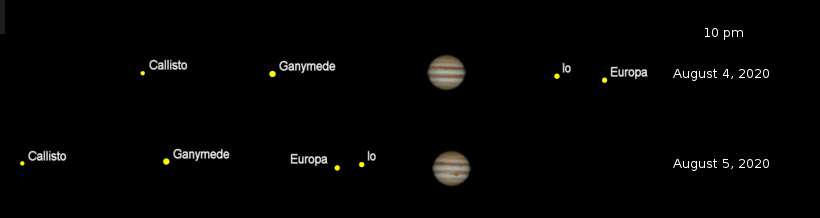
Jupiter and its Galilean moons for tonight and tomorrow night August 4 & 5, 2020. Those moons really move from night to night. This is shown north at the top, east to the left. Based on telescope design the image presented could be inverted, mirror image or both. Created using Cartes du Ciel (Sky Charts).
Due to the lack of time (59 seconds) I could only cover the moons. I’ll address Jupiter’s cloud features at another time. Can’t wait? Here’s a link: https://bobmoler.wordpress.com/2018/05/22/05-22-2018-ephemeris-seeing-detail-on-the-face-of-jupiter-with-a-small-telescope/
05/21/2018 – Ephemeris – 408 years ago Galileo discovered that Jupiter had moons
Ephemeris for Monday, May 21st. Today the Sun will be up for 15 hours and 2 minutes, setting at 9:10, and it will rise tomorrow at 6:07. The Moon, at first quarter today, will set at 2:55 tomorrow morning.
Jupiter is the bright star-like object in the southeast in the evening. In telescopes and even in binoculars the observer can spot up to four stars nearby. These aren’t stars, but moons or satellites of Jupiter. Galileo discovered them 408 years ago with his small telescope. Jupiter has 69 satellites in all at last count, but the rest are tiny objects. Of the four ‘Galilean’ satellites all but one is larger than the Moon. They are, in order from Jupiter Io, a volcano riddled world which is constantly resurfacing itself. Next is Europa an icy moon with a good probability of a salty ocean beneath. Giant Ganymede is next, larger than Mercury, it is also icy with the possibility of an ocean. Last is Callisto a dark moon with bright craters.
The times given are for the Traverse City/Interlochen area of Michigan. They may be different for your location.
Addendum
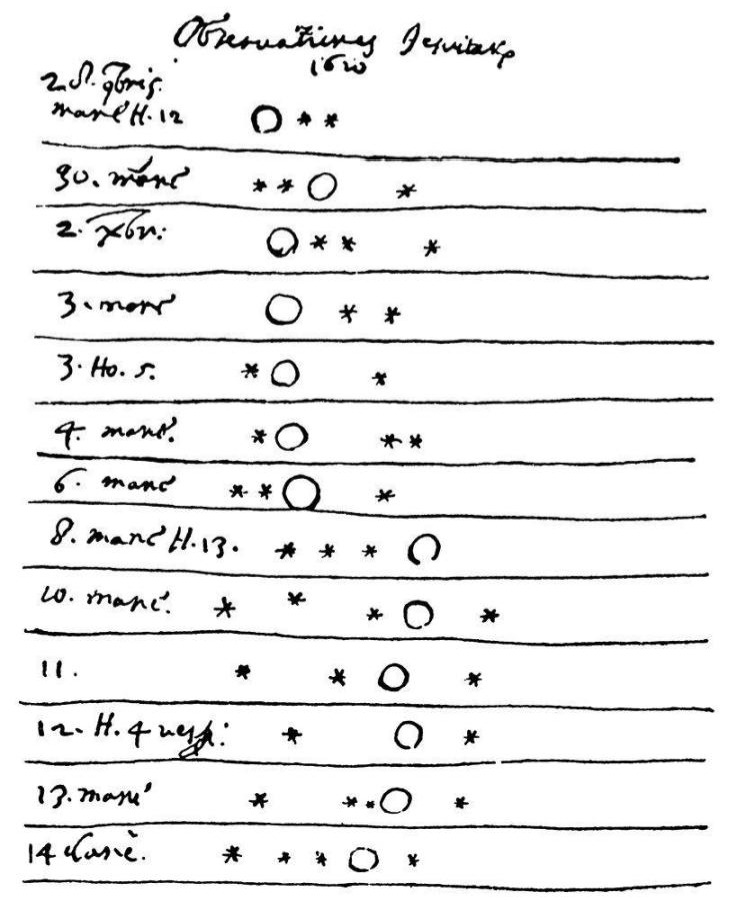
Multiple night sightings of Jupiter’s moons by Galileo.
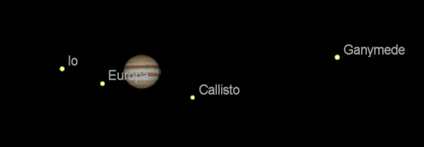
Jupiter and its moons tonight, May 21, 2018. Created using Cartes du Ciel (Sky Charts).
 Bob Moler's Ephemeris Blog