Archive
05/30/2023 – Ephemeris – The Terminator… No, not Arnold Swartzenegger
This is Ephemeris for Tuesday, May 30th. Today the Sun will be up for 15 hours and 17 minutes, setting at 9:19, and it will rise tomorrow at 6:01. The Moon, 3 days past first quarter, will set at 3:59 tomorrow morning.
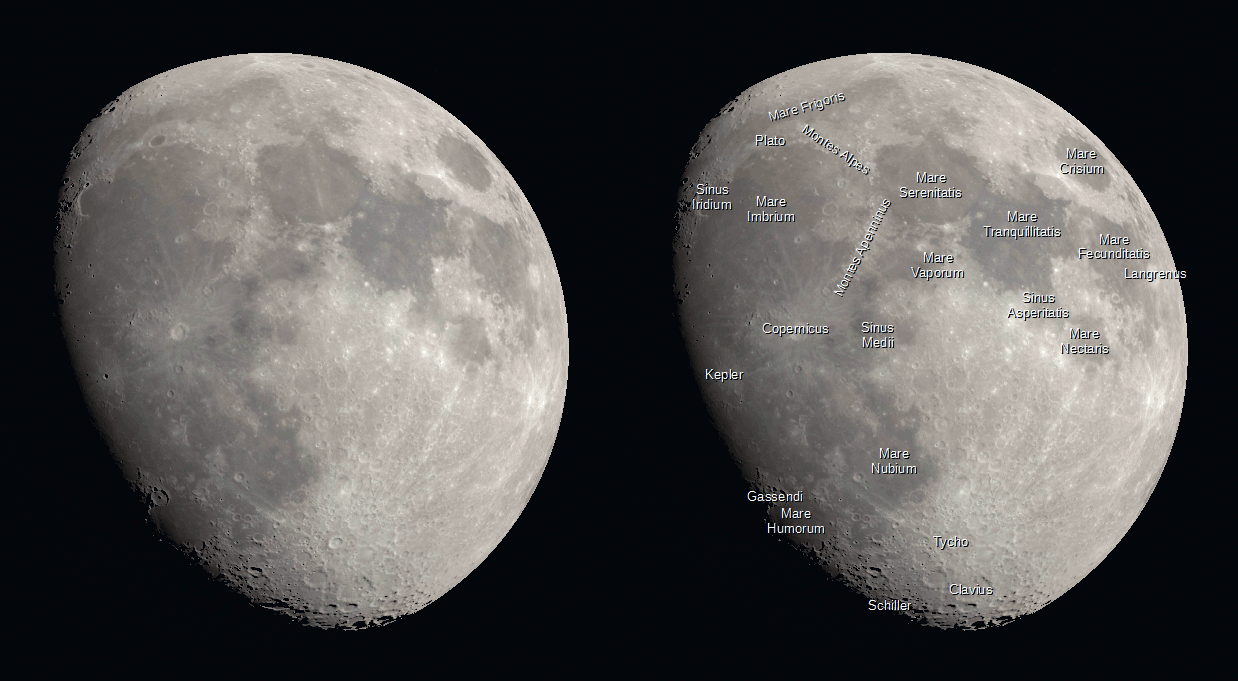
The Moon tonight is getting to be a fatter and fatter gibbous phase, until Saturday, when it will be full. The Moon will be blindingly bright in telescopes of low magnification. As always the case with the Moon, the most detail is seen near the terminator. The terminator, in the case of the waxing moon, is the sunrise line. After full moon, the terminator becomes the sunset line. This is where the shadows are longest, showing the detail of the craters. Farther from the terminator, where the Sun is higher in the Moon’s sky, shadows are short or nonexistent. Giving the surface a flat appearance. Even lacking wind and water, there is still erosion on the Moon, coming from meteoroid and asteroid impacts and their ejecta. And the breakdown of rocks due to the extreme day-night temperature swings.
The astronomical event times given are for the Traverse City/Interlochen area of Michigan (EDT, UT –4 hours). They may be different for your location.
Addendum
10/25/2012 – Ephemeris – Exploring the bright gibbous moon
Ephemeris for Thursday, October 25th. The sun will rise at 8:11. It’ll be up for 10 hours and 29 minutes, setting at 6:40. The moon, half way from first quarter to full, will set at 5:02 tomorrow morning.
The moon tonight is very bright, so looking at it with a telescope can be almost painful. There are moon filters sold at telescope stores for standard sized eyepieces that will alleviate that problem. Remember it’s daytime on the moon and the sunlight is as strong on the moon as it is on the earth. Concentrate the telescope on the left edge of the moon, the sunrise line where the shadows are. The small crater Kepler, named for the astronomer who gave us the laws the govern the motion of the planets is located near the terminator near the moon’s equator. The Crater Gassendi, to the lower left, is a ringed plain with low walls and a flat floor that has a rille or crack in it. Another distinctive crater is Schiller lower to the south and very elongated.
Times are for the Traverse City/Interlochen area of Michigan. They may be different for your location.
Addendum
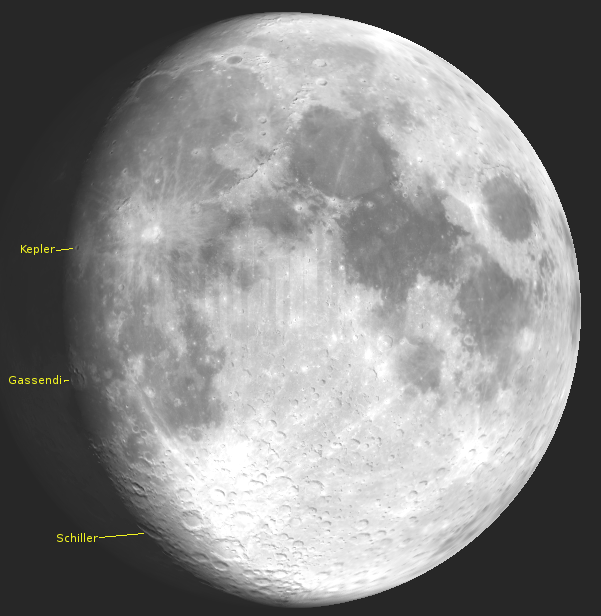
The bright gibbous moon highlighting three craters, Kepler, Gassendi, and Schiller. Created using the Virtual Moon Atlas.
Gassendi is named for Pierre Gassend, 17th French astronomer and pioneer in the use of a refractor telescope. Schiller is named for Julius Schiller a 17th century monk who came out with a Christian themed star atlas. These and other crater facts were obtained for the open source lunar program Virtual Moon Atlas.
 Bob Moler's Ephemeris Blog