Archive
Ephemeris: 07/11/2024 – Low energy routes to get to the Moon
This is Ephemeris for Thursday, July 11th. Today the Sun will be up for 15 hours and 19 minutes, setting at 9:27, and it will rise tomorrow at 6:09. The Moon, 2 days before first quarter, will set at 12:26 tomorrow morning.
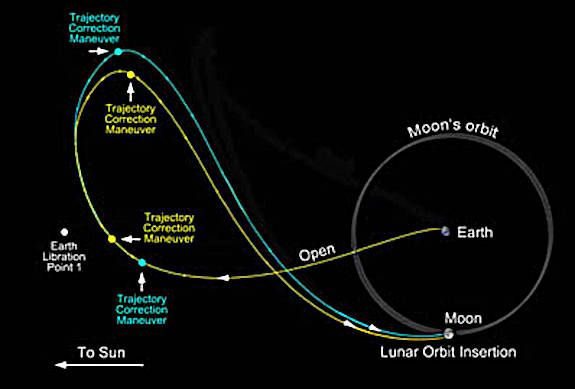
Back in the Apollo days when we sent people to the Moon, the trip out was only three days. The latest generation of unmanned probes to the Moon sent by the United States and other countries can take days, weeks, or even months to reach the Moon, so what’s going on? These are robot probes, needing little power. Humans however are high maintenance. Even when they’re doing nothing they are breathing, eating, and using resources. So when humans are aboard you have got to get there fast. Also, many of these probes are CubeSats, no bigger than a breadbox*. They must get into orbit of the Moon with very little thrust other than that of the rocket that launched them. They can go out as far as a million miles away before falling back to the Moon.
The astronomical event times given are for the Traverse City/Interlochen area of Michigan (EDT, UT–4 hours). They may be different for your location.
* OK, I’m an old guy, the modern size comparison would be a microwave.
Addendum
12/27/2012 – Ephemeris – That was the year that was.
Ephemeris for Thursday, December 27th. The sun will rise at 8:18. It’ll be up for 8 hours and 50 minutes, setting at 5:09. The moon, 1 day before full, will set at 8:10 tomorrow morning.
The end of the year is the perfect time to look back at the astronomical events of the year. There was a partial solar eclipse in May and the rare transit of Venus across the sun in June. You’ll have to wait until 2117 for the next one. In July came news that the Large Hadron Collider had detected something that sure looked like the long sought Higgs Boson. August brought the spectacular landing of the Mars Science laboratory, aka: The Curiosity rover, on Mars to begin an at least one martian year exploration. In September the Dawn spacecraft bid farewell to the asteroid Vesta after a year exploring that remarkable asteroid, cranking up its ion engine for a three year journey to the dwarf planet Ceres. The satellites Ebb and Flow completed their mission to map the moon’s interior.
Times are for the Traverse City/Interlochen area of Michigan. They may be different for your location.
Addendum
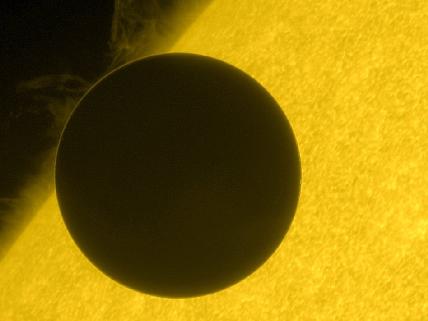
Hinode Views the 2012 Venus Transit. Credit: JAXA/NASA/Lockheed Martin
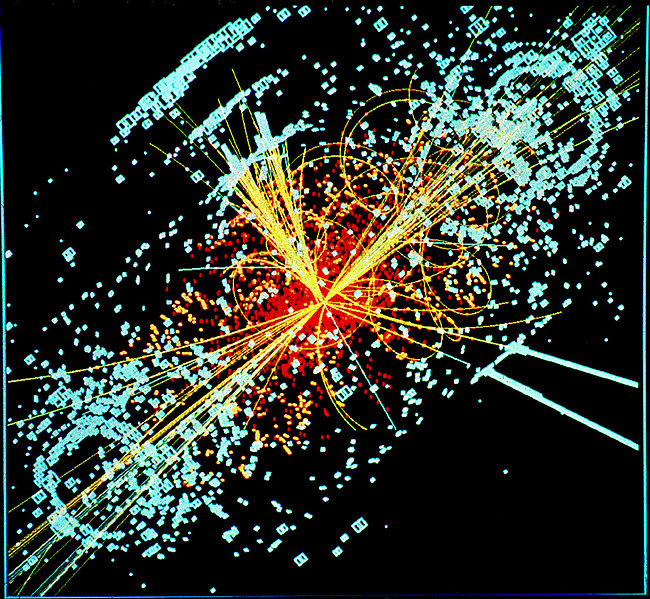
An example of simulated data modeled for the CMS particle detector on the Large Hadron Collider (LHC) at CERN. Here, following a collision of two protons, a Higgs boson is produced which decays into two jets of hadrons and two electrons. The lines represent the possible paths of particles produced by the proton-proton collision in the detector while the energy these particles deposit is shown in blue. Credit CERN.
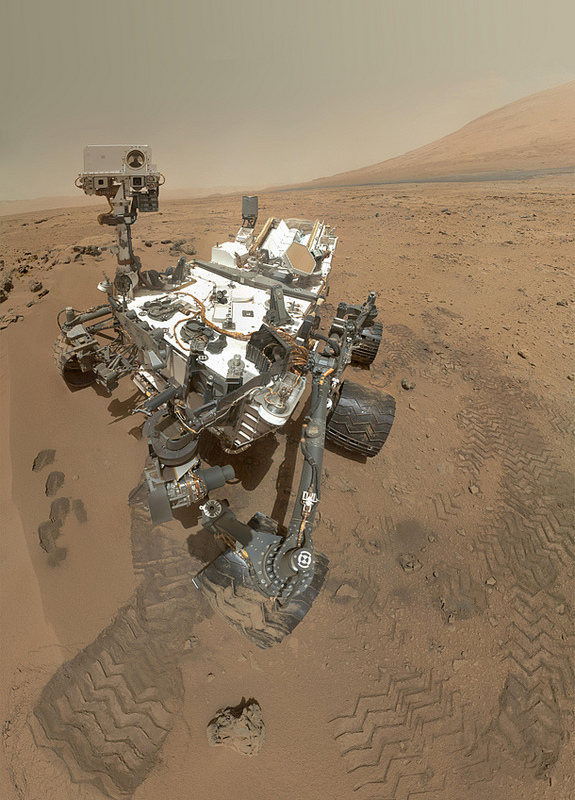
Curiosity rover self portrait. Credit: NASA/JPL-Caltech/Malin Space Science Systems
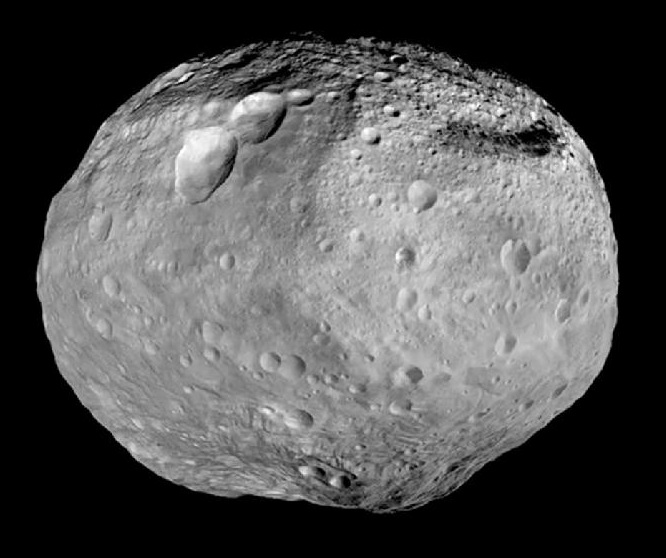
Looking back at Vesta as Dawn headed off to Ceres. Credit: NASA/JPL-Caltech/UCAL/MPS/DLR/IDA
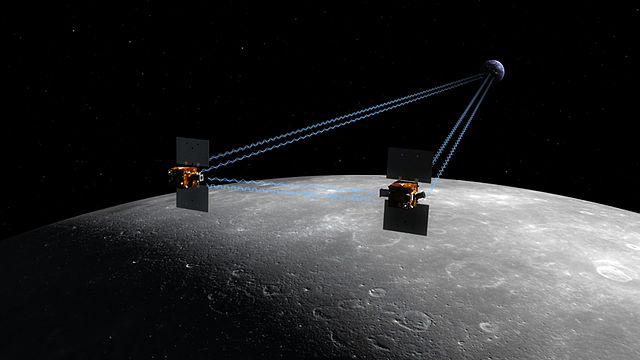
The Grail Spacecraft Ebb and Flow made the most detailed gravitational map of the moon to map its interior; orbiting as close as 15 miles above the surface. They were intentionally crashed into a crater wall on December 17th. Artist conception credit: NASA.
 Bob Moler's Ephemeris Blog