Archive
02/04/2016 – Ephemeris – Orion is visible from everywhere
Ephemeris for Thursday, February 4th. The Sun will rise at 7:58. It’ll be up for 9 hours and 56 minutes, setting at 5:55. The Moon, half way from last quarter to new, will rise at 5:21 tomorrow morning.
The constellation of Orion the hunter is now due south at 9 p.m. It is an upright rectangle of bright stars, the shoulders and knees of this giant. In the center are three stars in a straight line, his belt, and from his belt hangs a sword. Orion is the most famous of all constellations world-wide, due to its bright stars, and straddles the celestial equator, so that it is visible at least in part from pole to pole. It contains the closest star forming region to us, the Great Orion Nebula seen easily in his sword with binoculars or small telescope. The Horse Head Nebula is found below the left belt star, but only in photographs. Another photographic feature is Barnard’s Loop, the partial shell of an ancient supernova to the left of Orion.
Times are for the Traverse City/Interlochen area of Michigan. They may be different for your location.
Addendum
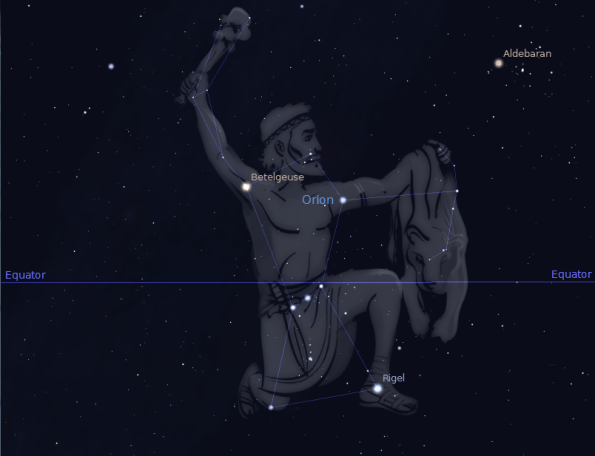
Orion from mid latitudes north of the equator. Orion would be upside down if viewed south of the equator. Created using Stellarium.
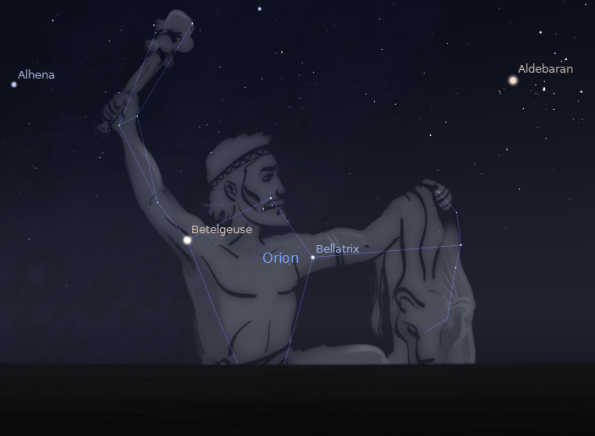
Orion from near the north pole. Created using Stellarium.
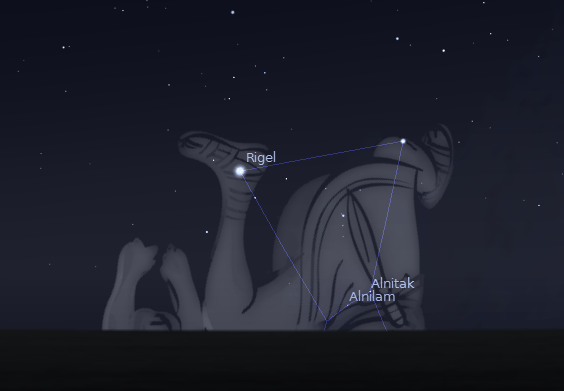
Orion from near the south pole. Created using Stellarium.
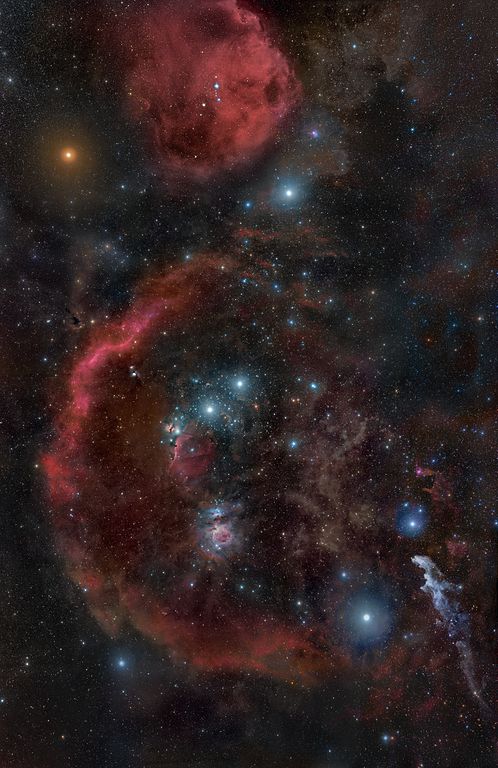
The nebulae in Orion including the Great Orion Nebula in the sword, the Horse Head Nebula below the leftmost star of Orion’s Belt named Alnitak. Barnard’s loop is the big arc on the left. Just above Alnitak is the Flame Nebula, I neglected to mention it in the program. It can be spotted in a telescope, especially if Alnitak is moved off the edge of the field of view. Credit Rogelio Bernal Andreo, via Wikipedia.
Note the nebula at the lower right. It’s the Witch’s Head Nebula, which I believe is shown brighter than it actually is. It’s being illuminated by the blue giant star Rigel to the left of it.
03/10/2015 – Ephemeris – The Great Orion Nebula
Ephemeris for Tuesday, March 10th. The Sun will rise at 8:04. It’ll be up for 11 hours and 37 minutes, setting at 7:42. The Moon, 3 days before last quarter, will rise at 12:43 tomorrow morning.
The constellation of Orion the hunter, now in the south at 9 p.m., contains the most beautiful star forming region in the northern sky. It is the Great Orion Nebula. A nebula is simply a cloud. Back in the early days of telescopes it was anything that appeared fuzzy. Today it’s any cloud, whether of gas or dust, light or dark. The Great Orion Nebula is made up of gas, which is ionized and shines by fluorescence by the ultraviolet light of a clutch of four stars in its heart called the Trapezium. The nebula can be glimpsed with binoculars surrounding what looks like the center star of the vertical line of three stars that appears as the sword hanging from Orion’s belt. It’s the bright end of a large dark cloud that’s behind the bright stars of Orion.
Times are for the Traverse City/Interlochen area of Michigan. They may be different for your location.
Addendum
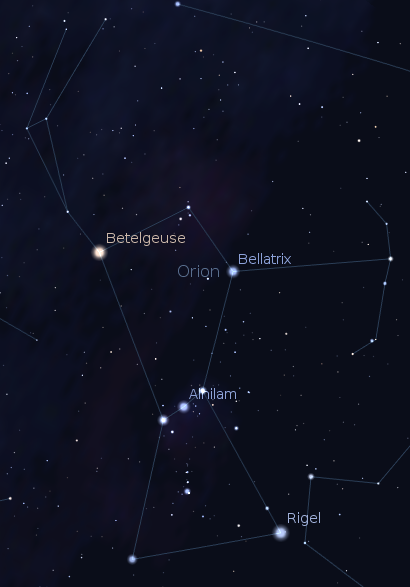
Orion upright and due south. Created using Stellarium.
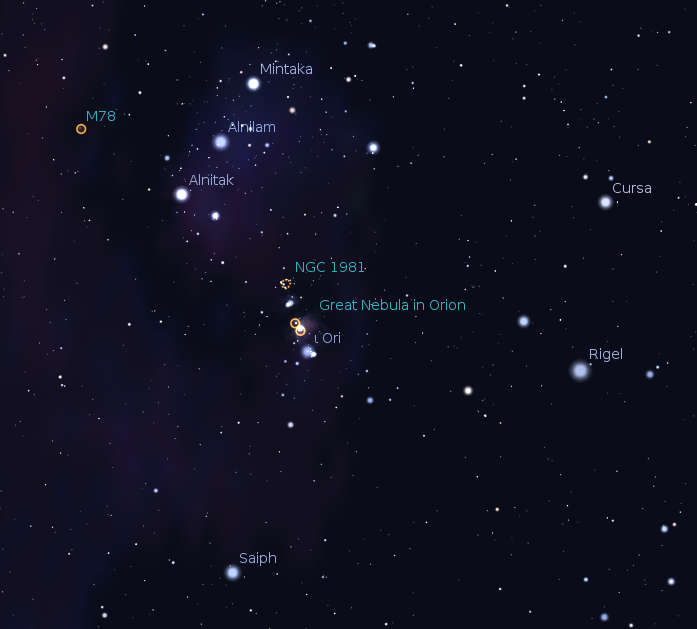
The lower part of Orion with the Great Orion Nebula. Created using Stellarium.
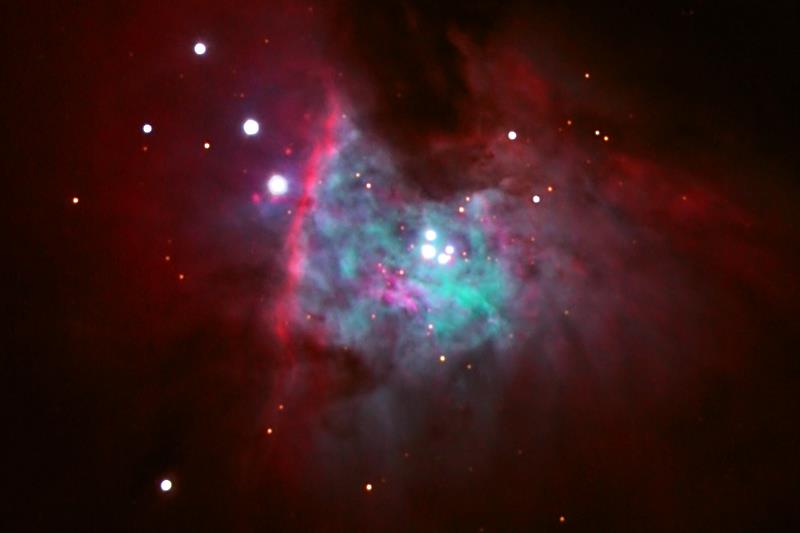
Inner part of the Great Orion Nebula with the Trapezium. Image by Scott Anttila
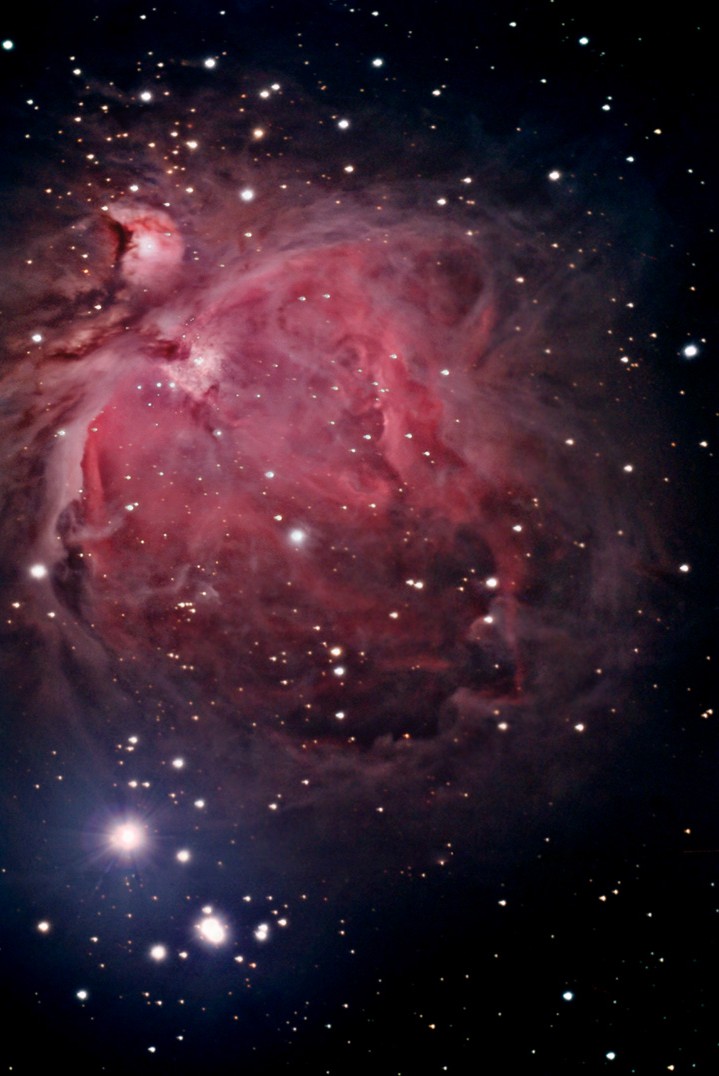
Great Orion Nebula by Scott Anttila
02/21/2014 – Ephemeris – Some nebulae in Orion
Ephemeris for Friday, February 21st. The sun will rise at 7:33. It’ll be up for 10 hours and 46 minutes, setting at 6:19. The moon, 1 day before last quarter, will rise at 1:31 tomorrow morning.
With the moon out of the sky, it’s a good time to get those binoculars or small telescope out to view at least one nebula in the constellation Orion the hunter and maybe even more. Orion is in the south with those belt stars lie in a straight line. Below the belt are three fainter stars, vertically arranged: Orion’s sword. In binoculars each of those stars are multiples. Around what looks like a center star there is a haze, which is the Great Orion Nebula, the nearest star forming region to us at around 1,400 light years away. Some of its gasses envelop the stars that make up the top star of the sword. Orion hosts the famous Horse head Nebula, which unfortunately can only be seen in photographs, It is right below the left star of the belt.
Times are for the Traverse City/Interlochen area of Michigan. They may be different for your location.
Addendum
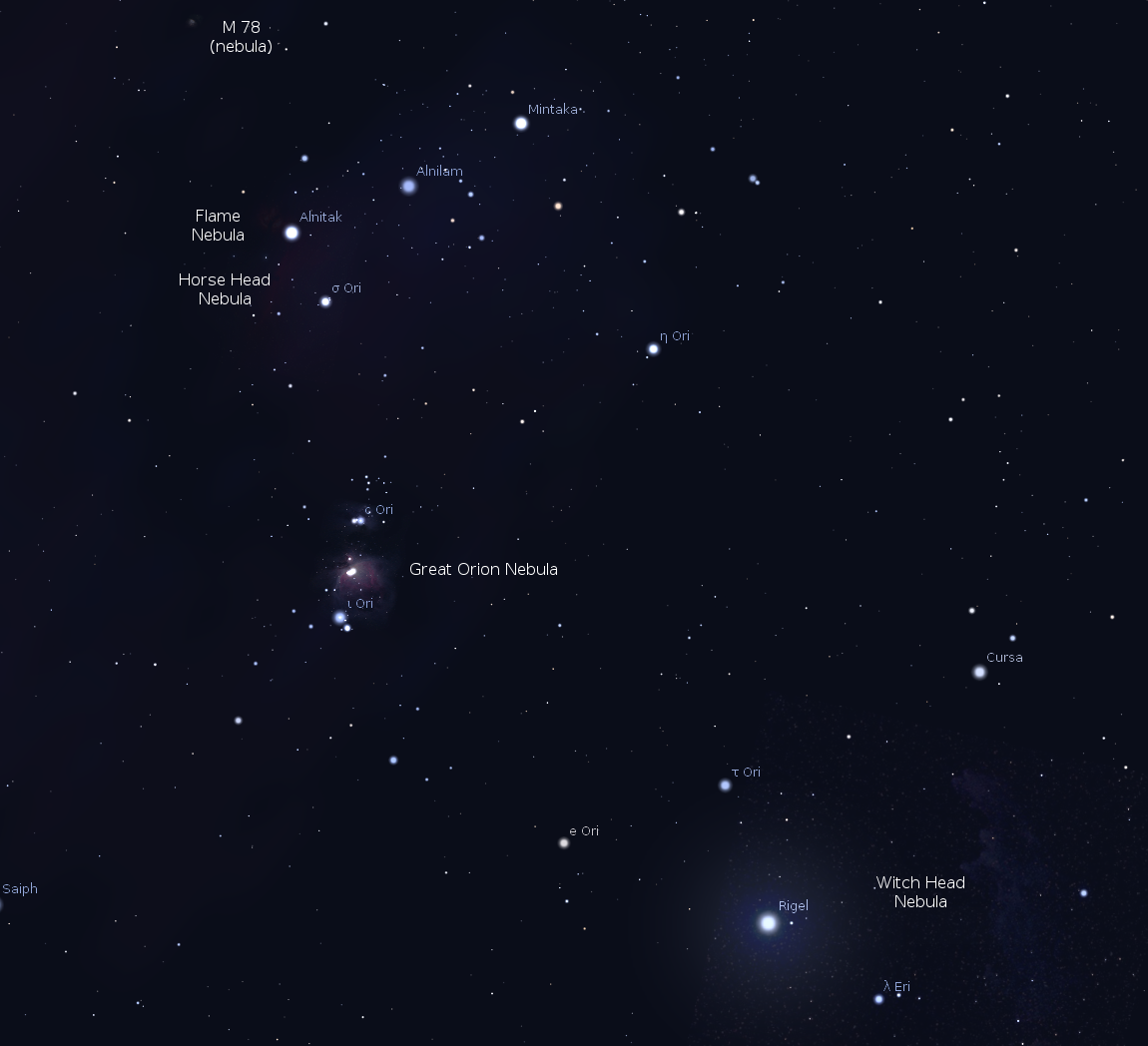
Orion’s Nebulae in the southern part of the constellation as displayed by Stellarium.
A couple of nebulae are seen here that are not in the text above. M78 is a small nebula north of the belt star Alnitak. It is visible in a telescope. The Witch Head Nebula, another large nebula, shining by the reflected light of Rigel. It’s officially in the neighboring constellation of Eridanus, and I believe strictly a photographic nebula. The witch head is best seen if the image is turned upside down.
01/08/2013 – Ephemeris – The Great Orion Nebula
Ephemeris for Tuesday, January 8th. The sun will rise at 8:18. It’ll be up for 9 hours and 1 minute, setting at 5:20. The moon, 3 days before new, will rise at 5:56 tomorrow morning.
The closest star firming region to us is the Great Orion Nebula. It’s 1,344 light years away give or take 20 light years. A light year is about 6 trillion miles, if you’re counting. It’s located in the constellation Orion’s sword that hangs below his belt. It shines by emission and reflection of the light of a clutch of four stars at its heart, astronomers have called the Trapezium. Binoculars can be used to spot the nebula surrounding what looks like the middle star of the sword. The sword stars aren’t single stars like the belt but groups of stars. Anyway a telescope, using its lowest power will see a glow around those Trapezium stars. The glow will have a dark notch out of it, which is a dark cloud in front if it. Wisps of gas may also be seen.
Times are for the Traverse City/Interlochen area of Michigan. They may be different for your location.
Addendum
The Great Orion Nebula is also number 42 on Charles Messier’s list of objects to avoid when searching for comets. Amateur astronomers know it as M42, the show piece of the winter sky.
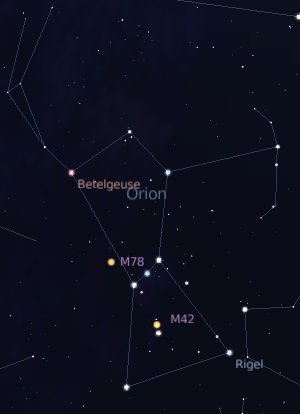
Orion via Stellarium.org
Inner part of the Great Orion Nebula (M42). Image by Scott Anttila.
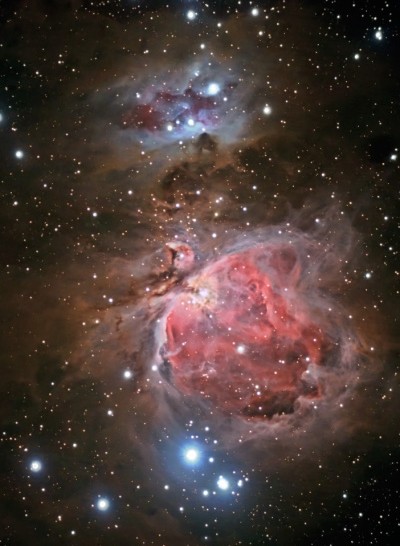
The Great Orion Nebula (M42) long exposure photograph by Scott Anttila. Includes all the sword stars.
01/20/2012 – Ephemeris – The Great Orion Nebula part 2
Ephemeris for Friday, January 20th. The sun will rise at 8:13. It’ll be up for 9 hours and 21 minutes, setting at 5:34. The moon, 3 days before new, will rise at 6:44 tomorrow morning.
The closest star nursery to us is the Great Orion Nebula, It 1,344 light years away give or take 20 light years. A light year is about 6 trillion miles, if you want to pace it out. It’s located in the constellation Orion’s sword that hangs below his belt. It shines by emission and reflection of the light of a clutch of four stars at its heart, astronomers have called the Trapezium. These extremely hot baby stars which look like eggs in a nest are not destined to live long. Unlike the sun’s 10 billion year life time these stars lifespan will be measured in millions of years. Yet do not mourn for them, Even now stars are forming in their dusty cocoons in the nebula. The Trapezium stars death will provide the material for new stars and planets to form in their stead.
* Times, as always are for the Traverse City/Interlochen area of Michigan.
Addendum
The lower part of Orion with the Great Orion Nebula. Created using Stellarium.
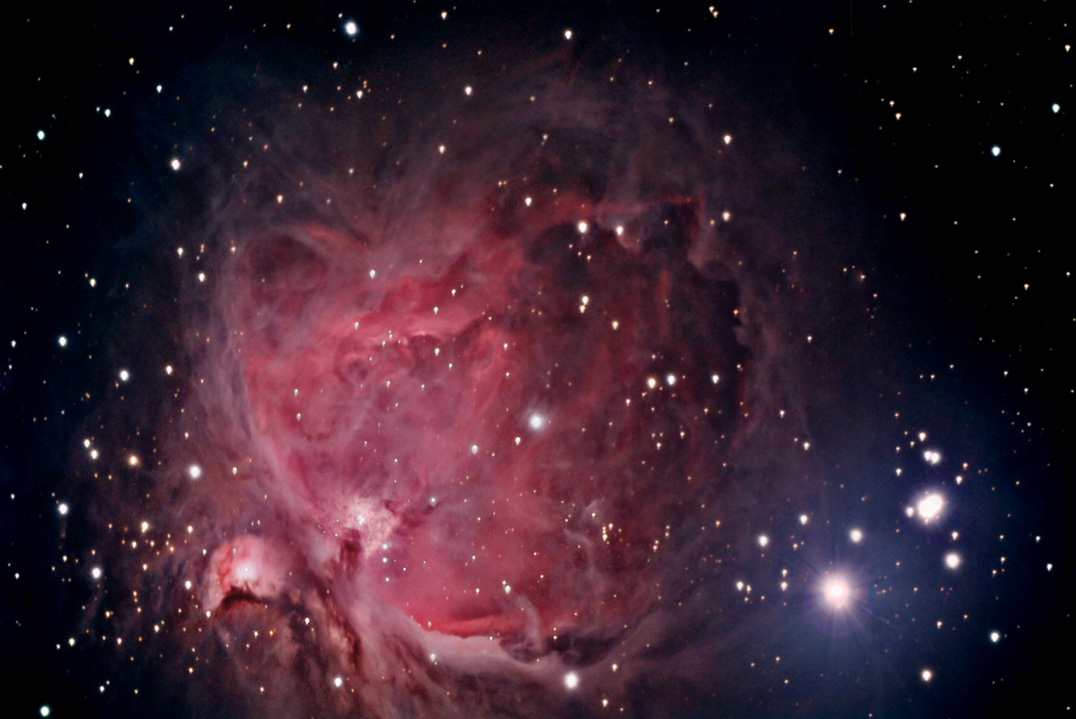
Great Orion Nebula by Scott Anttila
Inner part of the Great Orion Nebula. Image by Scott Anttila
This short exposure by Scott Anttila shows the Trapezium. It’s a bit rotated and enlarged compared to the photograph above, but the red bars and the Trapezium match up.
01/17/2012 – Ephemeris – The Great Orion Nebula part 1
Ephemeris for Tuesday, January 17th. The sun will rise at 8:15. It’ll be up for 9 hours and 15 minutes, setting at 5:30. The moon, 1 day past last quarter, will rise at 3:43 tomorrow morning.
One of the great questions of Christian theologians of Galileo’s time was why God would create stars that no human could see with the naked eye. Galileo’s primitive telescope showed a myriad of formerly invisible stars. Starting with Galileo, astronomers have shown that the stars weren’t made for man, and neither are the stars eternal. Stars are born and die, some spectacularly as supernovae. In the constellation of Orion the hunter, below the three stars of his belt are what appear another three stars hanging down as his sword.. Looking at what appears as the middle star with binoculars or a telescope one can detect a haze, a nebula astronomers call it. This is the Great Orion Nebula, even now the birthplace of stars.
* Times, as always are for the Traverse City/Interlochen area of Michigan.
Addendum
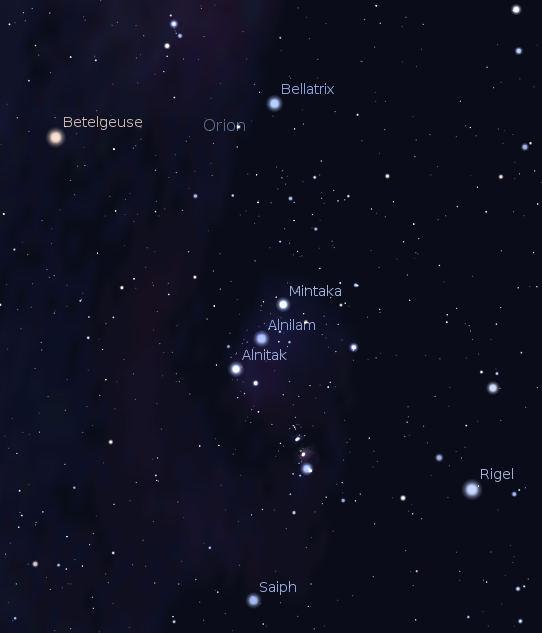
Torso of Orion centered on his belt. Created using Stellarium.
The lower part of Orion with the Great Orion Nebula. Created using Stellarium.
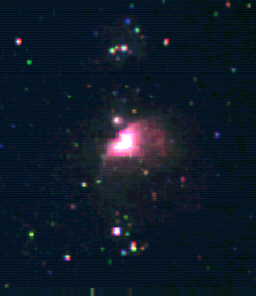
Great Orion Nebula in Orion's sword. My old photograph.
Note: The Great Orion Nebula usually photographs red due to the great abundance of the element hydrogen. However at low light levels our eyes are not sensitive to that particular color. So in the eyepiece the nebula looks gray or greenish due to the emission of hydrogen in the green and that of doubly ionized oxygen.
The Great Orion Nebula is also known by astronomers as M42 or Messier 42, a catalog of bright sky objects.
 Bob Moler's Ephemeris Blog