Archive
Ephemeris: 11/07/25 – GTAS meeting tonight, topic is Fighting Light Pollution
This is Ephemeris for Friday, November 7th. Today the Sun will be up for 9 hours and 53 minutes, setting at 5:23, and it will rise tomorrow at 7:30. The Moon, 2 days past full, will rise at 6:43 this evening.
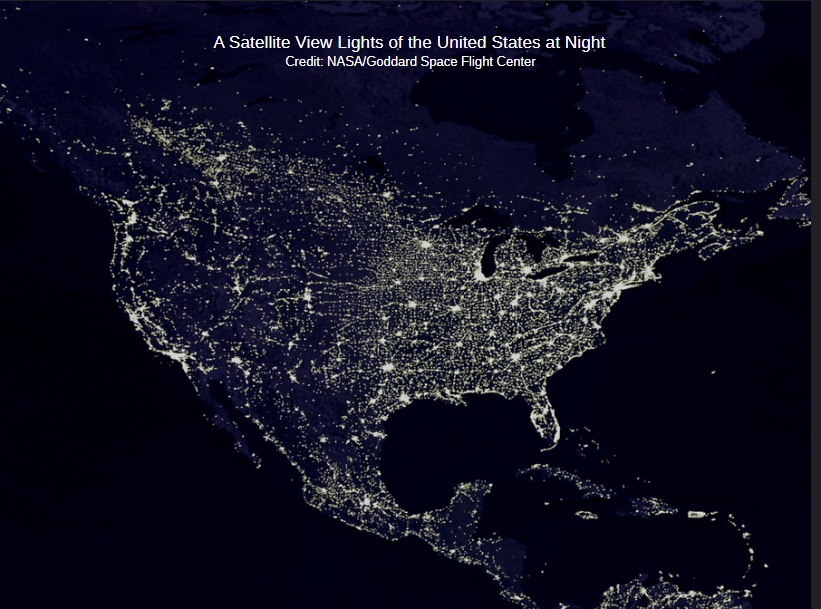
The Grand Traverse Astronomical Society will hold a special meeting and program at 7 PM tonight, a special time, at Northwestern Michigan College’s Rogers Observatory. Dr. Jerry Dobek, astronomy professor at NMC, will present an illustrated talk on Light Pollution. The focus of the talk will be on the general causes and effects of light pollution, as well as examples of proper lighting. Dr. Dobek has helped write lighting ordinances for governments here and around the nation. A star party will start around 8 pm, but only if it’s clear. The observatory is located south of Traverse City, on Birmley Road. The meeting is also available via Zoom. A link can be found on the society’s website, gtastro.org.
The astronomical event times given in this blog are for the Traverse City/Interlochen area of Michigan (Lat 44.7° N, Long 85.7° W; EDT, UT – 4 hours) unless stated otherwise. Times will be different for other locations.
Addendum
Ephemeris: 09/06/2024 – Grand Traverse Astronomical Meeting Tonight
This is Bob Moler with Ephemeris for Friday, September 6th. Today the Sun will be up for 12 hours and 57 minutes, setting at 8:09, and it will rise tomorrow at 7:12. The Moon, 4 days past new, will set at 9:26 this evening.
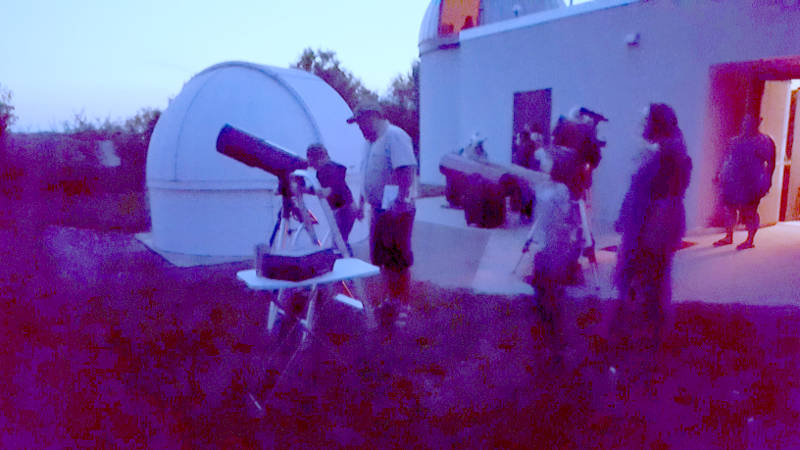
The Grand Traverse Astronomical Society will host its September meeting tonight at 8:00 PM at Northwestern Michigan College’s Joseph H Rogers Observatory, which is located on Birmley Rd. South of Traverse City between Garfield and Keystone roads. The program topic will be a surprise, at least to me. After the meeting about 9:00 PM if it’s clear there will be viewing of the heavens through the observatory’s telescopes, featuring possibly the Moon and Saturn, the first of which may be too low or be obstructed, and when it’s darker the wonders of the Milky Way will be visible including nebulae, open star clusters, and my favorite globular star clusters, spherical masses of hundreds of thousands of stars, as old as the Milky Way itself.
The astronomical event times given are for the Traverse City/Interlochen area of Michigan (EDT, UT–4 hours). Times will be different for other locations.
Addendum
Ephemeris: 06/28/2024 – Solar viewing at Sleeping Bear Dunes tomorrow
This is Ephemeris for Friday, June 28th. Today the Sun will be up for 15 hours and 32 minutes, setting at 9:32, and it will rise tomorrow at 6:00. The Moon, at last quarter today, will rise at 1:37 tomorrow morning.
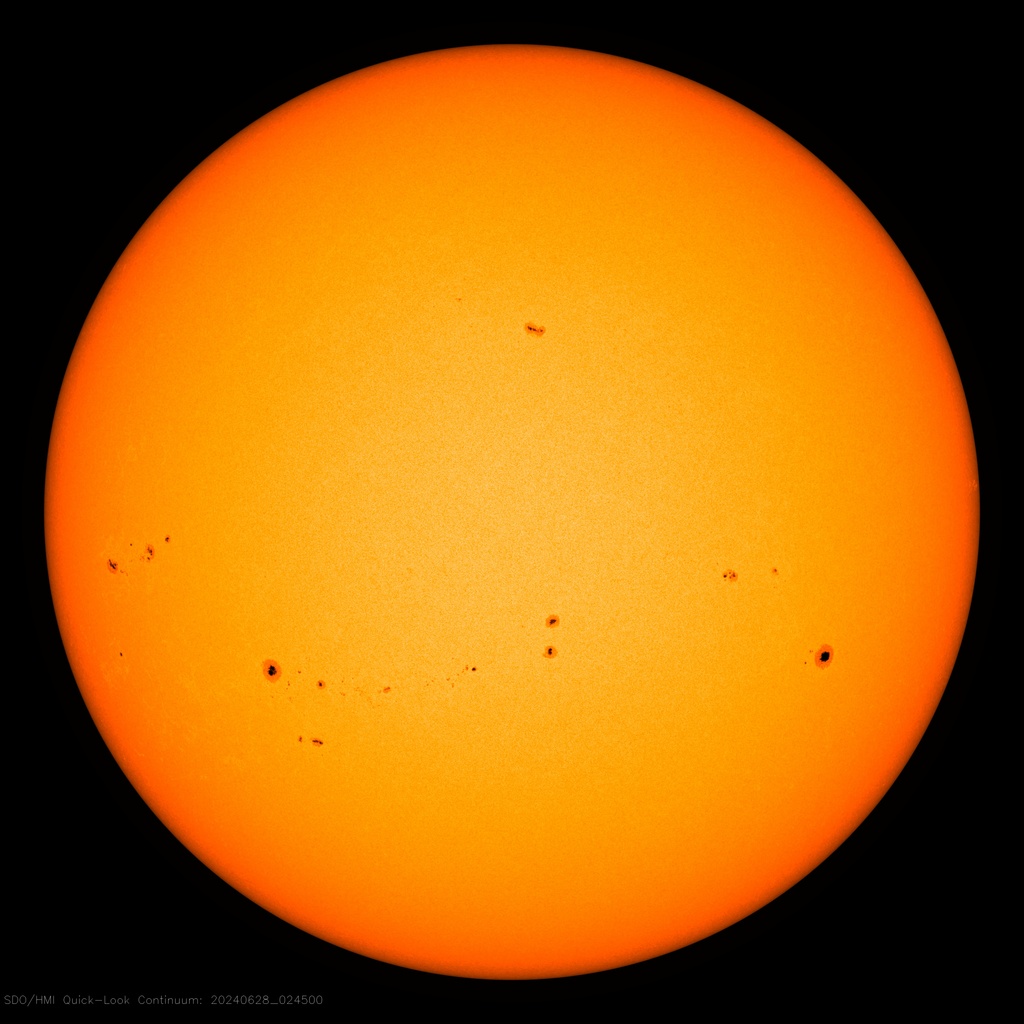
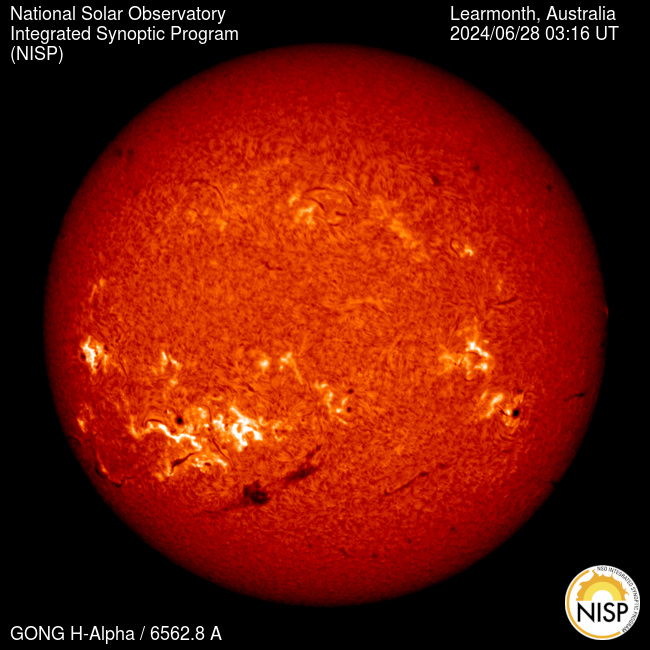
Tomorrow, Saturday, June 29th there will be solar viewing at the Sleeping Bear Dunes National Lakeshore, at the Dune Climb from 3 to 6 PM. Park Rangers will be joined by members of the Grand Traverse Astronomical Society with their specially filtered telescopes to view the Sun safely. This is a period of great solar activity. Remember the Aurora Borealis of a few weeks ago. Solar filtered telescopes will safely view the surface of the sun, called the photosphere and sunspots, while the society also has two special solar telescopes with which to view the layer of gas above the surface called the chromosphere and prominences which look like flames coming off the chromosphere. This is one of two solar observing opportunities this summer.
The astronomical event times given are for the Traverse City/Interlochen area of Michigan (EDT, UT–4 hours). They may be different for your location.
Addendum
Ephemeris: 06/07/2024 – GTAS hears from NASA engineer tonight
This is Ephemeris for Friday, June 7th. Today the Sun will be up for 15 hours and 28 minutes, setting at 9:26, and it will rise tomorrow at 5:57. The Moon, 1 day past new, will set at 11:19 this evening.
Tonight’s meeting of the Grand Traverse Astronomical Society will start at 9 pm, at Northwestern Michigan College’s Rogers Observatory. The later start time in June and July will allow the following star party, which will start at the end of the meeting, around 10 pm, to start after sunset. The sky will still be in bright twilight. We are pleased to have Joe Gibson, Principal Flight Software Engineer, from NASA’s Goddard Space Flight Center to speak to us. After the program, at about 10 pm, if it’s clear will be viewing of the skies as it gets dark. The public is always welcome. This meeting also marks the Society’s 42nd anniversary. The observatory is located south of Traverse City on Birmley Road between Garfield and Keystone roads.
The astronomical event times given are for the Traverse City/Interlochen area of Michigan (EDT, UT–4 hours). They may be different for your location.
Addendum

03/17/2023 – Ephemeris Extra – I’m now in Rehab
I’m hoping to be home by the end of the month. My daughter wants me to take some additional time before plunging back in. I don’t actually disagree with her.
A local event I’d like to preview is the Grand Traverse Astronomical Society’s part in International Astronomy Day, Saturday, April 29th. This annual event will be held at the Sleeping Bear Dunes National Lakeshore. I’ve been out of the loop on this, but the GTAS may be offering solar and night viewing. The sun has been unexpectedly active this year, and it is our star. Stay tuned.
Bob
01/06/2023 – Ephemeris – Telescope Clinic tonight at the Grand Traverse Astronomical Society Meeting tonight
This is Ephemeris for Friday, January 6th. Today the Sun will be up for 8 hours and 57 minutes, setting at 5:17, and it will rise tomorrow at 8:19. The Moon, at full today, will rise at 4:47 this evening.
The Grand Traverse Astronomical Society will hold their monthly meeting tonight with their annual Telescope Clinic, at 8 pm at Northwestern Michigan College’s Rogers Observatory. This is a chance to bring in that new Christmas telescope or even that old telescope gathering dust in the attic to learn how to use it. The society telescope experts will help in instruction and, if need be, adjustments to make the telescope work properly. In the past few years, the society has donated telescopes to public libraries in the region for patrons to check out and use. This is another way in which to learn to use a telescope and enjoy the sky at night. The observatory is located south of Traverse City on Birmley Road, south of Hammond, and between Garfield and Keystone roads. There will, if it’s clear after the meeting, be a star party or observing period using the observatory telescopes.
The astronomical event times given are for the Traverse City/Interlochen area of Michigan (EST, UT –5 hours). They may be different for your location.
Addendum
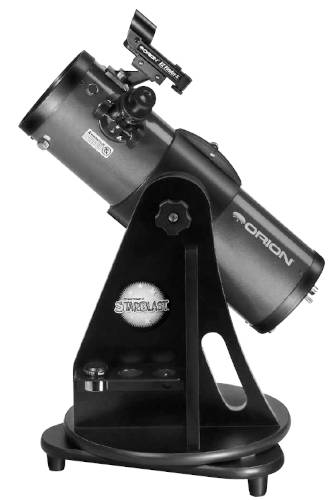
This is the type of telescope that the GTAS is donating to local libraries to lend out. The telescope can be set up on a table. The device on top is a red-dot finder. Looking through it will place a red dot on the object it’s pointed to. It has no magnification of its own. The telescope has a 4.5 inch diameter mirror, which produces a brighter image than the skinny refractor telescopes sold in most stores. The telescope eyepiece is a zoom type, so there is no need to remove it or change eyepieces to change magnification. The magnification range is from approximately 20 to 60 times (power). This is plenty for most objects in the sky, including the Moon, Jupiter and Saturn. Mars is a challenge for even the largest of amateur astronomer’s telescopes. Even then it’s best seen for a few months every 26 months.
The GTAS has a library telescope program where they donate small telescopes to local libraries to lend out. These are small tabletop telescopes with a 4.5 inch aperture. The telescope type is that invented by Sir Isaac Newton. In a telescope, magnification is secondary and usually variable. The real power of a telescope is light gathering power, the ability to gather in light to see objects too dim to be seen with the naked eye. Also, a telescope’s ability to see fine detail is tied to the telescope’s aperture or diameter of its primary mirror or lens. That’s not magnification, but the ability to use higher power to produce crisp images, rather than fuzzy ones.
07/02/2021 – Ephemeris – Virtual star party to be held tonight
This is Ephemeris for Friday, July 2nd. Today the Sun will be up for 15 hours and 29 minutes, setting at 9:31, and it will rise tomorrow at 6:02. The Moon, 1 day past last quarter, will rise at 2:14 tomorrow morning.
The Grand Traverse Astronomical Society hold a virtual star party starting at 10 pm tonight via Zoom app on the Internet. Jerry Dobek, professor of astronomy at Northwestern Michigan College, will host the event with the 16-inch telescope and an imager, but only if it’s clear in Traverse City. It should feature a look at Venus to start. There will be other objects visible in the darkening twilight, such as binary stars and a dramatic pair with contrasting colors. As it gets darker, we might spot clusters of stars including the Great Hercules Globular Cluster, a veritable popcorn ball of stars. Also, bright clouds of gas expelled by dying stars. Instructions to join the meeting and a link can be found on the society’s website, www.gtastro.org.
The astronomical event times given are for the Traverse City/Interlochen area of Michigan (EDT, UT-4). They may be different for your location.
01/08/2021 – Ephemeris – There will be a virtual star party tonight
This is Ephemeris for Friday, January 8th. Today the Sun will be up for 9 hours and 1 minute, setting at 5:20, and it will rise tomorrow at 8:19. The Moon, 2 days past last quarter, will rise at 4:31 tomorrow morning.
The Grand Traverse Astronomical Society will host a virtual star party at 8 pm tonight. It is via the Zoom app for smartphones, tablets or computers. Instructions and a link can be found on the society’s website gtastro.org. It will be hosted by Dr. Jerry Dobek, astronomy professor at Northwestern Michigan College. During a virtual star party the images are produced real time or near real time using a telescope mounted CCD camera. That is if it’s clear. If cloudy we’ll have a virtual, virtual star party using recently acquired images captured for his astronomy students. A couple of months ago we got a tantalizing look at the Great Orion Nebula as it rose in moonlight. Now it’s higher in the sky with no Moon. It should be spectacular!
The event times given are for the Traverse City/Interlochen area of Michigan. They may be different for your location.
06/03/2019 – Ephemeris – Two local astronomical events on tap for this weekend
Ephemeris for Friday, June 3rd. Today the Sun will be up for 15 hours and 24 minutes, setting at 9:23, and it will rise tomorrow at 5:58. The Moon, 1 day before new, will rise at 5:56 tomorrow morning.
There are two local astronomical events this weekend, starting this evening with the Grand Traverse Astronomical Society’s meeting tonight starting at 8 p.m. at Northwestern Michigan College’s Rogers Observatory. The program will be by Becky Shaw about some current female astronomers. At 9 p.m. will be a star party. Tomorrow night, the 4th society members will be in the town of Arcadia for a star party at the ball field starting at 9 p.m. Turn right from Oak St off M22 to North Ridgewood Drive. The townships around the Arcadia Dunes are in the process of applying for International Dark Skies Community status. Though it won’t get dark until late, the planets Jupiter, Mars and Saturn will be featured.
Times are for the Traverse City/Interlochen area of Michigan. They may be different for your location.
02/05/2016 – Ephemeris – Women in astronomy night at the GTAS tonight
Ephemeris for Friday, February 5th. The Sun will rise at 7:57. It’ll be up for 9 hours and 58 minutes, setting at 5:56. The Moon, 3 days before new, will rise at 6:12 tomorrow morning.
Tonight there will be a meeting of the Grand Traverse Astronomical Society at Northwestern Michigan College’s Rogers Observatory, featuring a graduate from NMC and the astronomy program: Becky Shaw who will present a talk Women in Astronomy. This is a second presentation of more female astronomers, the last was in November I especially recommend this for girls in school interested in the STEM fields, that is Science, Technology, Engineering and Math to find out the wonderful contributions these women have made. Astronomy, by the way encompasses all the STEM fields. The meeting starts at 8 p.m. and the observatory is located on Birmley Road, south of Traverse City. At 9 p.m. the will also be star party if it’s clear.
Times are for the Traverse City/Interlochen area of Michigan. They may be different for your location.
Addendum
Appropriate to our speaker’s topic: In the news now is Smith’s Cloud, discovered by Gail Smith (now Gail Bieger-Smith) in 1963 as an astronomy student at Leiden University in the Netherlands. In new studies with the Green Bank (Radio) Telescope and the Hubble Space Telescope the velocity and composition of the cloud has been measured. It somehow was ejected from the Milky Way some 70 million years ago, but it’s coming back! In 30 million years it will crash back in, hitting the Milky Way’s other gas clouds and will probably cause a burst of star formation of maybe 2 million new stars.
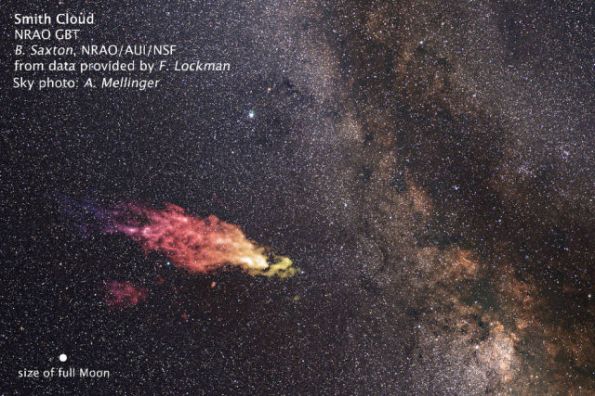
Smith’s cloud superimposed on the Milky Way. Smith’s Cloud is only visible at radio wavelengths, while the Milky Way shown is a visible photograph. Credit: Saxton/Lockman/NRAO/AUI/NSF/Mellinger.
 Bob Moler's Ephemeris Blog