Archive
07/26/2018 – Ephemeris – How can you get to Mars – the Hohmann transfer orbit
Ephemeris for Thursday, July 26th. The Sun rises at 6:22. It’ll be up for 14 hours and 53 minutes, setting at 9:15. The Moon, 1 day before full, will set at 6:06 tomorrow morning.
How does one get a spacecraft to another planet, like Mars? One might think to wait until the two planets are closest and zip across. That would take more energy than we are capable of. We cab barely escape the Earth and get a spacecraft into solar orbit. Also one needs energy to slow down to be captured by the planet if one wants to orbit it. The most economical way was devised way before the space age by Walter Hohmann, a German scientist in 1925. The idea is to launch a spacecraft with enough velocity to reach the other planet half way around the Sun, so the transfer orbit is tangent to both the Earth’s and the planet’s orbit. Transit times to Mars would be in the range of 7 months. The InSight lander is currently on such a trajectory.
The times given are for the Traverse City/Interlochen area of Michigan. They may be different for your location.
Addendum
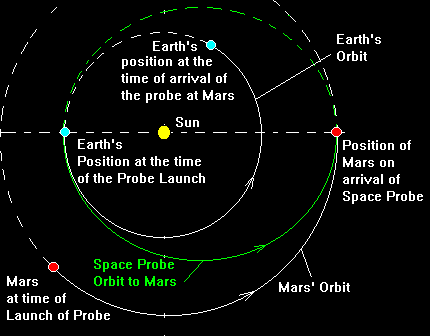
Hohmann transfer orbit. Credit Planetary Society-Myron Kayton
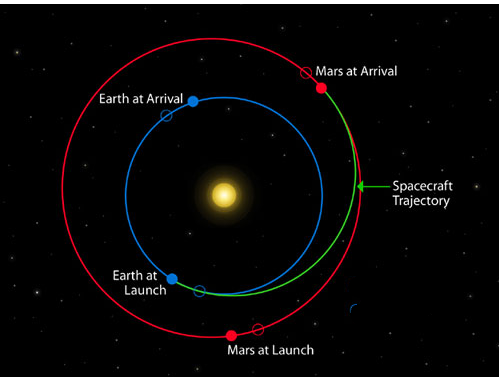
A Hohmann lowest energy transfer orbit to Mars. This diagram is for the Mars Exploration Rovers Spirit and Opportunity orbits, launched in 2003, arrived in 2004. Solid planets, Spirit launch and arrival. Ghost planets, Opportunity launch and arrival. Credit NASA/JPL.
12/14/2017 – Ephemeris – The Moon wanders over to Jupiter this morning
Dec 14. This is Bob Moler with Ephemeris for Thursday, December 14th. The Sun will rise at 8:11. It’ll be up for 8 hours and 50 minutes, setting at 5:02. The Moon, half way from last quarter to new, will rise at 5:26 tomorrow morning.
This morning the planet Jupiter will appear right below the crescent Moon. Jupiter is hard to miss, even without the Moon to point it out. It is with the rare exception of Mars when being its closest to the Earth the second brightest of the planets, after Venus. Speaking of Mars, which is to the upper right of Jupiter and has a reddish hue, if you’re going to send anything to Mars, next spring is the time to do it. Flight times to Mars are 6 to 7 months. The midpoint of the flight is when Mars is closest to the Earth, which next year is July 31st. NASA’s Insight Lander, grounded in 2016 due to an instrument failure has to wait 26 months for the next launch opportunity in May of next year.
The times given are for the Traverse City/Interlochen area of Michigan. They may be different for your location.
Addendum
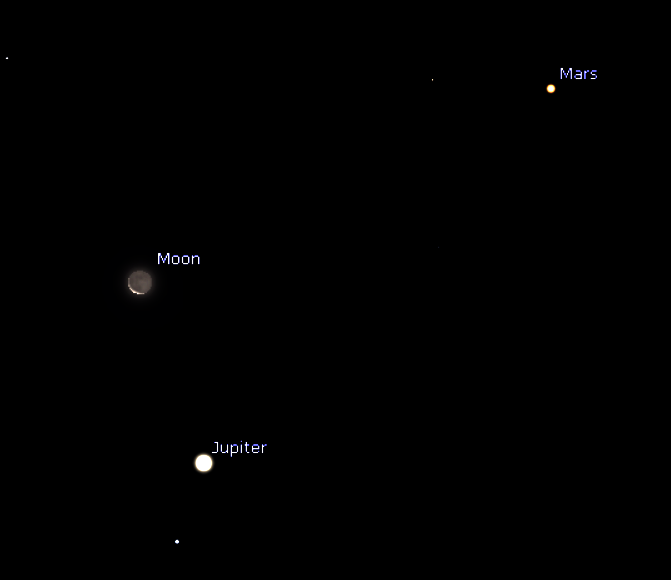
The Moon, Jupiter and Mars this morning, December 14, 2017. Earth shine should be visible as shown, though not as prominent. Created using Stellarium.
A Hohmann lowest energy transfer orbit to Mars. This diagram is for the Mars Exploration Rovers Spirit and Opportunity launched in 2003, arrived in 2004. Solid planets, Spirit launch and arrival. Ghost planets, Opportunity launch and arrival. Credit NASA/JPL.
What’s a Hohmann transfer orbit? NASA explains.
 Bob Moler's Ephemeris Blog