Archive
Ephemeris: 12/19/2024 – Jupiter’s dark moon Callisto
This is Bob Moler with Ephemeris for Thursday, December 19th. Today the Sun will be up for 8 hours and 48 minutes, setting at 5:04, and it will rise tomorrow at 8:16. The Moon, 3 days before last quarter, will rise at 9:47 this evening.
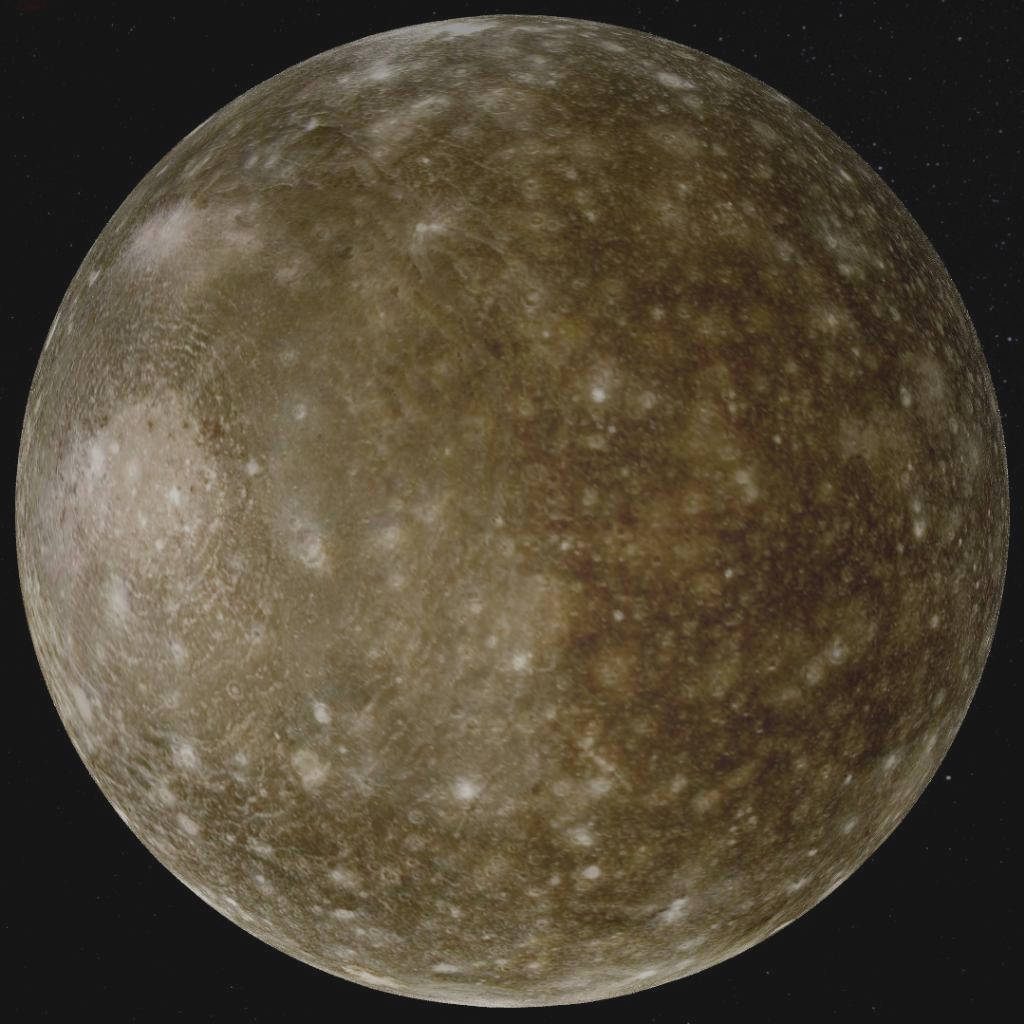
Callisto is the most distant of the Galilean moons from Jupiter, visible in small telescopes or even binoculars. It has the darkest surface of the four moons, and so appears the dimmest, even though it’s the second largest after Ganymede. The largest crater on Callisto is called Valhalla, and it doesn’t look like a crater at all. There’s many concentric, what look like, frozen ripples surrounding it, and it covers a good percentage of the moon’s surface. It is probably the only moon of Jupiter that we could send a crew to, since it’s the farthest from the intense radiation belts of Jupiter. Made of approximately equal parts of water mostly in the form of ice and rock, Callisto probably has a liquid water ocean underneath its icy crust, like Ganymede and Europa.
Addendum
Ephemeris: 12/12/2024 – Jupiter’s moon Europa
This is Bob Moler with Ephemeris for Thursday, December 12th. Today the Sun will be up for 8 hours and 51 minutes, setting at 5:02, and it will rise tomorrow at 8:12. The Moon, 3 days before full, will set at 6:24 tomorrow morning.
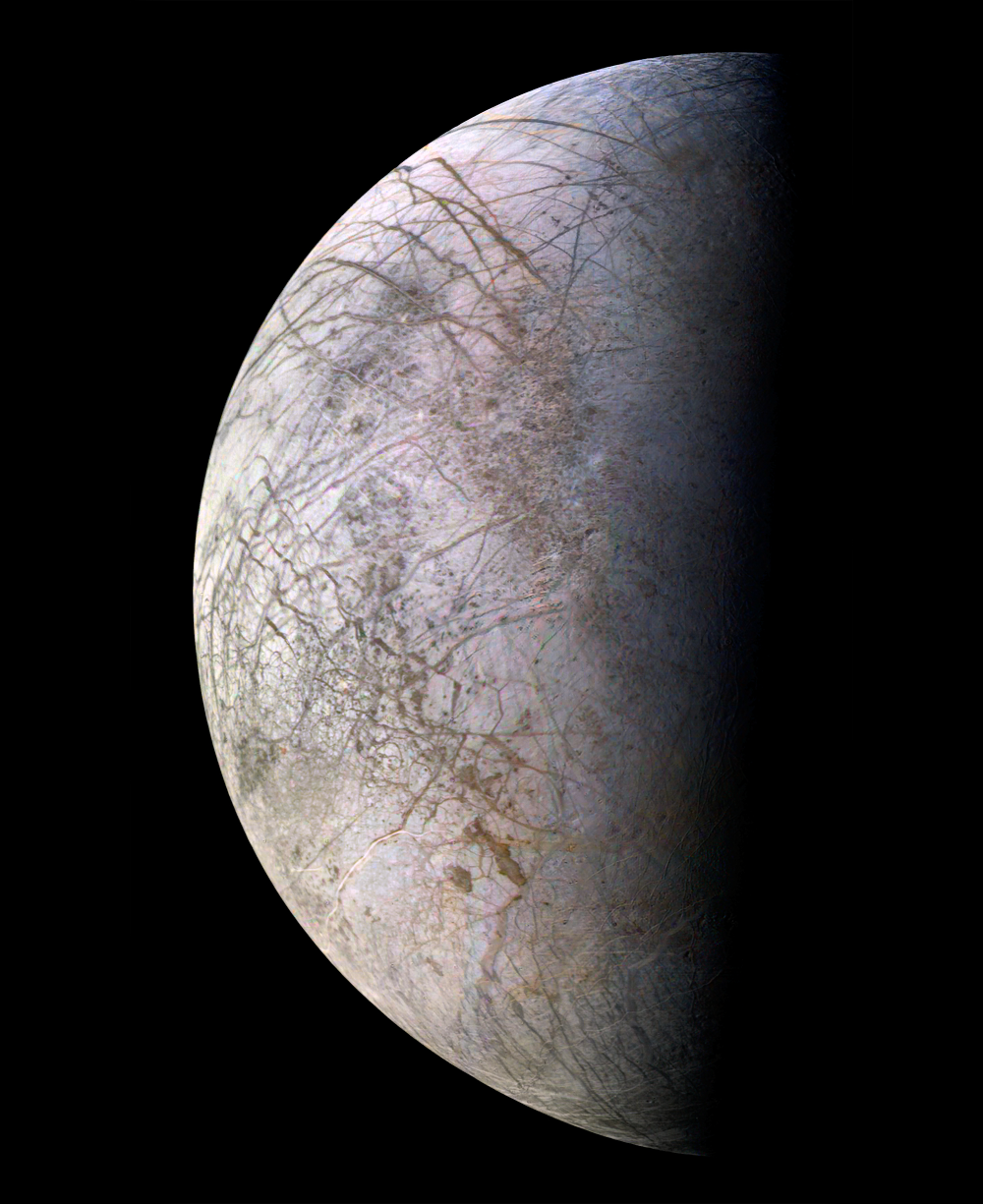
Jupiter’s four bright Galilean moons are nearly planet size. In fact Ganymede, the third one out, is larger than Mercury. But the most interesting moon to NASA and to scientists looking for life in the solar system, is the second moon out, Europa. When the Voyager spacecraft flew past Jupiter in the late 1970s they photographed a rather smooth surface on it with a lot of cracks and grooves, but very few craters. This meant Europa surface is quite young and has been evolving over time kind of like the Earth’s surface. The reason is that it appears Europa has a vast ocean under a thick crust of ice. Europa is heated by both radioactivity in its core and tidal forces caused by Jupiter and the other moon’s gravitational pull on it.
The astronomical event times given are for the Traverse City/Interlochen area of Michigan (EST, UT – 5 hours). Times will be different for other locations.
Addendum
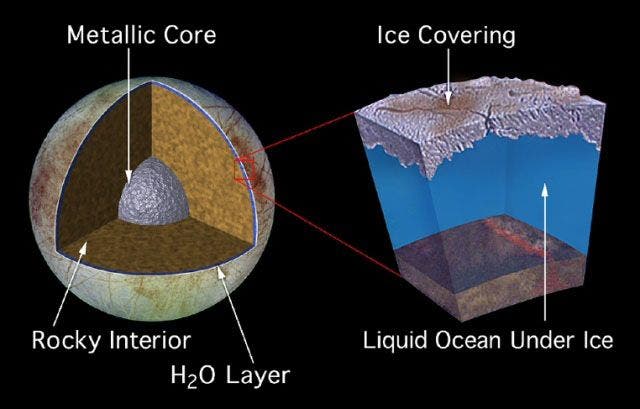
On Earth, wherever there’s water there’s life. Can the same be said of Europa?
Ephemeris: 01/18/2024 – A quick guide to Jupiter for the small telescope
This is Ephemeris for Thursday, January 18th. Today the Sun will be up for 9 hours and 16 minutes, setting at 5:31, and it will rise tomorrow at 8:14. The Moon, 1 day past first quarter, will set at 2:43 tomorrow morning.
Jupiter is the largest planets and is generally the largest appearing planet in a telescope. Venus appears a bit larger than Jupiter only for about four months when it’s the closest it gets to us. There’s always something going on with Jupiter and its 4 Galilean moons which appear to shuffle back and forth from one side to the other of the planet. Jupiter has cloud bands which run parallel to its equator and to the plane of the moon’s orbits. And it has the Great Red Spot, but that spot is not easily visible in small telescopes. Back in the 1950s it was big and brick red. It is since lost a great deal of its redness and size. The moons can hide behind Jupiter or in its shadow or cross in front of the planet. Tonight Jupiter will appear below and right of the Moon.
The astronomical event times given are for the Traverse City/Interlochen area of Michigan (EST, UT –5 hours). They may be different for your location.
Addendum
Ephemeris: 11/02/2023 – Jupiter is at opposition from the Sun tonight
This is Ephemeris for Thursday, November 2nd. The Sun will rise at 8:21. It’ll be up for 10 hours and 8 minutes, setting at 6:30. The Moon, 3 days before last quarter, will rise at 9:57 this evening.
Tonight the planet Jupiter is at opposition from the Sun. It is the time when the Earth is directly between the Sun and Jupiter, so that Jupiter rises at sunset and sets at sunrise. So for the next 6 or so months Jupiter will be in the evening sky and officially an evening planet. To the naked eye Jupiter is the second brightest planet after Venus and without Venus in the sky it may be mistaken for Jupiter. In binoculars Jupiter appears very bright and not quite star-like. It also has several of its moons that are visible in binoculars. These are its Galilean moons discovered by Galileo back in 1609. In telescopes four can be seen although not all of them may be visible at one time because the moons move back and forth from one side to the other of the planet.
The astronomical event times given are for the Traverse City/Interlochen area of Michigan (EDT, UT –4 hours). They may be different for your location.
Addendum
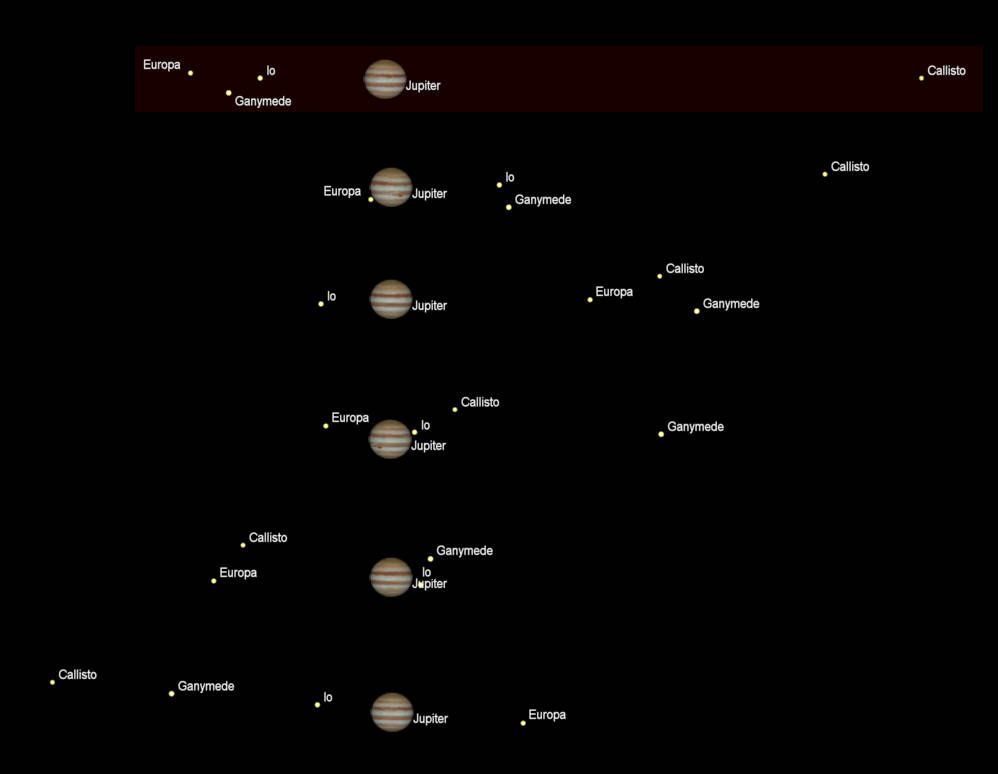
Follow Jupiter’s moons with this tool: Sky & Telescope’s Interactive Tool for Observing Jupiter’s Moons.
08/04/2020 – Ephemeris – Viewing Jupiter and its moons with binoculars or small telescope
This is Ephemeris for Tuesday, August 4th. Today the Sun will be up for 14 hours and 30 minutes, setting at 9:03, and it will rise tomorrow at 6:34. The Moon, 1 day past full, will rise at 10:06 this evening.
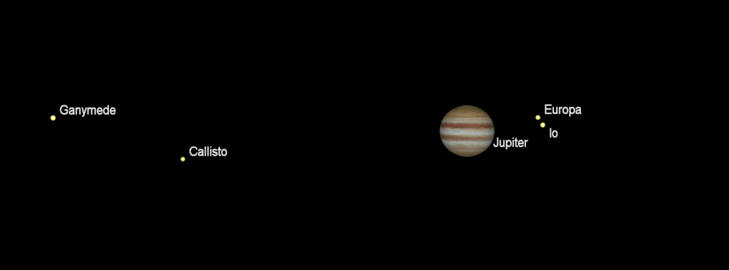
The planet Jupiter is a fine object to view with just about any optical aid be it a pair of binoculars, spotting scope or telescope. In binoculars, if held steady or mounted on a tripod Jupiter itself will no longer look star-like, but a tiny disk. Several of Jupiter’s moons can also be seen. With a telescope four of them can be seen, the same four Galileo discovered 410 years ago. At 10 pm they will be in the same order of distance from the planet that they actually are. The two nearest will be on the west side of the planet Io the closest, the Europa the next moon out. On the east side there is the third farthest Ganymede, and farthest out is Callisto. Their orbits are nearly edge on to us, so they shuttle from one side to the other of the planet.
The event times given are for the Traverse City/Interlochen area of Michigan. They may be different for your location.
Addendum
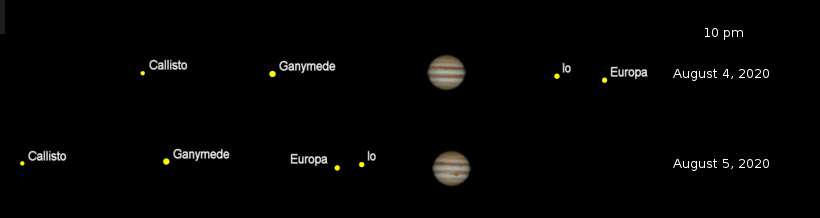
Jupiter and its Galilean moons for tonight and tomorrow night August 4 & 5, 2020. Those moons really move from night to night. This is shown north at the top, east to the left. Based on telescope design the image presented could be inverted, mirror image or both. Created using Cartes du Ciel (Sky Charts).
Due to the lack of time (59 seconds) I could only cover the moons. I’ll address Jupiter’s cloud features at another time. Can’t wait? Here’s a link: https://bobmoler.wordpress.com/2018/05/22/05-22-2018-ephemeris-seeing-detail-on-the-face-of-jupiter-with-a-small-telescope/
 Bob Moler's Ephemeris Blog