Archive
Ephemeris: 08/05/2025 – Why space faring nations are fixated on the Moon’s South Pole
This is Ephemeris for Tuesday, August 5th. Today the Sun will be up for 14 hours and 28 minutes, setting at 9:02, and it will rise tomorrow at 6:35. The Moon, halfway from first quarter to full, will set at 3:06 tomorrow morning.
After more than 50 years since the Apollo landings on the Moon, space faring nations are beginning to be interested in one particular place on the Moon for further exploration. That is the lunar South Pole. The reason is the discovery of something more valuable than gold. That there may be water hidden in permanently shadowed craters there. The moon’s North Pole is not as rugged, so there’s probably not as much water there. Water can exist on the Moon but only in its frozen form, ice in permanently shadowed craters. The Moon’s axial tilt is only about 1 1/2° compared to the Earth’s 23 1/2°. The water molecule is the second most abundant in the universe after diatomic hydrogen, but normally cannot exist this close to the Sun.
The astronomical event times given in this blog are for the Traverse City/Interlochen area of Michigan (Lat 44.7° N, Long 85.7° W; EDT, UT – 4 hours) unless stated otherwise. Times will be different for other locations.
Addendum
Ephemeris: 02/22/2024 – IM-1, the Odysseus spacecraft lunar landing is today
This is Bob Moler with Ephemeris for Thursday, February 22nd. Today the Sun will be up for 10 hours and 47 minutes, setting at 6:20, and it will rise tomorrow at 7:31. The Moon, 2 days before full, will set at 7:32 tomorrow morning.
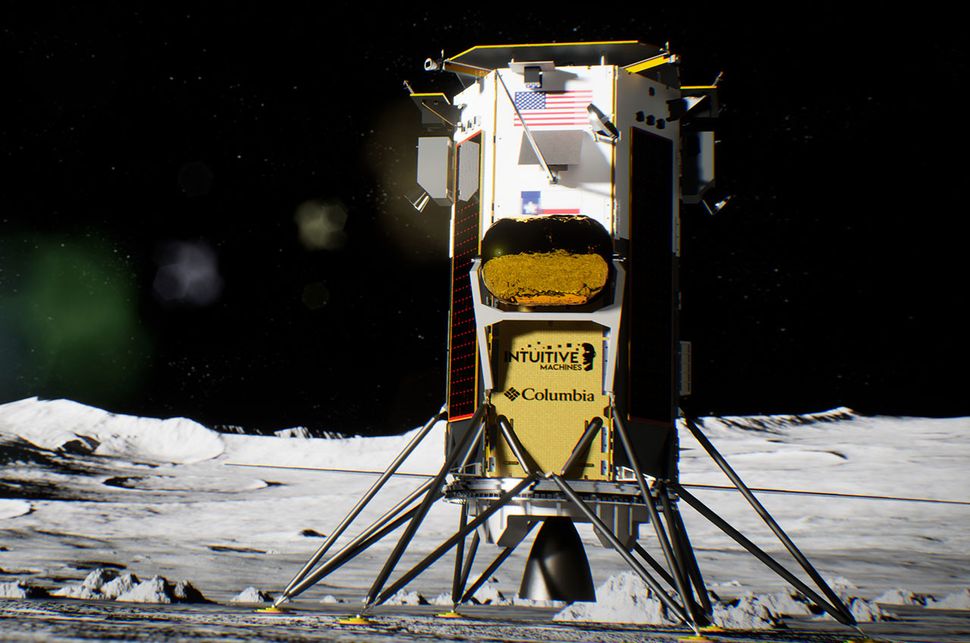
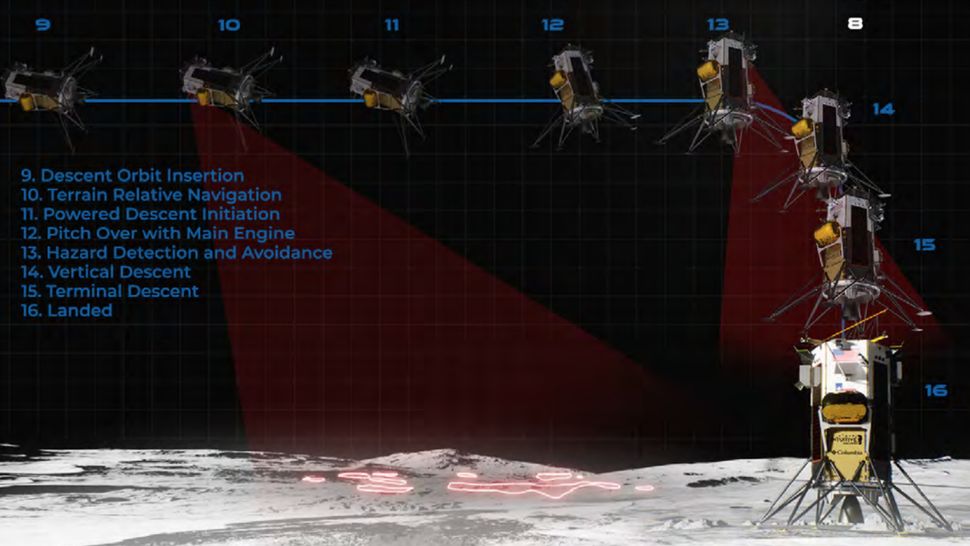
Today is the day the Intuitive Machines’ moon lander called Odysseus is slated to land on the Moon. It was launched a week ago on a SpaceX Falcon 9 rocket. And if successful it will be the first soft landing on the Moon by the United States since Apollo 17 back in 1972. I’m recording this last Sunday, so I don’t know the condition of the spacecraft and a lot can happen between launch and landing on the moon. The last spacecraft sent from the United States, last month, by the inaugural flight of United Launch Alliance’s Vulcan Centaur rocket crashed back on Earth. The spacecraft is supposed to land about 190 miles from the Moon’s South Pole, which is considerably closer to the South Pole than the Indian spacecraft landed last year.
The astronomical event times given are for the Traverse City/Interlochen area of Michigan (EST, UT –5 hours). They may be different for your location.
Addendum
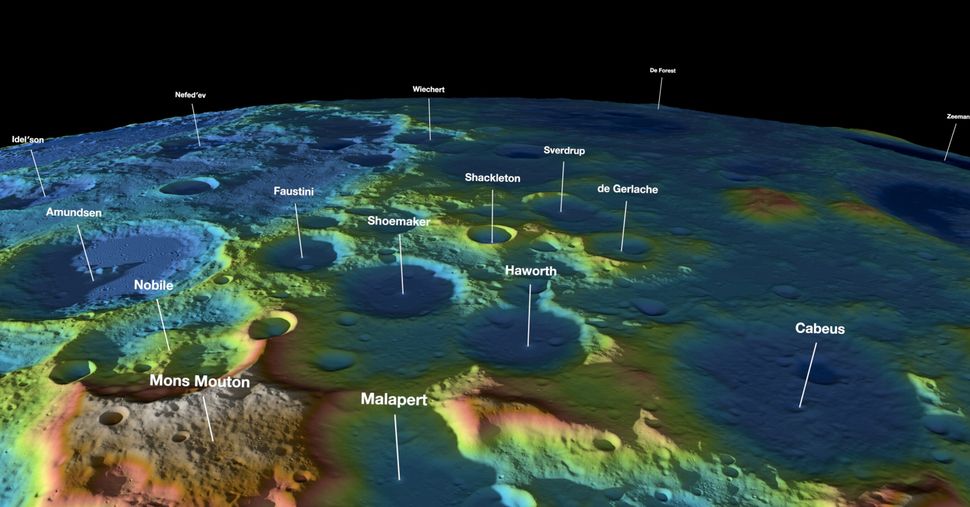
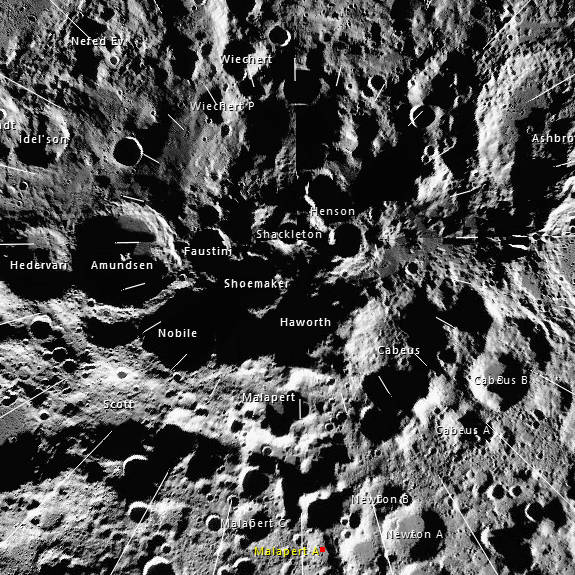
08/29/2022 – Ephemeris – On the day of the first Artemis I launch opportunity, a look at possible landing sites for Artemis III
As usual, the Ephemeris radio programs are recorded prior to them being aired. Monday’s programs have the longest lead times, being written and recorded eight days earlier, Sunday of the previous week. This blog post was created on the 28th. So I have no idea if Artemis I launches today or not. All three times this program will be sent out on-air will be before the scheduled launch.
This is Bob Moler with Ephemeris for Monday, August 29th. Today the Sun will be up for 13 hours and 23 minutes, setting at 8:24, and it will rise tomorrow at 7:02. The Moon, 2 days past new, will set at 9:43 this evening.
Earlier this month, NASA announced the selection of 13 possible landing areas near the South Pole of the Moon. The South Pole of the Moon was selected as the Artemis target since ice was found at the bottom of some of the craters there. Back in the Apollo days, landing sites were selected by being smooth, and the first were in the broad lava plains called lunar seas. The Moon’s South Pole is the opposite. It’s in the rugged lunar highlands. The landing areas turn out to be crater rims and ridges or small plateaus that catch the Sun, just above the lunar horizon. NASA is developing autonomous landing systems that can cope with landing on such difficult terrain, with deep shadows illuminated by a very low Sun. These are not ideal landing conditions.
The astronomical event times given are for the Traverse City/Interlochen area of Michigan (EDT, UT – 4 hours). They may be different for your location.
Addendum
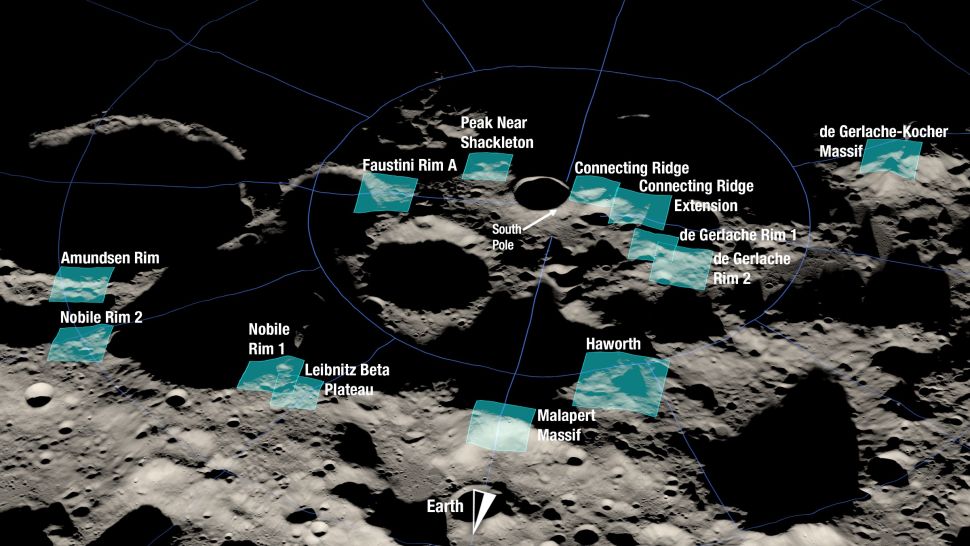
On August 19, 2022, NASA released the candidate lunar landing sites for Artemis III near the Moon’s South Pole. Click on the image to enlarge it. Credit: NASA, Lunar Reconnaissance Orbiter.
04/08/2022 – Ephemeris – Landing a spacecraft at the Moon’s South Pole will be a tricky prospect
This is Ephemeris for Friday, April 8th. Today the Sun will be up for 13 hours and 8 minutes, setting at 8:19, and it will rise tomorrow at 7:09. The Moon, 1 day before first quarter, will set at 3:58 tomorrow morning.
The Artemis missions are to land near the South Pole of the Moon. Unlike the Earth’s 23 and a half degree axial tilt the Moon’s is only a degree and a half, so there is little month long variation of the Sun angle, though the Sun’s direction along the horizon revolves 360 degrees over 29 and a half days, the length of its orbit of the Earth. It should make for quite a challenge to land the human lander safely near the lunar South Pole. The lander has to choose a spot in sunlight to land that’s relatively smooth. The reason for the attraction of the lunar South Pole is the presence of water ice in permanently shadowed craters near and at the pole. The Moon’s North Pole isn’t as heavily cratered, with fewer permanently shadowed craters.
The astronomical event times given are for the Traverse City/Interlochen area of Michigan (EDT, UT – 4 hours). They may be different for your location.
Addendum
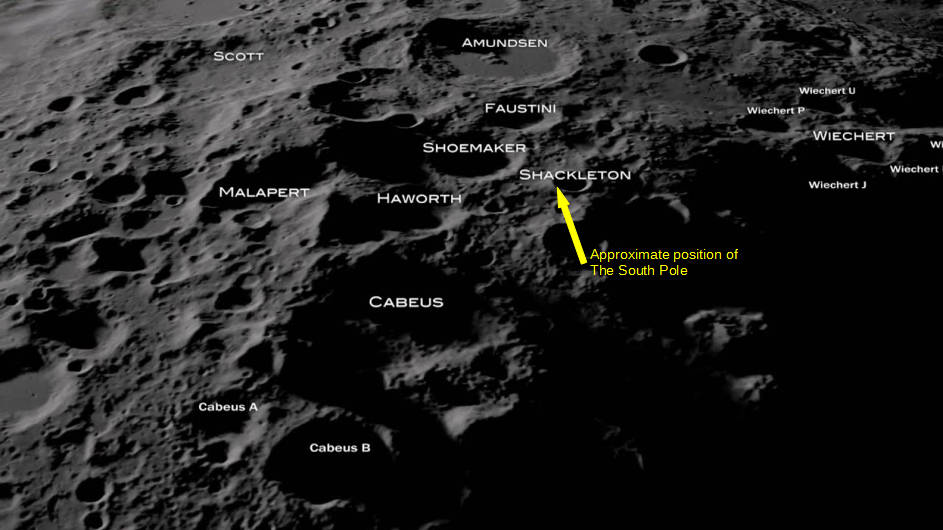
Lunar South Pole Flyover area with approximate South Pole marked based on Virtual Moon Atlas. Did you note a theme in some crater names? Click on the image to enlarge it. Credit: NASA/LRO.
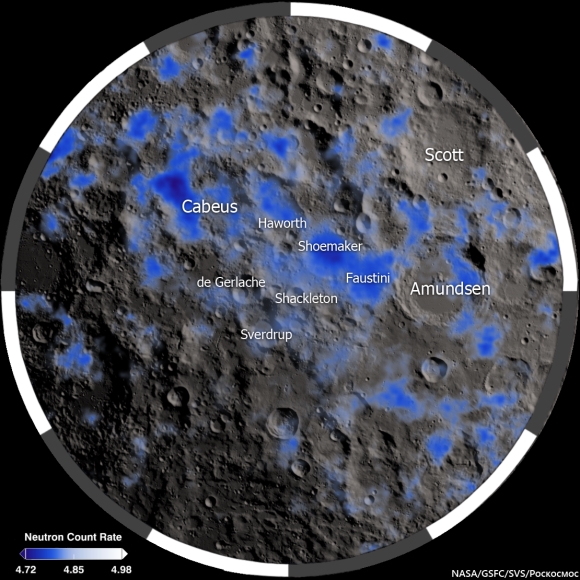
The South Pole of the Moon, where the presence of water ice is detected by the absorption of neutrons by the hydrogen atoms in the ice. Credit NASA/GSFC/SVS/Roscosmos.
01/19/2021 – Ephemeris – The Moon is a pretty straight up orb
This is Ephemeris for Tuesday, January 19th. Today the Sun will be up for 9 hours and 20 minutes, setting at 5:33, and it will rise tomorrow at 8:13. The Moon, 1 day before first quarter, will set at 12:36 tomorrow morning.
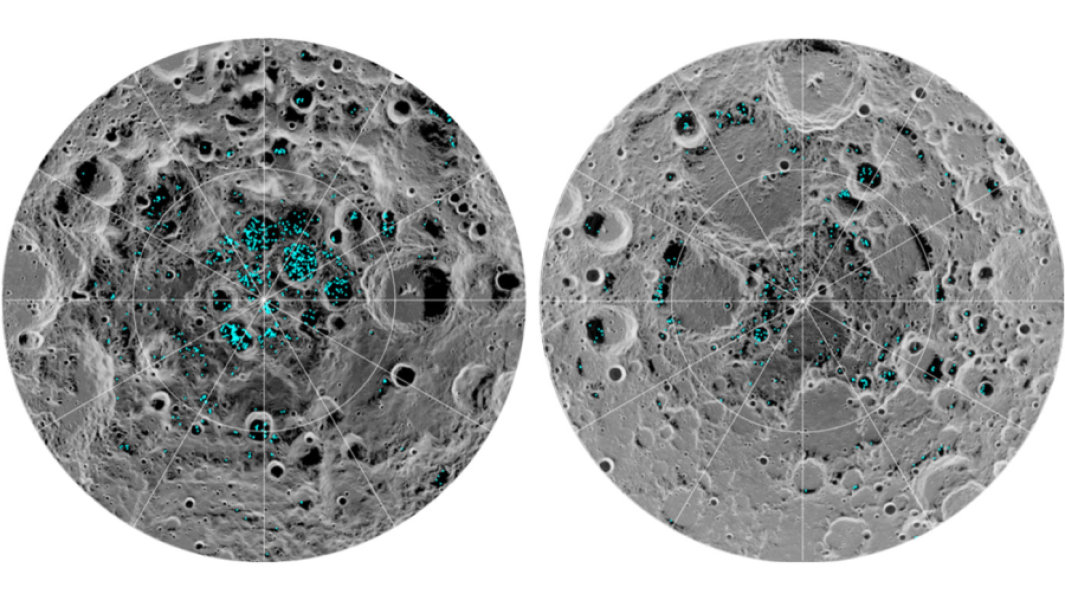
The Earth has an axial tilt to its orbit of the Sun of 23 ½ degrees. So the Earth has seasons, the cycle of which last one orbit of the Sun, or one year. Our Moon on the other hand has a 5 ½ degree axial tilt to its orbit of the Earth, but more importantly for future moon colonists, has only a degree and a half tilt compared to the Earth’s own orbit of the Sun. So there are spots at the north and south poles that never get the Sun’s heat or light. The Moon’s south polar region is more rugged with more and smaller craters than the north, so has collected, over the eons, what seems to be a great amount of water ice that is cold enough to be stable in the vacuum of space. That makes it an ideal place to build a sustainable lunar base.
The event times given are for the Traverse City/Interlochen area of Michigan. They may be different for your location.
Addendum
The Moon’s south pole area on the left and north pole on the right. The cyan color shows shadowed areas where ice is located. Credit NASA
09/04/2020 – Ephemeris – What area of the Moon is the Artemis program interested in?
This is Ephemeris for Friday, September 4th. Today the Sun will be up for 13 hours and 3 minutes, setting at 8:13, and it will rise tomorrow at 7:10. The Moon, 2 days past full, will rise at 9:40 this evening.
Where will Artemis missions land when they get to the Moon? The Apollo missions mostly landed on the flat lunar seas which were really lava plains. The Artemis missions are headed to the Moon’s south polar regions. The Moon, unlike the Earth has very little axial tilt, so some of the crater floors at the poles are forever in shadow and near absolute zero, so are cold traps for volatile matter like water. Satellites over the years have found hydrogen over the south pole of the moon hinting that there is water ice there from impacting comets. There’s also crater peaks that are always in sunlight where solar panels can be erected to provide power throughout the month long lunar day. On the Moon, water is more precious than gold. There’s water in them thar craters!
The event times given are for the Traverse City/Interlochen area of Michigan. They may be different for your location.
Addendum
The south pole of the Moon where the presence of water ice is detected by the absorption of neutrons by the hydrogen atoms in the ice. Credit NASA/GSFC/SVS/Roscosmos. Notice a theme in the crater names here?
 Bob Moler's Ephemeris Blog