Archive
04/21/2023 – Ephemeris – The first major meteor shower of spring reaches peak this weekend
This is Ephemeris for Friday, April 21st. Today the Sun will be up for 13 hours and 46 minutes, setting at 8:35, and it will rise tomorrow at 6:47. The Moon, 1 day past new, will set at 10:44 this evening.
Saturday night and Sunday morning will see the peak of the Lyrid meteor shower. This is the first of two major meteor showers of spring. The other one in two weeks will have to compete with a full Moon. This meteor shower will be visible all night. At the end of twilight the radiant of the shower, where the meteors will seem to come from, will be low in the northeast, to the right of the bright star Vega in the constellation of Lyra the harp, for which the meteor shower is named. The radiant point is actually between the constellations of Lyra and Hercules. Only 15 to 20 meteors an hour will be expected when the radiant is nearly overhead as morning twilight starts in the 5 am hour. The most famous meteor shower, for us, is the Perseids of August reaching peak on the morning of the 13th of August which will be seen in dark skies for most of the night.
The astronomical event times given are for the Traverse City/Interlochen area of Michigan (EST, UT –4 hours). They may be different for your location.
Addendum
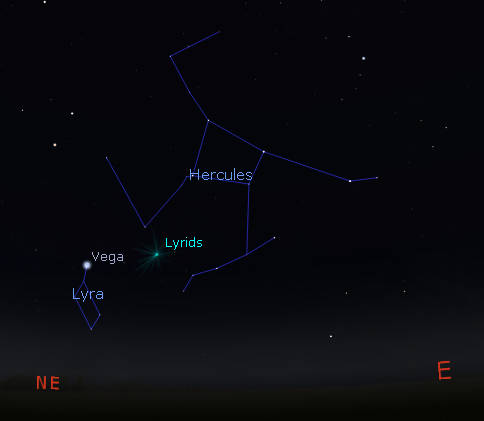
Lyrid radiant at 11 pm, looking to the east-northeast. The meteors will be seen all over the sky, but their tracks can be traced back to the radiant point, like the parallel rails of a train track recede to a point in the distance. Created using Stellarium.
04/21/2022 – Ephemeris – The Lyrid Meteor Shower reaches its peak tomorrow afternoon
This is Bob Moler with Ephemeris for Thursday, April 21st. Today the Sun will be up for 13 hours and 47 minutes, setting at 8:35, and it will rise tomorrow at 6:46. The Moon, 2 days before last quarter, will rise at 2:54 tomorrow morning.
The second major meteor shower this year will reach its peak tomorrow afternoon around 2 pm (~19h UT). One of the best times to see it will be tonight from about 10 pm to near 3 am when the Moon rises. The other is tomorrow night. The meteor shower is called the Lyrids, because they seem to come from near the constellation Lyra the harp and the bright star Vega. At 10 p.m. Vega is the brightest star low in the northeastern sky. By 3 a.m. Vega will be high in the east. The radiant of the meteors is to the west of Vega, between Lyra and the dim constellation of Hercules. The most meteors will be visible just before the Moon begins to brighten the sky before 3 a.m. Though a major shower, the peak hourly rate is expected to be less than 20 meteors an hour.
The astronomical event times given are for the Traverse City/Interlochen area of Michigan (EDT, UT – 4 hours). They may be different for your location.
Addendum
The Lyrid radiant at 11 pm, looking to the east-northeast. The meteors will be seen all over the sky, but their tracks can be traced back to the radiant point, like the parallel rails of a train track recede to a point in the distance. Click on the image to enlarge it. Created using Stellarium.
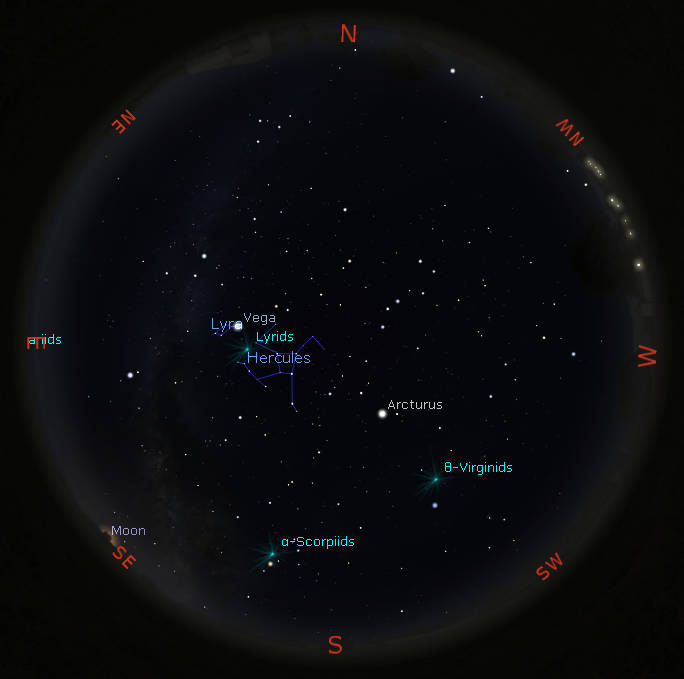
The Lyrid radiant at 3 am, looking in this all-sky view. Vega will be very high in the east and Hercules will be almost overhead. The meteors will be seen all over the sky, but their tracks can be traced back to the radiant point, like the parallel rails of a train track recede to a point in the distance. There are two other minor meteor showers happening at the same time, though neither is at peak, providing only a few meteors per hour. Click on the image to enlarge it. Created using Stellarium.
04/21/2020 – Ephemeris – The Lyrid Meteor Shower will reach its peak after midnight tonight
This is Ephemeris for Tuesday, April 21st. Today the Sun will be up for 13 hours and 48 minutes, setting at 8:36, and it will rise tomorrow at 6:45. The Moon, 1 day before new, will rise at 6:58 tomorrow morning.
The Lyrid meteor shower will reach its peak tomorrow morning at around 2 a.m. The Moon will be new tomorrow so it won’t interfere. The radiant point, from which the meteor seem to come is between the constellation Lyra the harp for which they are named with its bright star Vega and Hercules. The numbers of meteors seen in an hour could be between 12 and 20. The Lyrids are caused by the debris left when a comet last seen in 1861, crossed Earth’s orbit as Comet Thacher. Speaking of comets, a new comet named SWAN was discovered a month ago. It was detected by with the Solar Wind An-iso-tropies camera or SWAN aboard the Solar and Heliospheric Observatory or (SOHO) spacecraft. We’ll follow Comet SWAN as it approaches the Sun next month.
The event times given are for the Traverse City/Interlochen area of Michigan. They may be different for your location.
Addendum
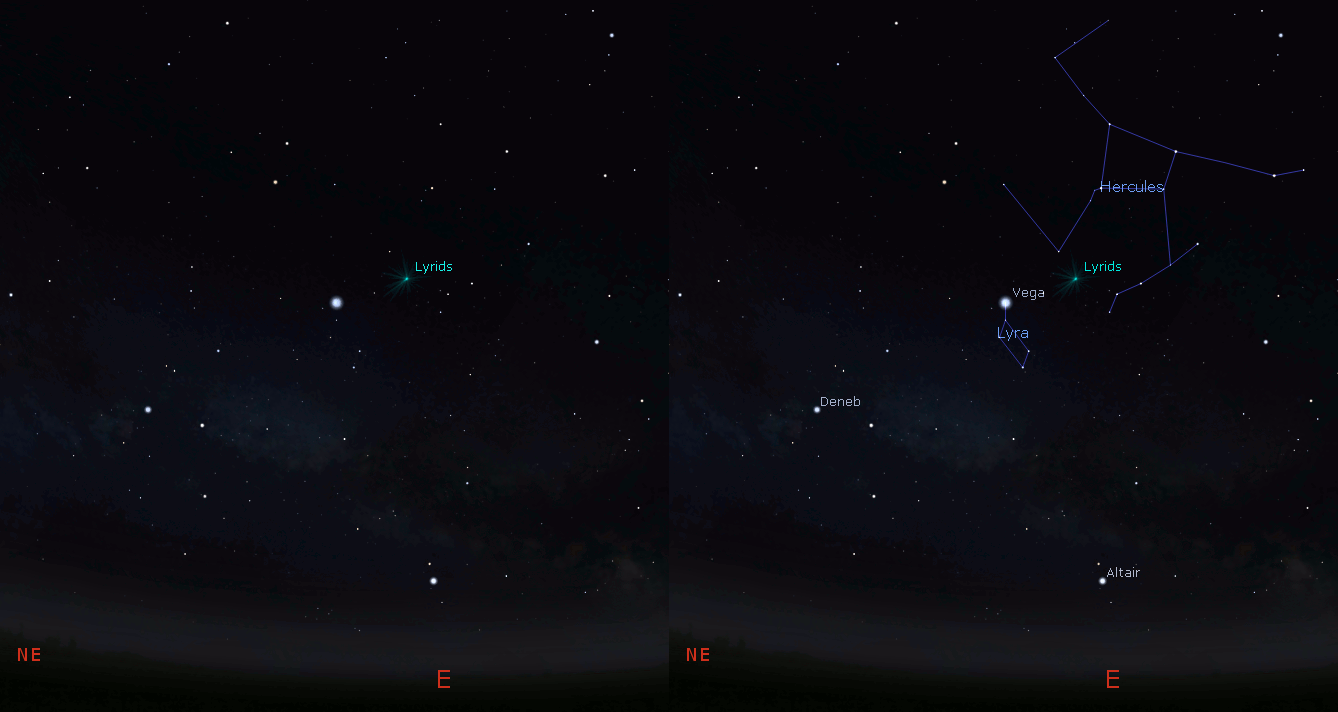
An animation Looking east at 2 a.m. April 22, 2020 toward Lyra, and Hercules with the Lyrid meteor radiant. The named stars are the stars of the Summer Triangle. Click on the image to enlarge. The meteors will appear all over the sky, but Lyrid meteors can be back traced to the radiant point. Created using Stellarium and GIMP.
04/20/2018 – Ephemeris – Astronomy Day and the Lyrid meteor shower this weekend
Ephemeris for Friday, April 20th. The Sun rises at 6:50. It’ll be up for 13 hours and 44 minutes, setting at 8:34. The Moon, 2 days before first quarter, will set at 1:50 tomorrow morning.
Tomorrow is Astronomy Day. The Grand Traverse Astronomical Society will celebrate with a star party at Northwestern Michigan College’s Rogers Observatory. Tomorrow April 21st, from 9 p.m. to 11 p.m. There will also be activities inside the observatory, so clear or cloudy there will be something to see or do for all ages. The Lyrid Meteor Shower will be active this weekend and reach a peak Sunday. The meteors from this shower will seem to come from near the constellation of Lyra the harp, a small and narrow parallelogram of stars with the bright star Vega near it. The best viewing will be for a few hours in the wee morning hours after the Moon sets Sunday or Monday mornings.
The times given are for the Traverse City/Interlochen area of Michigan. They may be different for your location.
Addendum
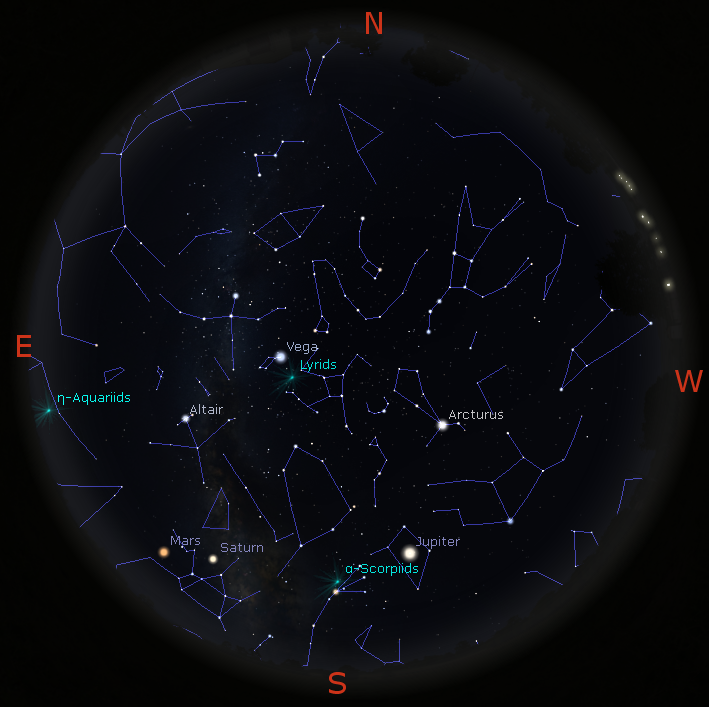
All sky view at 4 a.m. Sunday or Monday morning with the Lyrid radiant. Created using Stellarium.
The additional radiants showing in the image above are the (sigma) σ-Scorpids which will reach peak on April 28th, a minor shower and (eta) η-Auqariids which will reach peak on May 6th. Both these meteor showers have severe interference by the Moon.
04/20/2017 – Ephemeris – The Lyrid meteors are reaching their peak now
Ephemeris for Thursday, April 20th. The Sun rises at 6:49. It’ll be up for 13 hours and 44 minutes, setting at 8:33. The Moon, 1 day past last quarter, will rise at 4:20 tomorrow morning.
We are in a period where the Lyrid meteors appear. This capricious shower peaks at various times and with a variety of peak numbers from 14 to 90 per hour. The expected peak will be April 22nd at 8 a.m. The radiant point, from where the meteors seem to come, lies between the constellation Lyra and its bright star Vega and Hercules to the west of it. The radiant point starts the evening low in the northeast and moves nearly overhead when the Moon finally rises. The meteors, sometimes called falling stars will appear all over the sky, but can be traced back to that radiant point. The best time to see these or any meteor shower is when the radiant point is highest in the sky. That will be Saturday morning.
The times given are for the Traverse City/Interlochen area of Michigan. They may be different for your location.
Addendum
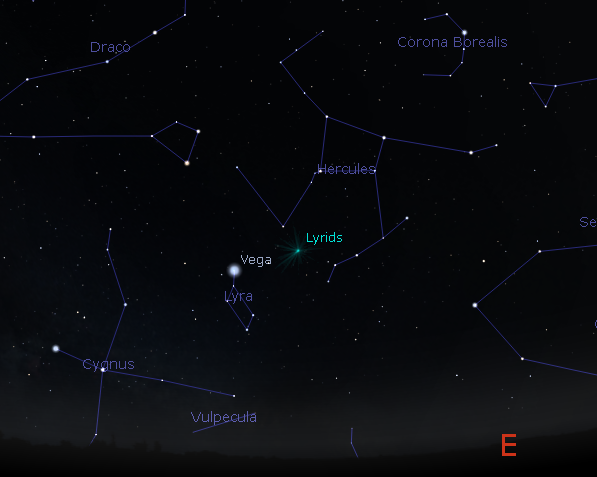
Location of the Lyrid meteor radiant at midnight. Note that the radiant point is a spot that the meteors can be back tracked to. The meteors will appear all over the sky. If they appear near the radiant they will appear to move the slowest, since their actual motion is mostly toward the observer. Created using Stellarium.
The display of meteor shower radiants is a plug-in in the latest versions of Stellarium.
04/20/2015 – Ephemeris – The Lyrid meteor shower will reach peak Wednesday evening
Ephemeris for Monday, April 20th. The Sun rises at 6:50. It’ll be up for 13 hours and 43 minutes, setting at 8:33. The Moon, 2 days past new, will set at 10:57 this evening.
This week the Lyrid meteor shower will reach its peak. The expected peak will be Wednesday the 22nd at 8 p.m. (24 hr UT). Unfortunately the radiant point will not have risen by then. The radiant, near the star Vega in the constellation of Lyra will rise in the northeast by 10 p.m. It will approach the zenith by 6 a.m. as morning twilight brightens. The normal peak hourly rate is about 18 when the radiant is at the zenith, This year it could be as many as 90 per hour. However Europe and Asia will be prime locations to view the shower near the zenith at peak. The shower is caused by the debris of Comet Thatcher, seen only once in 1861. When comets approach the Sun they shed gas, dust and small bits of rock. When the Earth passes through it we get a meteor shower.
Times are for the Traverse City/Interlochen area of Michigan. They may be different for your location.
Addendum
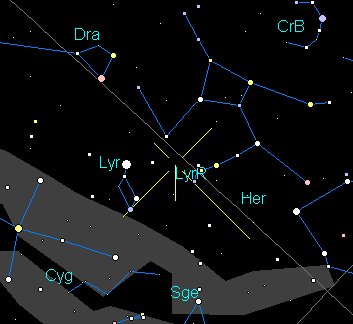
Lyrid meteor radiant is near Lyra and the bright star Vega. Th bright star by “Lyr” is Vega. Create by Bob Moler’s LookingUp program.
04/28/2014 – Ephemeris – The Lyrid meteor shower will reach peak tomorrow
Ephemeris for Monday, April 21st. The sun rises at 6:48. It’ll be up for 13 hours and 46 minutes, setting at 8:34. The moon, 1 day before last quarter, will rise at 2:52 tomorrow morning.
The second major meteor shower this year will reach its peak tomorrow afternoon (~18h UT). The best shot to see it will be tonight from about 10 to near 3 a.m. when the moon rises. The meteor shower is called the Lyrids, because they seem to come from near the constellation Lyra the harp and the bright star Vega. At 10 p.m. Vega is the brightest star low in the northeastern sky. By 3 a.m. Vega will be high in the east. The radiant of the meteors is to the west of Vega between Lyra and the dim constellation of Hercules. The most meteors will be visible just before the moon begins to brighten the sky before 3 a.m. Though a major shower the peak hourly rate is expected to be 18 meteors an hour. However we won’t quite get close to that rate.
Times are for the Traverse City/Interlochen area of Michigan. They may be different for your location.
Addendum
Lyrid meteor radiant. The bright star is Vega
The source of my information, the International Meteor Organization calendar can be downloaded from here.
David Dickinson’s post on this year’s Lyrid meteor shower on Universe Today is here.
04/19/2013 – Ephemeris Plus* – Astronomy Day and the Lyrid meteor shower
Ephemeris Plus for Friday, April 19th. The sun rises at 6:51. It’ll be up for 13 hours and 41 minutes, setting at 8:32. The moon, 1 day past first quarter, will set at 3:51 tomorrow morning.
Tomorrow is Astronomy Day 2013. Astronomy Day is generally held on the Saturday closest to the first quarter moon in late April or early May. The Grand Traverse Astronomical Society will celebrate with a star party at Northwestern Michigan College. Tomorrow April 20th, from 9 p.m. to 11 p.m. There will also be activities inside the observatory, so clear or cloudy there will be something to see or do for all ages.
The Lyrid Meteor Shower will be active this weekend and reach a peak Monday morning. The meteors from this shower will seem to come from near the constellation of Lyra the harp, a northern summer constellation, with the bright star Vega with a small and narrow parallelogram of stars near it. We do have a moon problem this year, so it just might be caught by early risers in the next couple of mornings. It is not a super active shower, and has a peak rate of only 18 and hour when Vega is overhead, which it will be at 5 in the morning. With the experience of the bright meteor that broke windows in Russia, be comforted to know that meteor showers members are created with very small grains, not big boulders.
Times are for the Traverse City/Interlochen area of Michigan. They may be different for your location.
*Ephemeris Plus contains more information in the post’s body that could not fit into the time constraints of the Ephemeris program.
Addendum
Lyrid meteor radiant. The bright star is Vega
04/20/2012 – Ephemeris – The Lyrid meteor shower peaks this weekend.
Ephemeris for Friday, April 20th. The sun rises at 6:49. It’ll be up for 13 hours and 45 minutes, setting at 8:34. The moon, 1 day before new, will rise at 6:41 tomorrow morning.
The Lyrid meteor shower is reaching a peak soon. With the nearly new moon, the moon will not interfere with the display. While this a major annual shower, it usually produces only 15 meteors an hour at peak, although in some years as many as 90 an hour have been spotted. The Lyrids are so named because the seem to come from the direction of the constellation Lyra the harp, one of the more famous summer constellations. Well, they seen to come from between Lyra and Hercules to the west. The peak of the shower occurs just after midnight on Sunday morning the 22nd. The radiant point is up all night. In the evening the meteors will come from the northeast from near the bright star Vega. The numbers of meteors will increase through the night until dawn.
* Times are for the Traverse City/Interlochen area of Michigan. They may be different for your location.
Addendum
Lyrid meteor radiant. The bright star is Vega
 Bob Moler's Ephemeris Blog