Archive
Ephemeris: 01/20/2026 – What’s happening inside the Great Orion Nebula
This is Bob Moler with Ephemeris for Tuesday, January 20th. Today the Sun will be up for 9 hours and 21 minutes, setting at 5:35, and it will rise tomorrow at 8:12. The Moon, 2 days past new, will set at 7:42 this evening.
The closest star nursery to us, places where stars are being born, is the Great Orion Nebula, 1,300 light years away. A light year is about 6 trillion miles, if you want to pace it out. It’s located in the constellation Orion’s sword that hangs below his belt. It is seen in as little as a pair of binoculars, and shines by emission and reflection of the light of a tiny clutch of four stars at its heart, called the Trapezium. These extremely hot young massive stars are not destined to live long. Unlike the Sun’s 10 billion year lifetime, these stars lifespans will be measured in millions of years. Yet do not mourn for them, even now stars are forming within their dusty cocoons in the nebula. The Trapezium stars’ deaths will provide heavy elements for new stars and planets.
The astronomical event times given in this blog are for the Traverse City/Interlochen area of Michigan (Lat 44.7° N, Long 85.7° W; EST, UT – 5 hours) unless stated otherwise. Times will be different for other locations.
Addendum
There are several videos produced by NASA, ESA and others of a fanciful trip through the Great Orion Nebula. I found them by typing: NASA trip through the Orion nebula into my Internet browser.
Ephemeris: 01/21/2025 – How to find the Great Orion Nebula
This is Ephemeris for Tuesday, January 21st. Today the Sun will be up for 9 hours and 24 minutes, setting at 5:36, and it will rise tomorrow at 8:11. The Moon, at last quarter today, will rise at 2:01 tomorrow morning.
The constellation Orion the hunter is in the southeast at 8 PM. Its rectangle of four stars lean to the left and frame his belt of three stars in a straight line in the center of the rectangle. Below the belt is what appear to the unaided eye as three more stars arranged in a shorter straight line, his sword. Binoculars aimed at the middle stars of the sword will find a glowing haze around those stars. That is the Great Orion Nebula, also known as Messier 42 or M 42. It is the birthplace of stars, illuminated by a clutch of four hot young stars. Besides stars and protostars being born in the nebula, there are also many double planets not belonging to stars discovered by the James Webb Space Telescope. The planets are only detectable in the infrared, Webb’s specialty.
The astronomical event times given are for the Traverse City/Interlochen area of Michigan (EST, UT – 5 hours). Times will be different for other locations.
Addendum
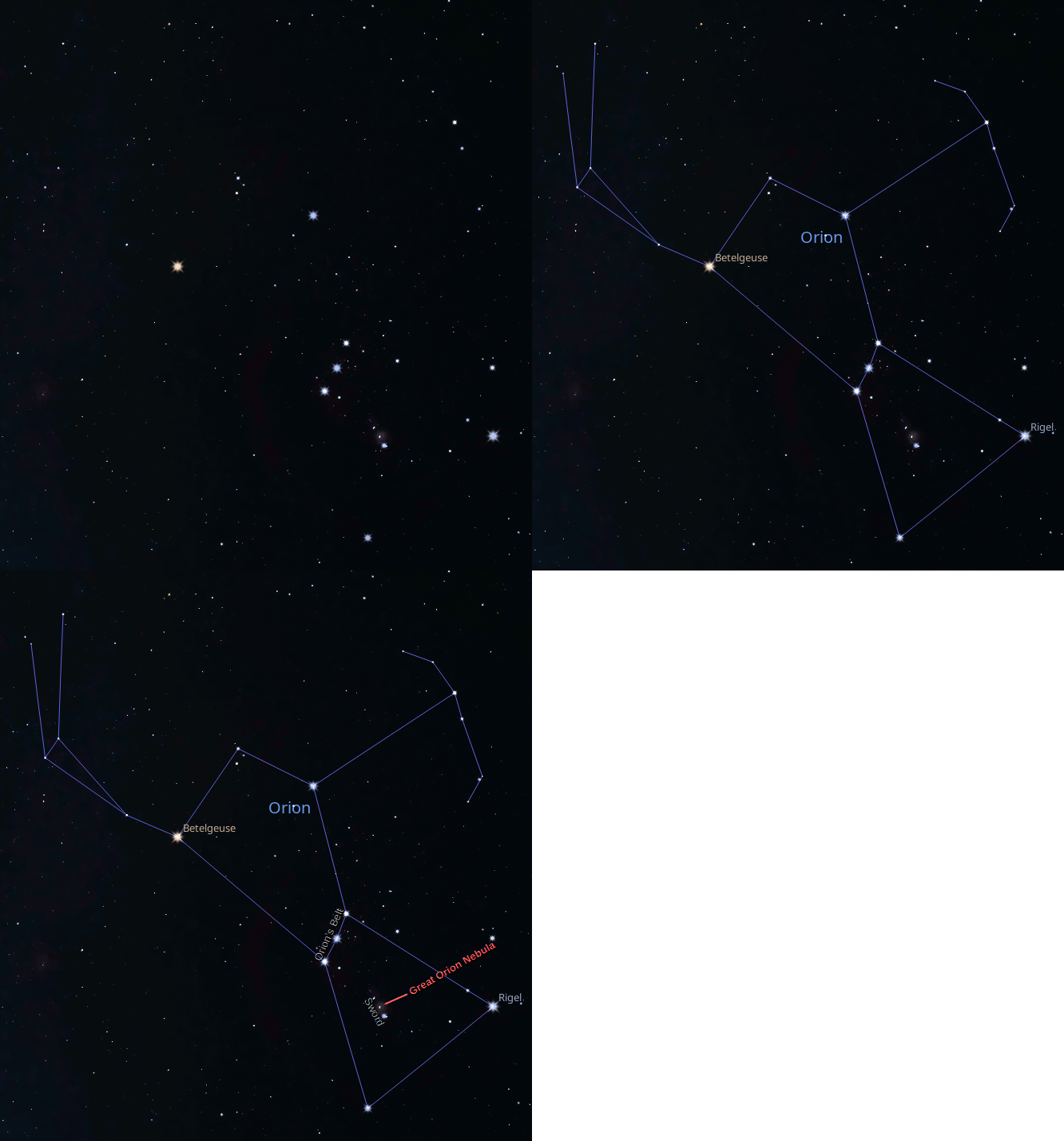
The blog’s archive has many other posts about the Great Orion Nebula and other nebulae in Orion.
Ephemeris: 01/05/2024 – The Great Orion Nebula
This is Ephemeris for Friday, January 5th. The Sun will rise at 8:20. It’ll be up for 8 hours and 56 minutes, setting at 5:16. The Moon, 2 days past last quarter, will rise at 3:18 tomorrow morning.
The constellation Orion the hunter is in the south-southeast at 9 p.m. Its upright rectangle of four stars frame his belt of three stars in a straight line and still tilt a bit to the left. Below the belt is what appear to the unaided eye as three more stars arranged vertically, his sword. Binoculars aimed at the middle stars of the sword will find a glowing haze around those stars. That is the Great Orion Nebula, also known as Messier 42 or M42. It is the birthplace of stars, and is even illuminated by a clutch of four hot young stars. Besides stars and protostars being born in the nebula, there are also many double planets not belonging to stars discovered by the James Webb Space Telescope. The planets are only detectable in the infrared, Webb’s specialty.
The astronomical event times given are for the Traverse City/Interlochen area of Michigan (EST, UT –5 hours). They may be different for your location.
Addendum
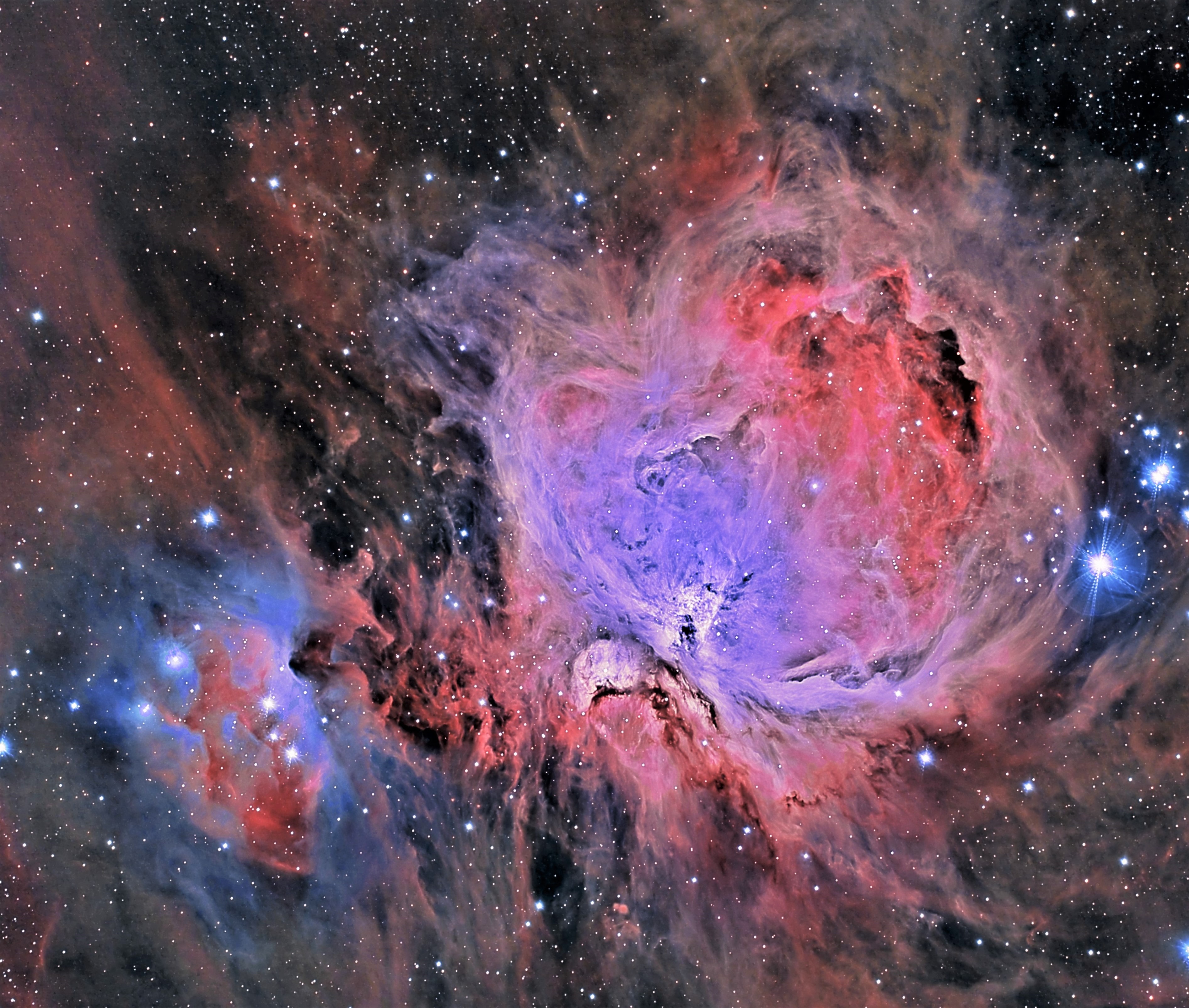
01/24/2022 – Ephemeris – The Great Orion Nebula
This is Ephemeris for Monday, January 24th. Today the Sun will be up for 9 hours and 30 minutes, setting at 5:40, and it will rise tomorrow at 8:09. The Moon, 1 day before last quarter, will rise at 1:03 tomorrow morning.
The closest star nursery to us, places where stars are being born, is the Great Orion Nebula, 1,300 light years away. A light year is about 6 trillion miles, if you want to pace it out. It’s located in the constellation Orion’s sword that hangs below his belt. In as little as a pair of binoculars, it shines by emission and reflection of the light of a tiny clutch of four stars at its heart, which astronomers have called the Trapezium. These extremely hot young massive stars are not destined to live long. Unlike the Sun’s 10 billion year lifetime, these stars lifespans will be measured in millions of years. Yet do not mourn for them, even now stars are forming within their dusty cocoons in the nebula. The Trapezium stars’ deaths will provide heavy elements for new stars and planets.
The astronomical event times given are for the Traverse City/Interlochen area of Michigan (EST, UT – 5 hours). They may be different for your location.
Addendum
The lower part of Orion, with the Great Orion Nebula. Created using Stellarium.
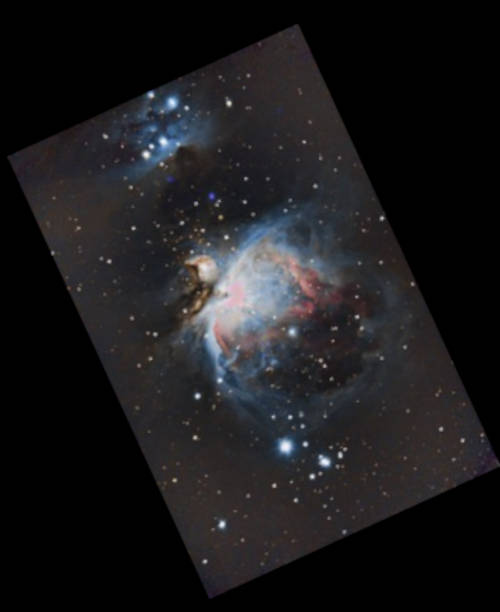
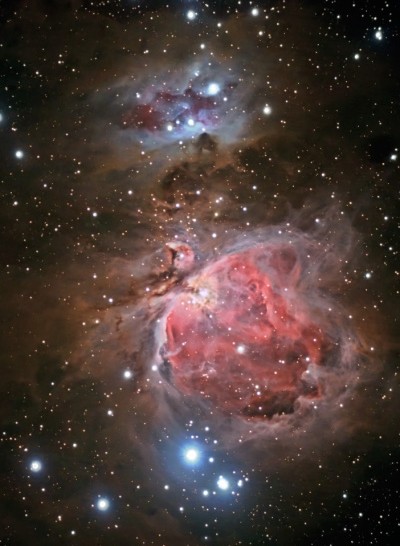
The Great Orion Nebula (M42) long exposure photograph by Scott Anttila. Includes all the sword stars.
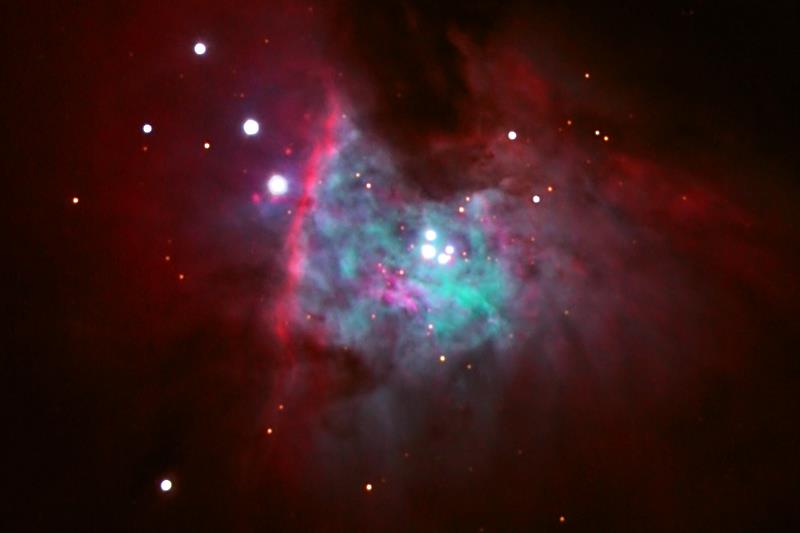
The inner and brightest part of the Great Orion Nebula. Also, visible are the four stars of the Trapezium, whose ultraviolet emissions light up the nebula. This is pretty much one’s perception of the nebula as seen in a small telescope, except it would appear colorless. In larger telescopes, one would perceive a greenish color. The red color of hydrogen is outside our night adapted visual range. The green emission is due to mainly doubly ionized oxygen and the green emission of hydrogen. Image by Scott Anttila.
01/16/2017 – Ephemeris – The bright cloud in Orion, the Great Orion Nebula
Ephemeris for Martin Luther King Day, Monday, January 16th. The Sun will rise at 8:15. It’ll be up for 9 hours and 14 minutes, setting at 5:30. The Moon, 3 days before last quarter, will rise at 10:30 this evening.
The constellation Orion the hunter, which is in the south-southeast at 9 p.m., is the brightest of constellations with 2 first magnitude stars and 5 second magnitude stars in its torso. Orion’s most famous feature is the Great Orion Nebula which lies in and around the stars of his sword. It is bright, and lies about 1,344 light years away. By the way, the word nebula is Latin and means cloud or haze. The plural of nebula is nebulae. It can be seen with binoculars as a haze around what to the naked eye looks like the center of the three stars of Orion’s sword. It is the lit end of a large dark cloud where stars are being formed. It is illuminated by a clutch of four young stars in a tiny group called the Trapezium.
Times are for the Traverse City/Interlochen area of Michigan. They may be different for your location.
Addendum
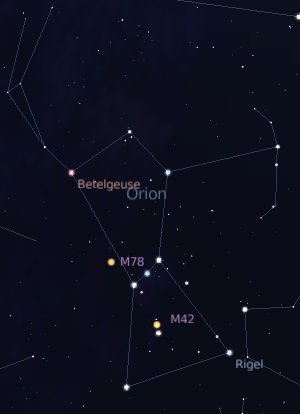
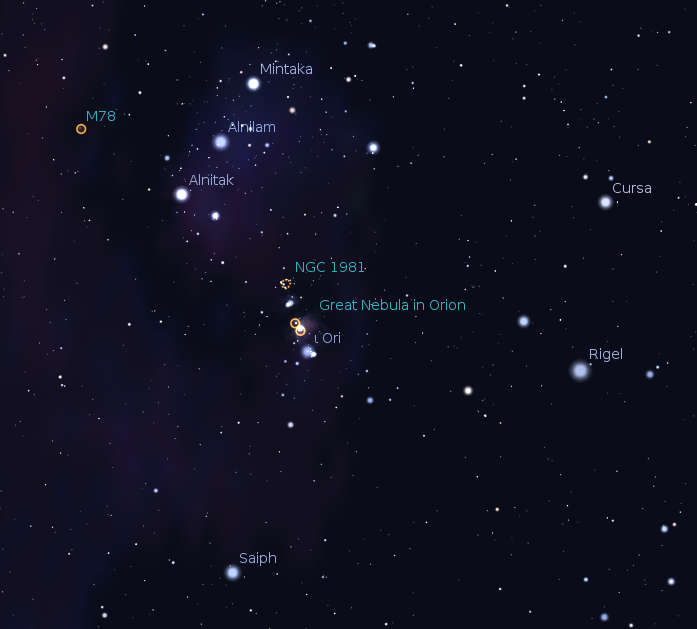
Orion with two nebulae. The Great Orion Nebula is M42. M78 is another small nebula. Created using Stellarium.
The Great Orion Nebula (M42) long exposure photograph by Scott Anttila. Includes all the sword stars.
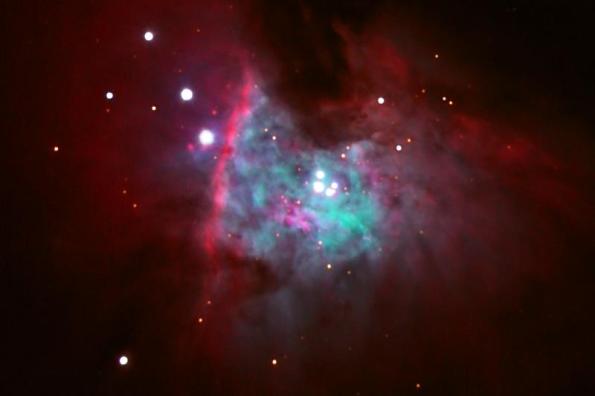
Inner part of the Great Orion Nebula with the four stars of the Trapezium. Image by Scott Anttila.
01/08/2013 – Ephemeris – The Great Orion Nebula
Ephemeris for Tuesday, January 8th. The sun will rise at 8:18. It’ll be up for 9 hours and 1 minute, setting at 5:20. The moon, 3 days before new, will rise at 5:56 tomorrow morning.
The closest star firming region to us is the Great Orion Nebula. It’s 1,344 light years away give or take 20 light years. A light year is about 6 trillion miles, if you’re counting. It’s located in the constellation Orion’s sword that hangs below his belt. It shines by emission and reflection of the light of a clutch of four stars at its heart, astronomers have called the Trapezium. Binoculars can be used to spot the nebula surrounding what looks like the middle star of the sword. The sword stars aren’t single stars like the belt but groups of stars. Anyway a telescope, using its lowest power will see a glow around those Trapezium stars. The glow will have a dark notch out of it, which is a dark cloud in front if it. Wisps of gas may also be seen.
Times are for the Traverse City/Interlochen area of Michigan. They may be different for your location.
Addendum
The Great Orion Nebula is also number 42 on Charles Messier’s list of objects to avoid when searching for comets. Amateur astronomers know it as M42, the show piece of the winter sky.
Orion via Stellarium.org
Inner part of the Great Orion Nebula (M42). Image by Scott Anttila.
The Great Orion Nebula (M42) long exposure photograph by Scott Anttila. Includes all the sword stars.
01/17/2012 – Ephemeris – The Great Orion Nebula part 1
Ephemeris for Tuesday, January 17th. The sun will rise at 8:15. It’ll be up for 9 hours and 15 minutes, setting at 5:30. The moon, 1 day past last quarter, will rise at 3:43 tomorrow morning.
One of the great questions of Christian theologians of Galileo’s time was why God would create stars that no human could see with the naked eye. Galileo’s primitive telescope showed a myriad of formerly invisible stars. Starting with Galileo, astronomers have shown that the stars weren’t made for man, and neither are the stars eternal. Stars are born and die, some spectacularly as supernovae. In the constellation of Orion the hunter, below the three stars of his belt are what appear another three stars hanging down as his sword.. Looking at what appears as the middle star with binoculars or a telescope one can detect a haze, a nebula astronomers call it. This is the Great Orion Nebula, even now the birthplace of stars.
* Times, as always are for the Traverse City/Interlochen area of Michigan.
Addendum
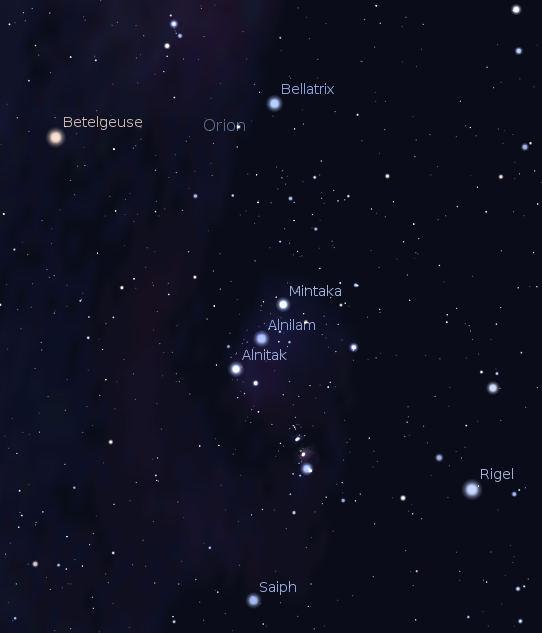
Torso of Orion centered on his belt. Created using Stellarium.
The lower part of Orion with the Great Orion Nebula. Created using Stellarium.
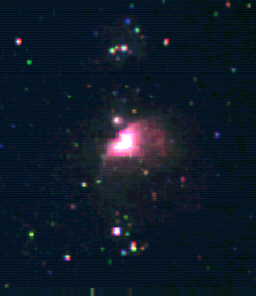
Great Orion Nebula in Orion's sword. My old photograph.
Note: The Great Orion Nebula usually photographs red due to the great abundance of the element hydrogen. However at low light levels our eyes are not sensitive to that particular color. So in the eyepiece the nebula looks gray or greenish due to the emission of hydrogen in the green and that of doubly ionized oxygen.
The Great Orion Nebula is also known by astronomers as M42 or Messier 42, a catalog of bright sky objects.
 Bob Moler's Ephemeris Blog