Archive
Ephemeris: 03/13/2025 – Get ready for tomorrow morning’s total lunar eclipse
This is Ephemeris for Thursday, March 13th. Today the Sun will be up for 11 hours and 48 minutes, setting at 7:46, and it will rise tomorrow at 7:56. The Moon, 1 day before full, will set at 8:06 tomorrow morning.
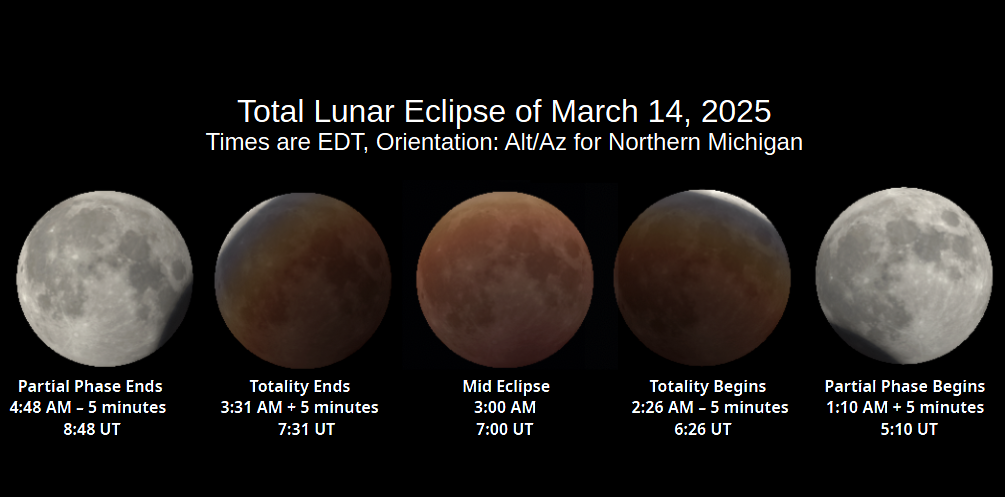
Late, late, late, tonight, or actually early tomorrow morning there will be a total eclipse of the Moon. The moment of full moon, which is necessary for a lunar eclipse will occur at 2:55 AM tomorrow, and the middle of the eclipse will be 5 minutes later. The partial phase of the lunar eclipse will start at 1:10 AM. This partial phase will grow until 2:26 AM when totality will begin. During this period of time the Moon should have a dull reddish color because it is illuminated only by the light filtering through the Earth’s atmosphere from the combined sunrises and sunsets around the world at that time. The total phase will end at 3:31 AM. The ending partial phase will continue until 4:48 AM.
The astronomical event times given are for the Traverse City/Interlochen area of Michigan (EDT, UT – 4 hours). Times will be different for other locations.
Addendum
Ephemeris: 03/11/2025 – There will be a lunar eclipse early Friday morning
This is Ephemeris for Tuesday, March 11th. Today the Sun will be up for 11 hours and 42 minutes, setting at 7:44, and it will rise tomorrow at 8:00. The Moon, 3 days before full, will set at 7:32 tomorrow morning.
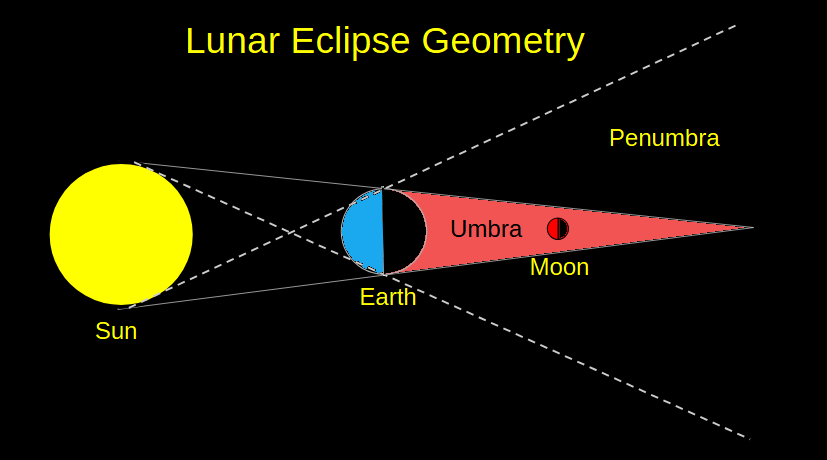
Early Friday morning, the 14th there will be a total eclipse of the Moon. Of course, we all hope for clear skies, but this is March. About 12:30 AM, keen observers might notice that the lower left side of the Moon seems to be a bit dimmer than the opposite side rather than the Moon being evenly illuminated. That’s because that leading edge of the Moon is witnessing a partial eclipse of the Sun. The moon is in the Earth’s penumbra or partial shadow where the Sun is being gradually cut off from the eastern part of the moon to the western part. The partial phase will begin at 1:10 AM Friday morning. Totality will begin at 2:26 AM and last until 3:31 AM. The ending partial phase will continue to 4:48 AM.
The astronomical event times given are for the Traverse City/Interlochen area of Michigan (EDT, UT – 4 hours). Times will be different for other locations.
Addendum
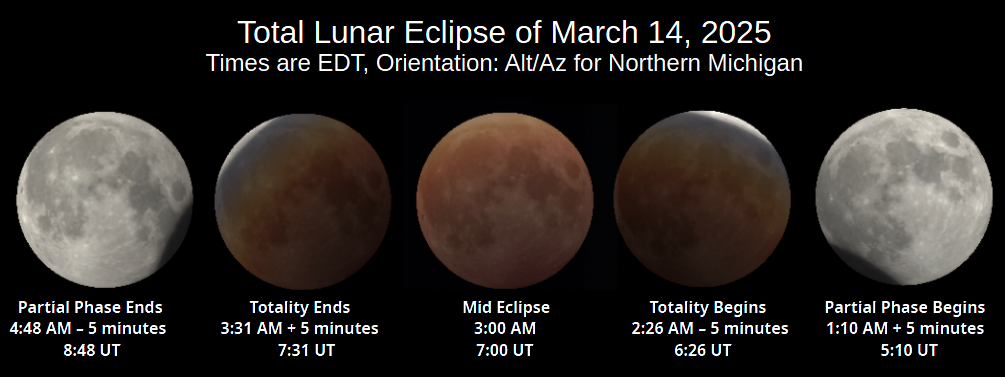
I don’t show the Moon when it enters or leaves the penumbra is because nothing is noticeable. About a half hour before the Moon enters the umbra to begin the partial phase of the eclipse, the side of the Moon nearest the umbra will be noticeably duller than the other side. The same is true after the partial phase is over. The effect of the deepening penumbra is more easily seen in sunglasses, that will darken the still bright Moon.
 Bob Moler's Ephemeris Blog