Archive
Ephemeris: 01/16/2025 – Mars has the second most eccentric orbit of all the planets
This is Ephemeris for Thursday, January 16th. Today the Sun will be up for 9 hours and 14 minutes, setting at 5:30, and it will rise tomorrow at 8:15. The Moon, 3 days past full, will rise at 8:37 this evening.
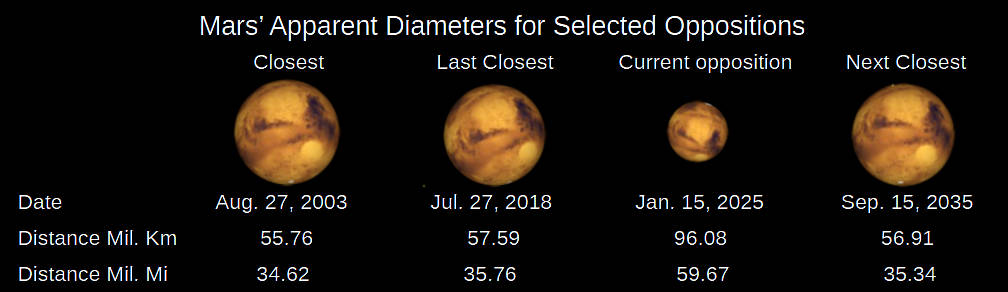
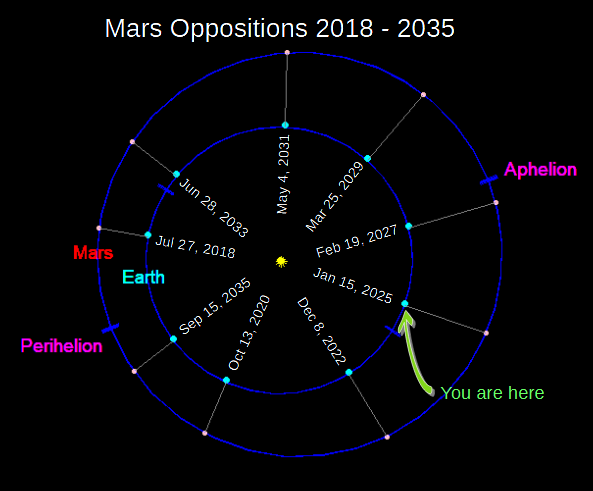
The planet Mars has the second most eccentric orbit of all the planets, after Mercury. But with yesterday’s opposition of Mars it only came down to 59.7 million miles away. At its absolute closest to us, which occurred in 2003, Mars got down to 34.6 million miles away. Since Mars orbits the Sun in little less than two earth years we catch up to it a little farther down in its orbit every time. Mars closest approaches occur every 15 or 17 years. The last close approach was in 2018. The next closest approach will occur in 2035 a span of 17 years. The closest approach before 2018 occurred in 2003 the span between those two was 15 years. Even at closest approach Martian detail is hard to see with a small telescope.
The astronomical event times given are for the Traverse City/Interlochen area of Michigan (EST, UT – 5 hours). Times will be different for other locations.
Addendum
10/06/2020 – Ephemeris – Mars is closest today, also the Draconid meteors are at peak
This is Ephemeris for Tuesday, October 6th. Today the Sun will be up for 11 hours and 25 minutes, setting at 7:13, and it will rise tomorrow at 7:48. The Moon, 3 days before last quarter, will rise at 9:46 this evening.
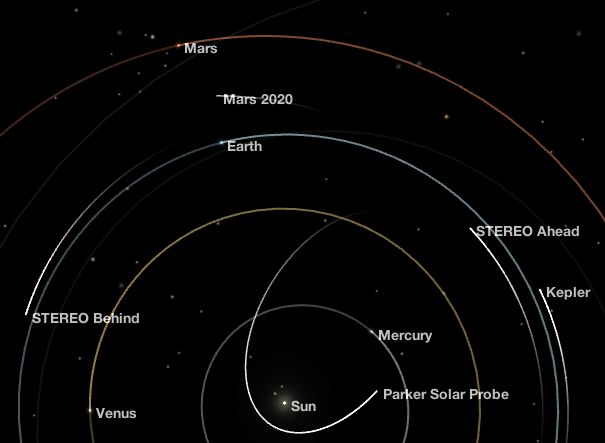
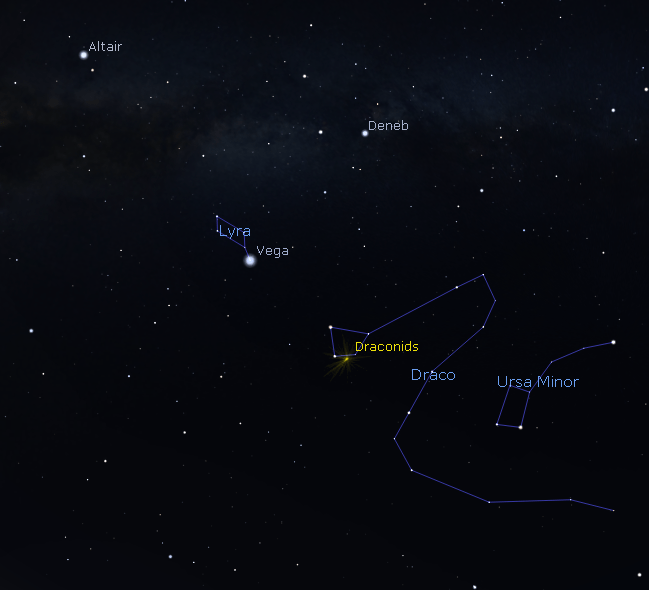
Today Mars is at its closest to the Earth of this close approach, what astronomers call an apparition. The last close approach was at the end of July two years ago. It is still pretty small in telescopes. However being this close, 38.6 million miles (62.1 million kilometers) away, it is actually slightly brighter than Jupiter. Check them out. Mars is the bright orange tinged star in the east while Jupiter is in the south-southwest at 9 pm tonight. It’s still a week before Mars lines up with the Earth and Sun in opposition. Mars is closer now because it is moving away from the Sun in its orbit. We are at the peak of a weak meteor shower most years. It’s the Draconids, which appear to come from the head of Draco the dragon near the bright star Vega, nearly overhead in the evening.
The event times given are for the Traverse City/Interlochen area of Michigan. They may be different for your location.
Addenda
Mars
Draconid Meteor Shower
07/30/2018 – Ephemeris – Early tomorrow morning Mars will be the closest to is in 15 years
Ephemeris for Monday, July 30th. The Sun rises at 6:26. It’ll be up for 14 hours and 44 minutes, setting at 9:10. The Moon, 3 days past full, will rise at 10:51 this evening.
Mars’ closest approach to the Earth since August 27, 2003 is tomorrow at about 3:51 a.m. at a distance of 35.8 million miles (57.6 million km). The last really close approach of Mars was on August 27, 2003 when it was about 600 thousand miles (a million km) closer. That close approach was probably the closest in 50 thousand years. Mars and the Earth get close in their orbits about every 26 months. But because Mars has a much more elliptical orbit than the Earth, the very best close encounters occur every 15 or 17 years. Despite the fact that we have satellites that orbit Mars and two rovers operating on its surface, amateur astronomers still challenge themselves to observe and photograph Mars at its very closest.
The times given are for the Traverse City/Interlochen area of Michigan. They may be different for your location.
Addendum
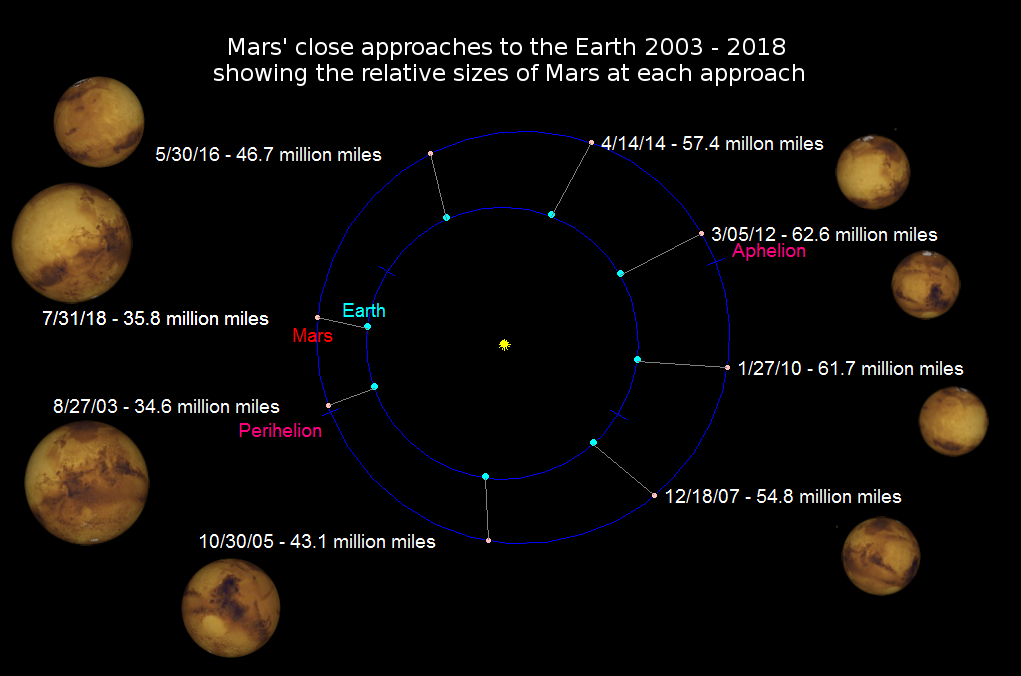
Mars’ closest approaches to the Earth in the period 2003 to 2018 also showing the apparent sizes of the planet at each approach. Click on image to enlarge. Created using my LookingUp program and Cartes du Ciel (Sky Charts).
05/30/2016 – Ephemeris – Mars is closest to the Earth of this go around today
Ephemeris for Memorial Day, Monday, May 30th. Today the Sun will be up for 15 hours and 18 minutes, setting at 9:20, and will rise tomorrow at 6:00. The Moon, 1 day past last quarter, will rise at 3:21 tomorrow morning.
Mars is the closest it gets to the Earth in this go-around today. Mars is the next planet out from the Sun. Earth is number 3 and Mars is number 4. Mars has a much more eccentric orbit than the Earth and varies from 128 million miles (207 million km) at its closest to the Sun, called perihelion to 155 million miles (249 million km) at aphelion. So at closest approach of Mars to the Earth the nearest distance can vary by nearly 30 million miles (42 million km). Mars moves slower in its orbit than does the Earth, taking 687 Earth days to orbit the Sun. That’s about 1 year, 10 ½ months. We catch up to Mars every 26 months or so, in a different part of its orbit. This time it will close to 46.7 million miles (75.2 million km) today.
Times are for the Traverse City/Interlochen area of Michigan. They may be different for your location.
Addendum
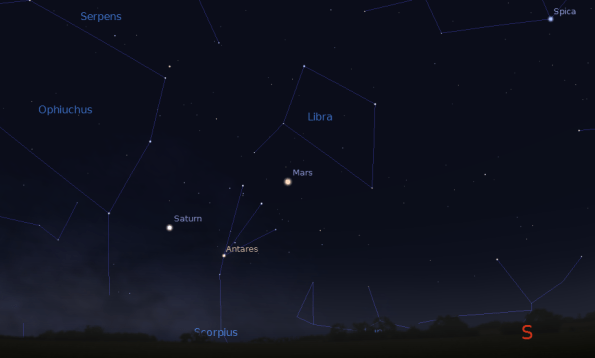
Mars finder chart for 11 p.m. May 30, 2016. Created using Stellarium.
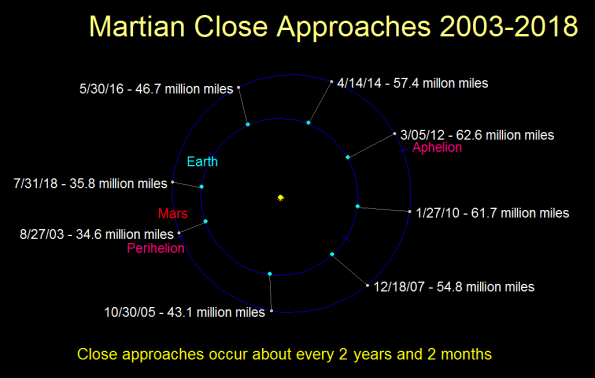
Mars closest approaches from 2003 to 2017. Created by my LookingUp program.
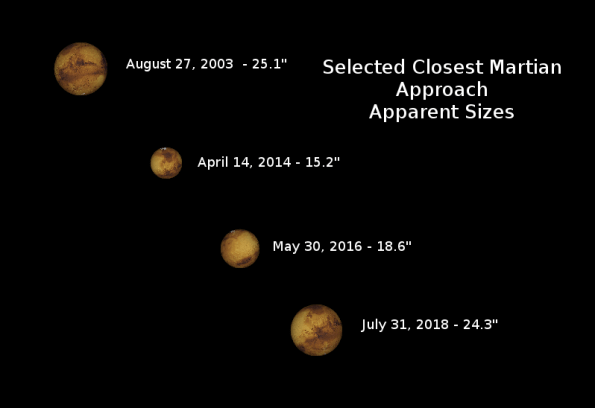
Selected Martian Closest Approaches Apparent sizes from 2003 to 2018. Created using Cartes du Ciel (Sky Charts).
05/23/2016 – Ephemeris – Mars was at opposition yesterday and will be closest next Monday
Ephemeris for Monday, May 23rd. Today the Sun will be up for 15 hours and 7 minutes, setting at 9:13. The Moon, 2 days past full, will rise at 10:45 this evening. Tomorrow the Sun will rise at 6:05.
Yesterday the planet Mars passed a point where it was opposite in the sky from the Sun. Astronomers call it opposition. This is a time when a planet is normally its closest to the Earth, since the Earth is more of less directly between the planet and the Sun. But due to Mars’ quite elliptical orbit, it is still approaching the Sun, and though the Earth is nudging ahead of it a bit, Mars won’t be closest to the Earth until next Monday, the 30th, 8 days after opposition. On that day it will be about 650 thousand miles (1 million, 46 thousand km) closer to the Earth than it was yesterday. On the 30th that will be 46.7 million miles (76.2 million km) away. The next closest approach in 26 months will be a bit closer yet.
Times are for the Traverse City/Interlochen area of Michigan. They may be different for your location.
Addendum
Mars closest approaches from 2003 to 2018. Created by my LookingUp program.
Selected Martian Closest Approaches Apparent Sizes from 2003 to 2018. Created using Cartes du Ciel (Sky Charts). Note that ” is seconds of arc. 1″ = 1/3600 of a degree. The Moon and Sun are about 1,800 seconds of arc in diameter.
Also note that at the star party last Saturday night Mars looked great, even though it was low in the sky.
05/06/2016 – Ephemeris – Learn about Monday’s transit of Mercury tonight
Ephemeris for Friday, May 6th. The Sun rises at 6:25. It’ll be up for 14 hours and 29 minutes, setting at 8:54. The Moon is new today, and won’t be visible.
Learn more about next Monday’s transit of Mercury across the Sun at tonight’s meeting of the Grand Traverse Astronomical Society at 8 p.m. at the Northwestern Michigan College’s Rogers Observatory, on Birmley Road, South of Traverse City. Afterward at 9 p.m., there will be another program and weather permitting there will be viewing of Jupiter, and later Mars. On Monday the Society will host transit viewing at two locations. The transit runs 6 ½ hours from 7:12 a.m. to 2:42 p.m. The Rogers Observatory will be open for that period. Also telescopes with be stationed at the Dune Climb at the Sleeping Bear Dunes National Lakeshore by yours truly to view the transit. The event is not visible to the naked eye and dangerous to even attempt it.
The program will also preview the coming opposition of Mars and closest approach since 2003 on the 30th.
Times are for the Traverse City/Interlochen area of Michigan. They may be different for your location.
Addendum
I posted these yesterday, but here they are again:
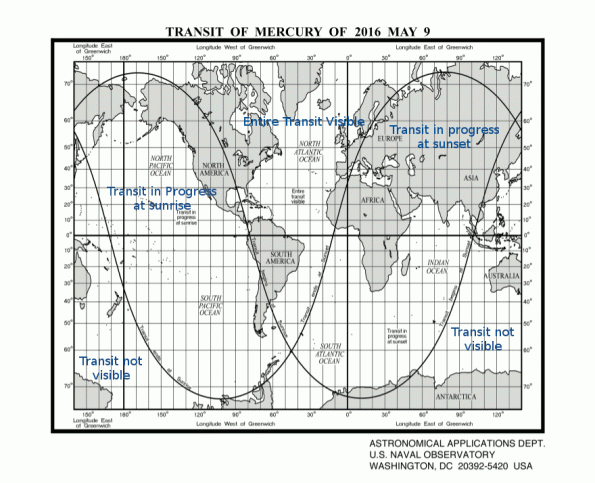
Transit visibility map with added captions to make it more readable. Credit United States Naval Observatory, The Astronomical Almanac Online.
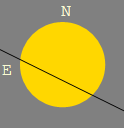
The track of Mercury across the face of the Sun. Mercury will travel from upper left to lower right. Mercury will not be visible until it impinges upon the disk of the Sun. Credit IOTA’s program Occult4.
From IOTA’s Occult4 program
Transit of Mercury on 2016 May 9 (TT)
   {'+' => next day; '-' => previous day }
                                           Overhead at
     Geocentric Event      UTC         P.A.  Long  Lat
                         h  m  s       o      o    o
[1]  Exterior Ingress   11 12 16     83.1     11   17
[2]  Minimum Separation 14 57 38             -45   18
[3]  Exterior Egress    18 42 23    224.4   -102   18

Minimum sepn 318.5";  Radii - Sun 950.4", Mercury 6.0"
delta T =  68.2 secs,  Ephemeris = DE0
Note: These timings are geocentric. Occult4 has timings for various cities of the world. Occult4.0.2 can be downloaded here. They can vary by several minutes for different cities due to parallax.
I will post more information on the transit in an Ephemeris Extra tomorrow.
03/28/2014 – Ephemeris – Mars approaches
Ephemeris for Friday, March 28th. The sun will rise at 7:30. It’ll be up for 12 hours and 34 minutes, setting at 8:04. The moon, 2 days before new, will rise at 6:40 tomorrow morning.
The planet Mars is making its every 26 month on average close approach to the Earth. Mars will reach opposition from the sun on April 8th, rising at sunset and setting at sunrise. Due to Mars’ strongly elliptical orbit, it will actually be closest to us 6 days later on April 14th. That distance will be about 57.4 million miles, nearly twice that if its closest distance of 34.6 million miles it came back in 2003. But take heart, the opposition distances are closing. On July 31, 2018 it will again be below 36 million miles away. Even at its closest, Mars is a tiny object for the telescope. It’s half the size of the Earth and at its closest will appear less that half the size that Jupiter appears to us.
Times are for the Traverse City/Interlochen area of Michigan. They may be different for your location.
Addendum
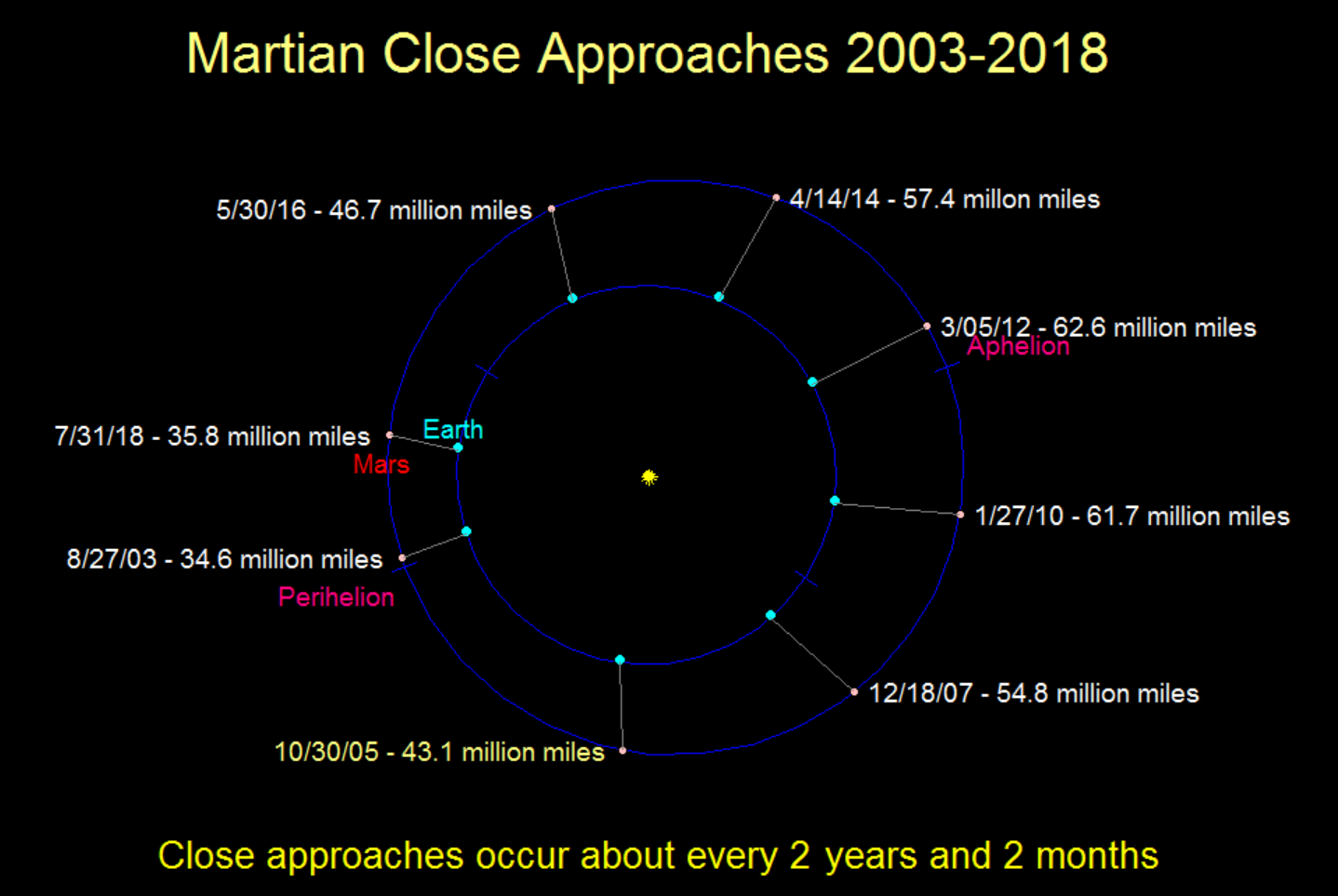
Mars’ closest approaches with the earth 2003 to 2018. Created with my LookingUp program.
 Bob Moler's Ephemeris Blog