Archive
Ephemeris: 11/20/2025 – Venus is disappearing from the morning sky
This is Ephemeris for Thursday, November 20th. Today the Sun will be up for 9 hours and 23 minutes, setting at 5:09, and it will rise tomorrow at 7:48. The Moon is new today, and won’t be visible.
Yesterday I mentioned that Venus is getting very difficult to spot in the morning sky, rising at about 7:00 AM. It’s moving around behind the Sun, what’s called superior conjunction, so it moves slower than it would when it moves toward inferior conjunction meaning it moves between the Earth and the Sun. It’s closer to the Earth so it appears to move faster. Then it’s only gone for maybe 8 to 10 days, transitioning from the evening sky to the morning sky. However, at superior conjunction which will occur on January 6, it will disappear for 50 days or actually longer. The ancient Mayans calculated that around superior conjunction Venus would disappear for about 50 days. We at a higher latitude would see a longer disappearance, losing it until sometime in late February or early March.
The astronomical event times given in this blog are for the Traverse City/Interlochen area of Michigan (Lat 44.7° N, Long 85.7° W; EDT, UT – 4 hours) unless stated otherwise. Times will be different for other locations.
Addendum
Ephemeris: 01/09/2025 – Venus is at its greatest separation from the Sun today
This is Ephemeris for Thursday, January 9th. Today the Sun will be up for 9 hours and 2 minutes, setting at 5:21, and it will rise tomorrow at 8:18. The Moon, 3 days past first quarter, will set at 5:25 tomorrow morning.
Tonight, Venus will be at its greatest separation from the Sun in the sky at a little bit more than a 47° angle. Venus, being inside the Earth’s orbit, can ever stray far from the Sun. So today it is at its greatest eastern elongation from the Sun. For the rest of winter it will be moving closer to the Sun from our perspective. Crossing between the Earth and the Sun on March 22nd. During this period of time Venus will be a great object for the telescope, as it moves closer to the Earth and gets larger in telescopes and its phase, moving from being like a quarter moon to a very thin crescent near the end of winter. At inferior conjunction with the Sun, Venus will be only 26 million miles away from us, but quite invisible in the Sun’s glare.
The astronomical event times given are for the Traverse City/Interlochen area of Michigan (EST, UT – 5 hours). Times will be different for other locations.
Addendum
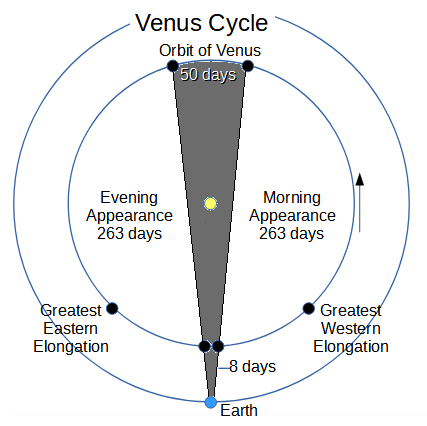
The Mayan civilization of Central America had several calendars. One of them was based on the planet Venus. They discovered that Venus repeated its positions in the sky with respect with the seasonal calendar over a period of eight years, which they called a Venus Sequence. They paid close attention to Venus and discovered it appeared to go around the Sun in the sky in 584 days, which they called a Venus Cycle. We call it Venus’ synodic period, which is the number of days between inferior conjunction, when Venus passes between the Earth and the Sun, then moves through the morning sky, and disappears behind the Sun at superior conjunction, then appears in the evening sky and back to inferior conjunction again. The gray area in the diagram is where Venus is not visible because it’s too close to the sun. However, at our latitude the number of days that Venus is invisible varies with the season. The Mayans, being in the tropics, didn’t have as much variation as we do. The Mayans discovered that Venus completed 5 cycles in almost exactly 8 years.
Today, Venus is at its greatest eastern elongation. On March 22nd Venus will pass inferior conjunction. That is 72 days from today. So it spends most of its time, 7 months, moving from around behind the Sun to the greatest elongation and only a short time, about 2 1/2 months moving from there to inferior conjunction. These 2 1/2 months are the best time to view Venus with a telescope, since Venus will grow in size and become an ever thinning crescent.
Check out my Wednesday posts showing the ever-growing and thinning Venus crescent until March 22nd. Or better yet, see it for yourself with a small telescope.
 Bob Moler's Ephemeris Blog