Archive
01/12/2016 – Ephemeris – Down a lazy river to Achernar
Ephemeris for Tuesday, January 12th. The Sun will rise at 8:18. It’ll be up for 9 hours and 5 minutes, setting at 5:24. The Moon, 3 days past new, will set at 8:46 this evening.
There’s a long and sinuous constellation that’s part of the winter sky. It is Eridanus, which depicts a river. The river starts near the lower right corner of Orion, near the bright star Rigel and flows to the right then down near the southern horizon, then it meanders below the horizon. One has to travel to the far southern United States or even farther south to see the southern terminus of the river, the bright star Achernar. Writers over the ages have seen here the Nile and the earth circling river Ocean of the flat earth days. In fiction Star Trek’s Mr. Spock supposedly came from a planet called Vulcan orbiting a star in Eridanus, sometimes identified as 40 Eridani, a dim triple star system 16.5 light years away.
Times are for the Traverse City/Interlochen area of Michigan. They may be different for your location.
Addendum
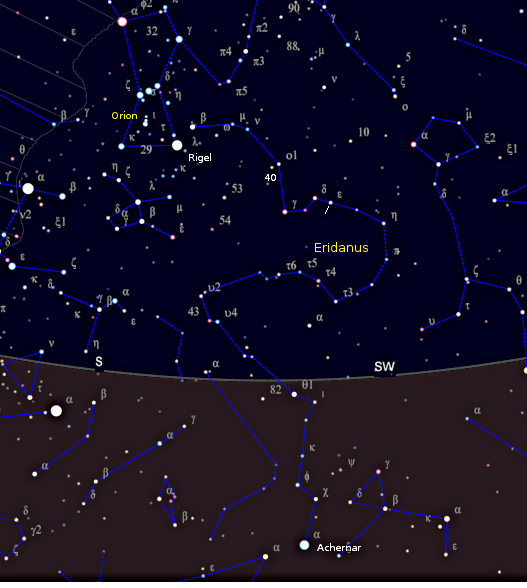
Eridanus with possible homes for Mr. Spock indicated. Created using Cartes du Ciel (Sky Charts).
In the chart above I’ve displayed that Bayer Greek letter designations and the Flamsteed numerical designations for the stars. There’s actually two candidate stars for Spock’s home world Vulcan. Epsilon (ε) is one. I’ve even mentioned it in prior posts. It’s 10.5 light years away. The star itself is 82% the mass of the Sun. It also has one and possibly two planets. The problem is that the star is young, lass than a billion years old. Any planet in the habitable zone of that star would be approximately the same state of development as the Earth 3 1/2 billion years ago.
The second star is 40 Eridani or Omicron 2 (ο2). The star is not labeled on the chart. It’s just above the “40” I marked on the chart. It is a triple star system that’s about 16.5 light years away. The brightest star is 84% the mass of the Sun, cooler, and about half as bright. The nearest of the companion stars comes almost as close as the orbit of Neptune to the primary star. The other one is much farther away. Though no planets have been found, a planet in the habitable zone would have a stable orbit. This star system is about a billion years older than the Sun, so it would be an ideal place to have an advanced civilization. Though the exact location of Vulcan has never been mentioned in any of the Star Trek series or movies, even Gene Roddenberry, the series creator has seemed to accept 40 Eridani as the location for Vulcan.
01/23/2014 – Ephemeris – The river Eridanus
Ephemeris for Thursday, January 23rd. The sun will rise at 8:10. It’ll be up for 9 hours and 28 minutes, setting at 5:38. The moon, 1 day before last quarter, will rise at 1:31 tomorrow morning.
There is a long and sinuous constellation that’s part of the winter sky. It is Eridanus, which depicts a river. The river starts near the lower right corner of Orion, near the bright star Rigel and flows to the right then down near the southern horizon, then it meanders below the horizon. One has to travel to the far southern United States or even farther south to see the southern terminus of the river, the bright star Achernar. Writers over the ages have seen here the Nile and the earth circling river Ocean of the flat earth days. One of its stars is close to us and famous. It’s Omicron 2 Eridani a triple star system and the fictional home to Mr. Spock and other Vulcans of the Star Trek franchise. No real planet has been found there. Yet.
Times are for the Traverse City/Interlochen area of Michigan. They may be different for your location.
Addendum
Note: In previous posts about Eridanus I had identified Epsilon Eridani and the fictional Mr. Spock’s home star. It’s actually Omicron 2 according to Gene Roddenberry himself.
Speaking of Vulcan, Star Trek fans nominated Vulcan for one of the names for Pluto’s latest two satellites, apparently forgetting that Vulcan was borrowed from Roman mythology as the god of fire, and the history of astronomy. Pluto and its satellites are some of the coldest bodies in the solar system, and the International Astronomical Union (IAU) had designated that the satellites carry on the Pluto and Hades or underworld theme. Anyway, in the mid 19th century some astronomers thought they discovered a planet that resided inside the orbit of Mercury and named it appropriately, Vulcan. If anything is ever found orbiting inside Mercury, it may get the name Vulcan. As for the names of the latest two moons of Pluto, they are Styx named after the the River Styx; and Kerberos, Greek for Cerberus the three headed dog that guards the entrance to Hades. Harry Potter fans may know this creature better as “Fluffy”.
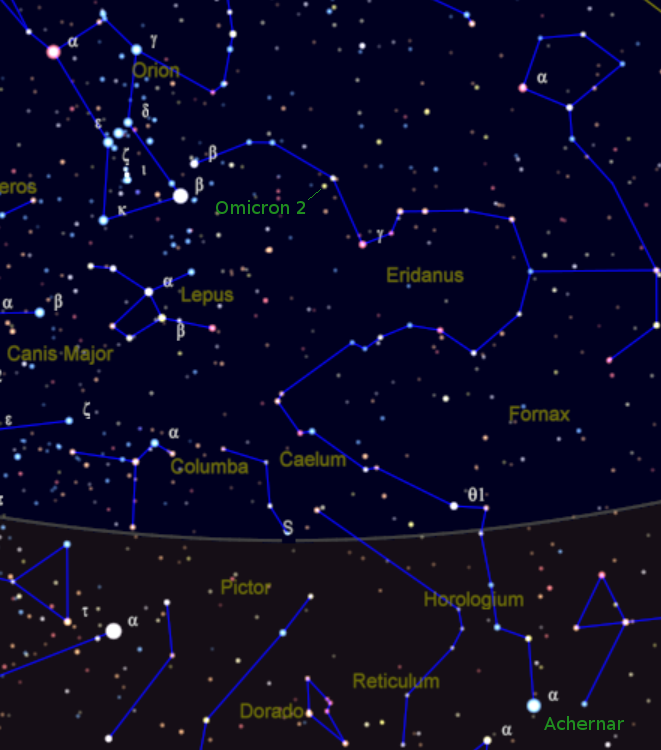
The constellation of the river Eridanus above and below the horizon for 9 p.m. on January 23, 2014. Created using Cartes du Ciel (Sky Charts).
 Bob Moler's Ephemeris Blog