Archive
Ephemeris: 05/03/2024 – GTAS meeting tonight: Eclipse Tales
This is Ephemeris for Friday, May 3rd. Today the Sun will be up for 14 hours and 21 minutes, setting at 8:50, and it will rise tomorrow at 6:27. The Moon, 2 days past last quarter, will rise at 4:48 tomorrow morning.
The Grand Traverse Astronomical Society will meet this evening at 8:00 PM at the NMC’s Joseph Rogers observatory which is on Birmley Road, south of Traverse City. The program will consist of returning members from the total solar eclipse last month showing their photographs, and recounting their adventures of going down to the path of totality. And in my case a video of the changes in the sky at totality, as the Moon’s shadow passed over us. Afterward, if it’s clear, will be viewing the skies, though there will be no planets or the Moon out. In the morning hours before dawn tomorrow and Sunday morning there will be a meteor shower, the Eta Aquariid meteor shower of particles from Halley’s Comet striking the Earth’s atmosphere.
The astronomical event times given are for the Traverse City/Interlochen area of Michigan (EDT, UT–4 hours). They may be different for your location.
Addendum
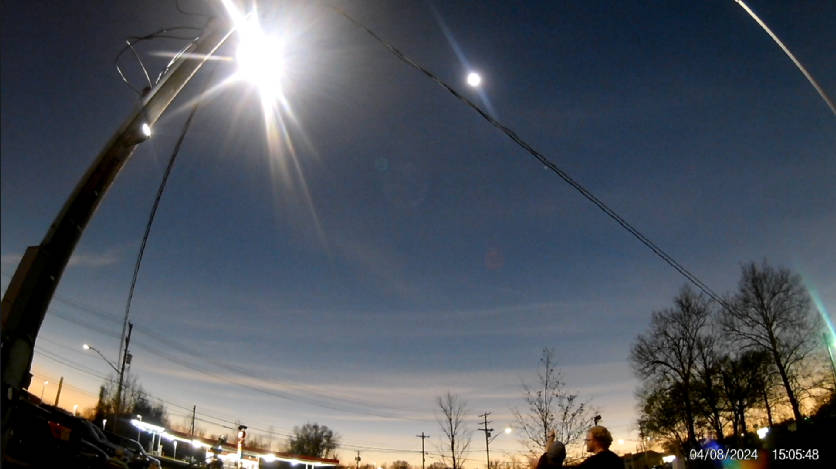
There will be more photos and stories at the meeting.
05/05/2023 – Ephemeris – Learn about the upcoming total solar eclipse tonight
This is Ephemeris for Cinco de Mayo, Friday, May 5th. Today the Sun will be up for 14 hours and 25 minutes, setting at 8:52, and it will rise tomorrow at 6:25. The Moon, at full today, will rise at 9:13 this evening.
Eleven months is not too early to plan for a total solar eclipse. On April 8th next year there will be such an eclipse whose path of totality clips the southeastern corner of Michigan. Indianapolis, Toledo and Cleveland also lie in the path of totality. The path runs from Texas to Maine. Member Dan Dall’Olmo will have all the particulars at this month’s meeting of the Grand Traverse Astronomical Society, starting at 8 pm tonight at Northwestern Michigan College’s Joseph H. Rogers Observatory. For those staying home, the Sun for this eclipse will be a bit more covered by the Moon than the 2017 August solar eclipse. We’ll also have another partial solar eclipse to practice on this October 14th.
The astronomical event times given are for the Traverse City/Interlochen area of Michigan (EDT, UT –4 hours). They may be different for your location.
Addendum
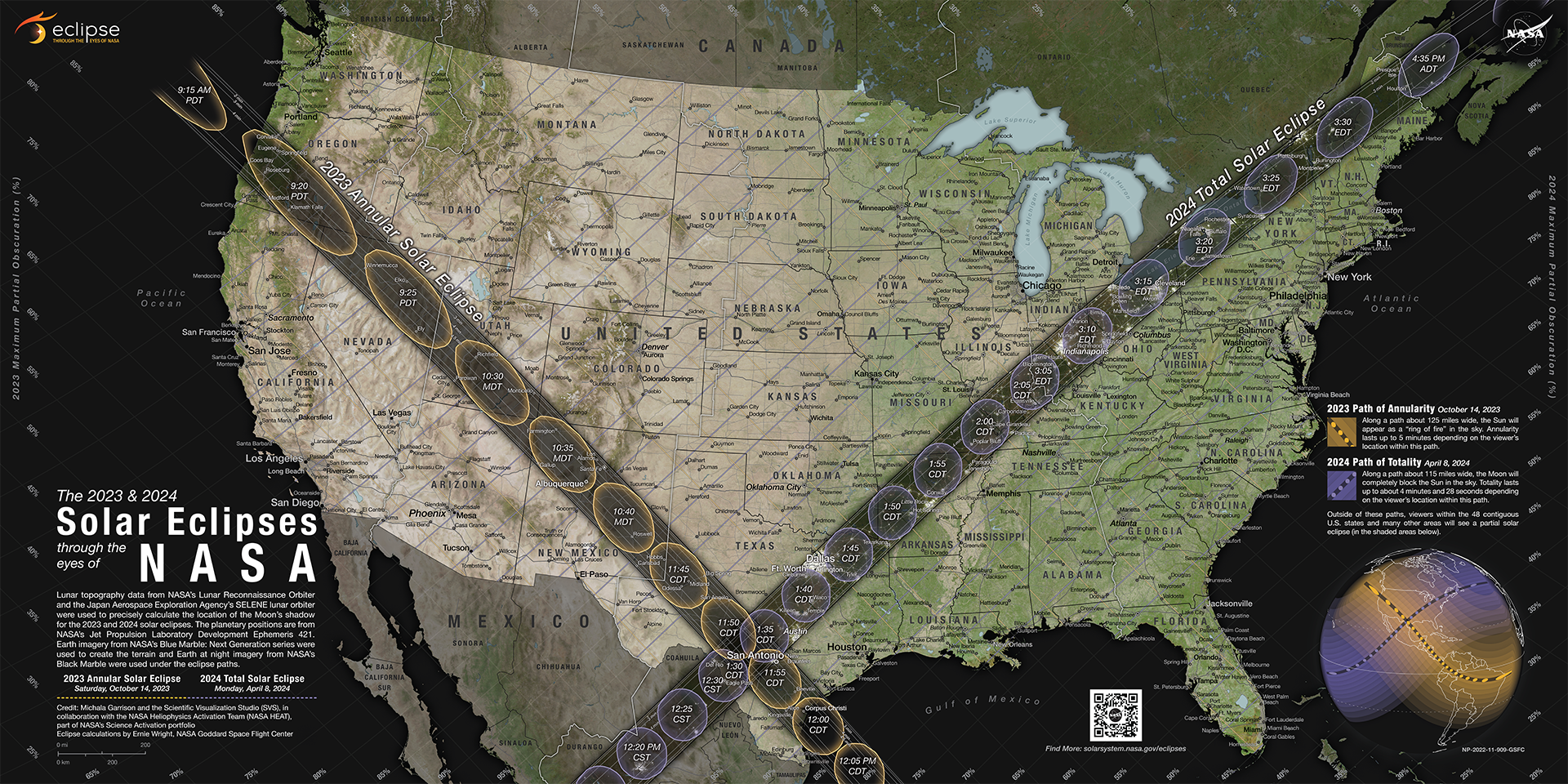
The paths of maximum eclipse of the October 14, 2023, and April 8, 2024. Click or tap on the image to enlarge it. Credit: NASA/Scientific Visualization Studio/Michala Garrison; eclipse calculations by Ernie Wright, NASA Goddard Space Flight Center.
10/07/2022 – Ephemeris – Learn about the Sun tonight and view the Moon on Saturday
This is Bob Moler with Ephemeris for Friday, October 7th. Today the Sun will be up for 11 hours and 24 minutes, setting at 7:12, and it will rise tomorrow at 7:49. The Moon, 2 days before full, will set at 6:08 tomorrow morning.
Tonight at 8 pm, the Grand Traverse Astronomical Society will have an in-person meeting at Northwestern Michigan College’s Rogers Observatory. The meeting will also be available via Zoom. The program will be presented by Mary Gribbin who has been observing the sun through her special solar telescope. She’ll describe the features visible with a solar telescope. If it’s clear, there will be a star party following the meeting. The observatory is located south of Traverse City off Birmley Road, between Garfield and Keystone roads. A Zoom link is available at gtastro.org. There will be a Moon and star party at the Sleeping Bear Dunes, Dune Climb tomorrow starting at 8 pm. That may be our last of the year out there. 2023 promises to have a full slate of star parties out there.
The astronomical event times given are for the Traverse City/Interlochen area of Michigan (EDT, UT – 4 hours). They may be different for your location.
Addendum
Excerpt from the Sleeping Bear Dunes National Lakeshore calendar posting:
“These events will be cancelled if the sky is not visible due to weather conditions. The decision to cancel is usually made either three hours in advance or by 4:30 p.m. the day prior to the event. Please call park rangers at 231-326-4700, ext. 5005, for a voicemail message with the decision. For the early morning and late evening astronomy events, bring a flashlight for the walk to and from the event. Park rangers and GTAS staff will wear red glow bracelets at the events. For more information about the Grand Traverse Astronomical Society, go to http://www.gtastro.org/.“
09/30/2022 – Ephemeris – View the Sun and Moon tomorrow in the Grand Traverse Area!
This is Ephemeris for Friday, September 30th. Today the Sun will be up for 11 hours and 45 minutes, setting at 7:25, and it will rise tomorrow at 7:40. The Moon, 2 days before first quarter, will set at 9:57 this evening.
There are two observing sessions tomorrow in the Traverse City area with the assistance of the Grand Traverse Astronomical Society. First at the Dennos Museum Center grounds, from 2 to 4 pm, there will be telescopes to safely view the Sun. The Sun’s eleven-year sunspot cycle is getting active again. There will be telescopes to see those sunspots, and special solar hydrogen alpha telescopes to view the Sun’s chromosphere and any prominences above the Sun that day. From 8 to 10 pm, Northwestern Michigan College’s Rogers Observatory will be open for International Observe The Moon Night. There will also be a telescope on the 200 Block of East Front Street to observe the Moon during this time. Of course, all this is contingent on clear or mostly clear skies.
Update: It’s supposed to be nice this weekend, after a week of cold and rain.
The astronomical event times given are for the Traverse City/Interlochen area of Michigan (EDT, UT – 4 hours). They may be different for your location.
Addendum
Later today I’ll add a Moon Map for tomorrow evening and what the Sun looks like today, which should give a clue to what’s happening on the Sun now.
Sun in white light (How we normally see it with a solar filter)
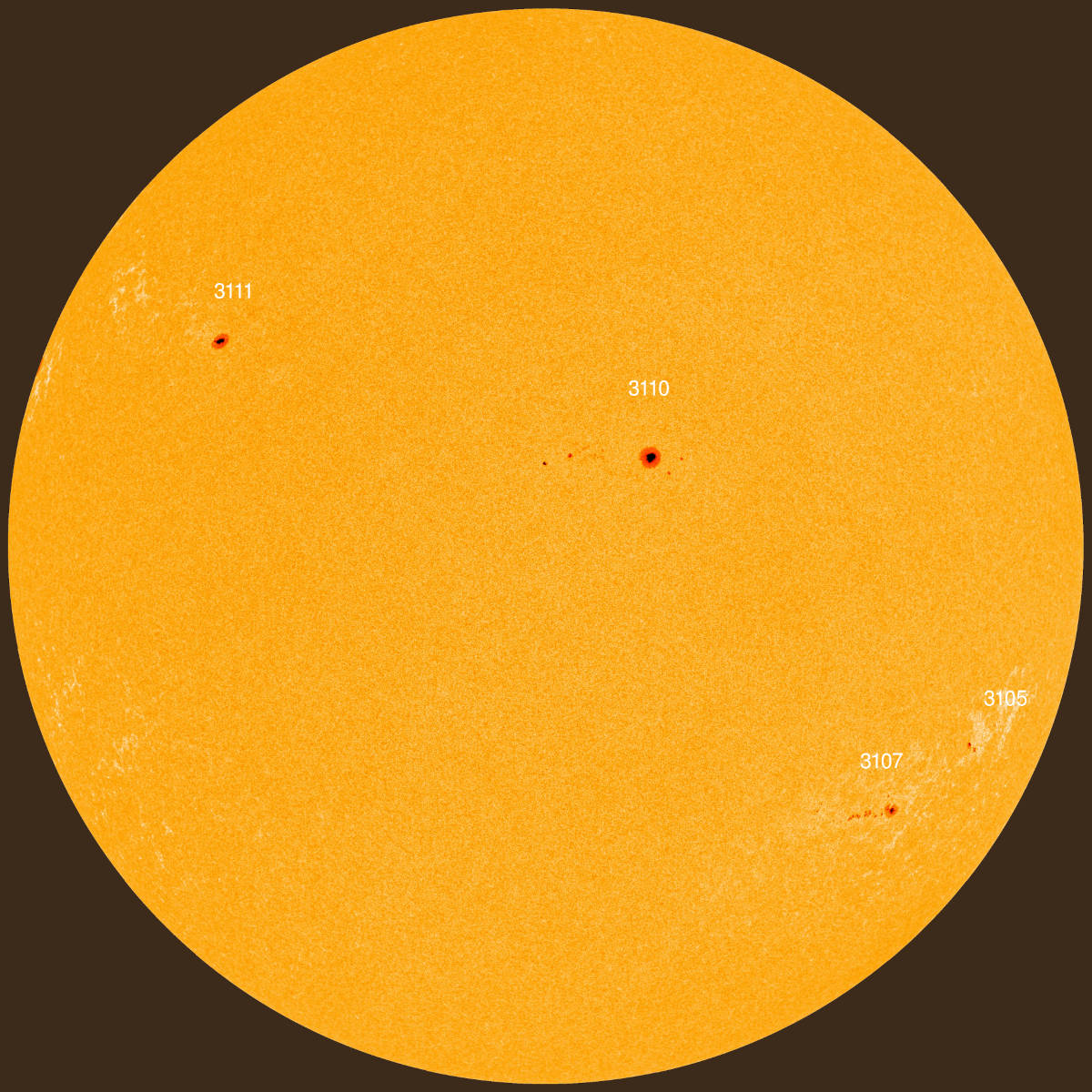
The Sun in white light, by the Solar Dynamics Observatory on September 30, 2022. What is seen is the photosphere, the visible “surface” of the Sun, where the energy transport from the interior changes from convection to radiation. The apparent roughness of the surface are the tops of the convection cells, called granules, which are usually about 600 miles wide that bubble up and recede. The numbers label active areas. The dark spots are sunspots, areas of intense magnetic activity. Brighter wispy or splotchy areas are faculae and are associated with sunspots or precursors of a new group forming. The rotation of the Sun will move the surface features from left to right in this image with north up. Telescopes may show the image upside down or mirror reversed. Click on the image to enlarge it. Credit NASA/SDO.
Sun in the light of the Hydrogen Alpha wavelength. Light absorbed and emitted by the hydrogen atom.
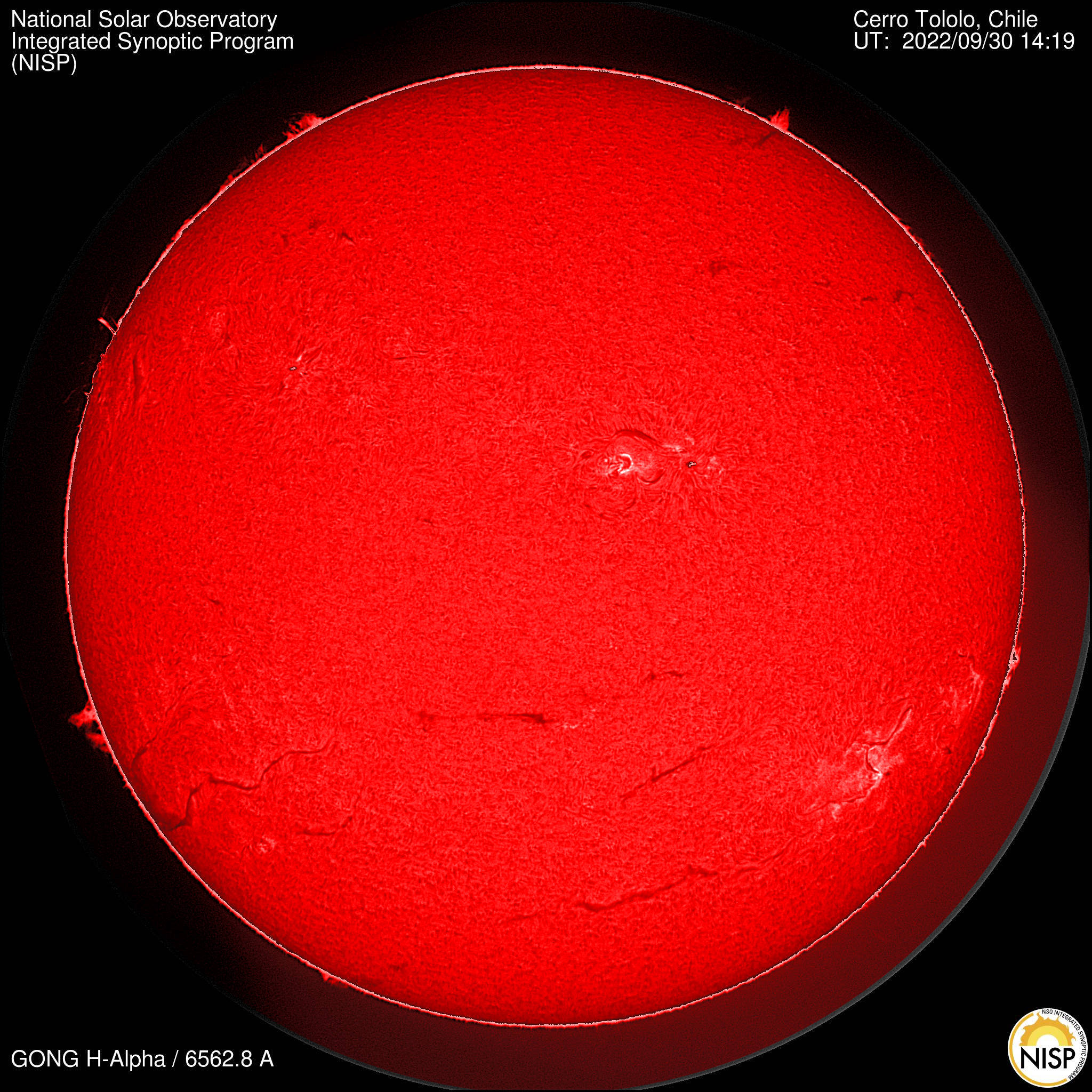
The Sun in Hydrogen-Alpha light, taken at 10:19 EDT today, September 30, 2022. It is in the same orientation as the SDO image above, but may have been taken at a different time of the day. This image was taken from the web page https://gong2.nso.edu/products/tableView/table.php?configFile=configs/hAlpha.cfg I colorized the image to show how it would look in a Hydrogen-Alpha telescope, of which we may have several, both the society’s and personal. The images may be dim since they select one narrow frequency of light from the broad spectrum of white light coming up from the photosphere. Its temperature is 10,000 degrees F. The thin dark markings are called filaments. These are the same thing as the bright prominences seen off the edge or limb of the Sun. Brighter areas of the chromosphere are called plages and are associated with active regions. The Chromosphere is a thin layer of the Sun’s atmosphere lying above the photosphere only 3,000 miles thick, and slightly hotter than the photosphere, its appearance is rougher than the granules of the photosphere. It reminds me of uneven, red grass that hasn’t been mown in a few weeks. They grow and recede in minutes. Sometimes a bright spot will appear in a sunspot group. These are solar flares and are caused by magnetic disruptions in sunspot groups. They last only a relatively few minutes but emit x-rays, electrons and protons as the most energetic explosions in the solar system. The x-rays arrive at Earth in 8 and a half minutes at the speed of light, the particles a day or two later will affect the Earth’s magnetic field if aimed in our direction, causing the aurora (northern and southern lights), and possibly disrupt communications and the power grid. On Earth, it’s called a geomagnetic storm.
The Moon for Saturday evening during the International Observe the Moon Night
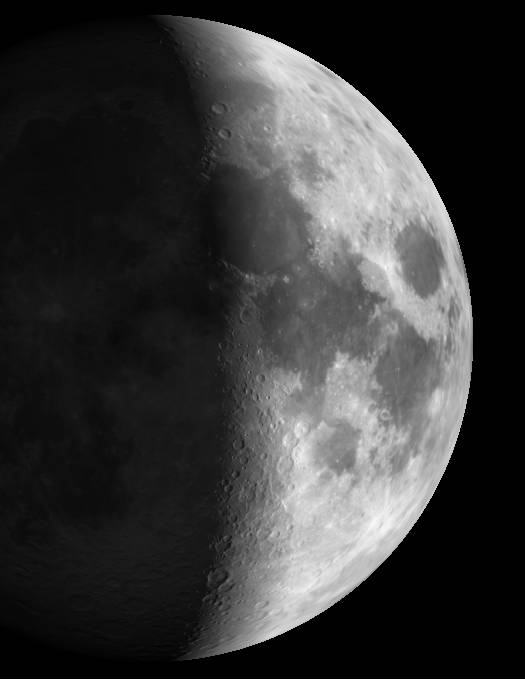
The Moon as it should appear at 9 pm EDT, October 1st, 2022. The telescopic image would be sharper than this. Created using Virtual Moon Atlas.
Download page of maps from the Official 2022 International Observe the Moon Night website.
Images in astronomical telescopes produce images of various orientations. They may be right side up or upside down, mirror reversed or both. Telescopes with an odd number of mirrors produce mirror images. Astronomers are used to it, though they have a preferred orientation… The one their favorable telescope produces.
Come on out!
08/05/2022 – Ephemeris – Star Party tonight at the Joseph H. Rogers Observatory
This is Bob Moler with Ephemeris for Friday, August 5th. Today the Sun will be up for 14 hours and 29 minutes, setting at 9:03, and it will rise tomorrow at 6:34. The Moon, at first quarter today, will set at 12:45 tomorrow morning.
Tonight, the Grand Traverse Astronomical Society will host a star party at Northwestern Michigan College’s Rogers Observatory from 10 pm to midnight, if it’s clear. The first quarter Moon, and the planet Saturn, will be seen. Toward the end of the evening, Jupiter will make an appearance. Saturn is always magnificent with its rings, and Jupiter with its moons and cloud bands. Also, visible will be some brighter wonders beyond the solar system. Nebulae, which are clouds of gas, and great clusters of stars. Views from one of the observatory telescopes will be available via Zoom, link at gtastro.org. Some society members will also bring their telescopes for displaying the sky for attending visitors. The observatory is located south of Traverse City on Birmley Road. The approach to the observatory from Keystone Road from the south may be blocked by the construction of a roundabout at the Keystone-Cass Rd intersection.
The astronomical event times given are for the Traverse City/Interlochen area of Michigan (EDT, UT – 4 hours). They may be different for your location.
Addendum
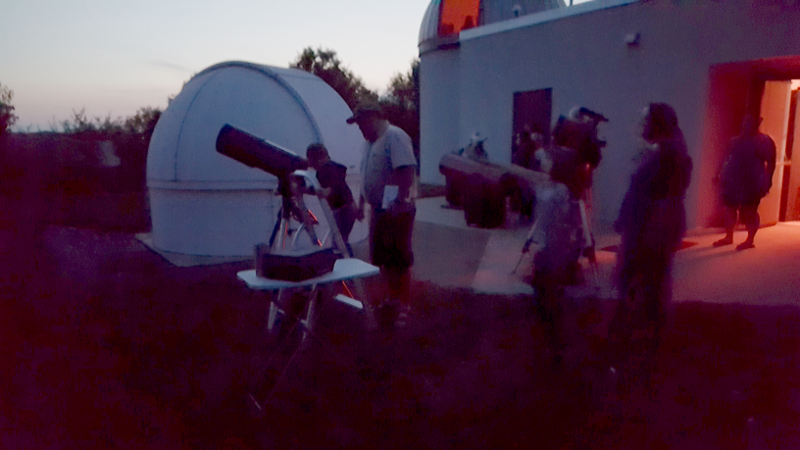
Telescopes set up by members of the Grand Traverse Astronomical Society at the back of Northwestern Michigan College’s Joseph H. Rogers Observatory on August 3, 2018. Credit mine.
This may be the first time since 2019 that members will set their telescopes out behind the observatory for a star party. The telescope in the small dome is the one used for Zoom views of the Moon and possibly Saturn. Saturn will be blocked by trees for most of the evening, except from the observatory dome which is high enough, so Saturn will clear the trees sooner.
The sky is forecast to be partly cloudy, whatever that means. The Clear Sky Chart for the observatory shows that it will be clear. There is also a possibility of haze from the forest fires out west, dimming the sky and making observation of deep sky objects more difficult.
Events of the evening:
The first quarter Moon will already be up and will set at 12:45 am
9:03 pm – sunset
9:24 pm – Saturn rises*
10:20 pm – Nautical twilight ends
11:02 pm – Jupiter rises*
11:07 pm – Astronomical twilight ends
* It may be at least a half hour after rising before the image of these planets become half way sharp, due to the great amount of atmosphere we are looking through to see them. The higher in the sky they are, the better they will appear.
06/03/2022 – Ephemeris – GTAS Astronomy meeting tonight explores women of science
This is Bob Moler with Ephemeris for Friday, June 3rd. Today the Sun will be up for 15 hours and 23 minutes, setting at 9:23, and it will rise tomorrow at 5:58. The Moon, halfway from new to first quarter, will set at 1:11 tomorrow morning.
Tonight at 9 pm, the Grand Traverse Astronomical Society will have an in-person meeting at Northwestern Michigan College’s Rogers Observatory. The meeting will also be available via Zoom. The program will be presented by Becky Shaw. Her presentation will be An Encore to the Women of Science. Becky’s programs have always feature historic women of science, from Hypatia of ancient Alexandria to Cecilia Payne’s historic discovery of the elemental makeup of stars 100 years ago. If it’s clear, there will be a star party following the meeting. The observatory is located south of Traverse City off Birmley Road, between Garfield and Keystone roads. A Zoom link will be available at gtastro.org before the meeting.
The astronomical event times given are for the Traverse City/Interlochen area of Michigan (EDT, UT – 4 hours). They may be different for your location.
Addendum
This meeting will mark the 40th anniversary of the Grand Traverse Astronomical Society. I hear someone might be bringing 40 cupcakes to celebrate.
Three of the female astronomers and planetary scientists I follow on Twitter are:
Alessondra Springmann @sondy, Planetary scientist
Dr. Katie Mack, @AstroKatie, Theoretical astrophysicist, Author of The End of Everything (Astrophysically Speaking)
Dr Carolyn Porco, @carolynporco, Planetary scientist
There are lots more in all the science disciplines.
07/05/2019 – Ephemeris – Apollo 11 memories tonight and a Sun ‘n Star Party tomorrow
Ephemeris for Friday, July 5th. Today the Sun will be up for 15 hours and 27 minutes, setting at 9:31, and it will rise tomorrow at 6:04. The Moon, 3 days past new, will set at 11:59 this evening.
Tonight the Grand Traverse Astronomical Society will invite all those who are old enough to have seen the Apollo 11 launch and Moon landing as it happened to relate their experiences at the NMC Rogers Observatory at 8 p.m. Tomorrow afternoon and evening will be what we call a Sun & Star Party at the Sleeping Bear Dunes National Lakeshore Dune Climb hosted by the society and the rangers and volunteers of the park. From 4 to 6 p.m., the Sun will be featured with special solar telescopes. Starting at 9 p.m. will be a star party, actually mostly a planet party, viewing the planets Jupiter and Saturn, plus the Moon. There will be other celestial wonders visible in the deepening twilight. If cloudy one or both Dunes events can be canceled.
The times given are for the Traverse City/Interlochen area of Michigan. They may be different for your location.
Addendum
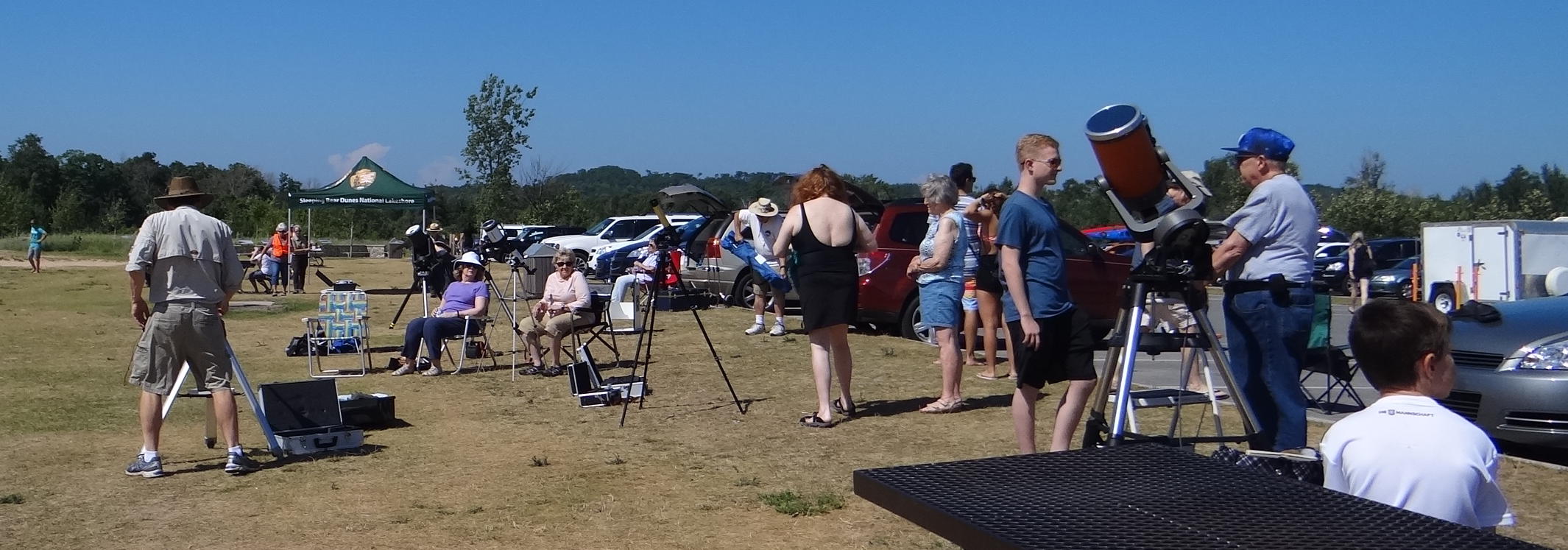
A Sun Party at the Dune Climb. Credit: Eileen Carlisle.
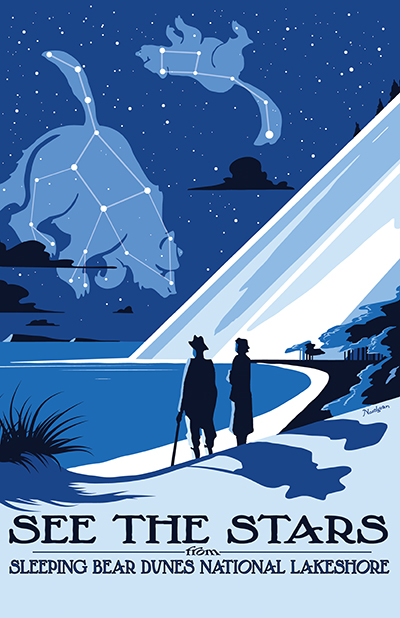
See the Stars from Sleeping Bear Dunes National Lakeshore Poster by Tyler Nordgren.
09/14/2018 – Ephemeris – Local astronomy activities Saturday the 15th
Note: I’m a bit late with this post due to unscheduled star party last night for Greenspire School at Leelanau Outdoor Center near Pyramid Point. Then I had a sail this morning for Inland Seas. I came home absolutely pooped out. Anyway the events described except for the first paragraph below are for tomorrow.
Ephemeris for Friday, September 14th. The Sun will rise at 7:20. It’ll be up for 12 hours and 34 minutes, setting at 7:55. The Moon, 2 days before first quarter, will set at 11:00 this evening.
There are two local astronomical events tomorrow. The Leland Heritage Celebration will take place from 10 a.m. to 4 p.m. at Fishtown in Leland. The Grand Traverse Astronomical Society will be there to show the Sun through member’s telescopes, maybe spot the Moon and the planet Venus plus give out NASA items for the kids. We’ll exhibit pictures gained from last year’s total solar eclipse. Then starting at 9 p.m. the crew will be at Northwestern Michigan College’s Rogers Observatory for a star party, viewing Mars, Saturn, Jupiter and the Moon, plus some brighter objects beyond the solar system. Rain will affect the Leland event. The observatory is located on south of Traverse City on Birmley Road between Keystone and Garfield roads.
The times given are for the Traverse City/Interlochen area of Michigan. They may be different for your location.
Addendum
09/07/2018 – Ephemeris – Two astronomy events in the Grand Traverse region this weekend
Ephemeris for Friday, September 7th. The Sun will rise at 7:12. It’ll be up for 12 hours and 56 minutes, setting at 8:08. The Moon, 2 days before new, will rise at 5:35 tomorrow morning.
This evening the Grand Traverse Astronomical Society will hold its monthly meeting at the Northwestern Michigan College’s Rogers Observatory at 8 p.m. with a program featuring Dr. David Penney and his talk Large Impacts on the Earth. After watching the impacts of Comet Shoemaker-Levy 9 into Jupiter in 1994 the public and space agencies began to take the possibility of an asteroid or comet impact on the Earth seriously. Dr. Penney will talk about evidence of such impacts on the Earth in the past. After the talk, at 9 p.m. there will be a star party to view the heavens including Saturn and Mars and wonders of the Milky Way. The observatory is located south of Traverse City, on Birmley Road between Garfield and Keystone roads.
The times given are for the Traverse City/Interlochen area of Michigan. They may be different for your location.
Addendum
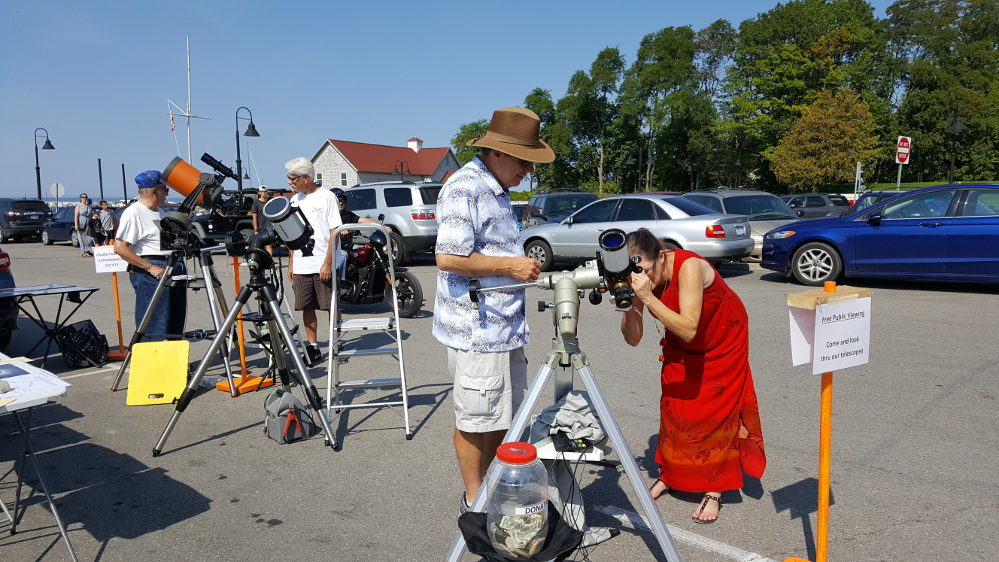
Telescopes set up by members of the Grand Traverse Astronomical Society at the back of Northwestern Michigan College’s Joseph H. Rogers Observatory on August 3, 2018. Credit mine.
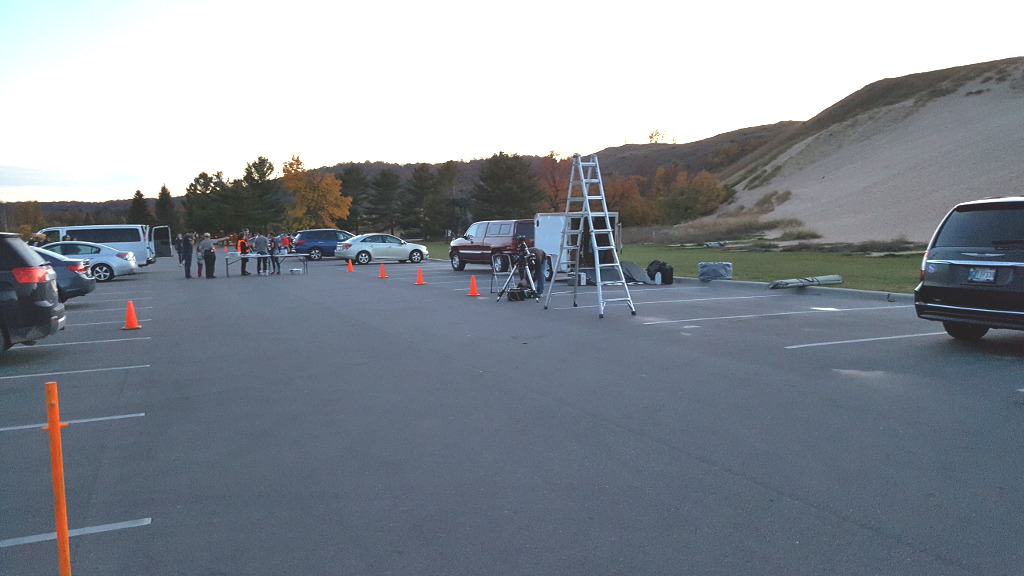
This in the beginning of setup for the October 21, 2917 star party at the dune climb. Taken early while there was enough light. The dune blocks up to 12 degrees from the southwest to northwest, but the rest of the horizon is quite low.
08/17/2018 – Ephemeris – Another busy weekend for the GTAS
Ephemeris for Friday, August 17th. The Sun rises at 6:47. It’ll be up for 13 hours and 57 minutes, setting at 8:45. The Moon, 1 day before first quarter, will set at 12:29 tomorrow morning.
The Grand Traverse Astronomical Society (GTAS) has another busy weekend. Tonight the society members will bring their telescopes to downtown Traverse City and Friday Night Live. During the event we’ll be looking at the Sun and the planet Venus and staying after to view Saturn and the Moon if it’s clear. Saturn’s rings are, of course, spectacular. Tomorrow night society members will be at Northwestern Michigan College’s Rogers Observatory beginning at 9 p.m. for a star party viewing Venus, Jupiter, Saturn and Mars. Later as it gets really dark, some of the brighter stellar wonders will come into view if it’s clear. There’s stars in groups called clusters great and small, and stars that orbit each other and can have different colors.
The times given are for the Traverse City/Interlochen area of Michigan. They may be different for your location.
Addendum
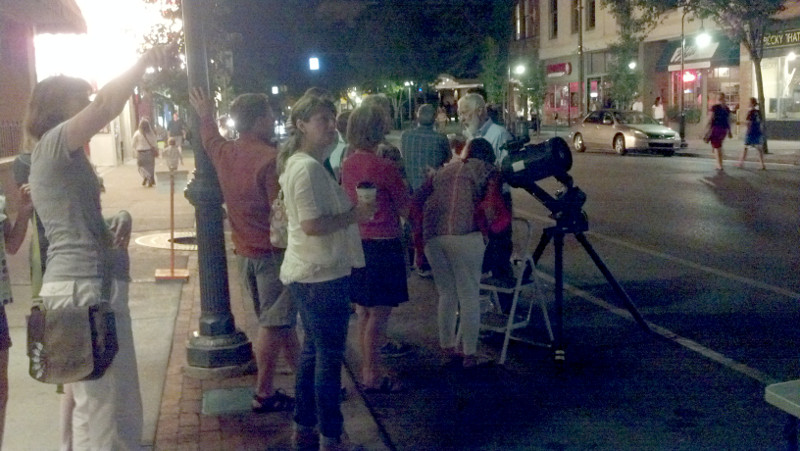
Ron Uthe (with the beard) explains that his telescope is pointed to Saturn after the 2013 Friday Night Live. Credit mine.
Telescopes set up by members of the Grand Traverse Astronomical Society at the back of Northwestern Michigan College’s Joseph H. Rogers Observatory on August 3, 2018. Credit mine.
 Bob Moler's Ephemeris Blog