Archive
11/12/2015 – Ephemeris – The North Taurid meteor shower
Ephemeris for Thursday, November 12th. The Sun will rise at 7:35. It’ll be up for 9 hours and 42 minutes, setting at 5:18. The Moon, 1 day past new, will set at 6:19 this evening.
Today is the expected peak of the Northern Taurid meteor shower. While poor in numbers, the two Taurid showers produce many fireballs, that are really, really bright. So bright they are not hindered by a bright moon. They will be visible all night because the radiant, near the head of Taurus the bull will rise in the east by the end of twilight. The radiant is below the Pleiades star cluster and just above the letter V group of stars that is the head of the bull. The path of Encke’s comet, which is responsible, crosses near the Earth’s orbit twice a year. Now and where the Earth is on June 30th. Those meteors then would seem to come from out of the Sun, leaving some to speculate that the Tunguska event in 1908 was caused by a piece of Encke’s Comet.
Times are for the Traverse City/Interlochen area of Michigan. They may be different for your location.
Addendum
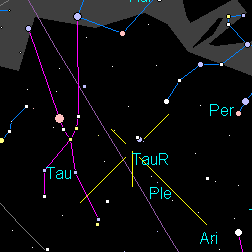
The Taurid Radiant
It turns out that Earth isn’t the only planet to have a meteor shower from Encke’s Comet. It happens to be Mercury. Dave Dickinson has a post on Universe Today pointing to an announcement of data returned from the MESSENGER spacecraft that orbited Mercury at the Division of Planetary Sciences of the American Astronomical Society (#DPS15) meeting this week.
11/10/2015 – Ephemeris – Twin meteor showers ongoing now
Ephemeris for Tuesday, November 10th. The Sun will rise at 7:32. It’ll be up for 9 hours and 47 minutes, setting at 5:20. The Moon, 1 day before new, will rise at 7:14 tomorrow morning.
Now through Thursday the North and South Taurid meteors will be most active. The North radiant, the point from which the meteors, or “shooting stars” will seem to come from, is just above the letter V star cluster that’s the head of Taurus the bull in the east in the early evening. The southern radiant is just below the V. Interestingly enough they belong to the same comet: Encke’s Comet. It has the shortest period on any known comet. Only 3.3 years. I’ll have more to say about Encke’s Comet on Thursday when I talk about the peak of the Northern Taurids that day. Today is the peak of the Southern Taurids. Both have expected peaks of only 5 meteors an hour. However both showers have a great number of fireballs.
Times are for the Traverse City/Interlochen area of Michigan. They may be different for your location.
Addendum
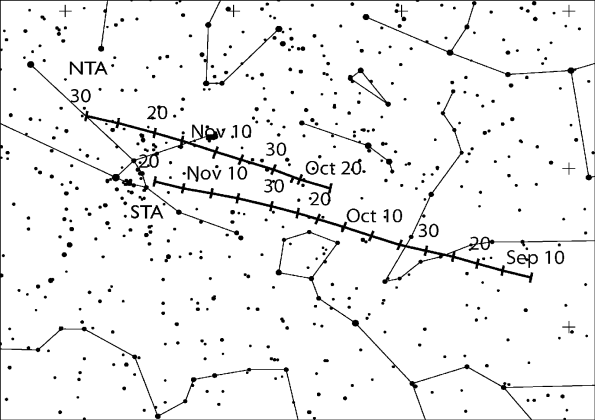
Tracks of how the North (NTA) and South (STA) Taurid radiants move in the sky with time. Credit International Meteor Organization 2015 Meteor Shower Calendar.
11/12/2012 – Ephemeris – The North Taurid Meteor Dhower
Ephemeris for Monday, November 12th. The sun will rise at 7:35. It’ll be up for 9 hours and 41 minutes, setting at 5:17. The moon, 1 day before new, will rise at 7:15 tomorrow morning.
This is the date of the peak of the Northern Taurid Meteor Shower. This shower has a long duration, from late October to early December. Taurus is up all night, so the meteors will be seen all night, but more numerous in the morning. There won’t be many of them, maybe 5 an hour, but they are very slow moving, only 29 kilometers per second or 18 miles per second, about half the speed of other meteors. It has more than its share of very bright meteors. These meteors are thought to have their origin with Comet Encke. Encke is the comet with the shortest period known, only 3.3 years. The peak will last several days, and there’s even an expectation of a swarm, a higher number or meteors, that might be visible during this period.
Times are for the Traverse City/Interlochen area of Michigan. They may be different for your location.
Addendum
The Taurid Radiant.
 Bob Moler's Ephemeris Blog