Archive

Posts Tagged ‘Mercury’

Ephemeris: 11/11/2026 – Taking our weekly look at the whereabouts of the naked-eye planets

November 11, 2026 Leave a comment

This is Ephemeris for Veteran’s Day, Wednesday, November 11th. Today the Sun will be up for 9 hours and 44 minutes, setting at 5:18, and it will rise tomorrow at 7:35. The Moon, 2 days past new, will set at 6:26 this evening.

Let’s take our weekly look at the whereabouts of the naked-eye planets. Three of the naked-eye planets are visible in the night sky. Tonight, Saturn will be in the east-southeastern sky as it gets dar k. It is the brightest starlike object low in that direction, and as it gets darker, will be seen below a large square of stars, the Great Square of Pegasus. Venus will be seen in the morning sky, rising at 5:18 AM. By 6 AM it will be low in the east southeast. Jupiter and Mars will be in the southeastern sky, above and right of it, with the dimmer and red Mars just above Jupiter. Mars will pass closest to Jupiter on Sunday morning. The bright star, that may look blue-white is below and left of Jupiter. That’s Regulus in Leo, the lion.

The astronomical event times given in this blog are for the Traverse City/Interlochen area of Michigan (Lat 44.7° N, Long 85.7° W; EST, UT – 5 hours) unless stated otherwise. Times will be different for other locations.

Addendum
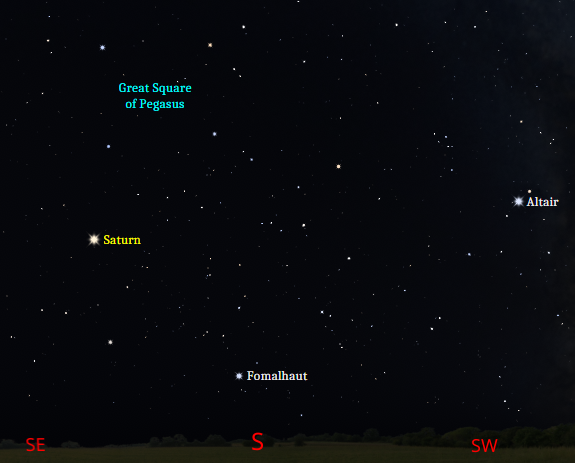
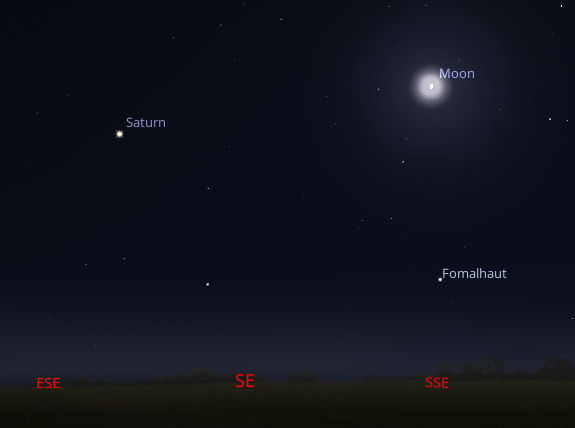
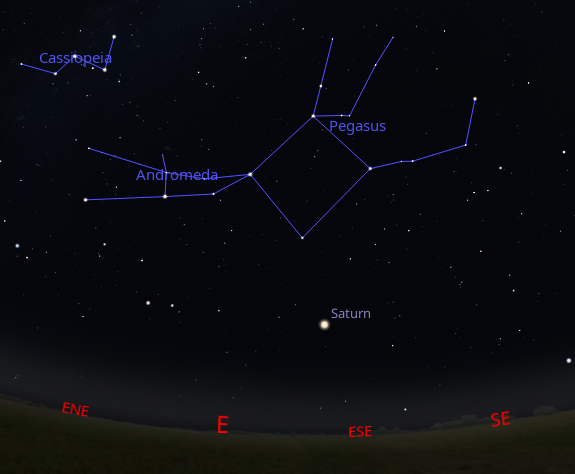
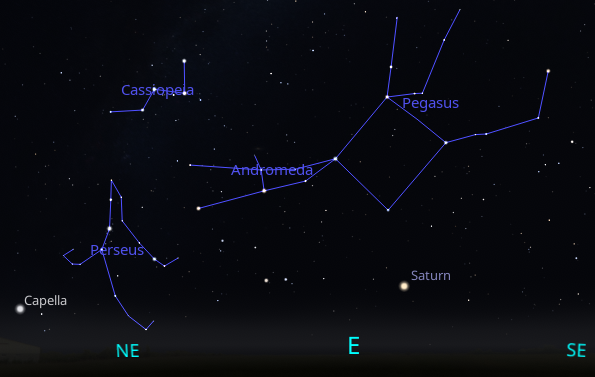
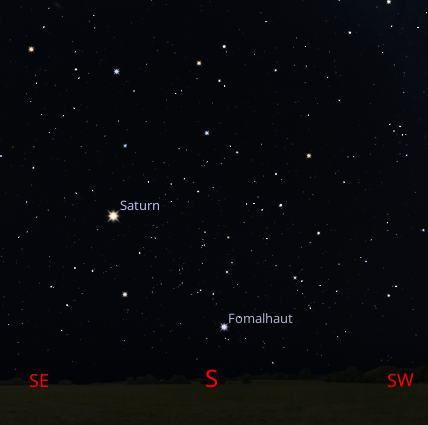
Saturn appears in the southeast at 8 PM November 11, 2026. It is appearing with, what is normally, the loneliest star in the sky: Fomalhaut.
Saturn appears in the southeast at 8 PM November 11, 2026. It is appearing with, what is normally, the loneliest star in the sky: Fomalhaut. Created using Stellarium.
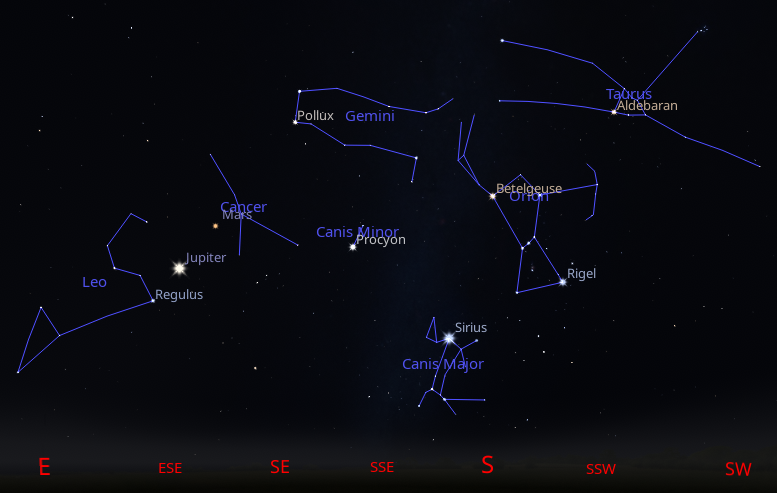
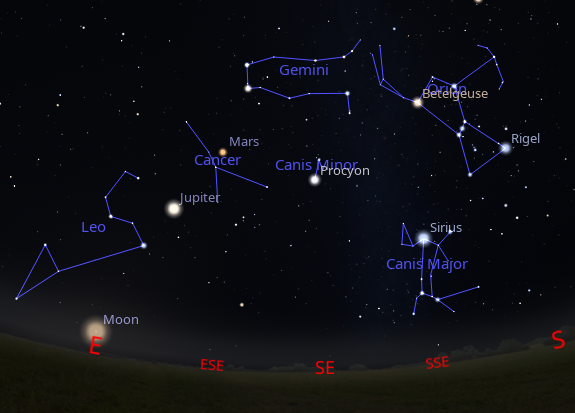
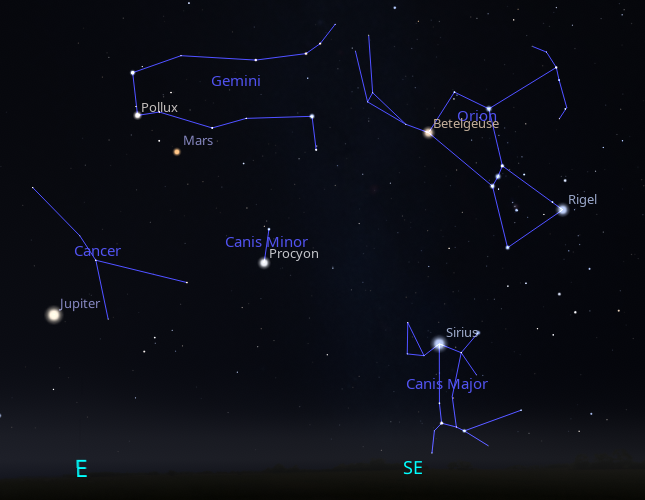
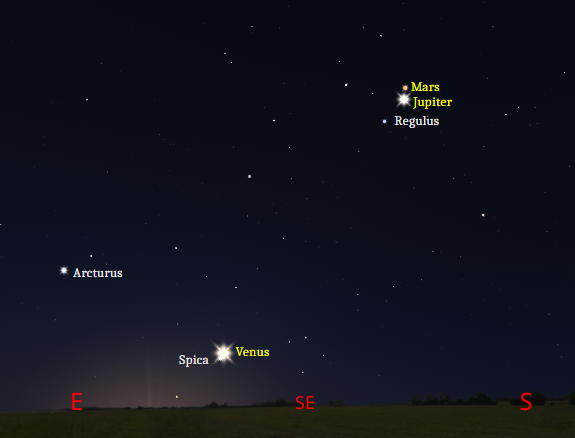
Mars and Jupiter appear to the east of the bright winter stars, and are approaching Regulus, in the spring constellation of Leo at 6:30 AM, November 12, 2026. Venus will also appear close to the horizon in the east southeast. The blue-white star Spica will be just below and left of Venus at that time.
Mars and Jupiter appear to the east of the bright winter stars, and are approaching Regulus, in the spring constellation of Leo at 6:30 AM, November 12, 2026. Venus will also appear close to the horizon in the east southeast. The blue-white star Spica will be just below and left of Venus at that time. Created using Stellarium.
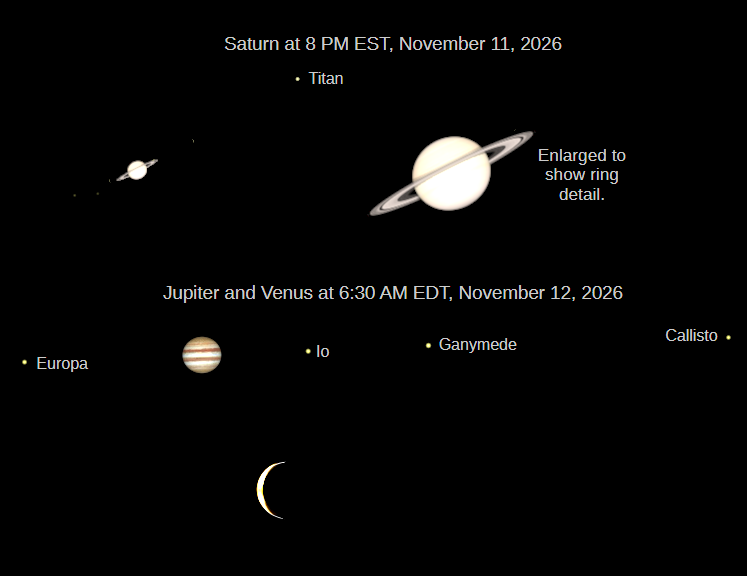
Telescopic views of the naked-eye planets as seen in a small telescope.
Telescopic views of the naked-eye planets as seen in a small telescope: At 8 PM, Saturn will be 19.2″ in diameter, and its rings extend to 44.7″. At 6:30 AM, Jupiter will be 37.0″ in diameter. Venus, close to the Earth now, will be 52.4″ in diameter and only 11.1% illuminated. Mars, not shown, will appear 7.0″ in diameter. The (”) symbol means seconds of arc, or 1/3600th of a degree. Created using4Cartes du Ciel (Sky Charts), LibreOffice Draw and GIMP.
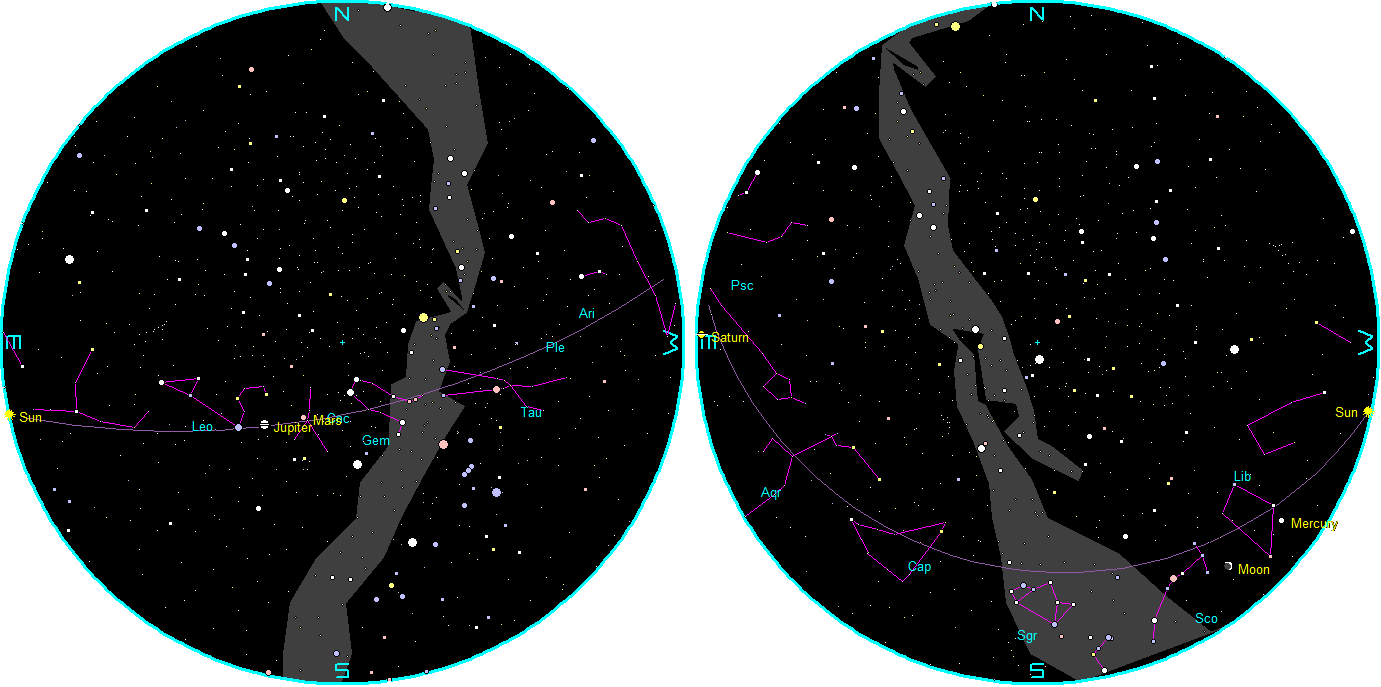
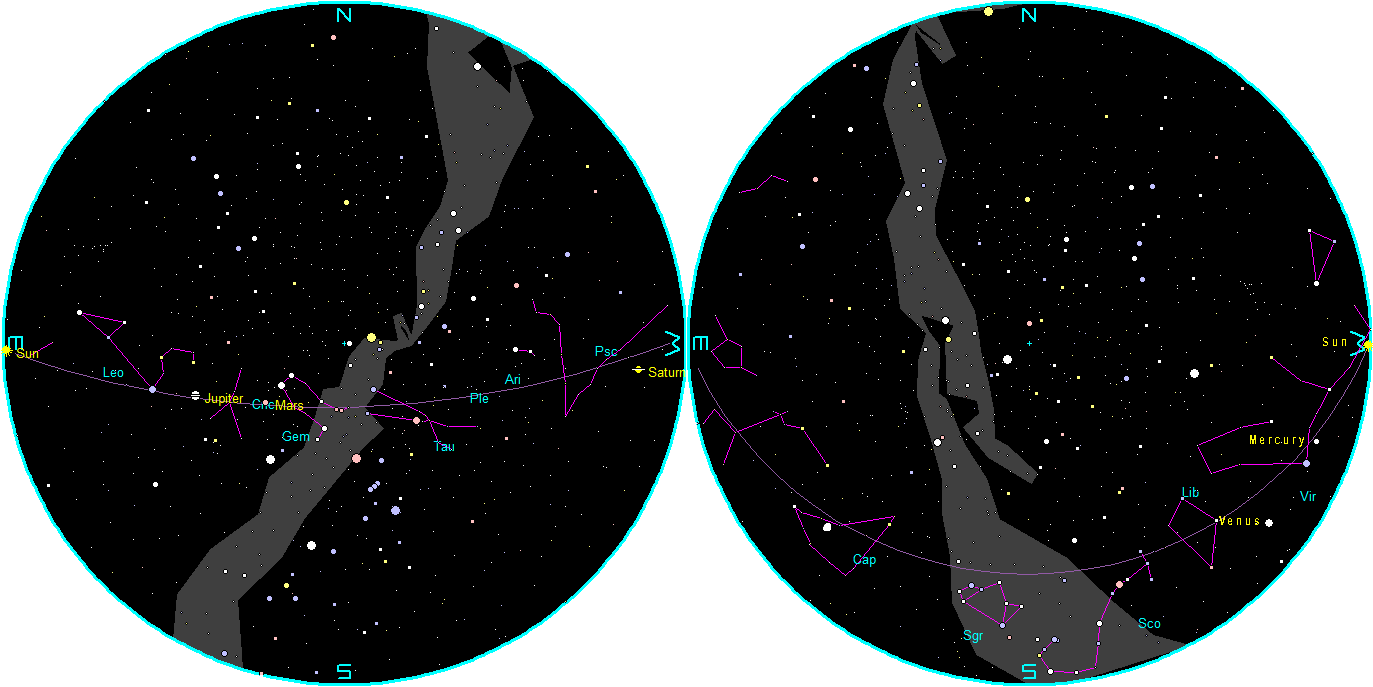
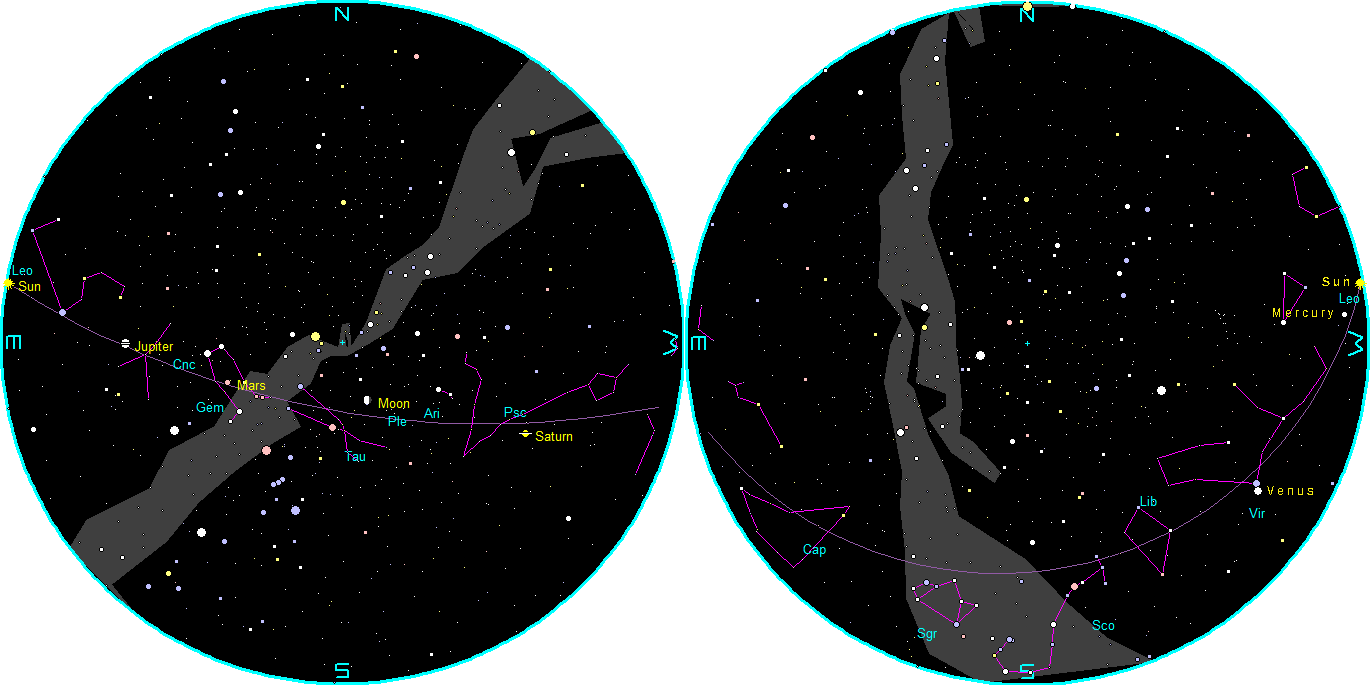
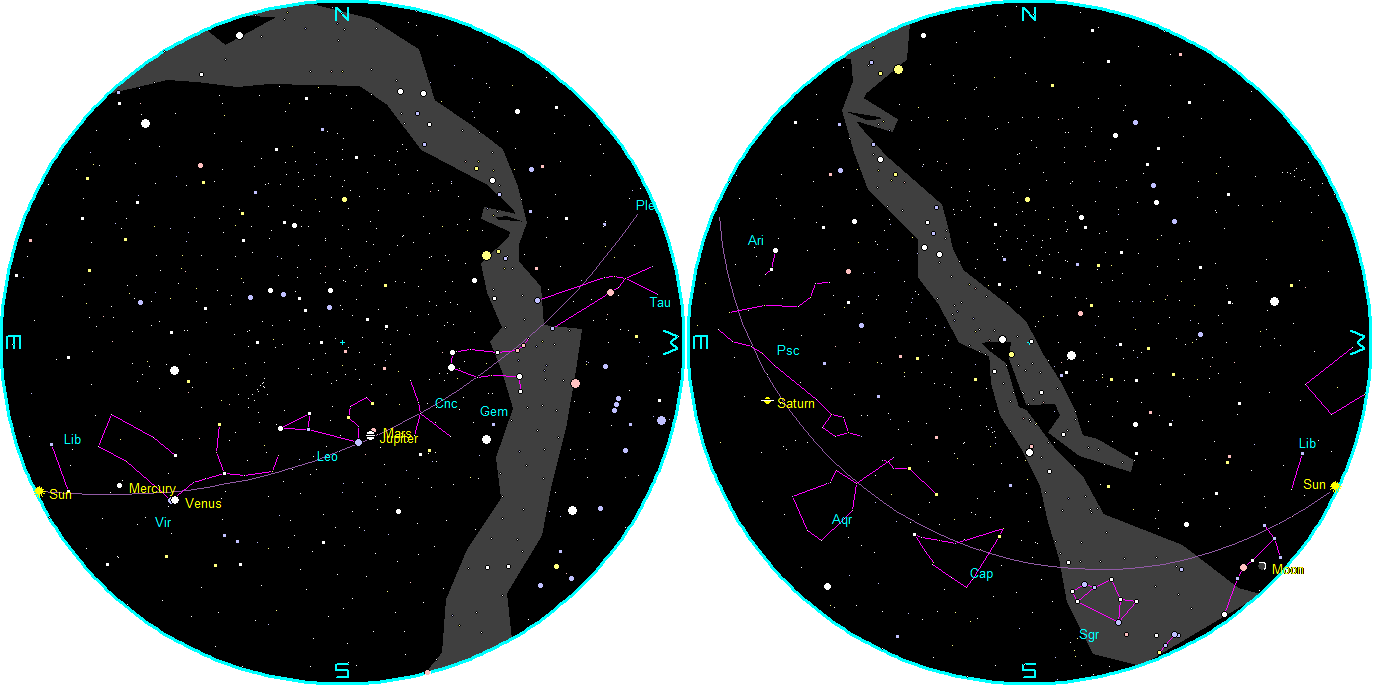
The naked-eye planets at sunset and sunrise on a single night, at sunset and sunrise
The naked-eye planets at sunset and sunrise on a single night, starting with sunset on the right on November 11, 2026. The night ends on the left with sunrise on the 12th. Click or tap on the image to enlarge it. Created using my LookingUp app and GIMP.
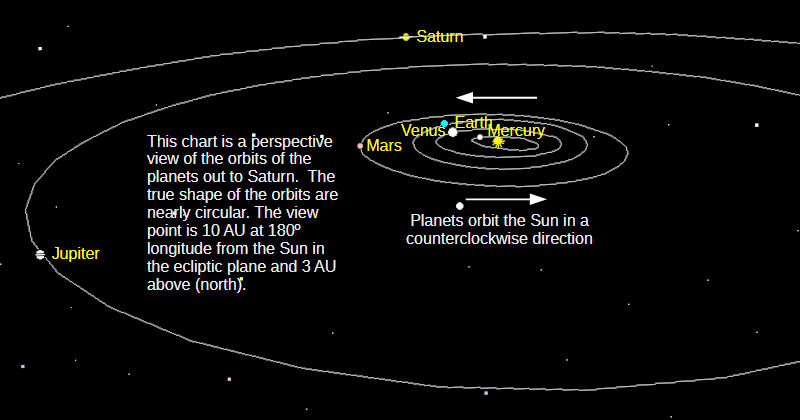
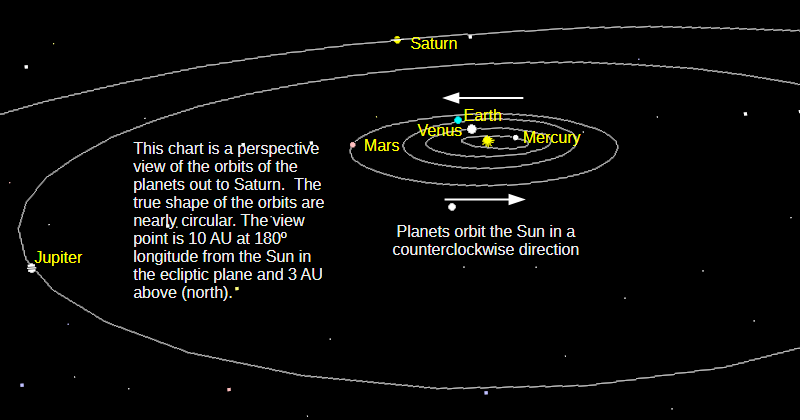
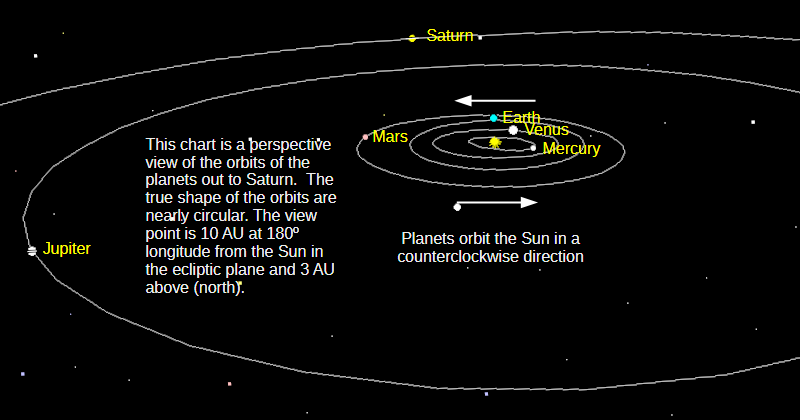
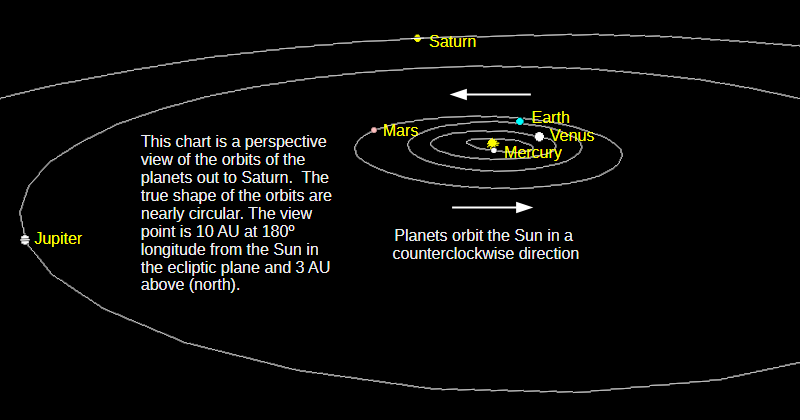
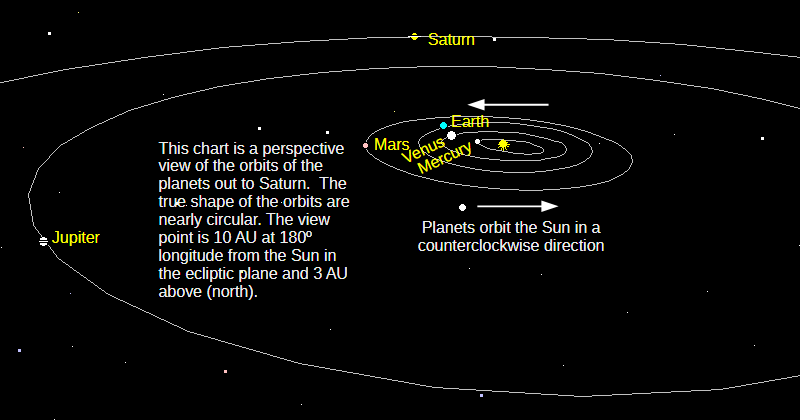
The naked-eye planets, from Mercury to Saturn, in a low angle perspective view of the solar system from above and a bit beyond Saturn’s orbit for today, November 11, 2026. Created using my LookingUp app, text and arrows created using LibreOffice Draw and produced a unified image using GIMP.

Ephemeris: 11/04/2026 – Taking our weekly look at the whereabouts of the naked-eye planets

November 4, 2026 Comments off

This is Ephemeris for Wednesday, November 4th. Today the Sun will be up for 10 hours and 2 minutes, setting at 5:27, and it will rise tomorrow at 7:26. The Moon, 3 days past last quarter, will rise at 3:32 tomorrow morning.

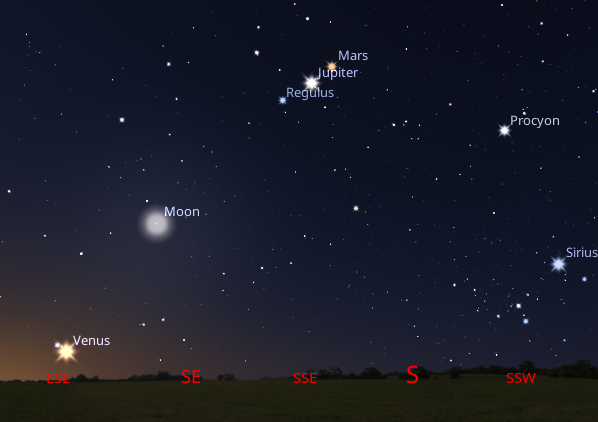
Let’s take our weekly look at the whereabouts of the naked-eye planets. Three of the naked-eye planets are visible in the night sky. Mercury moves throuigh inferior conjunction with the Sun today. Tonight, Saturn will be in the east-southeastern sky as it gets dark. It is the brightest starlike object low in that direction. Venus passed between the Earth and the Sun in inferior conjunction 12 days ago, and might be seen in the morning sky for sharp-eyed observers by 6:30 AM low in the east southeast. Jupiter and Mars will be in the southern sky by then with the waning crescent moon about halfway between them and Venus. Red Mars will be above and to the right of Jupiter and slowly closing. Mars will pass just above Jupiter on the 15th.

The astronomical event times given in this blog are for the Traverse City/Interlochen area of Michigan (Lat 44.7° N, Long 85.7° W; EST, UT – 5 hours) unless stated otherwise. Times will be different for other locations.

Addendum
Saturn appears in the southeast at 9 PM November 4, 2026. It is appearing with, what is normally, the loneliest star in the sky: Fomalhaut.
Saturn appears in the southeast at 9 PM November 4, 2026. It is appearing with, what is normally, the loneliest star in the sky: Fomalhaut. Created using Stellarium.
Mars and Jupiter appear to the east of the bright winter stars, and are approaching Regulus, in the spring constellation of Leo at 6:30 AM, November 5, 2026. Venus will also appear close to the horizon in the east southeast. The waning crescent moon will appear between Jupiter and Venus.
Mars and Jupiter appear to the east of the bright winter stars, and are approaching Regulus, in the spring constellation of Leo at 6:30 AM, November 5, 2026. Venus will also appear close to the horizon in the east southeast. The waning crescent moon will appear between Jupiter and Venus. Created using Stellarium.
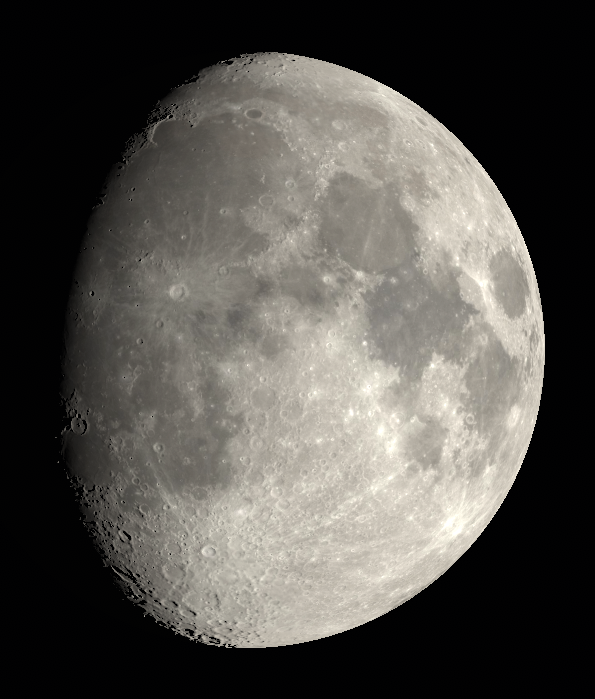
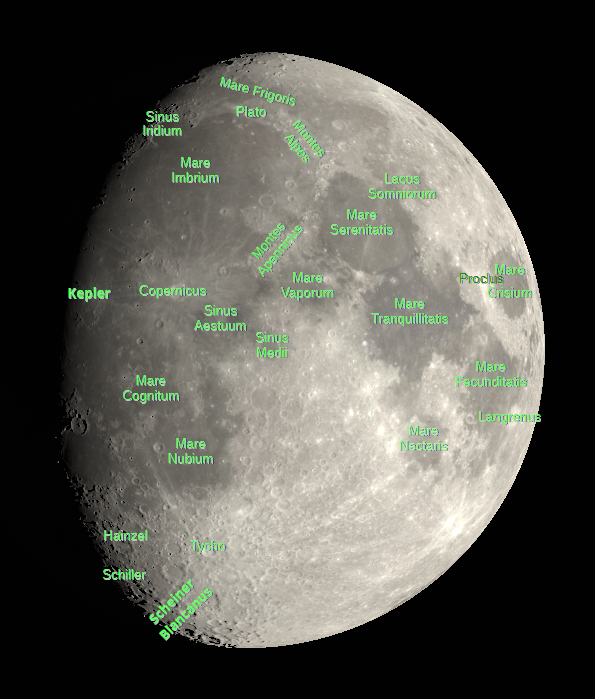
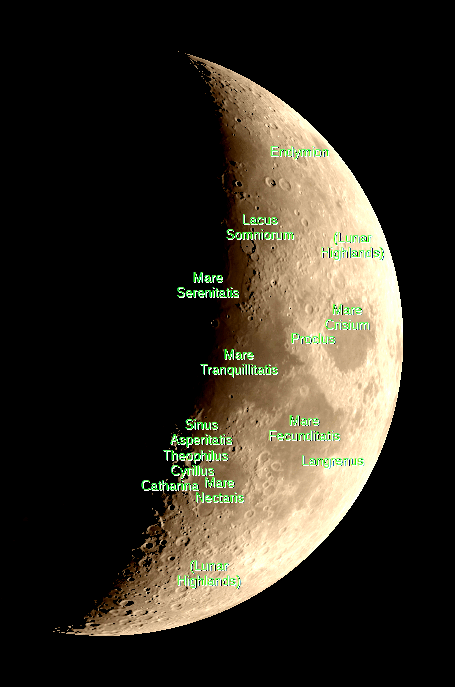
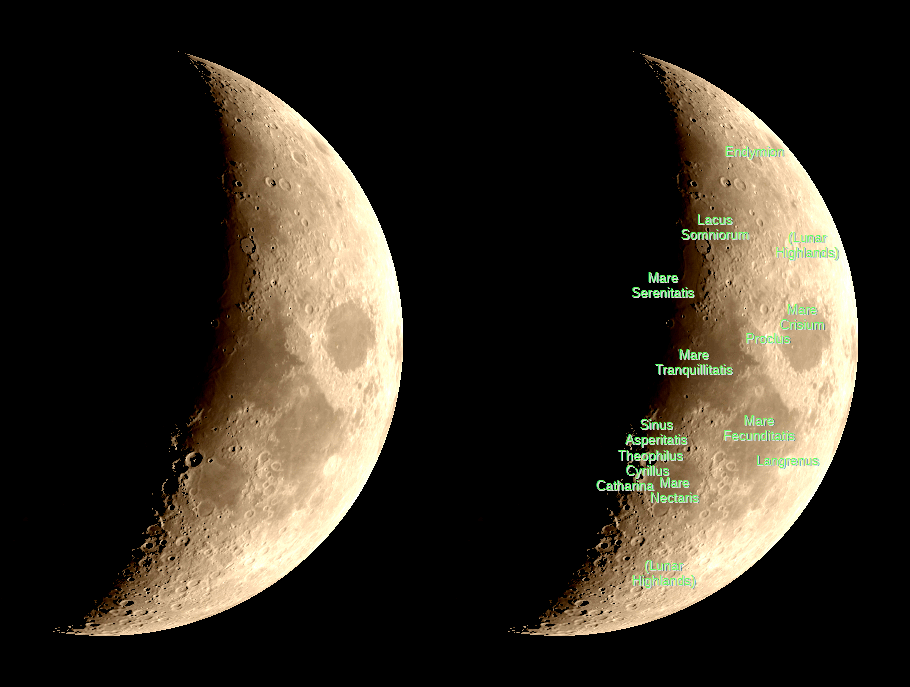
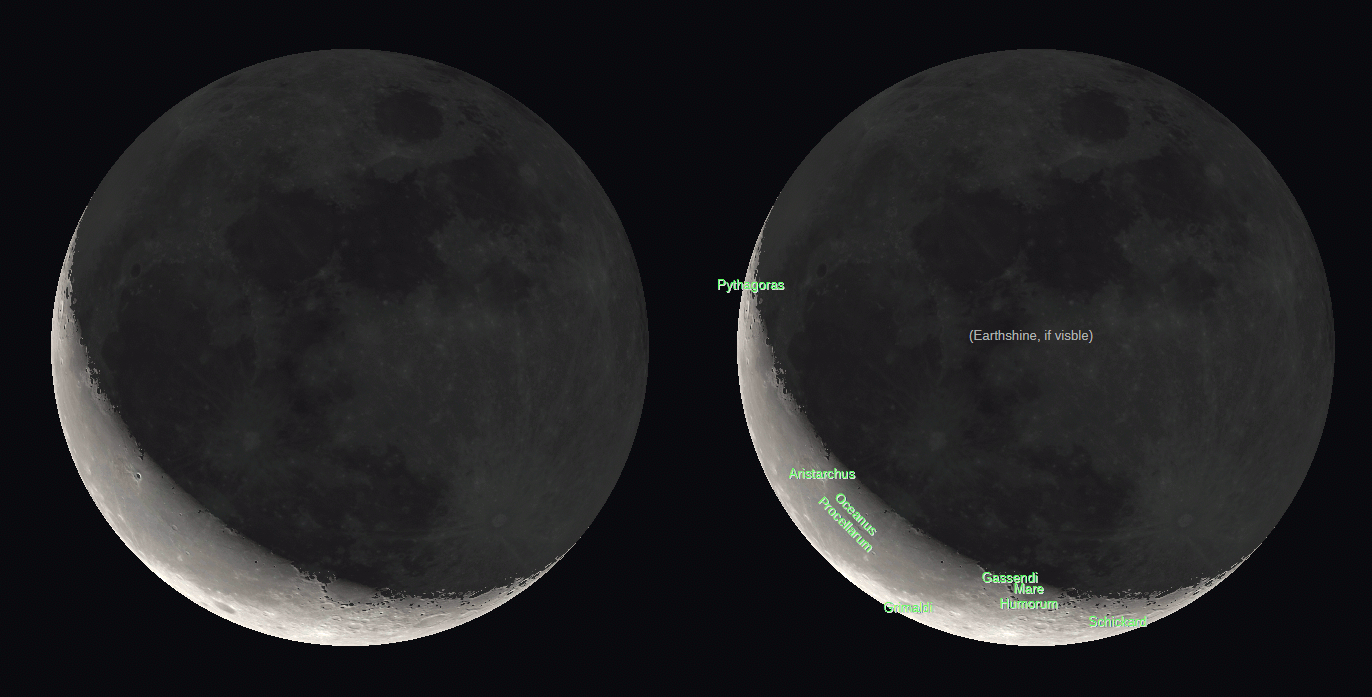
The Moon, 4 days before new, at 6:30 AM tgomorrow morning November 5, 2026. A view visible in small telescopes showing an image with and without selected features labeled.
The Moon, 4 days before new, at 6:30 AM tgomorrow morning November 5, 2026. A view visible in small telescopes showing an image with and without selected features labeled. Created using Stellarium, LibreOffice Draw, and GIMP.
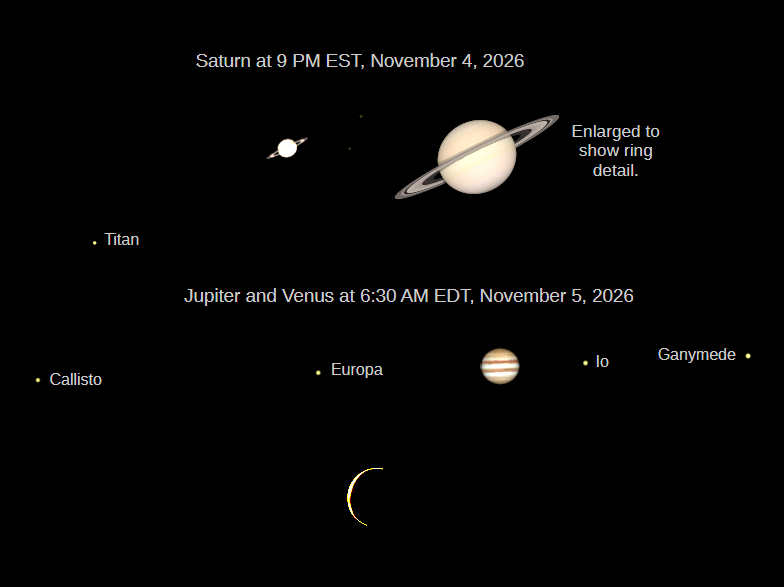
Telescopic views of the naked-eye planets as seen in a small telescope.
Telescopic views of the naked-eye planets as seen in a small telescope: At 9 PM, Saturn will be 19.4″ in diameter, and its rings extend to 45.1″. At 6:30 AM, Jupiter will be 36.3″ in diameter. Mars, not shown, will appear 6.7″ in diameter. Venus, really close to the Earth now (30.3 million miles or 48.9 million kilometers) will be 57.3″ in diameter and only 5.3% illuminated. The (”) symbol means seconds of arc, or 1/3600th of a degree. Created using4Cartes du Ciel (Sky Charts), LibreOffice Draw and GIMP.
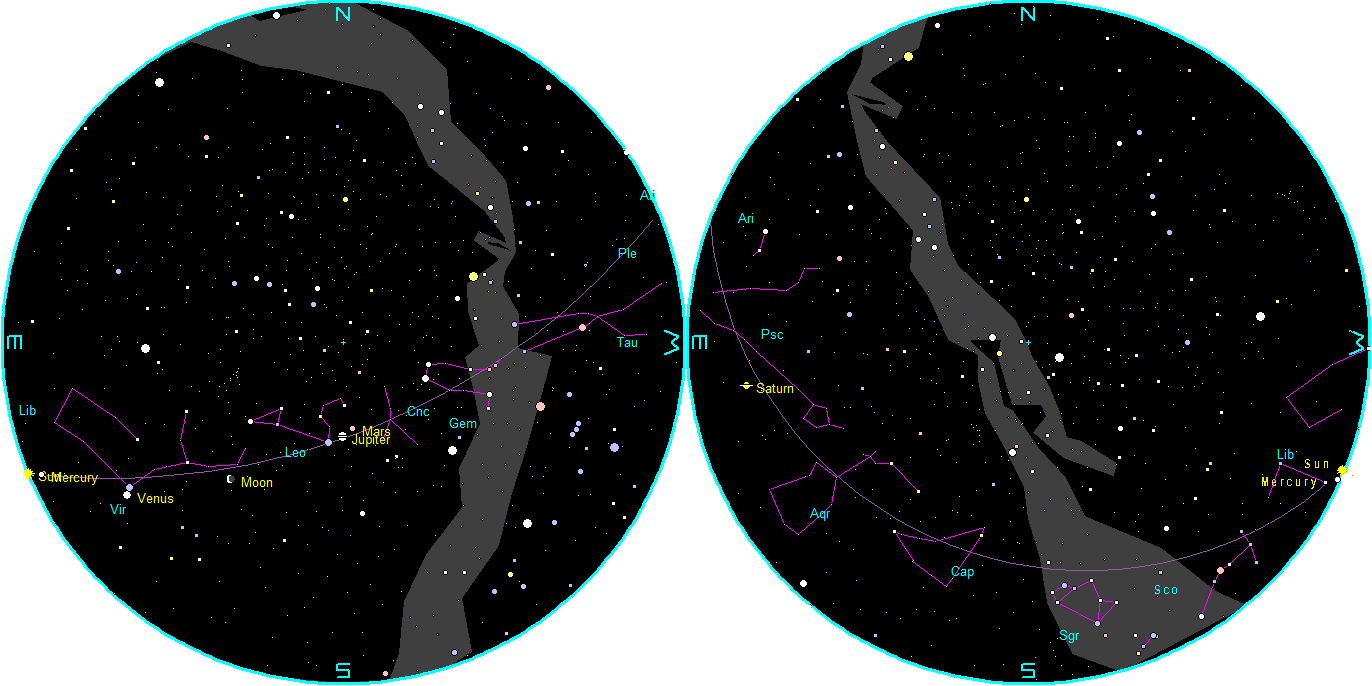
The naked-eye planets at sunset and sunrise on a single night, starting with sunset on the right on November 4, 2026. The night ends on the left with sunrise on the 5th.
The naked-eye planets at sunset and sunrise on a single night, starting with sunset on the right on November 4, 2026. The night ends on the left with sunrise on the 5th. Click or tap on the image to enlarge it. Created using my LookingUp app and GIMP.
The naked-eye planets, from Mercury to Saturn, in a low angle perspective view of the solar system from above and a bit beyond Saturn’s orbit for today, November 4, 2026.
The naked-eye planets, from Mercury to Saturn, in a low angle perspective view of the solar system from above and a bit beyond Saturn’s orbit for today, November 4, 2026. Created using my LookingUp app, text and arrows created using LibreOffice Draw and produced a unified image using GIMP.

Ephemeris: 10/28/2026 – Taking our weekly look at the whereabouts of the naked-eye planets

October 28, 2026 Comments off

This is Ephemeris for Wednesday, October 28th. Today the Sun will be up for 10 hours and 21 minutes, setting at 6:37, and it will rise tomorrow at 8:16. The Moon, 2 days past full, will rise at 8:00 this evening.

Let’s take our weekly look at the whereabouts of the naked-eye planets. Three of the naked-eye planets are visible in the night sky. Mercury sets too soon after the Sun to be seen. Venus passed between the Earth and the Sun in inferior conjunction 5 days ago, and might be seen in the morning sky for sharp-eyed observers next week. Tonight, Saturn will be in the east-southeastern sky as it gets dark. It is the brightest starlike object low in that direction. At 6 AM, Jupiter and Mars will in the southeastern sky. Jupiter is brightest and red Mars will be above and to the right of Jupiter and slowly closing. Mars will pass just above Jupiter on November 15th.

The astronomical event times given in this blog are for the Traverse City/Interlochen area of Michigan (Lat 44.7° N, Long 85.7° W; EDT, UT – 4 hours) unless stated otherwise. Times will be different for other locations.

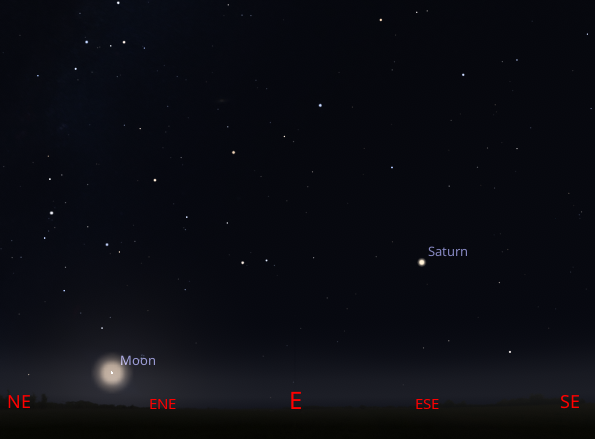
Addendum
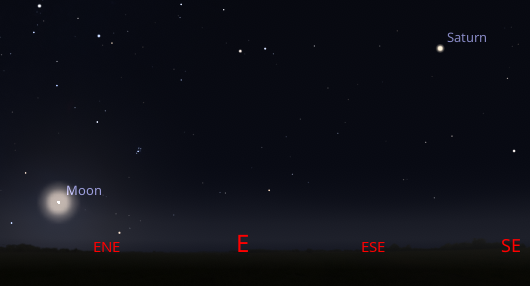
Saturn appears in the east southeast by 9 PM, with the Moon rising in the east northeast, October 28, 2026.
Saturn appears in the east southeast by 9 PM, with the Moon rising in the east northeast, October 28, 2026. Created using Stellarium.
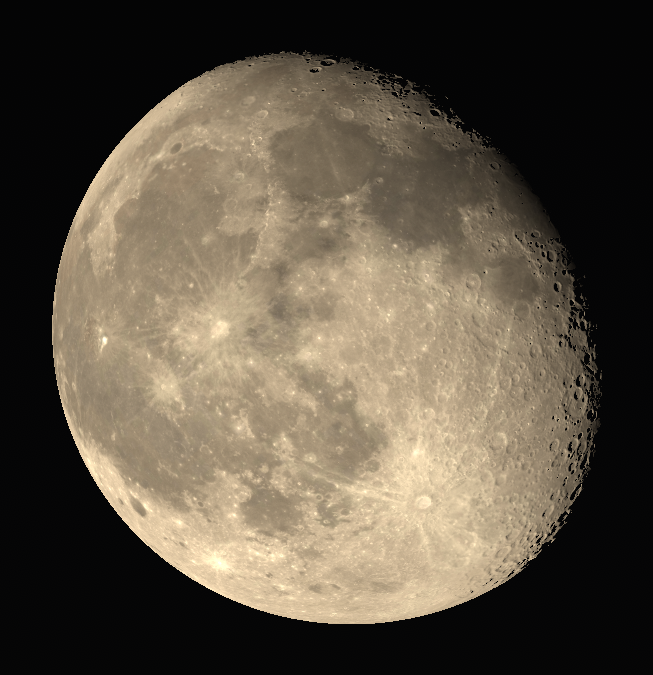
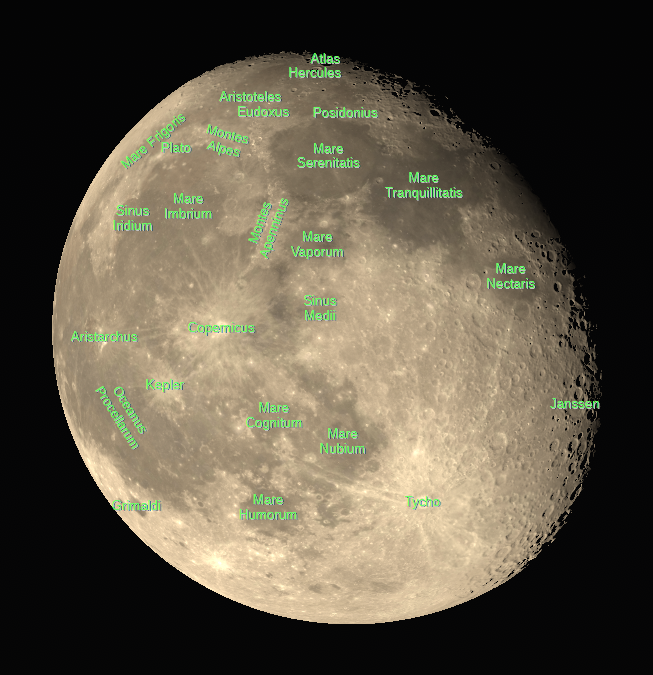
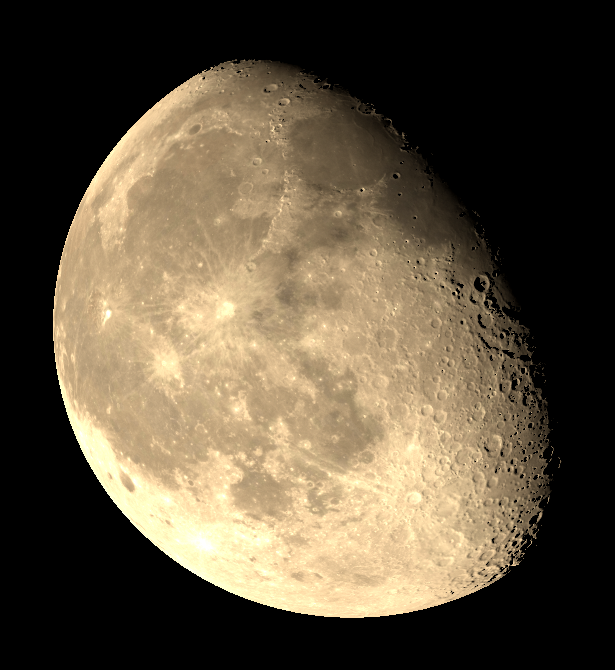
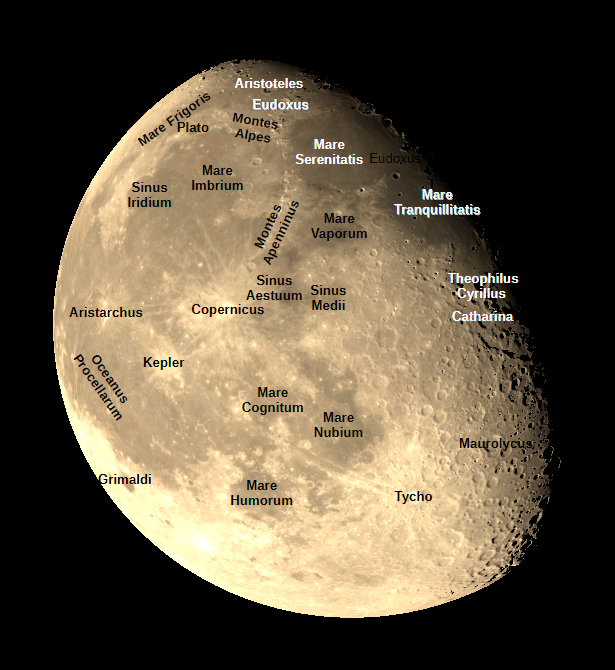
The Moon, 3 days after first quarter, at 9 PM tonight, October 28, 2026. A view visible in small telescopes showing an image with and without selected features labeled. Created using Stellarium, LibreOffice Draw, and GIMP.
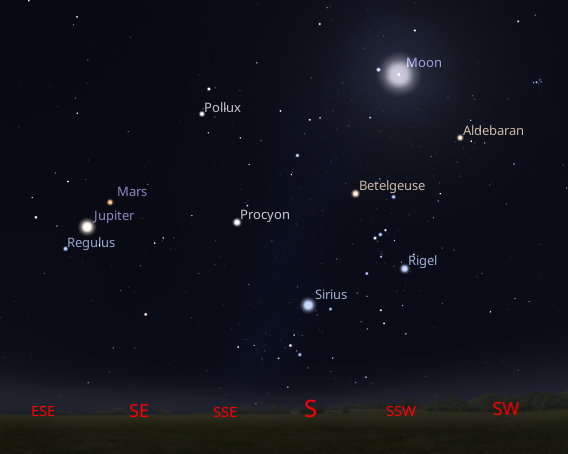
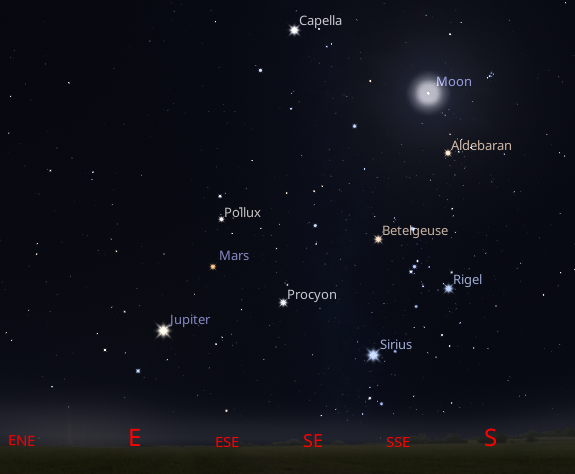
Mars and Jupiter appear with the bright stars of winter, which now adorn the predawn sky at 6 AM.
Mars and Jupiter appear with the bright stars of winter, which now adorn the predawn sky at 6 AM. Created using Stellarium.
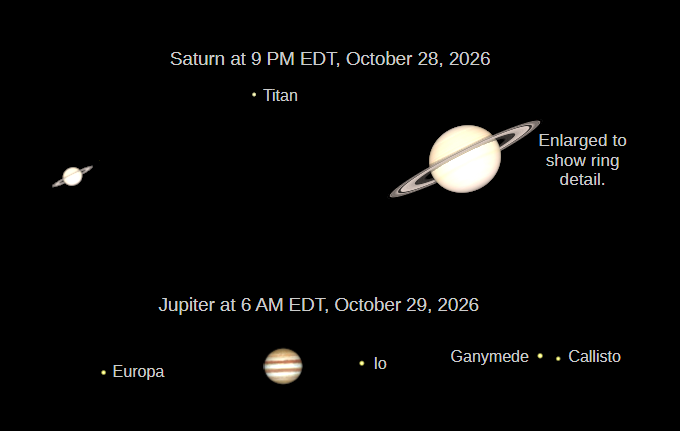
Telescopic views of the naked-eye planets as seen in a small telescope.
Telescopic views of the naked-eye planets as seen in a small telescope: At 9 PM, Saturn will be 19.5″ in diameter, and its rings extend to 45.4″. At 6 AM, Jupiter will be 35.6″ in diameter. Mars, not shown, will appear 6.4″ in diameter. The (”) symbol means seconds of arc, or 1/3600th of a degree. Created using4Cartes du Ciel (Sky Charts), LibreOffice Draw and GIMP.
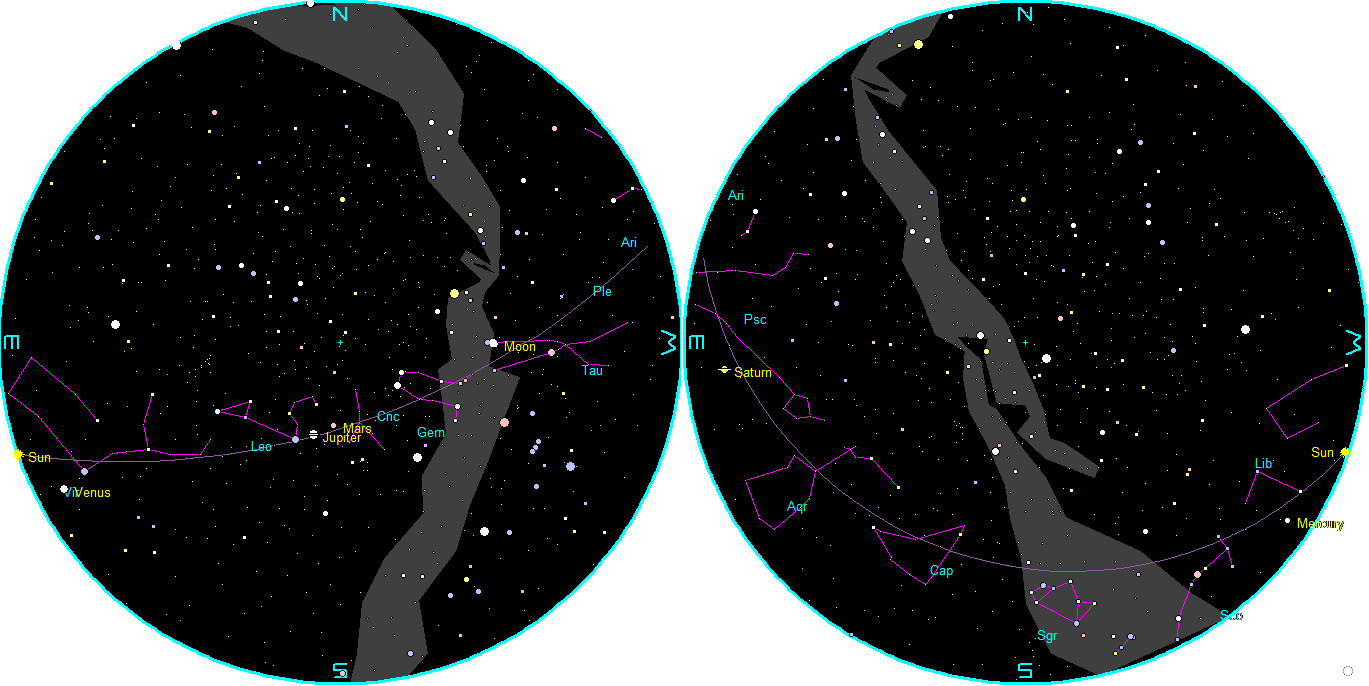
The naked-eye planets at sunset and sunrise on a single night.
The naked-eye planets at sunset and sunrise on a single night, starting with sunset on the right on October 28, 2026. The night ends on the left with sunrise on the 29th. Click or tap on the image to enlarge it. Created using my LookingUp app and GIMP.
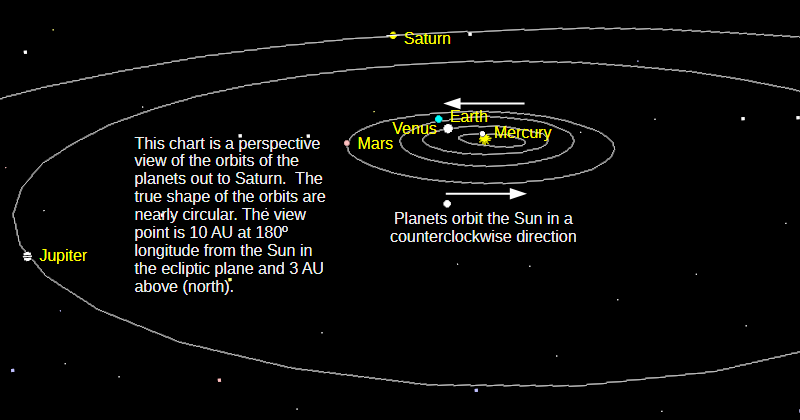
The naked-eye planets, from Mercury to Saturn, in a low angle perspective view of the solar system from above and a bit beyond Saturn’s orbit for today, October 28, 2026.
The naked-eye planets, from Mercury to Saturn, in a low angle perspective view of the solar system from above and a bit beyond Saturn’s orbit for today, October 28, 2026. Created using my LookingUp app, text and arrows created using LibreOffice Draw and produced a unified image using GIMP.

Ephemeris: 10/21/2026 – Taking our weekly look at the whereabouts of the naked-eye planets

October 21, 2026 Comments off

This is Ephemeris for Wednesday, October 21st. Today the Sun will be up for 10 hours and 41 minutes, setting at 6:47, and it will rise tomorrow at 8:07. The Moon, 3 days past first quarter, will set at 3:57 tomorrow morning.

Let’s take our weekly look at the whereabouts of the naked-eye planets. Three of the naked-eye planets are visible in the night sky. Mercury sets too soon after sunset to be seen. Venus will pass between the earth and the sun in inferior conjunction in two days, and might be seen in the morning sky for sharp-eyed observers by the end of the month. Tonight, Saturn will be in the east-southeastern sky as it gets dark. It is the brightest starlike object low in that direction. It is a ways to the left of and slightly below the Moon in the southeast. At 6 AM, Jupiter and Mars will in the east-southeast. Jupiter is brightest and red Mars will be above and to the right of Jupiter and slowly closing. Some Orionid meteors might be visble then.

The astronomical event times given in this blog are for the Traverse City/Interlochen area of Michigan (Lat 44.7° N, Long 85.7° W; EDT, UT – 4 hours) unless stated otherwise. Times will be different for other locations.

Addendum
Saturn appears in the east southeast by 9 PM, to the left of the Moon in the south-southeast.
Saturn appears in the east southeast by 9 PM, to the left of the Moon in the south-southeast, October 21, 2026. Created using Stellarium, LibreOffice Draw and GIMP
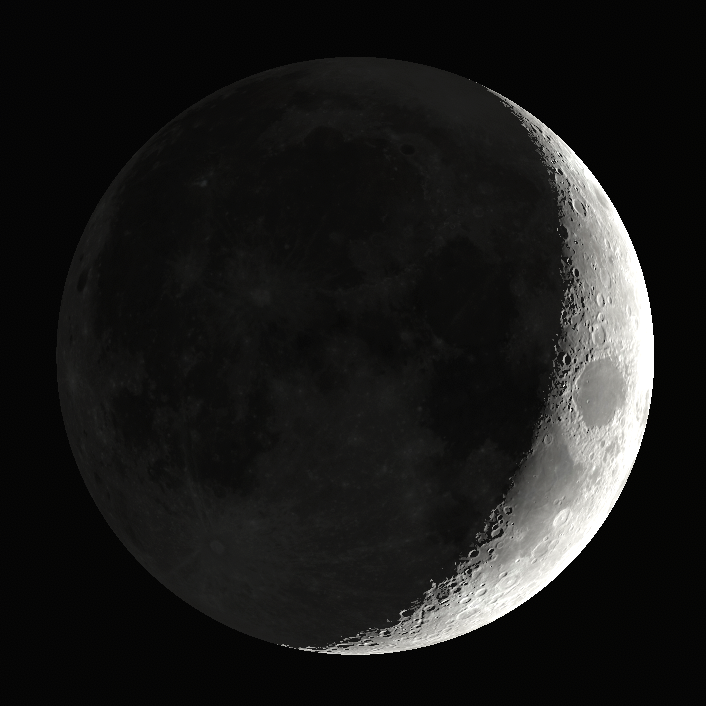
The Moon, 3 days after first quarter, at 9 PM tonight, October 21, 2026. A view visible in small telescopes showing an image with and without selected features labeled. Created using Stellarium, LibreOffice Draw, and GIMP.
Mars and Jupiter appear with the constellations of winter, which now adorn the predawn sky at 6 AM.
Mars and Jupiter appear with the constellations of winter, which now adorn the predawn sky at 6 AM. Created using Stellarium.
Telescopic views of the naked-eye planets as seen in a small telescope.
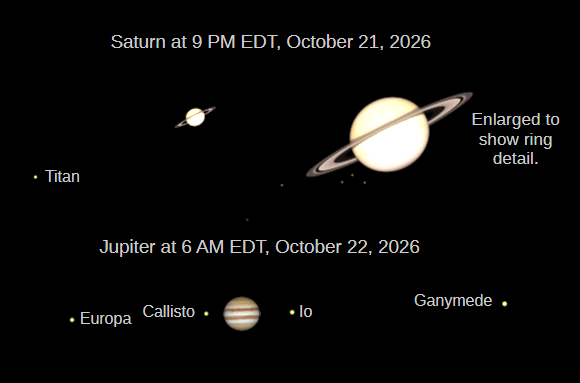
Telescopic views of the naked-eye planets as seen in a small telescope: At 9 PM, Saturn will be 19.6″ in diameter, and its rings extend to 45.7″. At 6 AM, Jupiter will be 35.0″ in diameter. Io will be eclipsed in the planet’s shadow fefore 7 AM. Mars, not shown, will appear 6.2″ in diameter. The (”) symbol means seconds of arc, or 1/3600th of a degree. Created using Cartes du Ciel (Sky Charts), LibreOffice Draw and GIMP.
The naked-eye planets at sunset and sunrise on a single night.
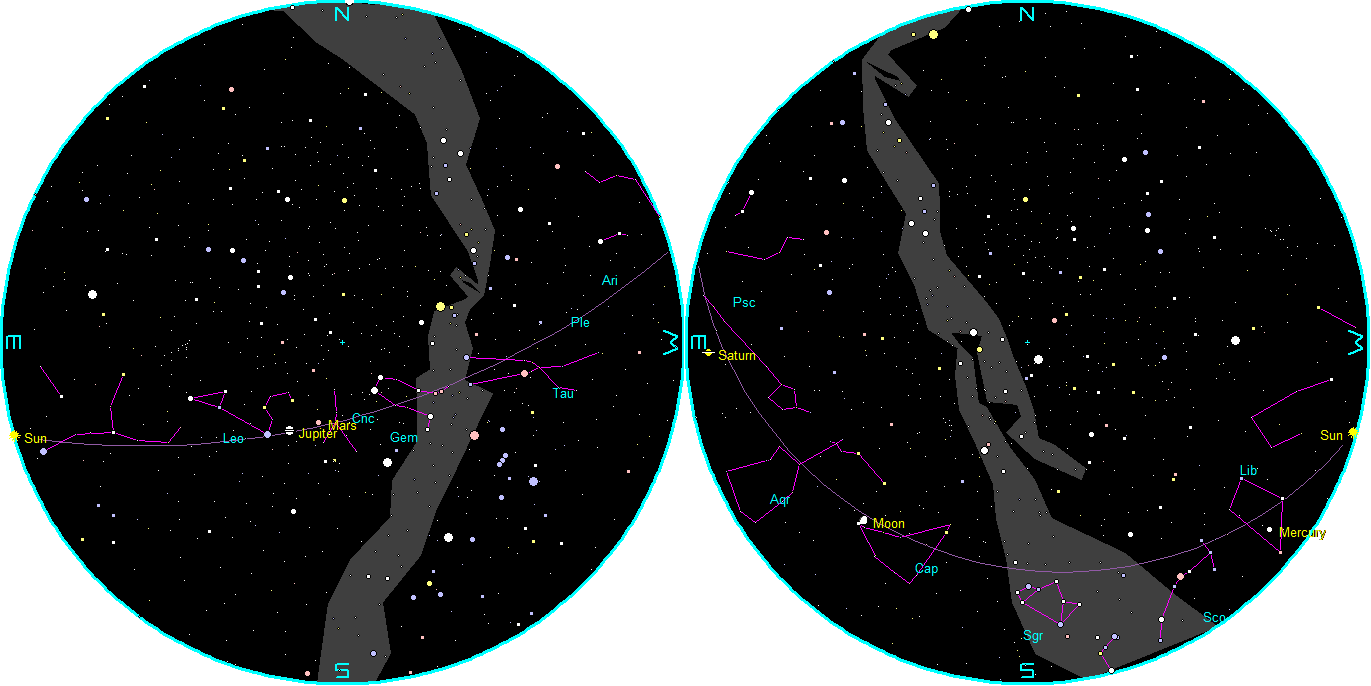
The naked-eye planets at sunset and sunrise on a single night, starting with sunset on the right on October 21, 2026. The night ends on the left with sunrise on the 22nd. Note that Venus is below the horizon at sunrise and sunset, since it is near inferior conjunction with the Sun (Oct 23rd), and south of the ecliptic. Click or tap on the image to enlarge it. Created using my LookingUp app and GIMP.
The naked-eye planets, from Mercury to Saturn, in a low angle perspective view of the solar system from above and a bit beyond Saturn’s orbit for today, October 21, 2026.
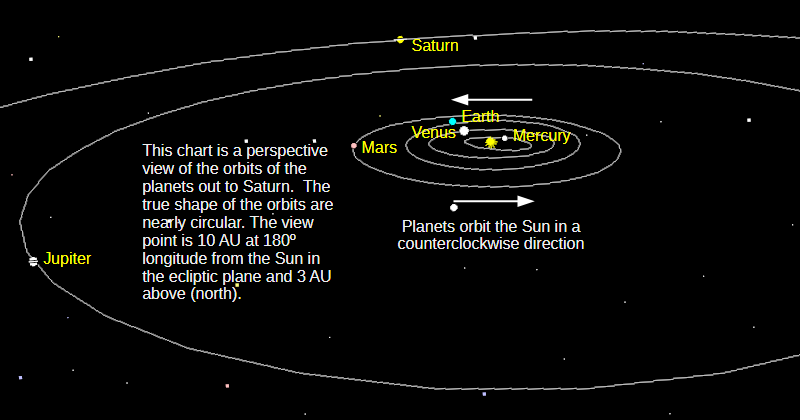
The naked-eye planets, from Mercury to Saturn, in a low angle perspective view of the solar system from above and a bit beyond Saturn’s orbit for today, October 21, 2026. Created using my LookingUp app, text and arrows created using LibreOffice Draw and produced a unified image using GIMP.

Ephemeris: 10/14/2026 – Taking our weekly look at the whereabouts of the naked-eye planets

October 14, 2026 Comments off

This is Bob Moler with Ephemeris for Wednesday, October 14th. Today the Sun will be up for 11 hours and 2 minutes, setting at 6:59, and it will rise tomorrow at 7:58. The Moon, halfway from new to first quarter, will set at 8:44 this evening.

Let’s take our weekly look at the whereabouts of the naked-eye planets. Three of the naked-eye planets are visible in the night sky. Mercury sets too soon after sunset to be seen. Venus is will pass between the earth and the sun on the 23rd, and might be seen in the morning sky as soon as a week later. Tonight, Saturn will be in the eastern sky as it gets dark. It is the brightest starlike object low in that direction. It will be below the four stars that make a large distinctive pattern that marks the body of Pegasus the flying horse, called the Great Square. At 6 AM, Jupiter and Mars will in the east. Jupiter is brightest and while red Mars will be above and to the right of Jupiter and slowly closing. It will pass Jupiter on November 15th.

The astronomical event times given in this blog are for the Traverse City/Interlochen area of Michigan (Lat 44.7° N, Long 85.7° W; EDT, UT – 4 hours) unless stated otherwise. Times will be different for other locations.

Addendum
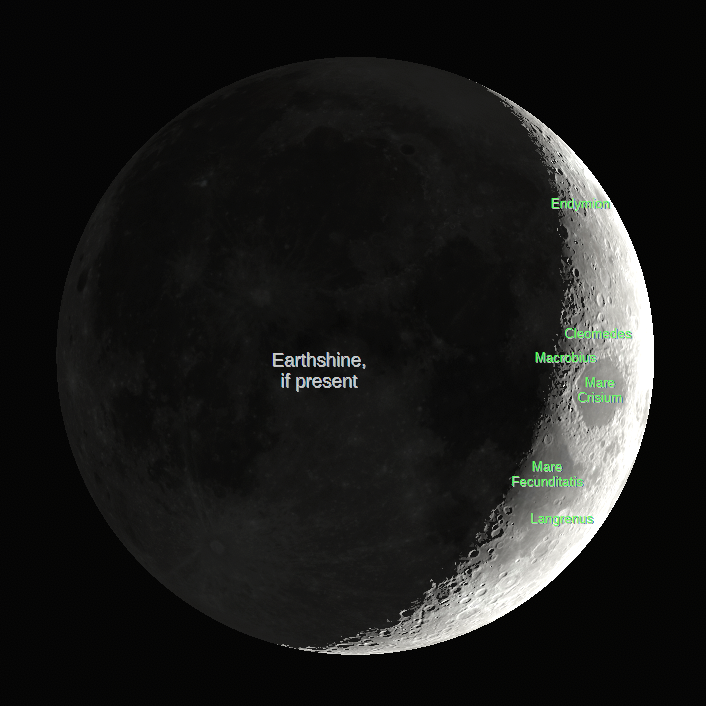
The Moon, halfway from new to first quarter at 8 PM tonight, October 14, 2026. A view visible in small telescopes showing an image with and without selected features labeled. Created using Stellarium, LibreOffice Draw, and GIMP.
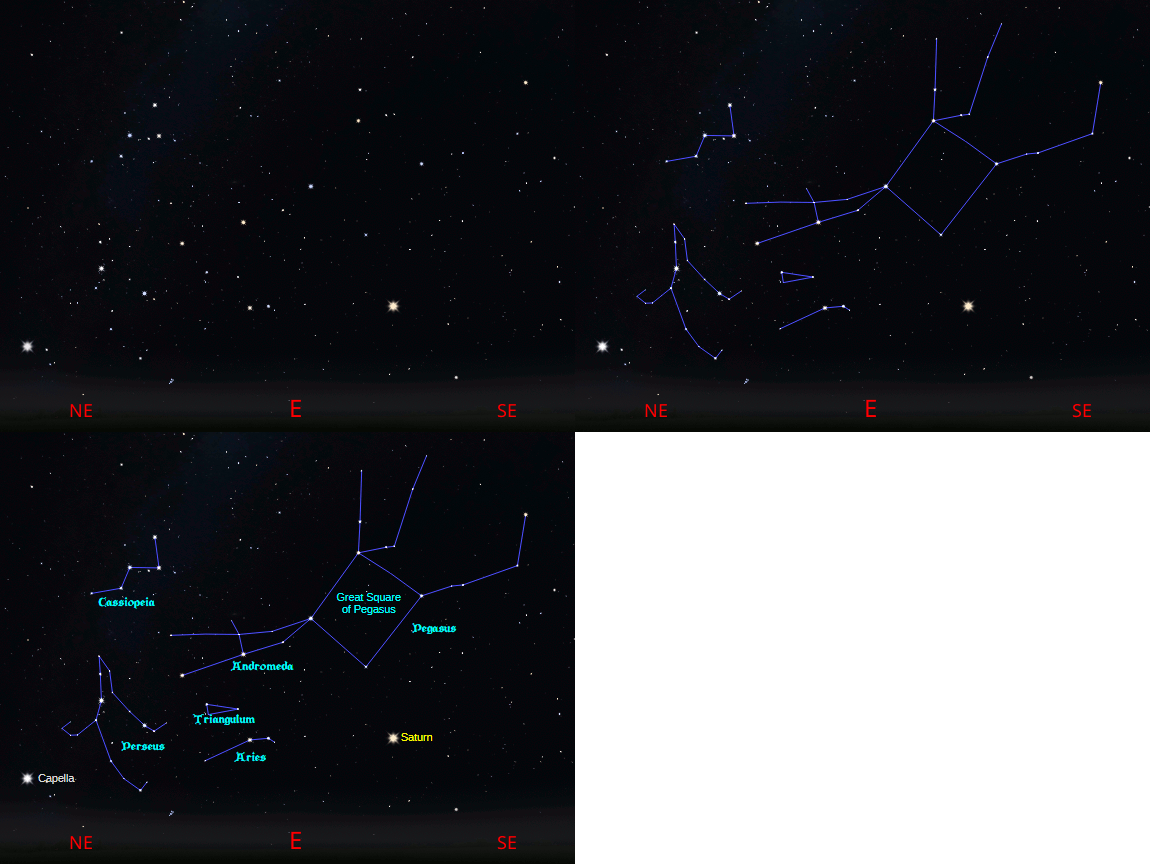
Saturn appears in the east southeast by 9 PM, below the constellations of autumn tonight, October 14, 2026.
Saturn appears in the east southeast by 9 PM, below the constellations of autumn tonight, October 14, 2026. Created using Stellarium, LibreOffice Draw and GIMP.
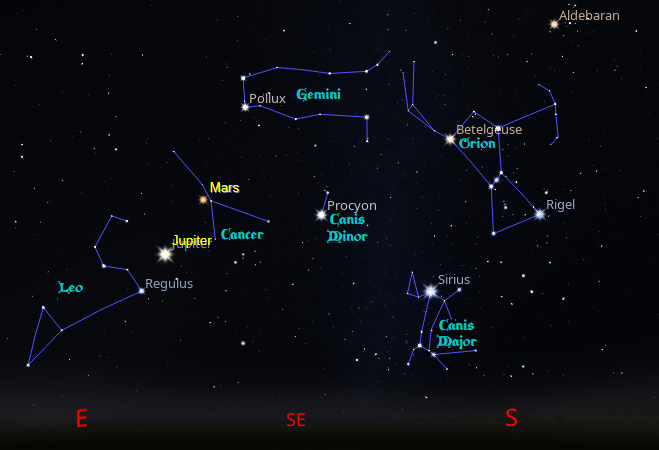
Mars and Jupiter appear with the constellations of winter, which now adorn the predawn sky at 6 AM.
Mars and Jupiter appear with the constellations of winter, which now adorn the predawn sky at 6 AM. Created using Stellarium.
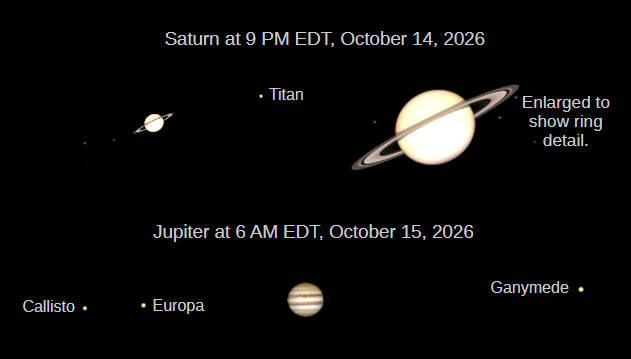
Telescopic views of the naked-eye planets as seen in a small telescope.
Telescopic views of the naked-eye planets as seen in a small telescope: At 9 PM, Saturn will be 19.7″ in diameter, and its rings extend to 45.8″. At 6 AM, Jupiter will be 34.4″ in diameter, with Io eclipsed in the planet’s shadow. Mars, not shown, will appear 6.0″ in diameter. The (”) symbol means seconds of arc, or 1/3600th of a degree. Created using Cartes du Ciel (Sky Charts), LibreOffice Draw and GIMP.
The naked-eye planets at sunset and sunrise on a single night, starting with sunset on the right on October 14, 2026. The night ends on the left with sunrise on the 15th.
The naked-eye planets at sunset and sunrise on a single night, starting with sunset on the right on October 14, 2026. The night ends on the left with sunrise on the 15th. Note that Venus is below the horizon at sunrise and sunset, since it is near inferior conjunction with the Sun (Oct 23rd), and south of the ecliptic. Click or tap on the image to enlarge it. Created using my LookingUp app and GIMP.
The naked-eye planets, from Mercury to Saturn, in a low angle perspective view of the solar system from above and a bit beyond Saturn’s orbit for today, October 14, 2026.
The naked-eye planets, from Mercury to Saturn, in a low angle perspective view of the solar system from above and a bit beyond Saturn’s orbit for today, October 14, 2026. Note the cool lineup of Saturn, Earth, Venus and the Sun. Created using my LookingUp app, text and arrows created using LibreOffice Draw and produced a unified image using GIMP.

Ephemeris: 10/7/2026 – Taking our weekly look at the whereabouts of the naked-eye planets

October 7, 2026 Comments off

This is Ephemeris for Wednesday, October 7th. Today the Sun will be up for 11 hours and 23 minutes, setting at 7:12, and it will rise tomorrow at 7:49. The Moon, 3 days before new, will rise at 5:32 tomorrow morning.

Let’s take our weekly look at the whereabouts of the naked-eye planets. Three of the naked-eye planets are visible in the night sky. Mercury sets too soon after sunset to be seen. Venus is will pass between the earth and the sun on the 23rd, and might be seen in the morning sky a week later. Tonight, Saturn will be in the eastern sky as it gets dark. It is the brightest starlike object low in that direction. It will be below the four stars that make large distinctive pattern, that marks the body of Pegasus the flying horse, called the Great Square. At 6 AM, Jupiter and Mars will in the east. Jupiter is brightest and while red Mars will be above and to the right of Jupiter. It will pass Jupiter on November 15th.

The astronomical event times given in this blog are for the Traverse City/Interlochen area of Michigan (Lat 44.7° N, Long 85.7° W; EDT, UT – 4 hours) unless stated otherwise. Times will be different for other locations.

Addendum
Saturn appears in the east southeast by 9 PM, under the Great Square of Pegasus.
Saturn appears in the east southeast by 9 PM, under the Great Square of Pegasus tonight, October 7, 2026. Created using Stellarium.
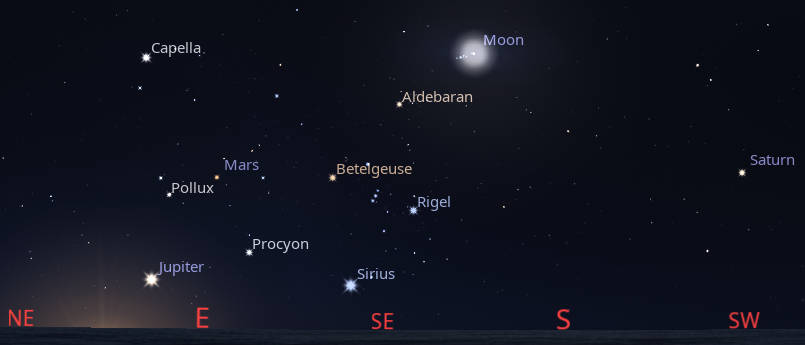
Mars and Jupiter appear with the moon and the constellations of winter, which now adorn the predawn sky at 6 AM.
Mars and Jupiter appear with the moon and the constellations of winter, which now adorn the predawn sky at 6 AM. Created using Stellarium.
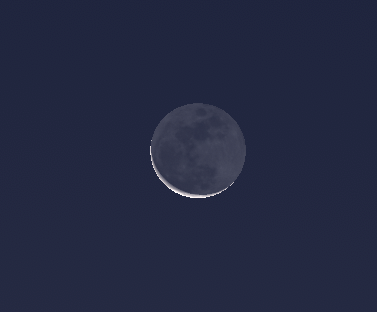
The really old sliver of a Moon with earthshine is seen low in the east tomorrow morning.
The really old sliver of a Moon with earthshine is seen low in the east tomorrow morning October 8, 2026. Created using Stellarium.
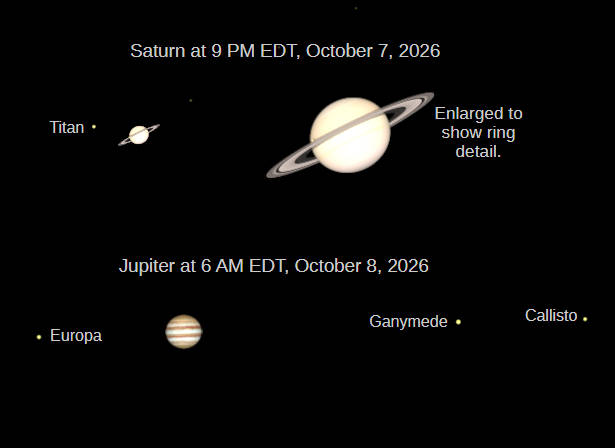
Telescopic views of the naked-eye planets as seen in a small telescope.
Telescopic views of the naked-eye planets as seen in a small telescope: At 9 PM, Saturn will be 19.7″ in diameter, and its rings extend to 45.9″. At 6 AM, Jupiter will be 33.8″ in diameter. Mars, not shown, will appear 5.8″ in diameter. The (”) symbol means seconds of arc, or 1/3600th of a degree. Created using Cartes du Ciel (Sky Charts), LibreOffice Draw and GIMP.
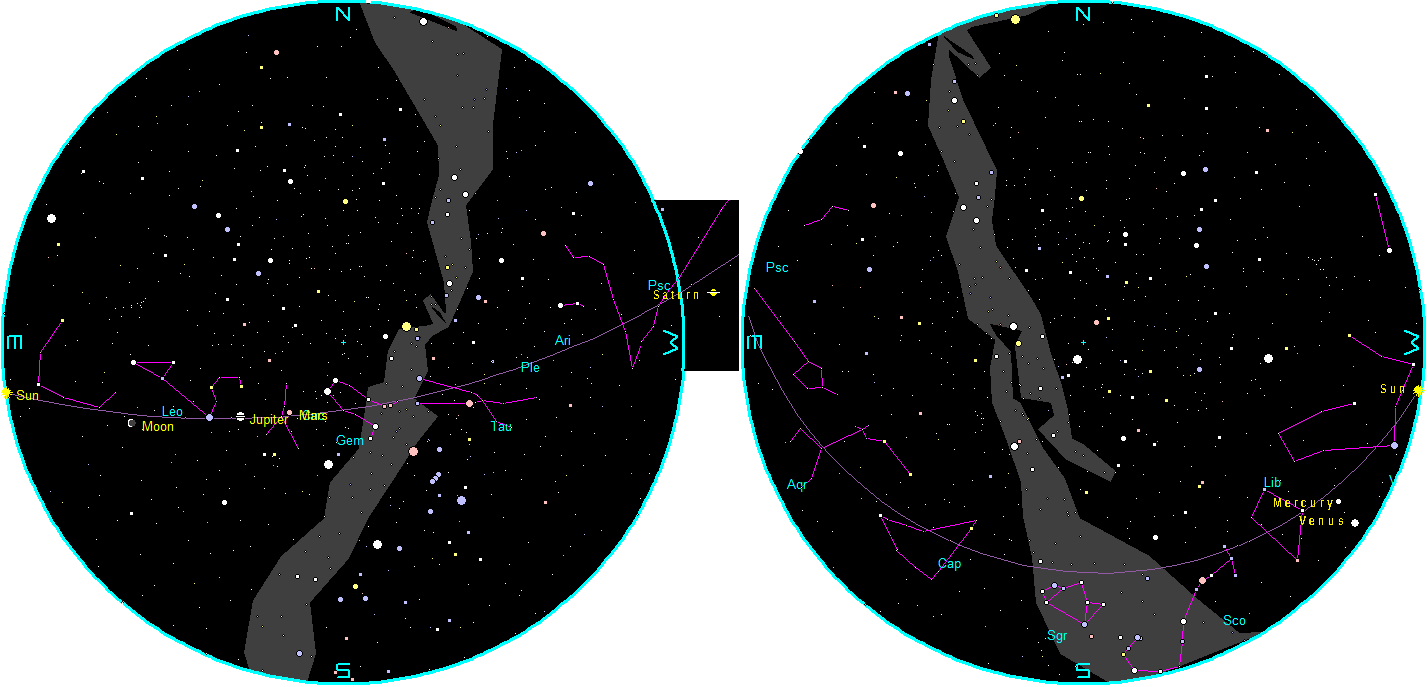
The naked-eye planets at sunset and sunrise on a single night.
The naked-eye planets at sunset and sunrise on a single night, starting with sunset on the right on October 7, 2026. The night ends on the left with sunrise on the 8th. Note that Saturn is below the horizon at sunrise and sunset, since it is near opposition (Oct 4th), and south of the ecliptic. Click or tap on the image to enlarge it. Created using my LookingUp app and GIMP.
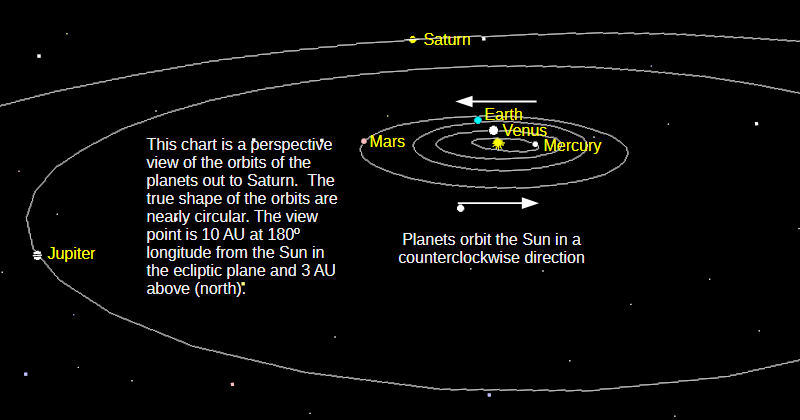
he naked-eye planets, from Mercury to Saturn, in a low angle perspective view of the solar system from above and a bit beyond Saturn’s orbit for today, October 8, 2026.
The naked-eye planets, from Mercury to Saturn, in a low angle perspective view of the solar system from above and a bit beyond Saturn’s orbit for today, October 8, 2026. Created using my LookingUp app, text and arrows created using LibreOffice Draw and produced a unified image using GIMP.

Ephemeris: 09/30/2026 – Taking our weekly look at the whereabouts of the naked-eye planets

September 30, 2026 Comments off

This is Ephemeris for Wednesday, September 30th. Today the Sun will be up for 11 hours and 45 minutes, setting at 7:25, and it will rise tomorrow at 7:40. The Moon, 3 days before last quarter, will rise at 9:14 this evening.

Let’s take our weekly look at the whereabouts of the naked-eye planets. Venus, now is too close to the horizon at sunset to easily spot. At sunset Venus will be only 4º above the horizon at sunset and will set at 7:52 PM. We will await its dramatic reappearance in the morning sky by early November. Saturn will be in the eastern sky as it gets dark. It is the brightest starlike object low in that direction. It will be below the four stars that make large distinctive pattern, that marks the body of Pegasus the flying horse, called the Great Square. At 6 AM, Jupiter and Mars will in the east. Jupiter is brightest and while red Mars will be above and just below and nearly in line with Castor and Pollux of Gemini.

The astronomical event times given in this blog are for the Traverse City/Interlochen area of Michigan (Lat 44.7° N, Long 85.7° W; EDT, UT – 4 hours) unless stated otherwise. Times will be different for other locations.

Addendum
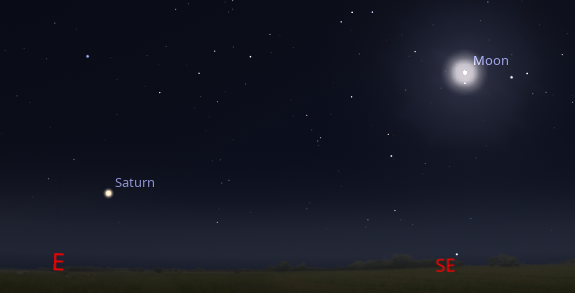
Saturn appears in the east southeast by 10 PM, to the far right of the Moon tonight.
Saturn appears in the east southeast by 10 PM, to the far right of the Moon tonight, September 30, 2026. Created using Stellarium.
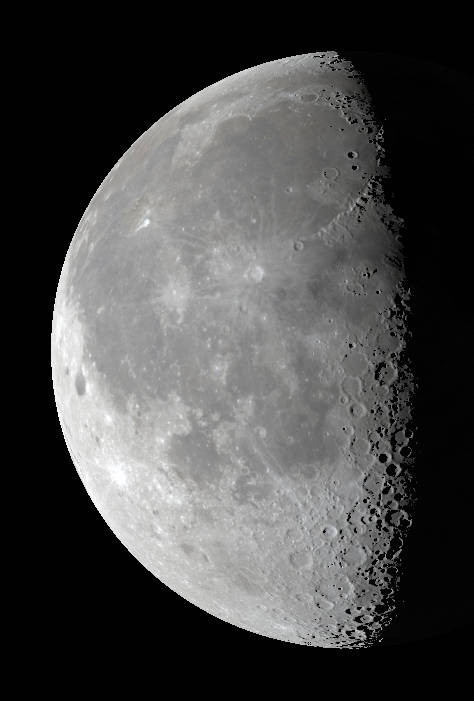
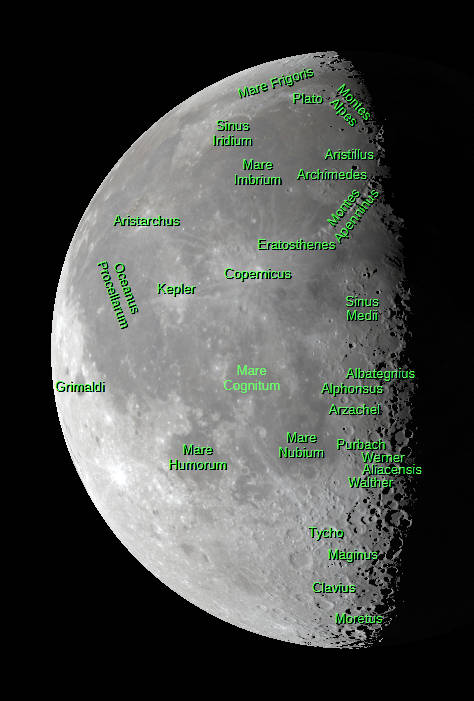
The Moon three days before full at 10 PM tonight, September 30, 2026. A view visible in small telescopes showing an image with and without selected features labeled. Created using Stellarium, LibreOffice Draw, and GIMP.
Mars and Jupiter appear with the moon and the stars of winter, which now adorn the predawn sky at 6 AM.
Mars and Jupiter appear with the moon and the stars of winter, which now adorn the predawn sky at 6 AM. Created using Stellarium.
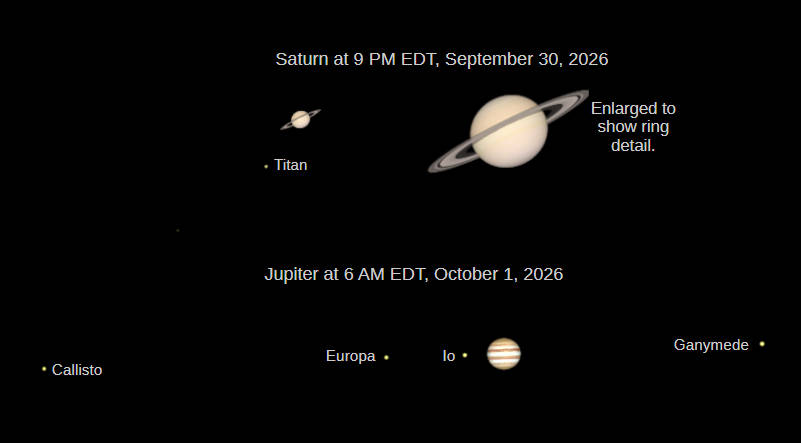
Telescopic views of the naked-eye planets as seen in a small telescope.
Telescopic views of the naked-eye planets as seen in a small telescope: At 9 PM, Saturn will be 19.7″ in diameter, and its rings extend to 45.9″. At 6 AM, Jupiter will be 33.3″ in diameter. Mars, not shown, will appear 5.6″ in diameter. The (”) symbol means seconds of arc, or 1/3600th of a degree. Created using Cartes du Ciel (Sky Charts), LibreOffice Draw and GIMP.
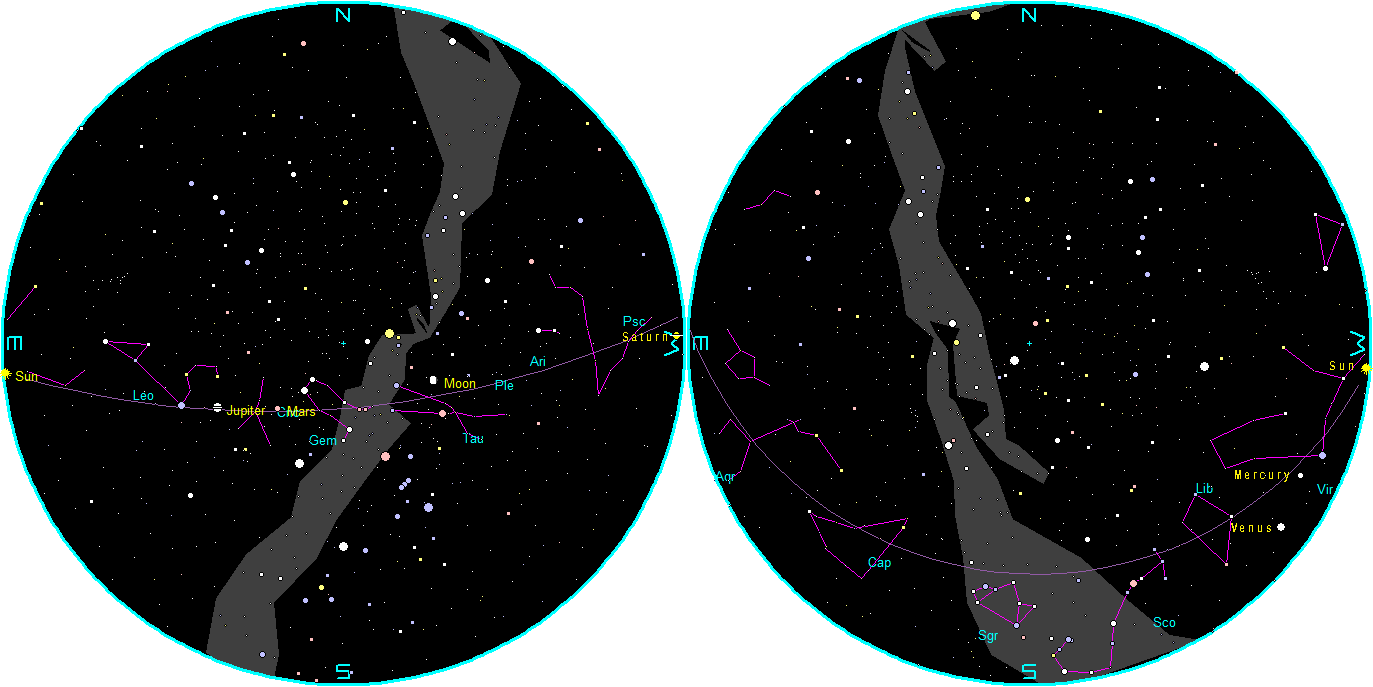
The naked-eye planets at sunset and sunrise on a single night, starting with sunset on the right on September 30, 2026. The night ends on the left with sunrise on October 1st.
The naked-eye planets at sunset and sunrise on a single night, starting with sunset on the right on September 30, 2026. The night ends on the left with sunrise on October 1st. Click or tap on the image to enlarge it. Created using my LookingUp app and GIMP.
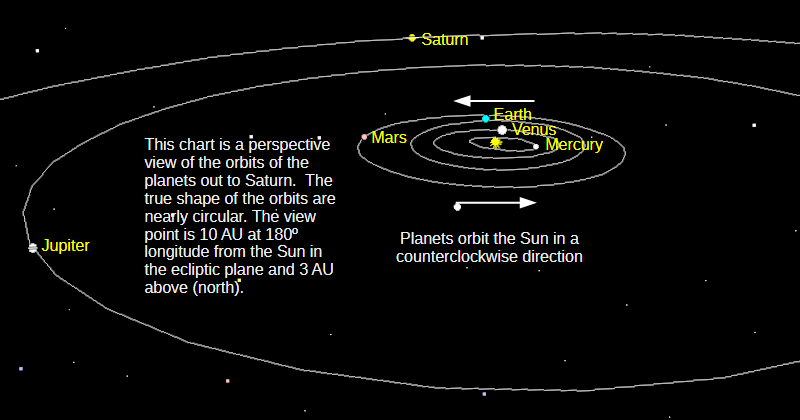
The naked-eye planets, from Mercury to Saturn, in a low angle perspective view of the solar system from above and a bit beyond Saturn’s orbit for today, September 30, 2026.
The naked-eye planets, from Mercury to Saturn, in a low angle perspective view of the solar system from above and a bit beyond Saturn’s orbit for today, September 30, 2026. Created using my LookingUp app, text and arrows created using LibreOffice Draw and produced a unified image using GIMP.

Ephemeris: 09/23/2026 – Where did Venus go?

September 23, 2026 Comments off

This is Ephemeris for Wednesday, September 23rd. Today the Sun will be up for 12 hours and 6 minutes, setting at 7:38, and it will rise tomorrow at 7:32. The Moon, 3 days before full, will set at 5:08 tomorrow morning.

Let’s take our weekly look at the whereabouts of the naked-eye planets. Venus, now is too close to the horizon at sunset to easily spot. At sunset Venus will be only 5º above the horizon at sunset and will set at 8:25 PM. We will await its dramatic reappearance in the morning sky in early November. Saturn will be in the eastern sky as it gets dark. It is the brightest starlike object low in that direction. It will be below the four stars that make large distinctive pattern, that marks the body of Pegasus the flying horse, called the Great Square of Pegasus. At 6 AM, Jupiter will be due east. Jupiter is brightest and lowest while Mars will be just below and nearly in line with Castor and Pollux of Gemini.

The astronomical event times given in this blog are for the Traverse City/Interlochen area of Michigan (Lat 44.7° N, Long 85.7° W; EDT, UT – 4 hours) unless stated otherwise. Times will be different for other locations.

Addendum
Saturn appers in the east by 9 PM, to the far left of the Moon tonight, September 23, 2026.
Saturn appers in the east by 9 PM, to the far left of the Moon tonight, September 23, 2026. Created using Stellarium.
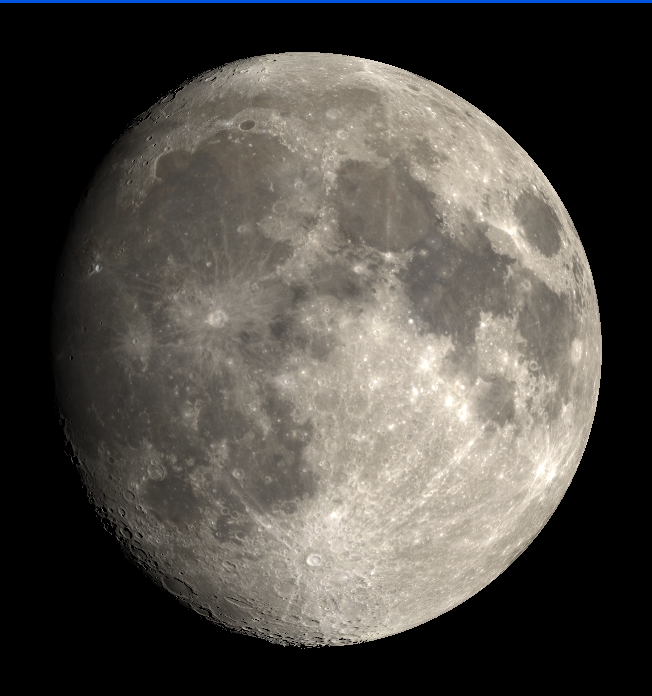
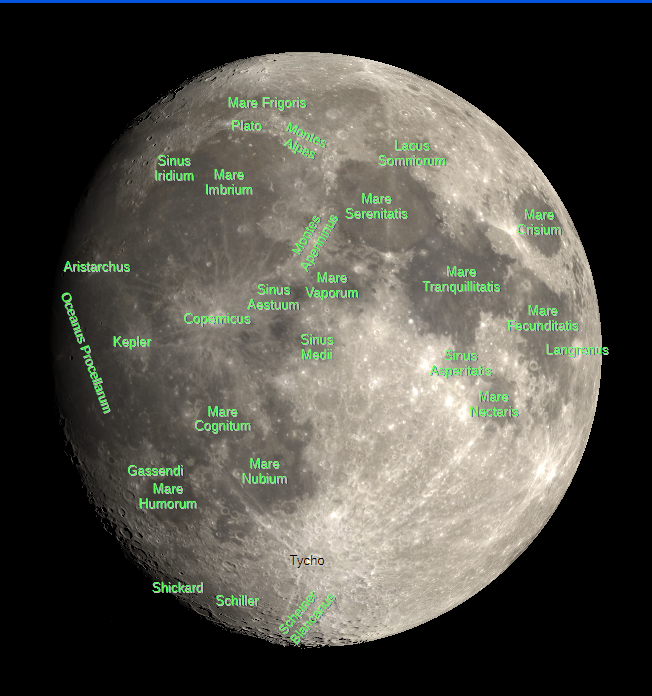
The Moon three days before full at 9 PM tonight, September 23, 2026. A view visible in small telescopes showing an image with and without selected features labeled. Created using Stellarium, LibreOffice Draw, and GIMP.
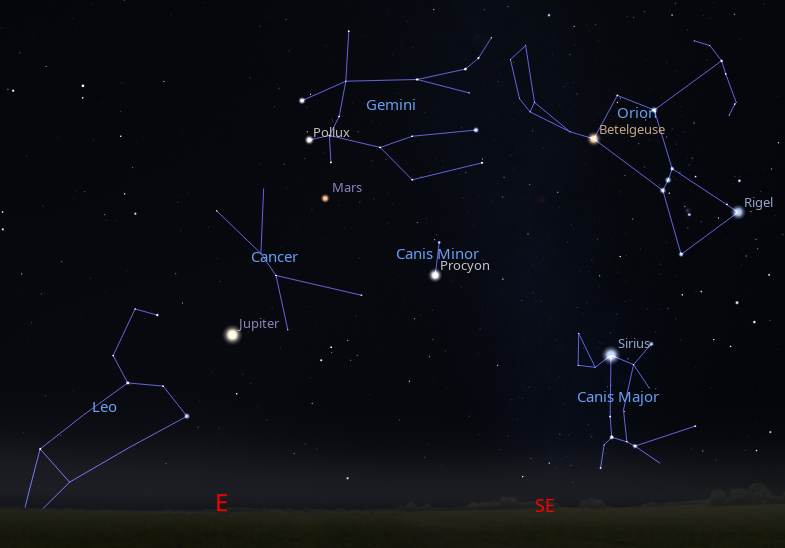
Mars and Jupiter appear with the stars of winter, which now adorn the predawn sky at 6 AM.
Mars and Jupiter appear with the stars of winter, which now adorn the predawn sky at 6 AM. Created using Stellarium.
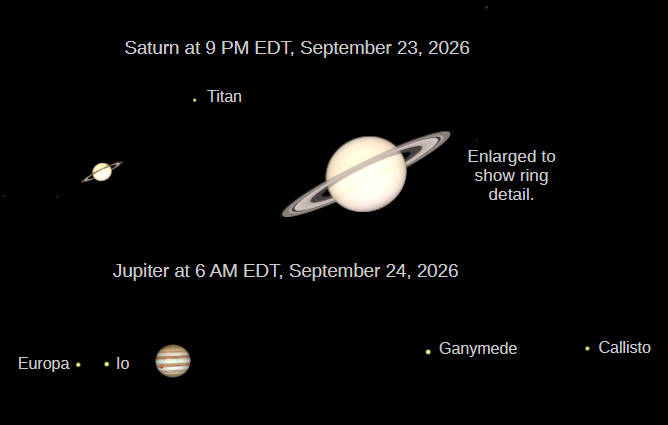
Telescopic views of the naked-eye planets as seen in a small telescope.
Telescopic views of the naked-eye planets as seen in a small telescope: At 9 PM, Saturn will be 19.7″ in diameter, and its rings extend to 45.8″. At 6 AM, Jupiter will be 32.9″ in diameter. Mars, not shown, will appear 5.5″ in diameter. The (”) symbol means seconds of arc, or 1/3600th of a degree. Created using Cartes du Ciel (Sky Charts), LibreOffice Draw and GIMP.
The naked-eye planets at sunset and sunrise on a single night.
The naked-eye planets at sunset and sunrise on a single night, starting with sunset on the right on September 23, 2026. The night ends on the left with sunrise on the 24th. Click or tap on the image to enlarge it. Created using my LookingUp app and GIMP.
The naked-eye planets, from Mercury to Saturn, in a low angle perspective view of the solar system.
The naked-eye planets, from Mercury to Saturn, in a low angle perspective view of the solar system from above and a bit beyond Saturn’s orbit for today, September 23, 2026. Created using my LookingUp app, text and arrows created using LibreOffice Draw and produced a unified image using GIMP.

Ephemeris: 09/16/2026 – Taking our weekly look at the whereabouts of the naked-eye planets

September 16, 2026 Comments off

This is Ephemeris for Wednesday, September 16th. Today the Sun will be up for 12 hours and 28 minutes, setting at 7:51, and it will rise tomorrow at 7:24. The Moon, 2 days before first quarter, will set at 10:08 this evening.

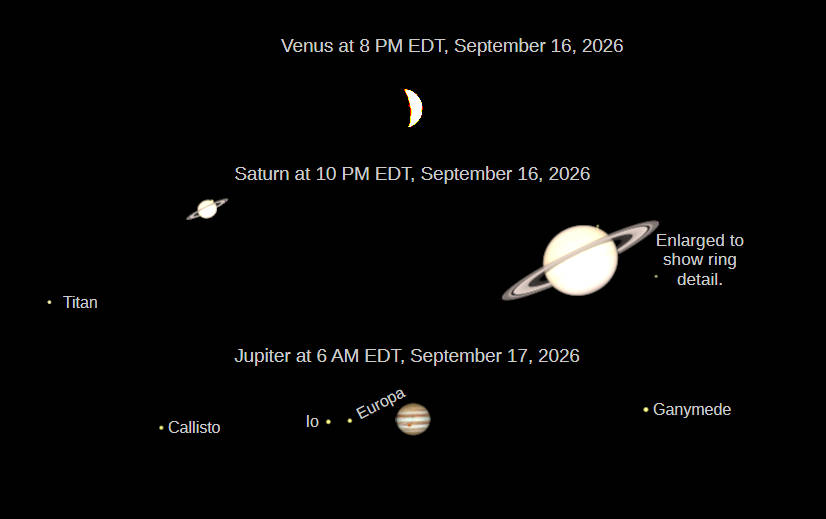
Let’s take our weekly look at the whereabouts of the naked-eye planets. By 8:15 tonight, about a half-hour after sunset, Venus will be spotted very low in the west southwestern sky with the moon above and to the left. Though at a 41º angle from the sun, it’ll only be 4º above the horizon then. A telescope will show a small crescent disk of the planet. It is now rapidly approaching earth in its orbit, at 41.2 million miles (66.3 mil km) away from us. Venus is becoming an ever decreasing crescent as its apparent diameter grows in telescopes. Saturn will rise at 8:47 PM in the east. At 6 AM, Mars and Jupiter will be in the east. Jupiter is brightest and lowest while Mars is just below and right of Pollux, the brightest star in Gemini.

The astronomical event times given in this blog are for the Traverse City/Interlochen area of Michigan (Lat 44.7° N, Long 85.7° W; EDT, UT – 4 hours) unless stated otherwise. Times will be different for other locations.

Addendum
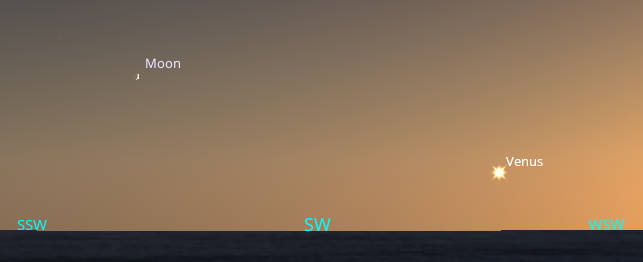
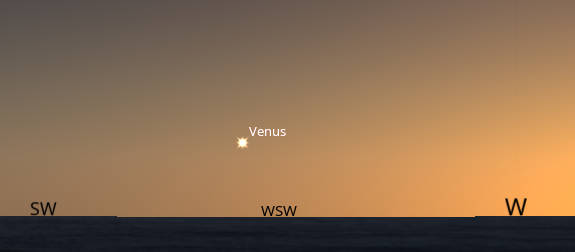
Venus appears low in the west southwestern sky, with the crescent moon in the south southwest at 8:15 PM tonight, September 16, 2026.
Venus appears low in the west southwestern sky, with the crescent moon in the south southwest at 8:15 PM tonight, September 16, 2026. Created using Stellarium.
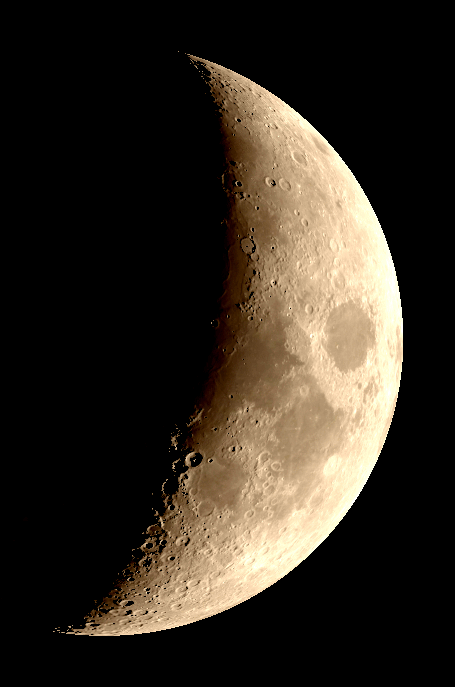
The Moon two days before first quarter at 10 PM tonight, September 16, 2026. A view visible in small telescopes showing an image with and without selected features labeled. Created using Stellarium, LibreOffice Draw, and GIMP. This presentation doesn’t work well on my Android phone.
The Moon two days before first quarter at 10 PM tonight, September 16, 2026.
The Moon two days before first quarter at 10 PM tonight, September 16, 2026. A view visible in small telescopes showing an image with and without selected features labeled. Created using Stellarium, LibreOffice Draw, and GIMP. Same as above, with an animated GIF. Answer in the comments, which you prefer.
Saturn appers in the east by 10 PM directly under the Great Square of Pegasus, the winged horse of Greek myth.
Saturn appers in the east by 10 PM directly under the Great Square of Pegasus, the winged horse of Greek myth. Created using Stellarium.
Mars and Jupiter appear with the stars of winter, now adorning the predawn sky at 6 AM.
Mars and Jupiter appear with the stars of winter, now adorning the predawn sky at 6 AM. Created using Stellarium.
Telescopic views of the naked-eye planets as seen in a small telescope.
Telescopic views of the naked-eye planets as seen in a small telescope: Venus’ apparent diameter at 8:15 PM tonight will be 38.5″, and be 26.8% illuminated. At 10 PM, Saturn will be 19.6″ in diameter, and its rings extend to 45.7″. At 6 AM, Jupiter will be 32.5″ in diameter. Mars, not shown, will appear 5.3″ in diameter. The (”) symbol means seconds of arc, or 1/3600th of a degree. Created using Cartes du Ciel (Sky Charts), LibreOffice Draw and GIMP.
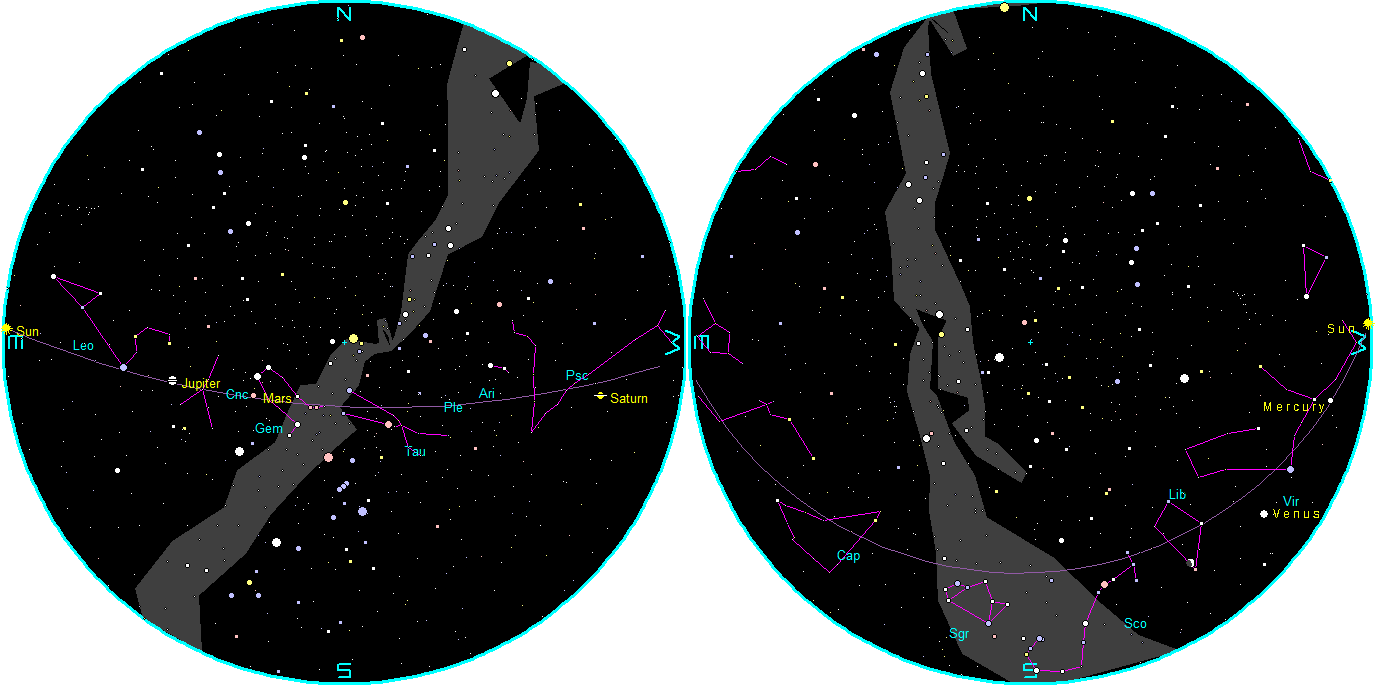
The naked-eye planets at sunset and sunrise on a single night.
The naked-eye planets at sunset and sunrise on a single night, starting with sunset on the right on September 16, 2026. The night ends on the left with sunrise on the 17th. Click or tap on the image to enlarge it. Created using my LookingUp app and GIMP.
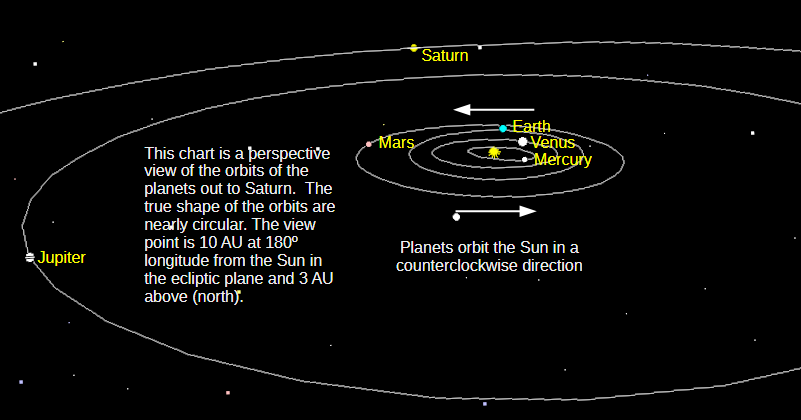
The naked-eye planets, from Mercury to Saturn, in a low angle perspective view of the solar system from above and a bit beyond Saturn’s orbit for today, September 16, 2026.
The naked-eye planets, from Mercury to Saturn, in a low angle perspective view of the solar system from above and a bit beyond Saturn’s orbit for today, September 16, 2026. Created using my LookingUp app, text and arrows created using LibreOffice Draw and produced a unified image using GIMP.

Ephemeris: 09/02/2026 – Taking our weekly look at the whereabouts of the naked-eye planets

September 2, 2026 Comments off

This is Ephemeris for Wednesday, September 2nd. Today the Sun will be up for 13 hours and 11 minutes, setting at 8:17, and it will rise tomorrow at 7:07. The Moon, 2 days before last quarter, will rise at 10:33 this evening.

Let’s take our weekly look at the whereabouts of the naked-eye planets. By 8:45 PM tonight, a nearly a half-hour after sunset, Venus will be spotted low in the west southwestern sky. Though at a 44º angle from the sun, it’ll only be 6º above the horizon then. A telescope will show a small crescent disk of the planet. It is now rapidly approaching earth in its orbit, at 50.8 million miles (81.8 mil km) away from us. Venus is becoming an ever decreasing crescent as its apparent diameter grows in telescopes. At 6 AM, Saturn will be alone in the southwest, while Mars and Jupiter will be in the east. Jupiter is brightest and lowest while Mars has the competition of brighter stars in Gemini.

The astronomical event times given in this blog are for the Traverse City/Interlochen area of Michigan (Lat 44.7° N, Long 85.7° W; EDT, UT – 4 hours) unless stated otherwise. Times will be different for other locations.

Addendum
Venus appears low in the west southwestern sky at 8:45 PM tonight
Venus appears low in the west southwestern sky at 8:45 PM tonight, September 2, 2026. Created using Stellarium.
Saturn, Mars, Jupiter and the Moon will be seen at 6:00 AM tomorrow morning September 3, 2026.
Saturn, Mars, Jupiter and the Moon will be seen at 6:00 AM tomorrow morning September 3, 2026. Mars, in Gemini, is entering the part of the sky with bright stars, the winter sky. So it won’t stand out until it gets much closer to the Earth. Jupiter is brighter than all the rest. Created using Stellarium.
Moon a day before last quarter at 6 AM tomorrow morning, September 3, 2026. A view visible in small telescopes showing an image with and without selected features labeled. Created using Stellarium, LibreOffice Draw, and GIMP.
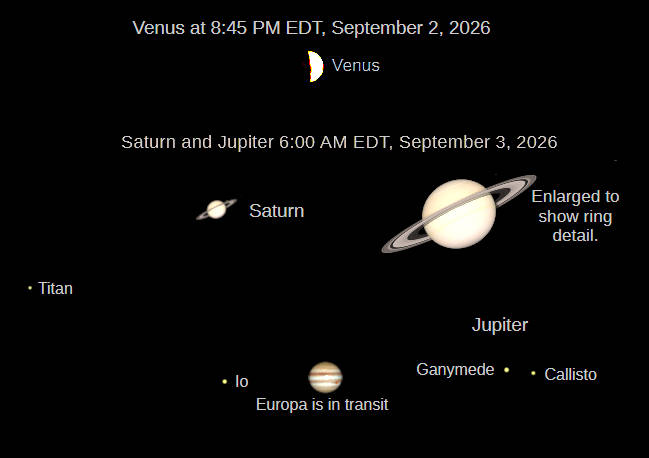
Telescopic Venus at 8:45 PM tonight, September 2, 2026, and Saturn and Jupiter at 6:00 AM.
Telescopic Venus at 8:45 PM tonight, September 2, 2026, and Saturn and Jupiter at 6:00 AM on the 3rd (north up), as they would be seen in a small telescope with the same magnification. Venus’ apparent diameter will be 31.0″, and be 37.5% illuminated. Saturn will be 19.4″ in diameter, and its rings extend to 45.1″, and are tilted 8.6º to our view. Jupiter will be 31.9″ in diameter. Mars, not shown, will appear 5.1″ in diameter. The (”) symbol means seconds of arc, or 1/3600th of a degree. Created using Cartes du Ciel (Sky Charts), LibreOffice Draw and GIMP.
Telescopic Venus at 8:45 PM tonight, September 2, 2026, and Saturn and Jupiter at 6:00 AM.
The naked-eye planets at sunset and sunrise on a single night, starting with sunset on the right on September 2, 2026. The night ends on the left with sunrise on the 3rd. Click or tap on the image to enlarge it. Created using my LookingUp app and GIMP.
The naked-eye planets, from Mercury to Saturn, in a low angle perspective view of the solar system from above and a bit beyond Saturn’s orbit for today, September 2, 2026.
The naked-eye planets, from Mercury to Saturn, in a low angle perspective view of the solar system from above and a bit beyond Saturn’s orbit for today, September 2, 2026. Created using my LookingUp app, text and arrows created using LibreOffice Draw and produced a unified image using GIMP.