Archive
Ephemeris: 10/10/2024 – Where did Comet Tsuchinshan-ATLAS come from?
This is Ephemeris for Thursday, October 10th. Today the Sun will be up for 11 hours and 13 minutes, setting at 7:05, and it will rise tomorrow at 7:53. The Moon, at first quarter today, will set at 12:05 tomorrow morning.
The comet Tsuchinshan-ATLAS will get far enough from the direction of the Sun so we can see it in the evening this weekend. It comes from the Oort Cloud of comets in the far reaches of the solar system probably extends maybe three quarters* of the way to the nearest other star to us Alpha Centauri. Somebody figured out that it has an orbital period of around 80,000 years. Every few million years or so a star comes close enough to the Sun to stir up the comets in the Oort Cloud, sending some of them out escaping the Sun and some sent in towards the inner solar system. This of course is one of the latter. No two comets are exactly alike so they’re quite unpredictable. Some have a lot of dust and some are mostly frozen gases.
The astronomical event times given are for the Traverse City/Interlochen area of Michigan (EDT, UT – 4 hours). Times will be different for other locations.
* On the radio program I stated a “quarter of the way”.
Addendum
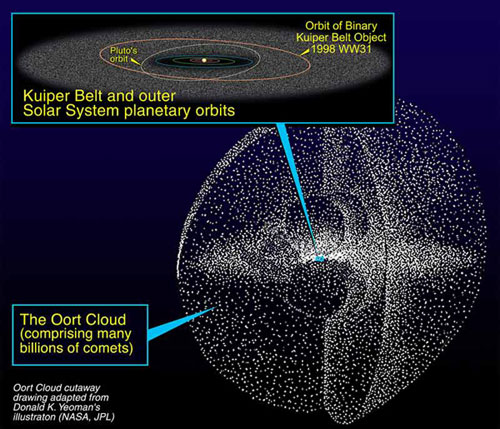
The Oort Cloud is named after Jan Oort, a Dutch astronomer, who proposed a cloud of comets in 1950 as the source of long period comets. The cloud would extend from 2,000 to 200,000 times Earth’s distance from the Sun. The shape of the cloud is roughly spherical. Comet encounters with Jupiter can cause them to become short period comets, or be ejected from the solar system.
01/06/2015 – Ephemeris – Star to stir up solar system’s comets, but you’re gotta wait a bit.
Ephemeris for Tuesday, January 6th. The sun will rise at 8:19. It’ll be up for 8 hours and 57 minutes, setting at 5:17. The moon, 2 days past full, will rise at 7:12 this evening.
In about a quarter to half a million years from now a star with the name HIP 85605 will pass through the Oort cloud of comets that is the extreme outer part of the solar system. The star’s name comes from the Hipparcos catalog created from data from the European satellite which created improved distances of nearby stars. HIP 85605 star is nearby and very faint. The star should pass through the Oort cloud twice, coming and going. What happens is the star will tend to scatter small bodies in its wake, throwing some comets in toward the sun and others it will eject from the solar system. There were all kinds of scare headlines out of this. Something like this “Will a comet shower end life on the Earth?” No it won’t. This kind of thing happens every few million years.
Times are for the Traverse City/Interlochen area of Michigan. They may be different for your location.
Addendum
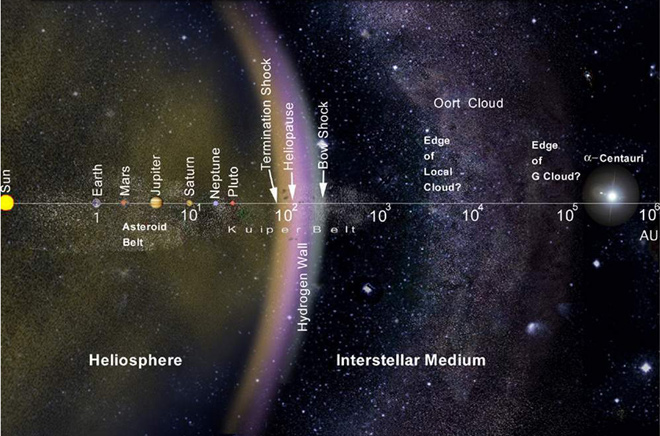
NASA diagram of the solar system on a logarithmic scale. Each interval is ten times longer than the one on the left. On this scale the star HIP 85605 will penetrate to the inner part of the Oort cloud. Click to enlarge.
Tip o’the old astronomer’s cap to Universe Today where I found this story.
03/21/2013 – Ephemeris – Where did Comet PanSTARRS come from?
Ephemeris for Thursday, March 21st. The sun will rise at 7:43. It’ll be up for 12 hours and 13 minutes, setting at 7:56. The moon, 2 days past first quarter, will set at 4:52 tomorrow morning.
Comet PanSTARRS is heading away from both the sun and the earth. It heading northward. Its orbit is inclined nearly 90 degrees away from the plane of the earth’s orbit. PanSTARRS will recede far past Neptune or the Kuiper Belt of objects that include the dwarf planet Pluto into the Oort cloud of cometary objects that extend out to a light year or 6 trillion miles from the sun. This cloud was named after Dutch astronomer Jan Oort. The comet may be ejected from the solar system. It’s orbit is currently calculated to be slightly hyperbolic. If that holds up, it will drift among the stars. It is thought that occasionally, in millions of years a star comes close or through the Oort cloud and scatters them.
Times are for the Traverse City/Interlochen area of Michigan. They may be different for your location.
Addendum
Artist’s impression of the Oort Cloud. (NASA/JPL). Hat Tip: Universe Today.
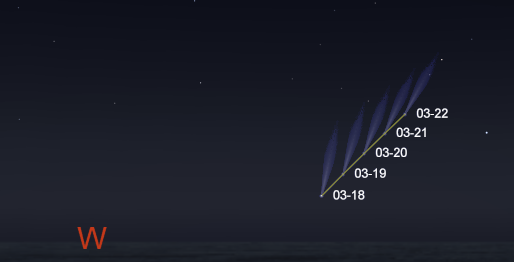
Comet PanSTARRS in the next 5 days at 9:15 p.m. Created using Stellarium and Cartes du Ciel.
 Bob Moler's Ephemeris Blog