Archive
Ephemeris: 11/12/2024 – SpaceX uses Cargo Dragon to change orbit of the ISS
This is Bob Moler with Ephemeris for Tuesday, November 12th. Today the Sun will be up for 9 hours and 40 minutes, setting at 5:17, and it will rise tomorrow at 7:37. The Moon, halfway from first quarter to full, will set at 4:39 tomorrow morning.
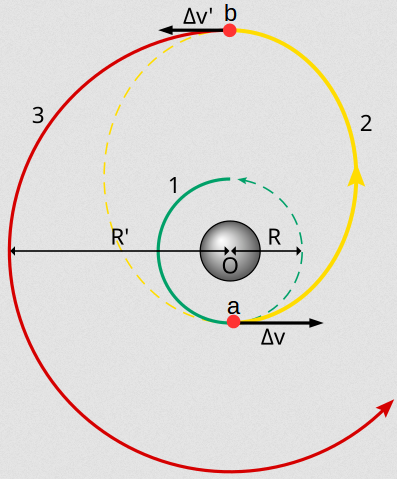
After the last SpaceX cargo mission arrived at the International Space Station, they used the thrusters on the SpaceX capsule to raise the orbital space station a little bit as a test. SpaceX capsules dock at the forward end of the space station according to direction of travel so in order to boost the station’s orbit they had to flip the station around so that the docking port was at the rear before they could apply the needed thrust. When thrust is applied to an object in orbit the effect of the change occurs mostly at the opposite side of the orbit. In order to permanently raise or lower an object’s circular orbit one must make 2 adjustments 180° away from each other. This is the essence of the Hohmann Transfer Orbit, proposed by German scientist Walter Hohmann in 1925.
The astronomical event times given are for the Traverse City/Interlochen area of Michigan (EST, UT – 5 hours). Times will be different for other locations
Addendum
Ephemeris: 07/11/2024 – Low energy routes to get to the Moon
This is Ephemeris for Thursday, July 11th. Today the Sun will be up for 15 hours and 19 minutes, setting at 9:27, and it will rise tomorrow at 6:09. The Moon, 2 days before first quarter, will set at 12:26 tomorrow morning.
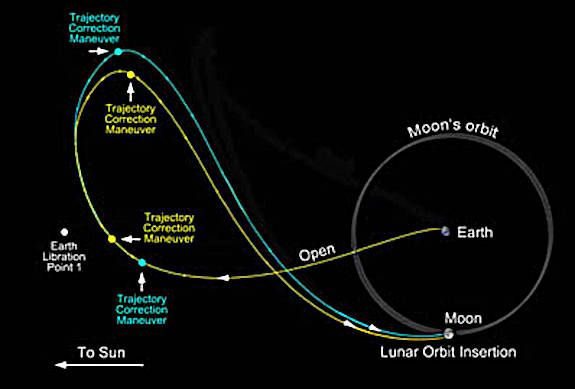
Back in the Apollo days when we sent people to the Moon, the trip out was only three days. The latest generation of unmanned probes to the Moon sent by the United States and other countries can take days, weeks, or even months to reach the Moon, so what’s going on? These are robot probes, needing little power. Humans however are high maintenance. Even when they’re doing nothing they are breathing, eating, and using resources. So when humans are aboard you have got to get there fast. Also, many of these probes are CubeSats, no bigger than a breadbox*. They must get into orbit of the Moon with very little thrust other than that of the rocket that launched them. They can go out as far as a million miles away before falling back to the Moon.
The astronomical event times given are for the Traverse City/Interlochen area of Michigan (EDT, UT–4 hours). They may be different for your location.
* OK, I’m an old guy, the modern size comparison would be a microwave.
Addendum
 Bob Moler's Ephemeris Blog