Archive
Ephemeris: 01/05/2026 – We just passed perihelion… Can’t you feel the warmth?
This is Ephemeris for Monday, January 5th. Today the Sun will be up for 8 hours and 57 minutes, setting at 5:16, and it will rise tomorrow at 8:19. The Moon, 2 days past full, will rise at 8:10 this evening.
While we were busy with other matters, several astronomical events happened over the weekend. First, on Friday we had our latest sunrise, so our lengthening days are beginning to show up in the morning now. On Saturday the Earth passed perihelion, that is its closest point in its orbit to the Sun. That doesn’t make things any warmer, but it does make winter the shortest season by about four days shorter than summer. Not that you could tell in Northern Michigan. The distance of the Earth from the Sun is still hanging around 91.4 million miles. The earth is moving faster so we move through winter quicker. Also, there was a meteor shower, the Quadrantids, which peaked on Saturday, but was pretty much wiped out by the full moon.
The astronomical event times given in this blog are for the Traverse City/Interlochen area of Michigan (Lat 44.7° N, Long 85.7° W; EST, UT – 5 hours) unless stated otherwise. Times will be different for other locations.
Addendum
Ephemeris: 01/02/2024 – We’re closest to the Sun today
This is Ephemeris for Tuesday, January 2nd. The Sun will rise at 8:20. It’ll be up for 8 hours and 53 minutes, setting at 5:13. The Moon, 1 day before last quarter, will rise at 12:01 tomorrow morning.
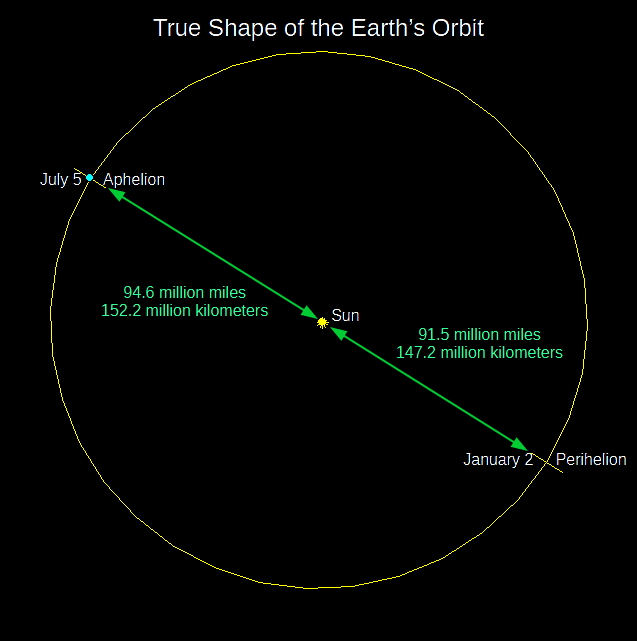
We start off the year with the Earth being really close to the Sun. As a matter of fact at 6:59 pm the Earth will reach perihelion, that is as close as it gets to the Sun for the entire year at 91.41 million miles (147.10 million kilometers). It’s not as big a deal as it seems, because the Earth varies only plus or minus a million and a half miles from the Sun over the year out of 93 million miles. It doesn’t make much difference in the amount of heat we get from the Sun. However, it’s much less than what the tilt of the Earth’s axis does to give us our seasons, but what it does do is alter the length of the seasons, and makes winter the shortest season. It’s shorter by about four days than summer, even though in Northern Michigan it doesn’t really seem like it. Today is also the date of the latest sunrise of the year.
The astronomical event times given are for the Traverse City/Interlochen area of Michigan (EST, UT –5 hours). They may be different for your location.
Addendum
01/02/2023 – Ephemeris – The Earth is actually closest to the Sun this week
This is Ephemeris for Monday, January 2nd 2023. The Sun will rise at 8:20, the latest of the year. It’ll be up for 8 hours and 53 minutes, setting at 5:13. The Moon, halfway from first quarter to full, will set at 5:36 tomorrow morning.
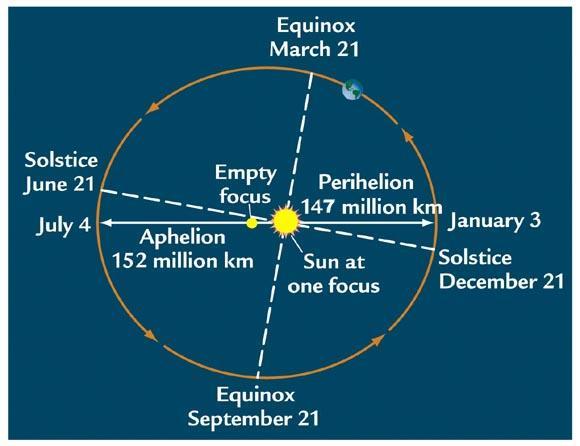
We have a fun week ahead. The first week of the year is an active one in astronomy. Not all the events are visible, though some could, if it weren’t cloudy, as it is so much this time of the year. But active nonetheless. Like Wednesday’s perihelion. A what? The date the Earth is closest to the Sun in its orbit. We’re a million and a half miles closer to the Sun than average. It’s a teensy bit hotter, which is more than offset by the Sun’s arc low in the sky, plus it’s up less than 9 hours. However, it does make winter the shortest season, because the Earth moves faster when closer to the Sun. This is Northern Michigan, so you probably don’t believe me. Get out a calendar and count the days. Winter has 89 days, while summer has 93.
The astronomical event times given are for the Traverse City/Interlochen area of Michigan (EST, UT –5 hours). They may be different for your location.
Addendum
The Earth’s orbit, somewhat exaggerated, showing perihelion and the seasons. Credit “Starts with a Bang” blog by Ethan Siegel.
01/03/2022 – Ephemeris – We’re the closest we get to the Sun of the whole year today
This is Bob Moler with Ephemeris for Monday, January 3rd, 2022. The Sun will rise at 8:20. It’ll be up for 8 hours and 54 minutes, setting at 5:14. The Moon, 1 day past new, will set at 6:14 this evening.
Today we are as close to the Sun as we’ll get for the rest of the year. The Earth will reach the perihelion point in its orbit at 7:59 this evening, at only 91.4 million miles. Since this is only a million and a half miles closer than average, it doesn’t affect the amount of heat the Earth as a whole gets from the Sun. But, since the Earth moves faster at perihelion than at any other time of the year, it makes winter the shortest season. Winter at 89 days is nearly 4 days shorter than the longest season, summer. I know, it doesn’t seem like it, but we live in Northern Michigan, and seemingly long winters come with the territory. January’s only major meteor shower, the Quadrantids, reaches peak at about 4 pm today. It reaches and falls off-peak rapidly, so we won’t have an impressive Quadrantid meteor shower this year.
The astronomical event times given are for the Traverse City/Interlochen area of Michigan (EST, UT – 5 hours). They may be different for your location.
Addendum
The Earth’s orbit, somewhat exaggerated, showing perihelion and the seasons. Credit: “Starts with a Bang” blog by Ethan Siegel.
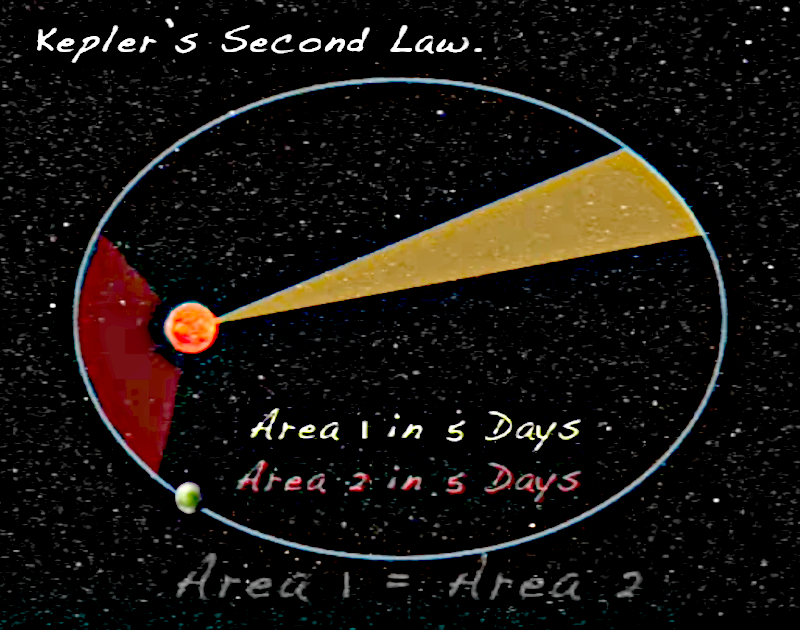
Kepler’s Second Law of Planetary Motion: the imaginary line joining a planet and the Sun sweeps equal areas of space during equal time intervals as the planet orbits. Credit: NASA, a screen capture from a video Solar Systems Dynamics-Orbits and Kepler’s Laws.
A note on the naming of the Quadrantid meteor shower. Meteor showers get their names from the constellation or nearby star where the meteor seem to come from at their peak. That point is called the radiant. The Quadrantids were named because they came from a constellation called the Mural Quadrant, back when the shower was discovered. The Mural Quadrant didn’t make the modern list of 88 constellations. The area where the Mural Quadrant resided is an area between northern Boötes, Draco and the handle of the Big Dipper.
01/06/2020 – Ephemeris – The Earth was closest to the Sun in its orbit yesterday
Ephemeris for Monday, January 6th. Today the Sun will be up for 8 hours and 57 minutes, setting at 5:17, and it will rise tomorrow at 8:19. The Moon, half way from first quarter to full, will set at 5:02 tomorrow morning.
Yesterday’s perihelion, or closest point of the Earth to the Sun of roughly 91.4 million miles (147 million km) is only 1.7% closer to the Sun than average. It doesn’t do much to make our winters warmer, but it does make winter the shortest season. That’s because the Earth travels faster when near the Sun than when it’s farther away. Winter lasts only 89 ½ days. The Earth’s aphelion, when it’s farthest from the Sun will be on the 4th of July, in summer, making that the longest season at 93 ½ days. Of course being this far north it feels like winter is longer than summer, but astronomically it’s the other way around. Being a leap year, with February having 29 days, spring will arrive a calendar day early on the 19th of March.
The times given are for the Traverse City/Interlochen area of Michigan. They may be different for your location.
Addendum
The Earth’s orbit, somewhat exaggerated, showing perihelion and the seasons. Credit “Starts with a Bang” blog by Ethan Siegel.

The Seasons for 2020 from data in Astronomical Tables of the Sun, Moon, and Planets Third Edition by Jean Meeus. Date and times are in TD, Dynamical Time. Subtract about 1 minutes to convert to Universal Time (UT). Also subtract 5 hours for Eastern Standard Time and 4 hours for Eastern Daylight Time.
For and explanation of the Cross-Quarter Days column, check out my Ground Hog Day post last year: https://bobmoler.wordpress.com/2019/02/02/02-02-2019-ephemeris-extra-groundhog-day-and-other-seasonal-days/
01/03/2020 – Ephemeris – Astronomical events this weekend
Ephemeris for Friday, January 3rd. The Sun will rise at 8:20. It’ll be up for 8 hours and 54 minutes, setting at 5:14. The Moon, 1 day past first quarter, will set at 1:49 tomorrow morning.
Tonight at 8 p.m. there will be a telescope clinic by the Grand Traverse Astronomical Society at the Rogers Observatory south of Traverse City on Birmley Road for those who have either received a telescope for Christmas or have one hidden away in an attic, to learn how to use it. Bring ‘em if you’ve got ‘em.
Tomorrow morning we’ll see the peak of the Quadrantid meteor shower after the Moon sets. The radiant for this shower is near the handle of the Big Dipper, though they will be seen all over the sky. The peak should be around 3:20 a.m. with the possibility of over a hundred meteors visible per hour.
On Sunday at 5 a.m. the Earth will be its closest to the Sun for the year of 91,394,000 miles (147,085,000 km).
The times given are for the Traverse City/Interlochen area of Michigan. They may be different for your location.
Addendum
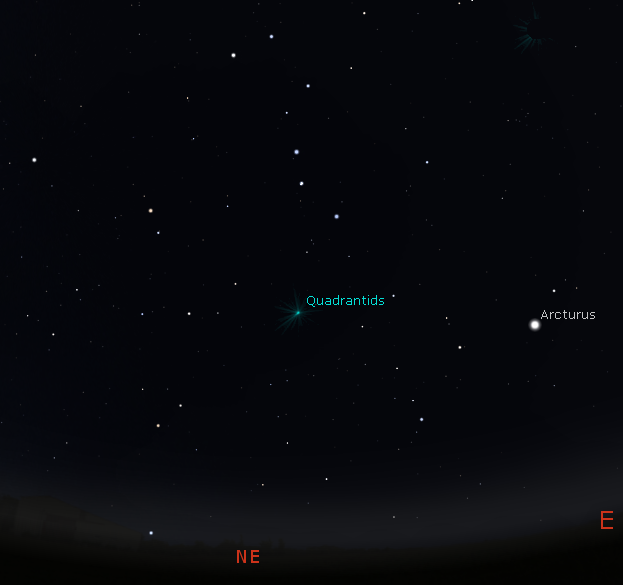
The location of the Quadrantid radiant at 3:20 a.m. January 4, 2020 for the peak of the meteor shower. Created using Stellarium.
The Earth’s orbit, somewhat exaggerated, showing perihelion and the seasons. Credit “Starts with a Bang” blog by Ethan Siegel.
01/02/2018 – Ephemeris – Cozying up to the Sun and a major meteor shower
Ephemeris for Tuesday, January 2nd. The Sun will rise at 8:20. It’ll be up for 8 hours and 53 minutes, setting at 5:13. The Moon, 1 day past full, will rise at 6:18 this evening.
Today the Earth will reach its closest distance from the sun, of 91.4 million miles. This point in Earth’s orbit is called perihelion. The Earth varies about 3 million miles from perihelion to aphelion its farthest point from the sun, which usually occurs around July 4th or 5th. Perihelion doesn’t help warm our winters though, but it does make winter the shortest season because the Earth moves its fastest at perihelion. That makes summer the longest season by several days. Tomorrow afternoon will see the peak of the Quadrantid Meteor Shower. This active meteor shower has its radiant north of the kite shape of Boötes and near the handle of the Big Dipper but the bright Moon will interfere both tomorrow and Thursday mornings.
The times given are for the Traverse City/Interlochen area of Michigan. They may be different for your location.
Addendum
The Earth’s orbit, somewhat exaggerated, showing perihelion and the seasons. Credit “Starts with a Bang” blog by Ethan Siegel.
While a planet’s distance from the Sun modify the seasons somewhat, seasons are always governed by the axial tilt of the planet with respect to the Sun.
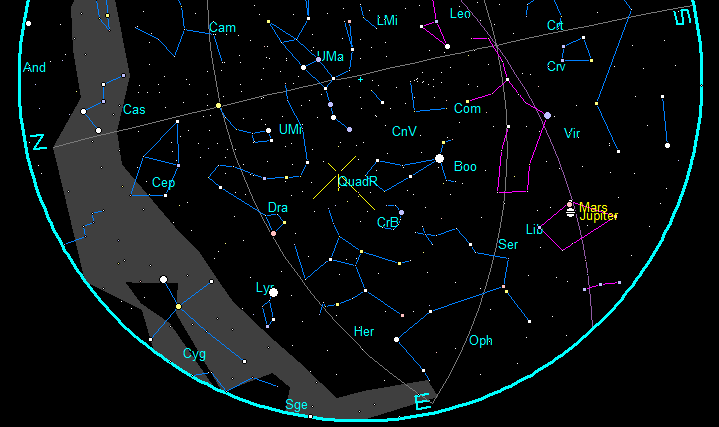
Facing the Quadrantid radiant at 6 a.m. January 3rd. Created using my LookingUp program.
01/03/2017 – Ephemeris – The Earth will be closest to the Sun tomorrow
Ephemeris for Tuesday, January 3rd. The Sun will rise at 8:19. It’ll be up for 8 hours and 55 minutes, setting at 5:15. The Moon, 2 days before first quarter, will set at 11:06 this evening.
The Earth has as elliptical orbit of the Sun, as do all planets. It is close to circular but not quite. The Earth’s distance from the Sun is 93 million miles (150 million km) plus or minus a million and a half miles. Tomorrow at about 6 a.m. the Sun will be at a point called perihelion, only 91.4 million miles (147 million km). It makes only a tiny difference in the Sun’s intensity, but since the Earth moves faster when closest to the Sun, it makes winter the shortest season at 89 days. Aphelion, Earth’s farthest distance from the sun occurs around July 4th which makes summer the longest season at 93 days. The eccentricity of an orbit can modify the seasons, but the seasons themselves are caused by the tilt of the planet’s axis alone.
Times are for the Traverse City/Interlochen area of Michigan. They may be different for your location.
Addendum
The Earth’s orbit, somewhat exaggerated, showing perihelion and the seasons. Credit “Starts with a Bang” blog by Ethan Siegel.
01/01/2016 – Ephemeris – Happy New Year – It’s a busy few days to start off the year
Happy New Year. This is Bob Moler with Ephemeris for New Years Day, Friday, January 1st, 2016. The Sun will rise at 8:20. It’ll be up for 8 hours and 52 minutes, setting at 5:12. The Moon, 1 day before last quarter, will rise at 12:54 tomorrow morning.
It’s always a busy time, astronomically speaking, around the start of the year. This year even more so. Comet Catalina is found near the bright star Arcturus now, which is a good way to find it in binoculars. Tomorrow at 7:59 p.m. (1:59 UT 3rd) the Earth will reach perihelion, the closest point in its orbit to the Sun at about 91.4 million miles (0.9833 AU). It doesn’t add much to the heat we get from the Sun, but it does make winter a couple of days shorter than summer. Monday at 3 a.m. will see the peak of the Quadrantid meteor shower. Unfortunately that’s about the time the Moon will rise. The radiant is north of the handle of the Big Dipper. Good news: tomorrow is the latest sunrise, it should be rising earlier until June.
Times are for the Traverse City/Interlochen area of Michigan. They may be different for your location.
Addenda
January Star Chart
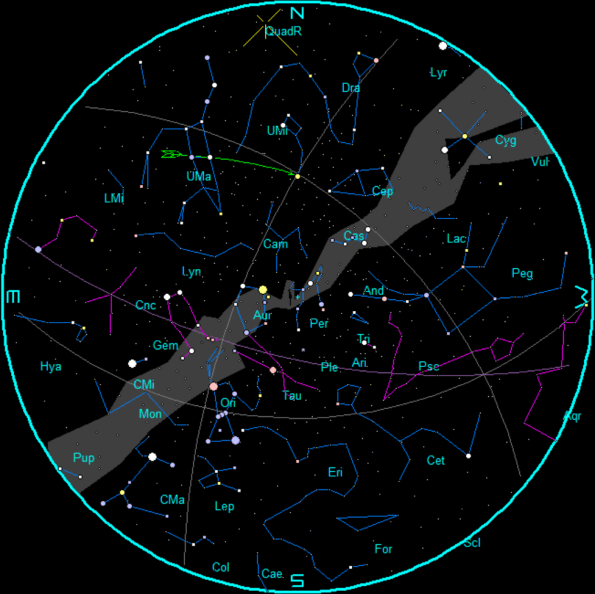
Star Chart for January 2016. Created using my LookingUp program. To enlarge in Firefox Right-click on image then click View Image.
The planets and stars are plotted for the 15th at 9 p.m. EST. That is chart time. Note, Traverse City is located 45 minutes behind our time meridian. To duplicate the star positions on a planisphere you may have to set it to 45 minutes earlier than the current time.
Evening astronomical twilight ends at 6:22 p.m. EST on January 1st, increasing to 6:55 p.m. EST on the 31st.
Morning astronomical twilight starts at 7:09 a.m. EST on January 1st, and decreasing to 6:57 a.m. EST on the 31st.
Add a half hour to the chart time every week before the 15th and subtract and hour for every week after the 15th.
For a list of constellation names to go with the abbreviations click here.
- Pointer stars at the front of the bowl of the Big Dipper point to Polaris the North Star.
- QuadR is the Quadrantid meteor shower radiant
Calendar of Planetary Events
Credit: Sky Events Calendar by Fred Espenak and Sumit Dutta (NASA’s GSFC)
To generate your own calendar go to http://eclipse.gsfc.nasa.gov/SKYCAL/SKYCAL.html
Times are Eastern Time. Some additions made to aid clarity.
     Date   Local      Event
            Time EST
Jan  01  Fr            Venus: 37.9° W
     02  Sa 12:30 a.m. Last Quarter
     02  Sa  6:53 a.m. Moon Apogee: 404300 km
     02  Sa  7:59 p.m. Perihelion: 0.9833 AU
     03  Su  1:45 p.m. Moon-Mars: 1.6° S
     04  Mo  3:01 a.m. Quadrantid Shower: ZHR = 120
     06  We  6:57 p.m. Moon-Venus: 3.3° S
     06  We 11:57 p.m. Moon-Saturn: 3.6° S
     07  Th  6:32 a.m. Venus-Antares: 6.4° N
     08  Fr 12:56 p.m. Moon South Dec.: 18.4° S
     09  Sa  2:42 a.m. Venus-Saturn: 0.1° N
     09  Sa  8:30 p.m. New Moon
     14  Th  9:02 a.m. Mercury Inferior Conj.
     14  Th 10:48 a.m. Moon Descending Node
     14  Th  9:10 p.m. Moon Perigee: 369600 km
     16  Sa  6:26 p.m. First Quarter
     19  Tu  9:16 p.m. Moon-Aldebaran: 0.5° S (Occultation*)
     21  Th 11:41 a.m. Moon North Dec.: 18.4° N
     23  Sa  8:46 p.m. Full Moon
     26  Tu 12:10 a.m. Moon-Regulus: 2.8° N
     27  We  6:58 p.m. Moon Ascending Node
     27  We  8:14 p.m. Moon-Jupiter: 1.6° N
     30  Sa  4:10 a.m. Moon Apogee: 404600 km
     31  Su 10:28 p.m. Last Quarter
Feb  01  Mo            Venus: 31.4° W
* Occultation of Aldebaran For the Grand Traverse Area ± 1-2 minutes:
Disappearance 9:06 p.m. Reappearance 10:25 p.m. I’ll have more information on the 19th.
Occultation Map
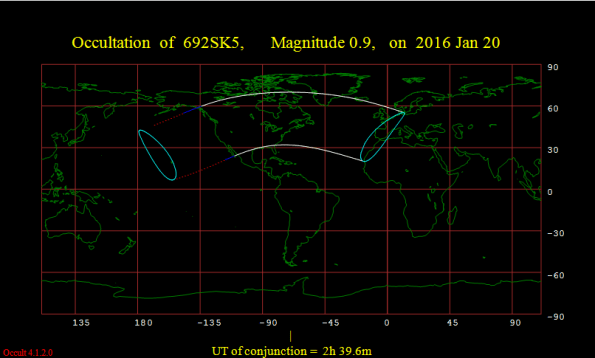
Occultation visibility map for January 20, 2016 (UT). Credit IOTA/Occult4 program.
Estimating occultation timings for your location
I used Cartes du Ciel the free software that I have a link to on the right. Make sure that the program is set for topocentric positions under Setup/Solar System. And you have entered your position under Setup/Observatory. You can find your location in Google Earth, or your GPS device or smart phone.
You can also use Stellarium. Just make sure the Moon is normal sized.
In both programs you can lock the Moon or Aldebaran in the center of the screen Pick a time in advance of the occultation and using the set time window walk the star towards the Moon, mark the time. Then walk the star out from the Moon and record the reappearance time. That’s it.
This should work with other planetarium programs too.
For better accuracy go to the International Occultation Timing Association (IOTA) website. Download and install their Occult4 program for Windows computers. Follow the instructions. When I ran the program for my location, the location I use for Interlochen/Traverse City (Since I live approximately half-way between the two). I got results within a half-minute of the IOTA Occult4 program results. So the approximation method using these planetarium programs is valid.
Comet C/2013 US10 (Catalina)
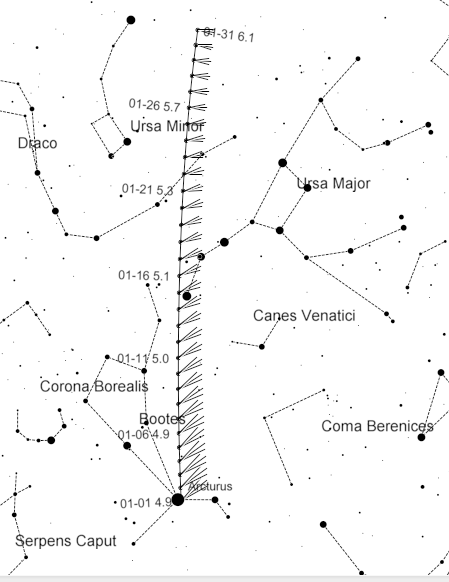
The track of Comet C/2013 US10 (Catalina) for January 2016. Created using Cartes du Ciel (Sky Charts).
The comet is roughly one magnitude fainter than given. Comet is plotted every day at 4 a.m. EST (9 hr UT) with the date and magnitude labeled every 5th day. According to the brightness graph the comet began to under perform in brightness back in September, however, according to a new brightness formula the comet may increase in brightness by a magnitude by late February when it will be well placed for viewing all night. To monitor the brightness reports from observers go to http://www.aerith.net/comet/catalog/2013US10/2013US10.html.
xxxvvvvv
07/06/2015- Ephemeris – Today we are at our greatest distance from the sun.
Ephemeris for Monday, July 6th. Today the Sun will be up for 15 hours and 26 minutes, setting at 9:30. The Moon, 2 days before last quarter, will rise at 12:23 tomorrow morning and tomorrow the Sun will rise at 6:04.
This is the day the we are the farthest we can get from the Sun for the year. The point in the Earth’s orbit that it occurs is called aphelion. Earth is closest to the Sun in January at perihelion. The actual distance difference between perihelion and aphelion is 3 million miles out of roughly 93 million miles. So now we’re roughly 94 and a half million miles from the Sun or 152 million kilometers., and will swoop down to 91 and a half million miles(91.4) or 147 kilometers from the Sun in early January. Because Earth’s northern and southern hemispheres have different ratios and placement of land versus ocean I’m not sure you could correlate seasonal differences of the hemispheres with the Earth’s distance from the Sun. Anyway the approximate time we reach aphelion will be 3 p.m. EDT (19 hr UT).
Times are for the Traverse City/Interlochen area of Michigan. They may be different for your location.
Addendum
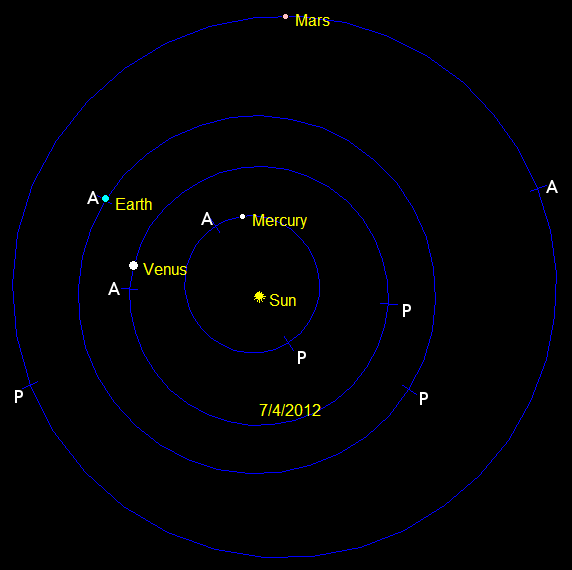
The orbits of the inner planets. (P)erihelion – (A)phelion
The above is a diagram from three years ago, so the planets other than the Earth will be in different positions today. The date of aphelion and perihelion move around over a greater range of dates than the equinoxes and solstices. I’m not sure why without researching it, but I suspect that the Moon has something to do with it.
 Bob Moler's Ephemeris Blog