Archive
Ephemeris: 12/13/2024 – The Geminid meteor shower peaks tonight
This is Bob Moler with Ephemeris for Friday, December 13th. Today the Sun will be up for 8 hours and 50 minutes, setting at 5:02, and it will rise tomorrow at 8:12. The Moon, 2 days before full, will set at 7:45 tomorrow morning.
Tonight is the peak of the Geminid meteor shower. Unfortunately this year we’re two days before a full moon so it will cut down their numbers, so only the brightest Geminids will be visible. The radiant for the meteor shower is a point near the star Castor at the head of constellation Gemini, the twins, which is why they’re called the Geminids. This is the most active annual shower of the year right now. The source of the Geminids is the asteroid Phaethon which is probably the core of a dead comet. It is the closest asteroid to the sun at its perihelion in its markedly elliptical orbit like a comet. One of the Stereo Sun observation satellites saw Phaethon shedding material as it moved around at its closest approach to the Sun.
The astronomical event times given are for the Traverse City/Interlochen area of Michigan (EST, UT – 5 hours). Times will be different for other locations.
Addendum
Ephemeris: 12/12/2023 – The source of the Geminid meteor shower
This is Bob Moler with Ephemeris for Tuesday, December 12th. Today the Sun will be up for 8 hours and 51 minutes, setting at 5:02, and it will rise tomorrow at 8:11. The Moon is new today, and won’t be visible.
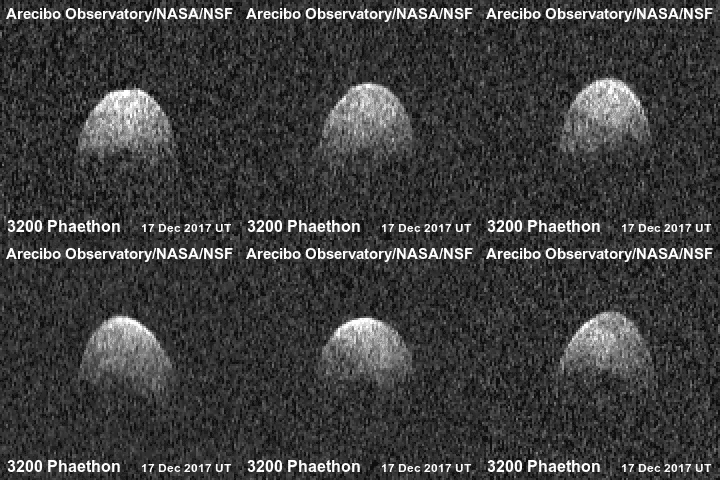
The Geminid meteor shower, which will peak this Thursday, is caused by a small body called 3200 Phaethon which looks like an asteroid but has the orbit of a comet, coming close to the Sun and back out to the asteroid belt. It’s probably a dead comet, with all the volatiles sublimated away leaving only the rocky bits. It is named Phaethon, because at the time it was the asteroid that came closest to the Sun. In Greek mythology Phaethon, the son of Helios the Sun god borrowed his father’s chariot that carried the Sun to take it out for a spin one day with disastrous results. The Geminid meteor shower was first recognized in 1862. The hourly rates of the Geminids have increased every year since then. The meteor stream has completely filled in the orbit of Phaethon, and they’re being pushed around by the gravitational effect of the planets and the pressure of sunlight.
The astronomical event times given are for the Traverse City/Interlochen area of Michigan (EST, UT –5 hours). They may be different for your location.
Addendum
12/13/2019 – Ephemeris – Tonight is the first night that straddles the peak of the Geminid meteor shower
Ephemeris for Friday, December 13th. Today the Sun will be up for 8 hours and 50 minutes, setting at 5:02, and it will rise tomorrow at 8:12. The Moon, 1 day past full, will rise at 6:33 this evening.
Tonight and tomorrow nights will straddle the peak of the Geminid meteor shower. It is the best meteor shower of the year and it is getting more active over the years. The Moon will interfere with all but the brightest meteors. The radiant is the point in space where the meteors seem to come from, which is near the star Castor in the constellation Gemini from which the shower gets its name. The meteors will be seen all over the sky, but they all can be traced back to the radiant. The body responsible for this meteor shower is an asteroid rather than a comet with the name 3200 Phaethon. It comes very close to the sun, So it may shed bits of itself due to heat stress. I suppose I can’t resist this: That’s how the asteroid crumbles.
The times given are for the Traverse City/Interlochen area of Michigan. They may be different for your location.
Addendum
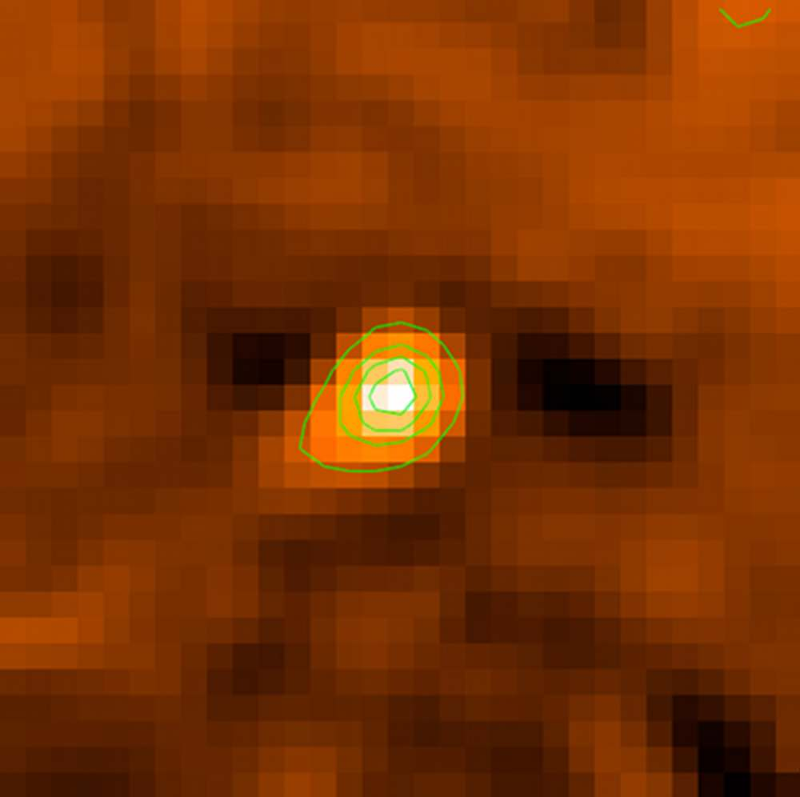
3200 Phaethon a rock comet showing a tail as it nears the Sun. Credit NASA/STEREO
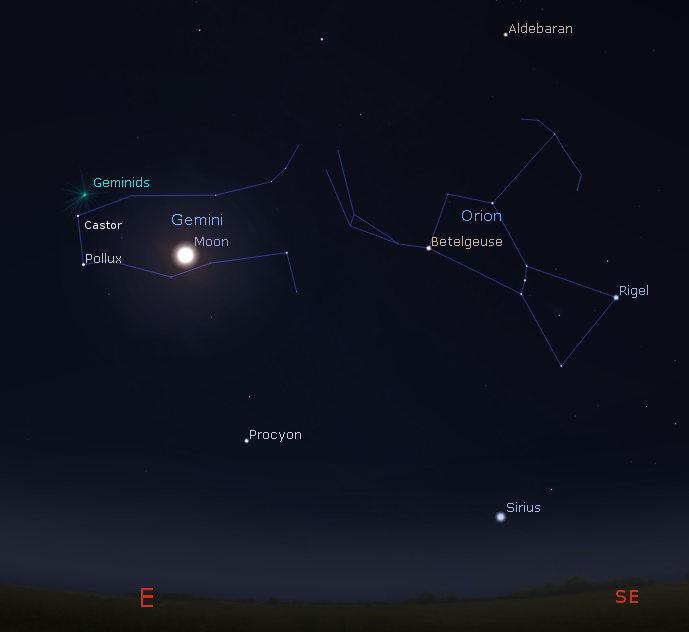
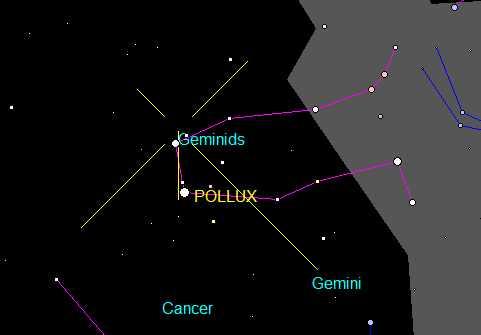
Eastern sky for Geminids at 10 p.m. December 13, 2019. On the 14th the Moon will be the same distance from Pollux but below it. Remember that the Geminid meteors will be seen all over the sky. It might help to hide the moon behind a building so as to better see the brighter meteors. Created using Stellarium.
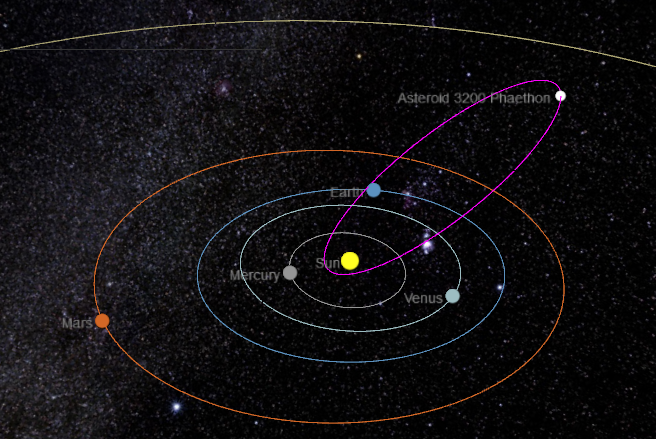
Orbit of 3200 Phaethon with the Earth and Phaethon at 10:02 p.m. December 12, 2019. (03:02 UT Dec 13) Credit TheSkyLive.com.
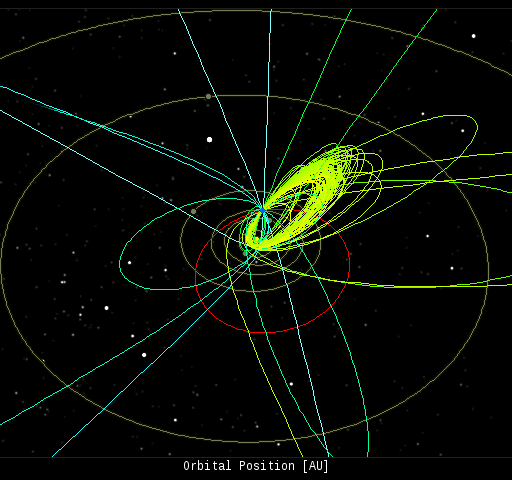
Orbits of Fireballs on the night of December 13-14 as recorded by NASA’s All Sky Cameras six years ago. The preponderance of fireballs (bright meteors) are Geminids. These are published daily on Spaceweather.com. Credit: NASA and Spaceweather.com.
Eastern sky for Geminids at 10 p.m. December 13, 2019. On the 14th the Moon will be the same distance from Pollux but below it. Remember that the Geminid meteors will be seen all over the sky. It might help to hide the moon behind a building so as to better see the brighter meteors. Created using Stellarium.
From the International Meteor Organization: Observing proposal: Geminids and Full Moon
12/08/2014 – Ephemeris – Looking forward to the Geminid meteor shower next weekend
Ephemeris for Monday, December 8th. The sun will rise at 8:06. It’ll be up for 8 hours and 55 minutes, setting at 5:02. The moon, 2 days past full, will rise at 7:28 this evening.
This upcoming weekend is the weekend of the greatest annual meteor shower of the year. They’re the Geminids. I confess to never having seen a Geminid. The reason is that it’s generally too cloudy, and for me too cold. They are now twice as active as the Perseid meteors of August with a 120 per hour peak, when the radiant point in Gemini is overhead. The body that was discovered to produce these meteors doesn’t appear to be a comet. It is designated as an asteroid 3200 Phaethon. Phaethon gets extremely close to the sun at 13 million miles (21 million km) and one of the STEREO Sun monitoring satellites caught it developing a tail when close to the Sun. Phaethon may then be the first known rock comet. I’ll have more later this week.
Times are for the Traverse City/Interlochen area of Michigan. They may be different for your location.
Addendum
Orbits of last year’s fireballs on the night of December 13-14 as recorded by NASA’s All Sky Cameras. The preponderance of fireballs (bright meteors) are Geminids. These are published daily on Spaceweather.com. Credit: NASA and Spaceweather.com
 Bob Moler's Ephemeris Blog