Archive
Ephemeris: 03/13/2026 – Precession of the equinoxes
This is Ephemeris for Friday, March 13th. Today the Sun will be up for 11 hours and 47 minutes, setting at 7:46, and it will rise tomorrow at 7:56. The Moon, 2 days past last quarter, will rise at 6:01 tomorrow morning.
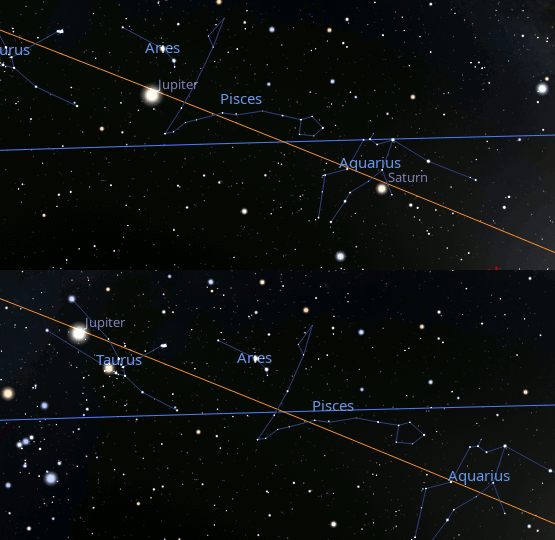
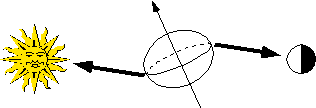
Yesterday I talked about the fact that the constellation of Cancer the crab is no longer the northernmost constellation of the zodiac, where the Sun is positioned on the first day of summer. There’s been a slow change in the position of the earth’s axis, in that it wobbles slowly in a period of nearly 26,000 years. The inclination of the Earth’s axis to its orbit is around 23 1/2 degrees, and the gravitational pull of the Moon and the Sun on the Earth’s equatorial bulge, wants to straighten it up. But because the Earth is spinning, it wobbles instead, slowly sliding the actual zodiacal constellations eastward about one constellation in 2,150 years. So the actual constellations are off one constellation from the astrological signs.
The astronomical event times given in this blog are for the Traverse City/Interlochen area of Michigan (Lat 44.7° N, Long 85.7° W; EST, UT – 5 hours) unless stated otherwise. Times will be different for other locations.
Addendum
06/19/2023 – Ephemeris – Juneteenth and the flight to freedom
This is Bob Moler with Ephemeris for Juneteenth, Monday, June 19th. Today the Sun will be up for 15 hours and 34 minutes, setting at 9:31, and it will rise tomorrow at 5:56. The Moon, 1 day past new, will set at 11:22 this evening.
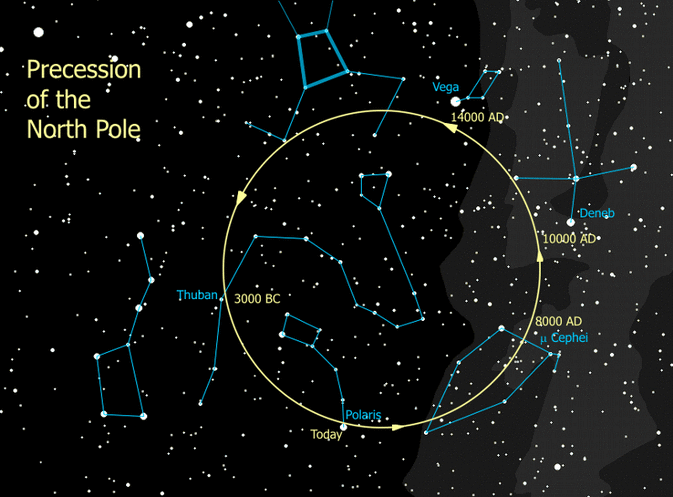
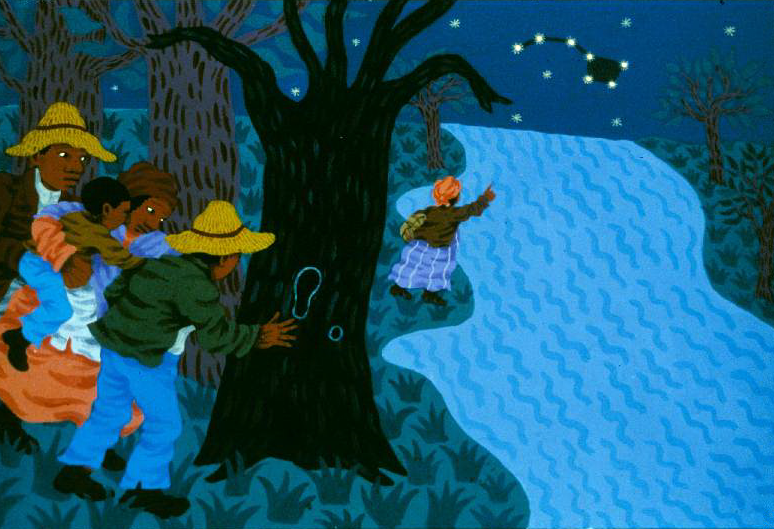
In 1865, it was on June 19th that the Union soldiers, led by Major General Gordon Granger, landed at Galveston, Texas with news that the war had ended and that the slaves were now free. Until then about the only path to freedom for the slaves was “To follow the Drinking Gourd”, or the Big Dipper, northward. The Big Dipper and the Great Bear, Ursa Major, has, for the last few millennia been the constellation of the north, being closer to the North Pole of the sky than it is now. The Earth’s axis has a slow wobble, called precession, caused by the gravitational pull of the Moon and Sun on Earth’s slight equatorial bulge of 30 miles wider than the pole to pole distance. That wobble period is nearly 26 thousand years.
The astronomical event times given are for the Traverse City/Interlochen area of Michigan (EDT, UT –4 hours). They may be different for your location.
Addendum
 Bob Moler's Ephemeris Blog