Archive
03/23/2017 – Ephemeris – a single headed Hydra
Ephemeris for Thursday, March 23rd. The Sun will rise at 7:39. It’ll be up for 12 hours and 19 minutes, setting at 7:59. The Moon, 3 days past last quarter, will rise at 5:48 tomorrow morning.
In the southern evening sky can be found the constellation of Hydra the water snake. Unlike the mythical monster Hercules fought of the same name this Hydra has but one head, which is its most distinctive part. At 9 p.m. look to the south. The head of Hydra is located directly to the left of Procyon the bright star in Orion’s little dog Canis Minor, and to the right of the star Regulus in Leo. Hydra’s head is a small distinctive group of 6 stars that make a loop and the snake’s slightly drooping head. At that time the sinuous body of Hydra sinks below the horizon in the southeast. As it gets later in the evening the rest of Hydra’s body will slither to just above the southeastern horizon below the planet Jupiter this year and the bright star Spica in the constellation of Virgo.
Times are for the Traverse City/Interlochen area of Michigan. They may be different for your location.
Addendum
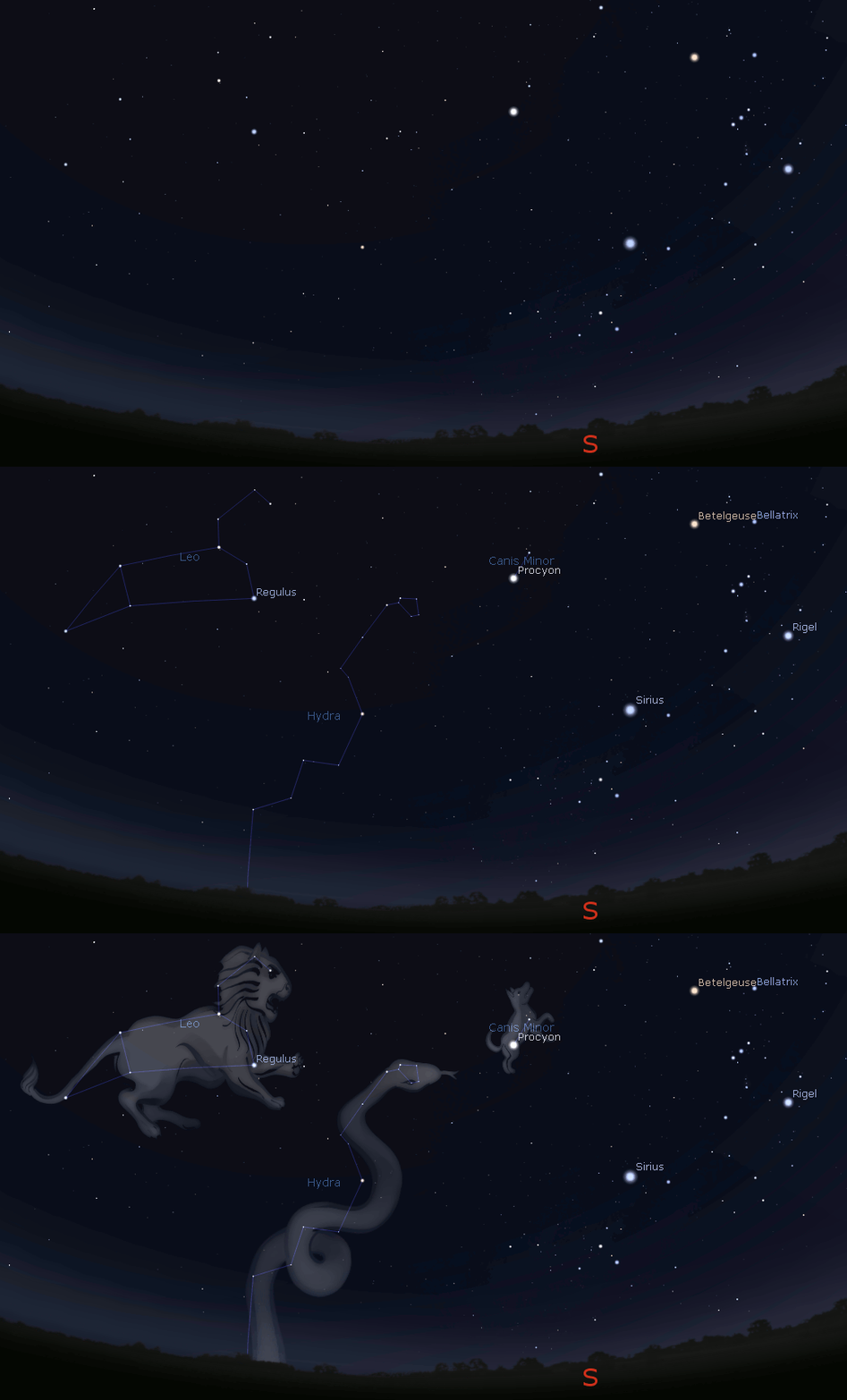
Finding Hydra animation for 9 p.m. March 23rd 2017. Created using Stellarium. Click on image to enlarge.
02/16/2017 – Ephemeris – The Winter Circle
Ephemeris for Thursday, February 16th. The Sun will rise at 7:40. It’ll be up for 10 hours and 32 minutes, setting at 6:12. The Moon, 2 days before last quarter, will rise at 12:17 tomorrow morning.
The winter skies are blessed with more first magnitude stars than any other season. These are the twenty-one brightest stars in the sky. Six of these stars lie in a large circle centered on the seventh. This circle is up all evening now that we are in the heart of winter. Starting high overhead is Capella in Auriga the charioteer. Moving clockwise, we come to Aldebaran in the face of Taurus the Bull. Then down to Orion’s knee we find Rigel. Down and left is the brightest star of all Sirius the Dog Star in Canis Major Orion’s large hunting dog, lowest of these stars in the south. Moving up and left there is Procyon in Canis Minor, Then above it is Pollux in Gemini the twins. All are centered on Betelgeuse in Orion.
Times are for the Traverse City/Interlochen area of Michigan. They may be different for your location.
Addendum
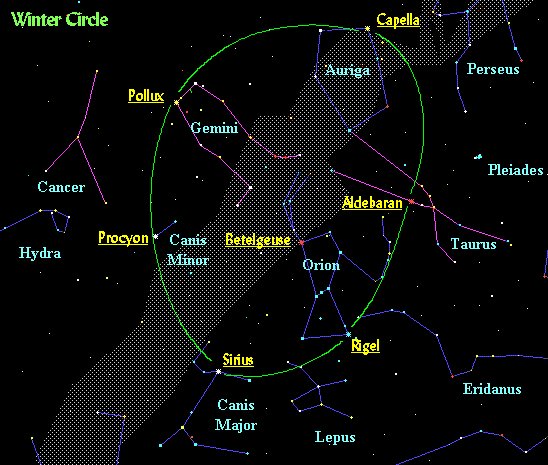
The Winter Circle of 1st magnitude stars. Created using my LookingUp program.
01/26/2017 – Ephemeris – Is it a dachshund or a hot dog?
Ephemeris for Thursday, January 26th. The Sun will rise at 8:07. It’ll be up for 9 hours and 36 minutes, setting at 5:43. The Moon, 1 day before new, will rise at 7:40 tomorrow morning.
The constellation Orion has two hunting dogs. We’ve seen Canis Major the greater dog at Orion’s feet with Sirius in its heart. The lesser dog, Canis Minor is level with Betelgeuse in Orion’s shoulder and off to the left. Just two stars mark it. Is it a dachshund or is it a hot dog? You decide. It’s brighter star’s name is Procyon which means “Before the dog”, an odd title. It means that though east of Sirius, it rises before Sirius, due to its more northerly position in the sky. In many ways Procyon is nearly a twin of Sirius. It shines with the same white color, although a bit cooler, and has a white dwarf companion like Sirius. It’s a bit farther away than Sirius’ 8 light years. Procyon is 11 and a half light years away. Procyon, Betelgeuse and Sirius make the winter triangle.
Times are for the Traverse City/Interlochen area of Michigan. They may be different for your location.
Addendum
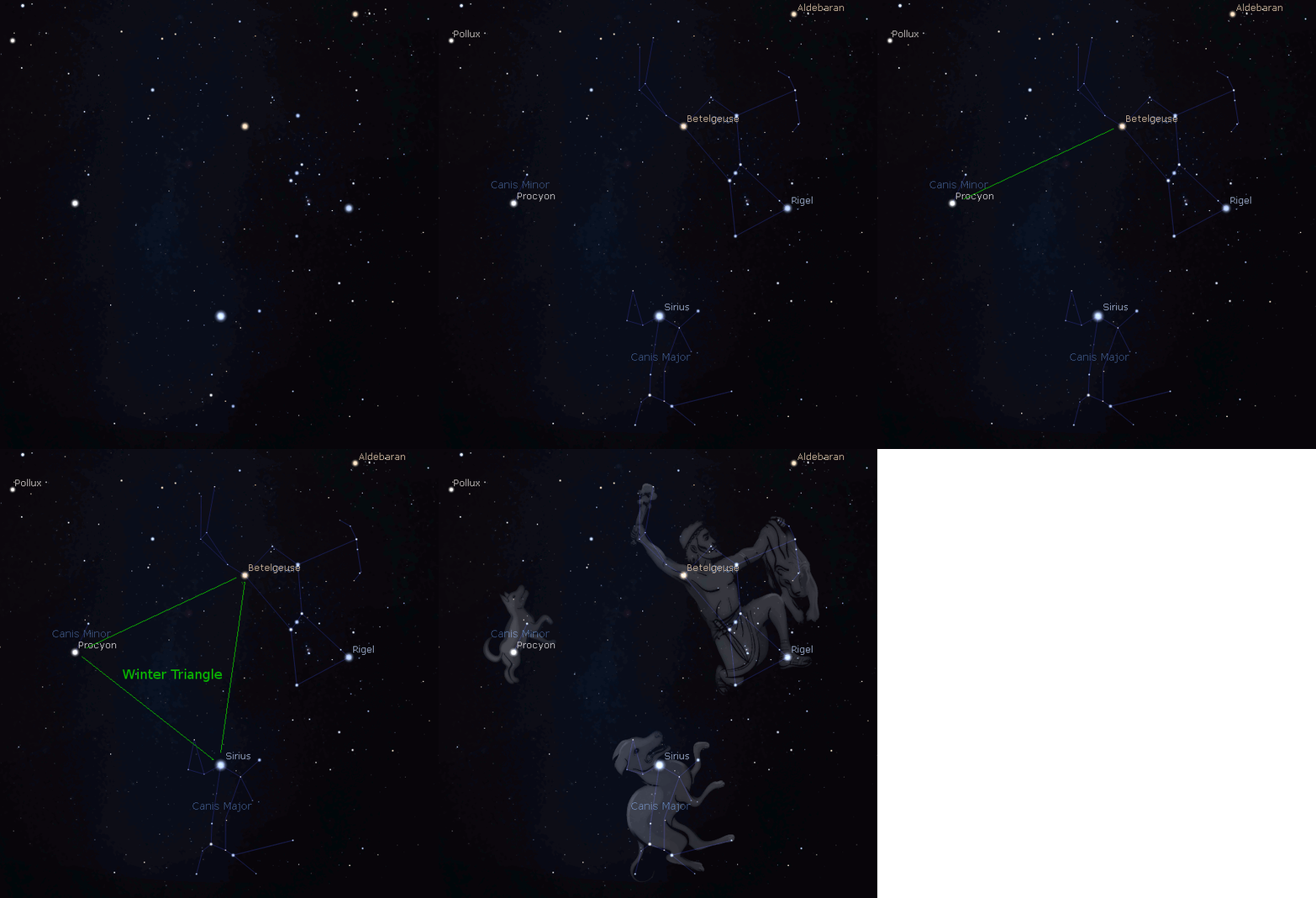
Procyon and Orion’s hunting dogs animation also showing the Winter Triangle asterism*. Created using Stellarium and GIMP.
* Asterism – an informal constellation like the Big Dipper, the Northern Cross, or the Summer Triangle. Not one of the 88 official constellations.
02/16/2015 – Ephemeris – The little Dog Star
Ephemeris for Tuesday, February 16th. The Sun will rise at 7:42. It’ll be up for 10 hours and 29 minutes, setting at 6:12. The Moon, 1 day past first quarter, will set at 3:45 tomorrow morning.
Procyon is the bright star to the east or left of Betelgeuse in the sky tonight, which puts it in the east-southeast at 9 tonight. Procyon is the brightest of the two stars in Canis Minor, Orion’s little hunting dog. Procyon is sometimes called the Little Dog Star for that reason. The Dog Star Sirius is a ways below and right of it. The name Procyon means “Before the Dog”, because Procyon, though east of Sirius, rises before it due to its more northerly position. This only works if one is north of 30 degrees north latitude. South of that, Sirius rises first. Procyon is a white star 11 and a half light years away, 3 light years farther than Sirius, and like Sirius it has a faint white dwarf companion. It’s a bit less than half the Sun’s age.
Times are for the Traverse City/Interlochen area of Michigan. They may be different for your location.
Addendum
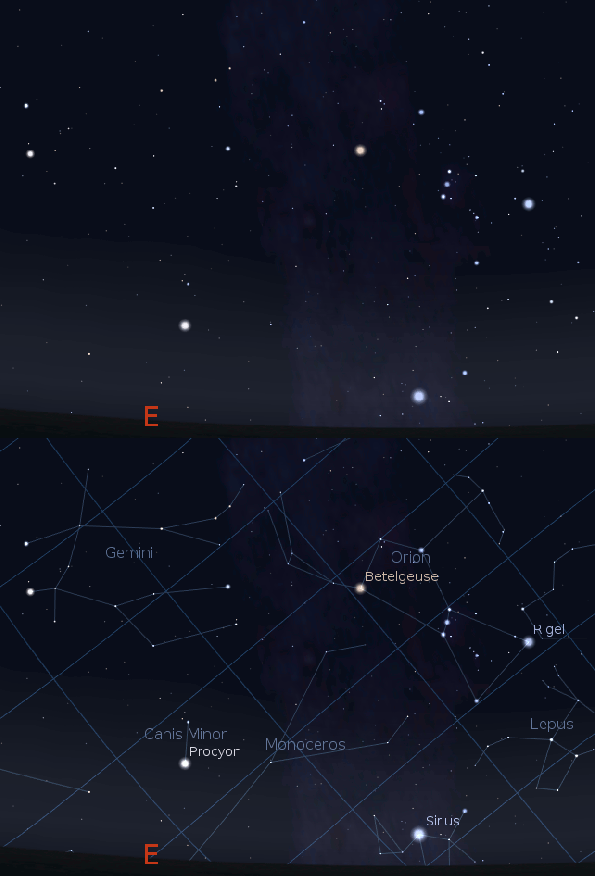
Procyon, Sirius and the stars of winter. Created using Stellarium
Note that at their rising Procyon is higher in the sky than Sirius.
There are some grid lines on the chart. The ones running from lower left to upper right are lines of declination, which are like latitude lines on the Earth. On this chart they are 10º apart. The line that intersects the horizon at the east compass point is the celestial equator. It will meet the western compass point at the horizon. As the Earth rotates the stars and planets will move westward in the direction of these declination lines. The lines that run from upper left to lower right are hour lines of right ascension. Here they are 15 degrees or one hour apart, The Earth rotates 360º in a sidereal* day. 360 divided by 24 hours gives 15º an hour. So the celestial sphere of stars and planets will slide 15º westward in a sidereal hour.
* A sidereal day, rotation with respect to the stars, is about 4 minutes shorter that the solar day, the day and time we keep based on the Sun. The Sun moves about one degree eastward each day, so the rotation has to catch up that one degree each day. The rotation of one degree takes 4 minutes. I’ll let you work that one out for yourself.
02/12/2016 – Ephemeris – A circle of bright stars in winter
Ephemeris for Friday, February 12th. The Sun will rise at 7:48. It’ll be up for 10 hours and 18 minutes, setting at 6:06. The Moon, 3 days before first quarter, will set at 11:19 this evening.
The winter skies are blessed with more first magnitude stars than any other season. With the moon out these stars will stand out even more, as dimmer stars are suppressed. Six of these stars lie in a large circle centered on the seventh, the Winter Circle.
This circle is up at 9 p.m. Starting high nearly overhead is Capella in Auriga the charioteer. Moving clockwise down to the south, we come to Aldebaran in the face of Taurus the Bull. Then down to Orion’s knee we find Rigel. Down and left is the brightest star of all Sirius in Canis Major Orion’s large hunting dog, lowest of these stars in the southeast. Moving up and left there is Procyon in Canis Minor, Above is Pollux in Gemini the twins. All are centered on Betelgeuse the bright red star in Orion’s shoulder.
Times are for the Traverse City/Interlochen area of Michigan. They may be different for your location.
Addendum
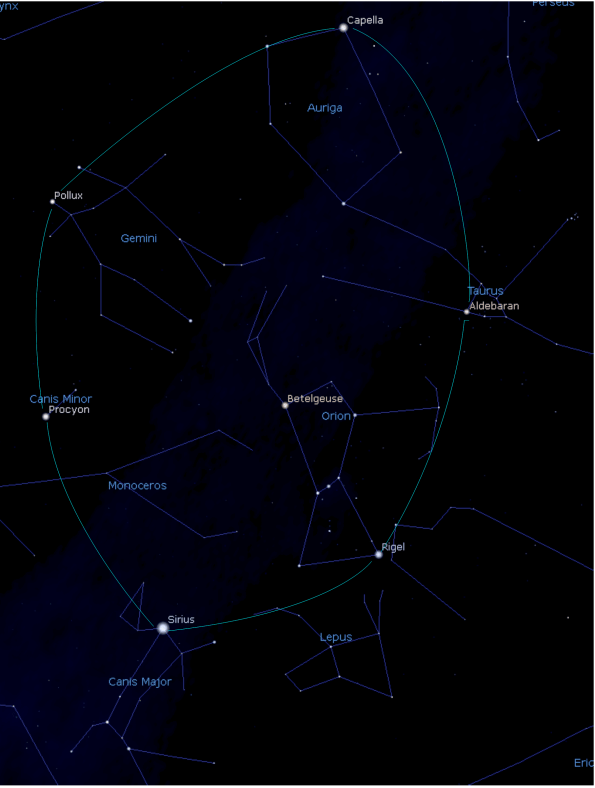
The bright stars of winter arrayed in a circle. Created using Stellarium.
Some also see a Winter Triangle consisting of the stars Betelgeuse, Sirius and Procyon.
01/28/2016 – Ephemeris – This post has gone to the dogs
Ephemeris for Thursday, January 28th. The Sun will rise at 8:06. It’ll be up for 9 hours and 38 minutes, setting at 5:45. The Moon, 3 days before last quarter, will rise at 10:42 this evening.
The great winter constellation or star group Orion the Hunter, is located in the southern sky at 9:30 p.m. His elongated rectangle of a torso is vertical. In the center of the rectangle are three stars in a line that make his belt. As a hunter, especially one of old, he has two hunting dogs. The larger, Canis Major can be found by following the three belt stars of Orion down and to the left. There lies the brilliant star called Sirius, also known as the Dog Star. It’s in the heart of a stick figure dog facing Orion that appears to be begging. The smaller dog can be found by extending a line through Orion’s shoulder stars to the left. We find a bright star called Procyon. It and one other star make up the hot-dog shaped constellation of Canis Minor, the little dog.
Times are for the Traverse City/Interlochen area of Michigan. They may be different for your location.
Addendum
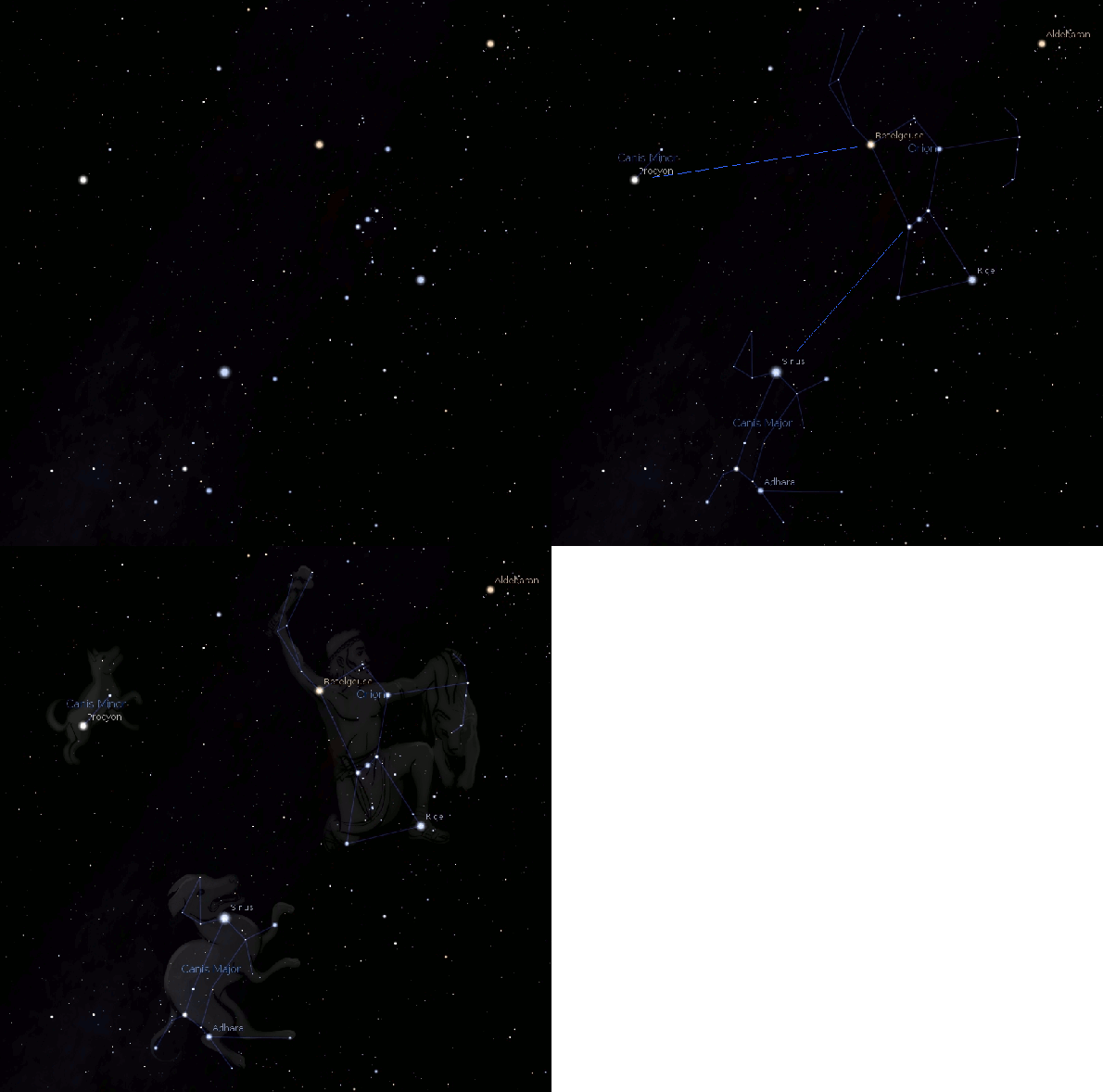
Orion and his hunting dogs revealed in animation. Created with Stellarium and GIMP.
01/07/2016 – Ephemeris – The Orion entourage
Ephemeris for Thursday, January 7th. The Sun will rise at 8:19. It’ll be up for 8 hours and 59 minutes, setting at 5:18. The Moon, 2 days before new, will rise at 6:42 tomorrow morning.
The whole Orion entourage is now visible in the southeast at 9 p.m. Orion the hunter with stars at his shoulders and knees and has a belt of three stars in a straight line. He has one arm upraised holding a club from the reddish star Betelgeuse and in the other arm he’s holding a lion skin shield fending off an attack from Taurus the bull above and right of him. Following the belt stars to the lower left we come to the brightest night-time star Sirius the Dog Star in the heart of Canis Major, his great hunting dog. Making a nearly equilateral triangle with Sirius and Betelgeuse is Procyon the little dog star in Canis Minor, Orion’s other small hunting dog. Hunched at the distracted Orion’s feet is the small constellation of Lepus the hare.
Times are for the Traverse City/Interlochen area of Michigan. They may be different for your location.
Addendum
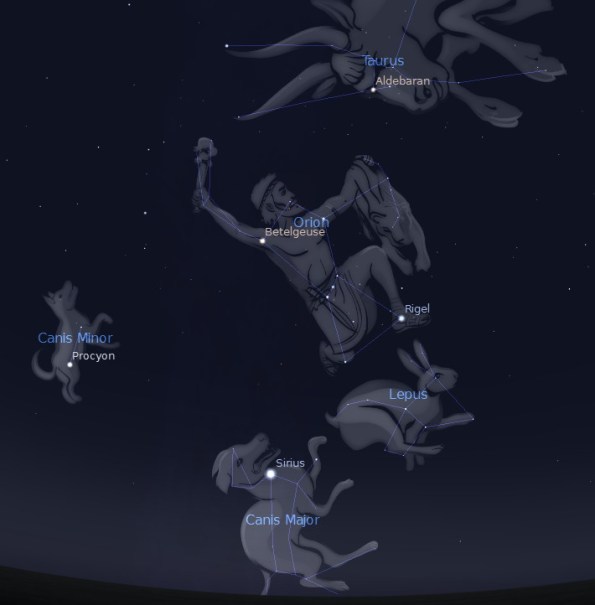
The Orion Entourage as seen at 9 p.m. January 7, 2016. Created using Stellarium
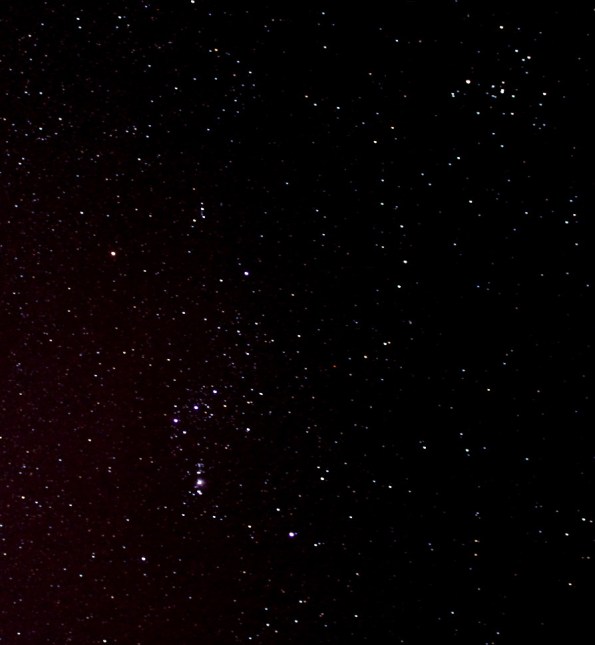
Orion and the head of Taurus photograph by myself January 4, 2016 at 11:30 p.m. It’s a stack of 5 untracked 20 second exposures.
Limiting magnitude is about 8, so you’re seeing stars you’d see with binoculars. The glow off to the left s from Traverse City, the center of which is 6 miles away to my northeast. I’m looking south here to get out of the glow, so Orion is more upright. I didn’t quite make it. My southwest through northwest is the darkest.
As you can probably guess I’ve got a new camera for my birthday/Christmas, a Canon EOS Rebel T5, and I’m investigating its astrophotographic capabilities. So expect some more “new” actual photographs on these posts.
12/15/2015 – Ephemeris – Procyon the star that’s “Before the dog”
Ephemeris for Tuesday, December 15th. The Sun will rise at 8:13. It’ll be up for 8 hours and 49 minutes, setting at 5:02. The Moon, 3 days before first quarter, will set at 9:48 this evening.
Visible low in the east at 9:30 p.m. appears the star Procyon to its lower left is Sirius the brightest night-time star. Procyon is the bright star in the constellation Canis Minor, or lesser dog. I can find only one other star in Canis Minor. Perhaps it’s a hot dog. If Sirius, in Canis major is the Dog Star then Procyon should be the Little Dog Star. However Procyon is an interesting name. It means “Before the dog”, which is an allusion to the fact that Procyon, though east of Sirius actually rises before it. This is due to Procyon’s more northerly position. This effect doesn’t work south of the equator, however. Sirius will rise at about 9 tonight. Procyon is a star much like Sirius but is 32% farther away. It’s 11.4 to Sirius’ 8.6 light years away.
Times are for the Traverse City/Interlochen area of Michigan. They may be different for your location.
Addendum
Procyon, Sirius and the stars of winter. Created using Stellarium
In the above chart, beside the constellation lines, we have the grid of right ascension, from lower left to upper right; and declination, from upper left to lower right. right ascension lines are like longitude on the Earth, while declination lines are latitude lines. They are tipped because I don’t live at either the equator or one of the poles. As the Earth rotates the Sun, stars and planets slide westward in the direction of the declination lines. Note that Sirius is closer to the horizon than Procyon. Also that Sirius is west of the 7 hour right ascension line. (Take my word for it.) Procyon is east of that line, thus Sirius is west of Procyon.
Other cool things can be seen in the chart. Note the declination line that touches the horizon at the east compass point and runs just above Orion’s belt. It is 0º declination, or the celestial equator. It extends to the west compass point on the western horizon. The Sun on the equinoxes will rise due east and set due west. The 6 hour right ascension line runs past Betelgeuse in Orion. At 23½º north declination, near Castor’s big toe in Gemini is where the Sun appears on the first day of summer, the summer solstice.
P.S. It was cloudy and rainy the last two days. Didn’t see a Geminid meteor again this year, keeping my record intact.
02/16/2015 – Ephemeris – The Winter Circle
Feb 16. This is Bob Moler with Ephemeris for President’s Day, Monday, February 16th. The sun will rise at 7:42. It’ll be up for 10 hours and 30 minutes, setting at 6:12. The moon, 2 days before new, will rise at 6:25 tomorrow morning.
The winter skies are blessed with more first magnitude stars than any other season. That’s a full one-third of the total are seen is a relatively small area. Six of these stars lie in a large circle centered on the seventh. This circle is up at 9 p.m. Starting high overhead is Capella in Auriga the charioteer. Moving down clockwise is Aldebaran in the face of Taurus the Bull. Then down to Orion’s knee we find Rigel. Down and left is the brightest star of all Sirius the Dog Star in Canis Major, lowest of these stars in the south-southeast. Moving up and left is Procyon in Canis Minor, Above Procyon is Pollux in Gemini the twins. All these are centered on Betelgeuse the bright red star in Orion’s shoulder.
Times are for the Traverse City/Interlochen area of Michigan. They may be different for your location.
Addendum
The Winter Circle of 1st magnitude stars
02/20/2014 – Ephemeris – Winter Circle plus 1
Ephemeris for Thursday, February 20th. The sun will rise at 7:34. It’ll be up for 10 hours and 43 minutes, setting at 6:18. The moon, 2 days before last quarter, will rise at 12:27 tomorrow morning.
The winter skies are blessed with more first magnitude stars than any other season. Six of these stars lie in a large circle centered on the seventh. This circle is up at 9 p.m. Starting high overhead is Capella in Auriga the charioteer. Moving down clockwise is Aldebaran in the face of Taurus the Bull. Then down to Orion’s knee we find Rigel. Down and left is the brightest star of all Sirius the Dog Star in Canis Major, lowest of these stars in the south-southeast. Moving up and left is Procyon in Canis Minor, Above Procyon is Pollux in Gemini the twins. All these are centered on Betelgeuse the bright red star in Orion’s shoulder. The interloper this year is Jupiter which is situated in Gemini and outshines them all.
Times are for the Traverse City/Interlochen area of Michigan. They may be different for your location.
Addendum
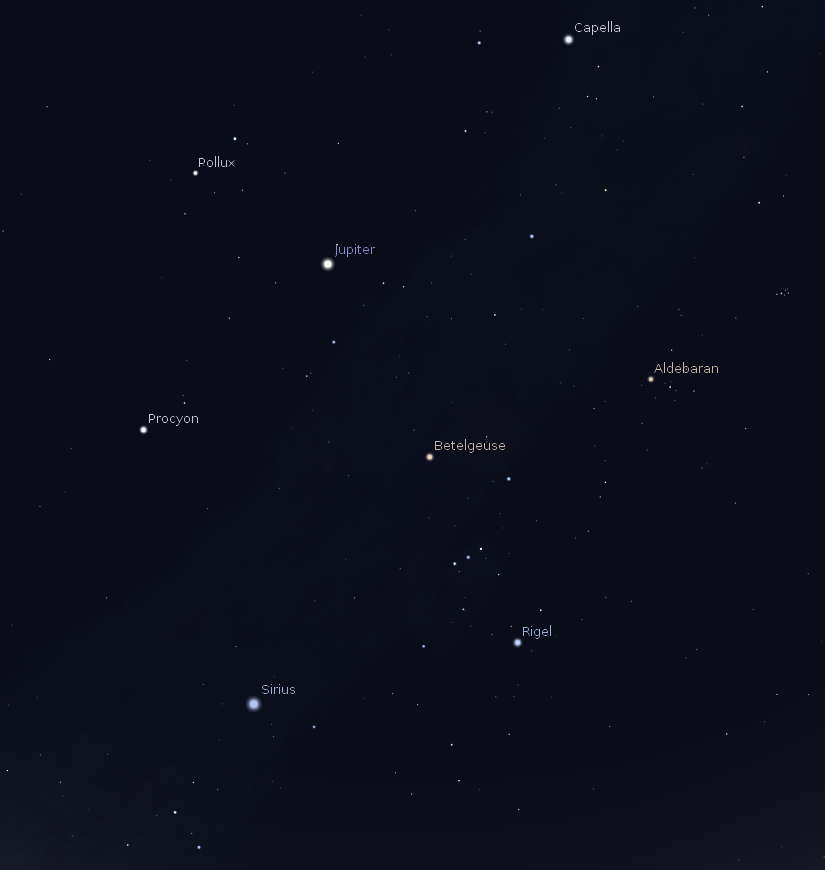
The Winter Circle plus Jupiter at 9 p.m. on February 20, 2014. Created using Stellarium.
 Bob Moler's Ephemeris Blog