Archive
03/10/2022 – Ephemeris – Viewing the Moon at first quarter tonight
This is Ephemeris for Thursday, March 10th. Today the Sun will be up for 11 hours and 38 minutes, setting at 6:42, and it will rise tomorrow at 7:02. The Moon, at first quarter today, will set at 3:26 tomorrow morning.
By the time we spot the moon this evening, it will be over half a day from being exactly first quarter phase. Looking at the brighter part of the Moon in binoculars, which is at the bottom or south end. We are looking at the lunar highlands of mostly very old craters that extend back to the formation of the Moon, nearly 4.5 billion years ago, that weren’t obliterated by the asteroid strikes that created the darker maria or lunar seas half a billion years later. In small telescopes there is a vertical line of three large craters whose names, from largest to smallest and top down, are Ptolemaeus, Alphonsus, and Arzachel. Alphonsus is a curious crater. In 1958 a Soviet astronomer recorded a possible volcanic eruption or outgassing from the crater floor.
The astronomical event times given are for the Traverse City/Interlochen area of Michigan (EST, UT – 5 hours). They may be different for your location.
Addendum
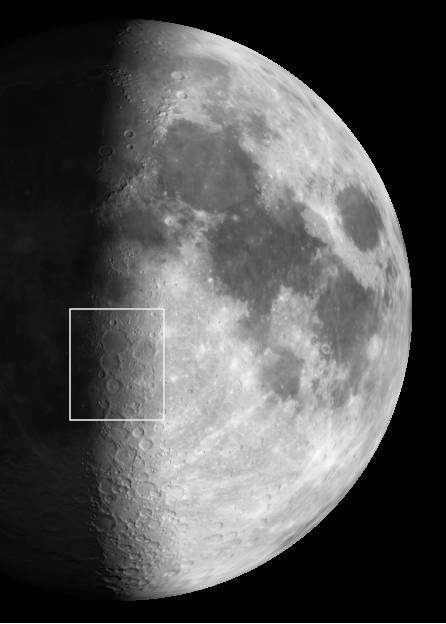
Lunar craters Ptolemaeus, Alphonsus and Arzachel outlined on the Moon’s disk, at first quarter, at 8 pm, March 10, 2022. Created using Virtual Moon Atlas.
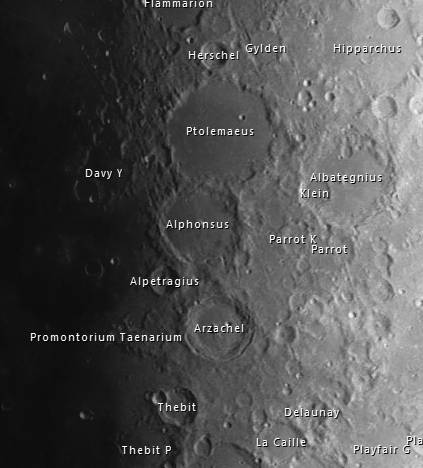
Closeup of lunar craters Ptolemaeus, Alphonsus and Arzachel, with other nearby craters, outlined above. Created using Virtual Moon Atlas.
10/22/2012 – Ephemeris – Three prominent craters on the moon tonight
Ephemeris for Monday, October 22nd. The sun will rise at 8:07. It’ll be up for 10 hours and 38 minutes, setting at 6:45. The moon, 1 day past first quarter, will set at 1:45 tomorrow morning.
Tonight’s slightly gibbous moon will reveal at its terminator a line of three craters just below the center of the moon. The one closest to the center of the moon, and the largest is Ptolemaeus, names for Claudius Ptolemy 2nd century astronomer. The next crater is Alphonsus named after Alphonse X, 13th century king of Castille, and responsible for improved astronomical tables. Alphonsus has been the site of transient reddish hazes that soggest to som of volcanis activity, but it’s never been proven. It was the target of the last Ranger spacecraft that crashed onto the moon taking pictures all the way down. The third crater is Arzackel , named after an 11th century Arabian astronomer.
Times are for the Traverse City/Interlochen area of Michigan. They may be different for your location.
Addendum
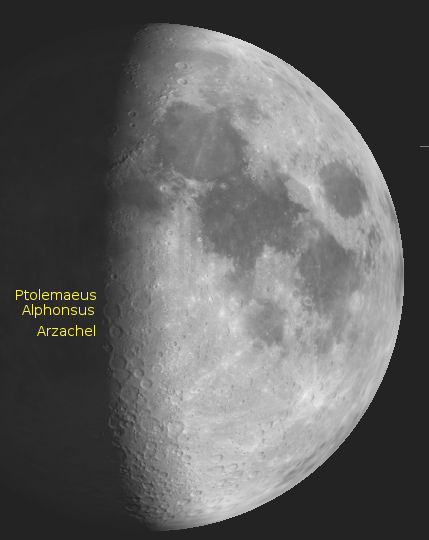
The moon at 10 p.m. on October 22, 2012. Created using Virtual Moon Atlas.
 Bob Moler's Ephemeris Blog