Archive
Ephemeris: 02/05/2026 – The celestial unicorn
Feb 5. This is Ephemeris for Thursday, February 5th. Today the Sun will be up for 10 hours even, setting at 5:57, and it will rise tomorrow at 7:55. The Moon, halfway from full to last quarter, will rise at 10:34 this evening.
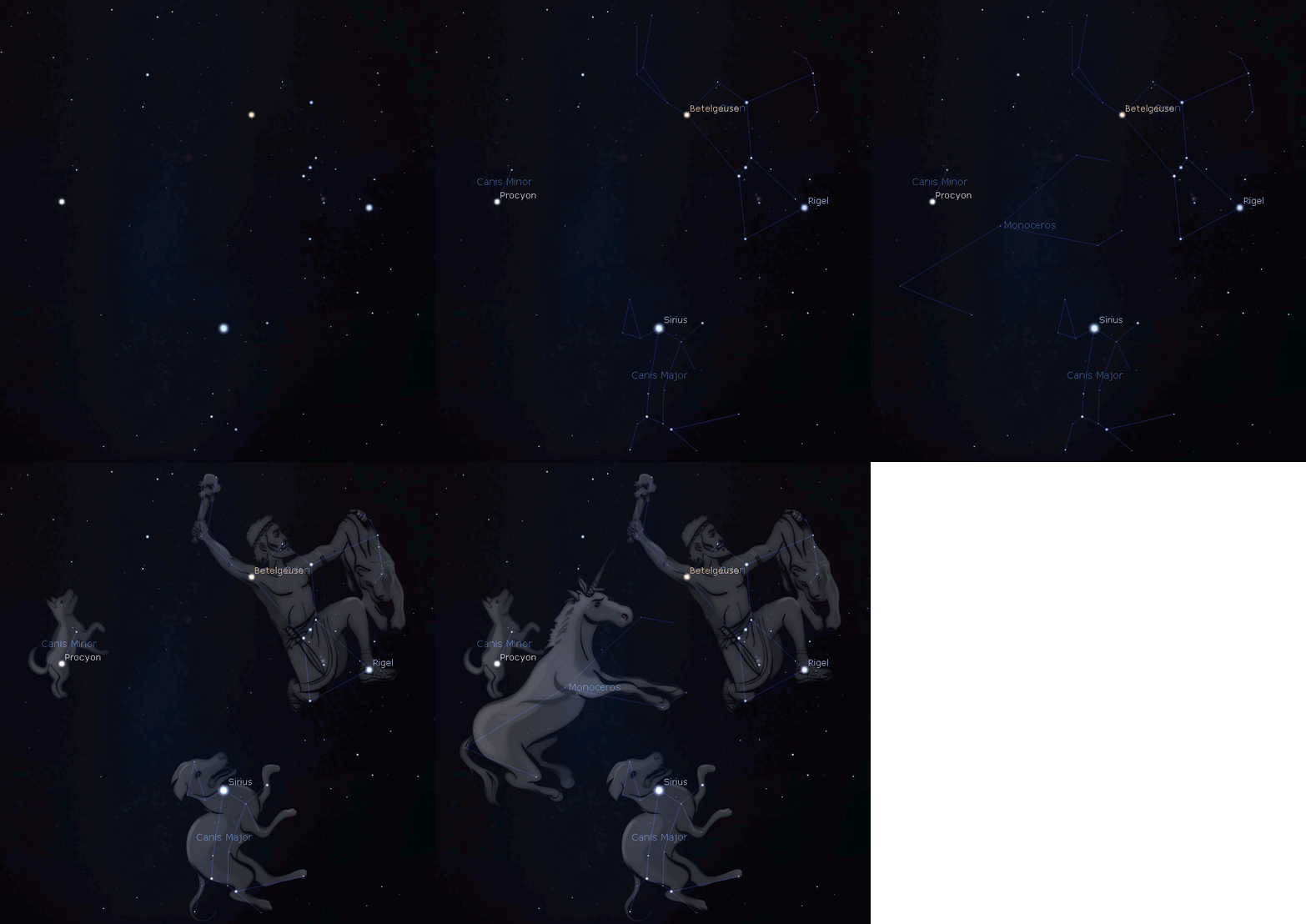
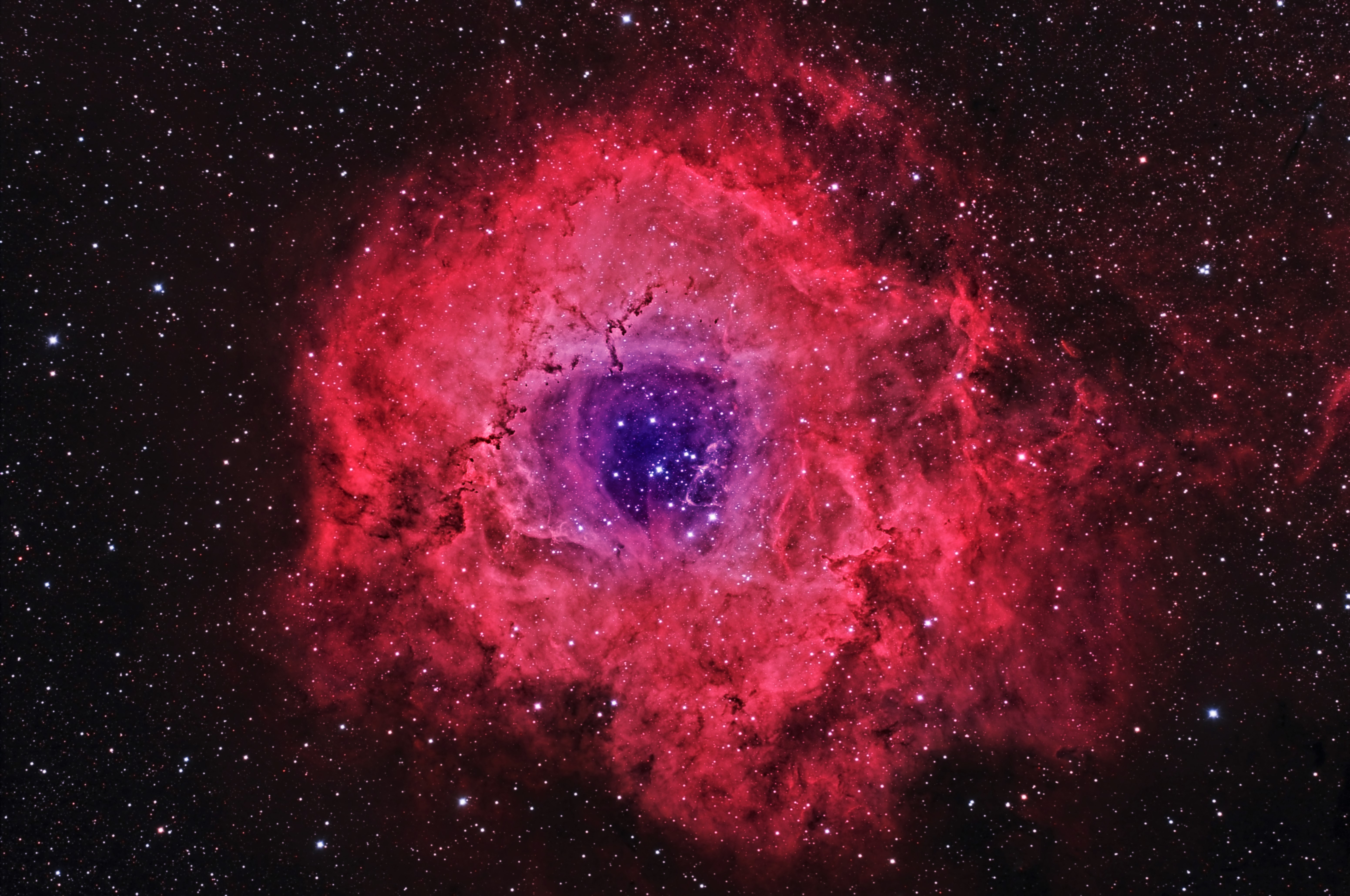
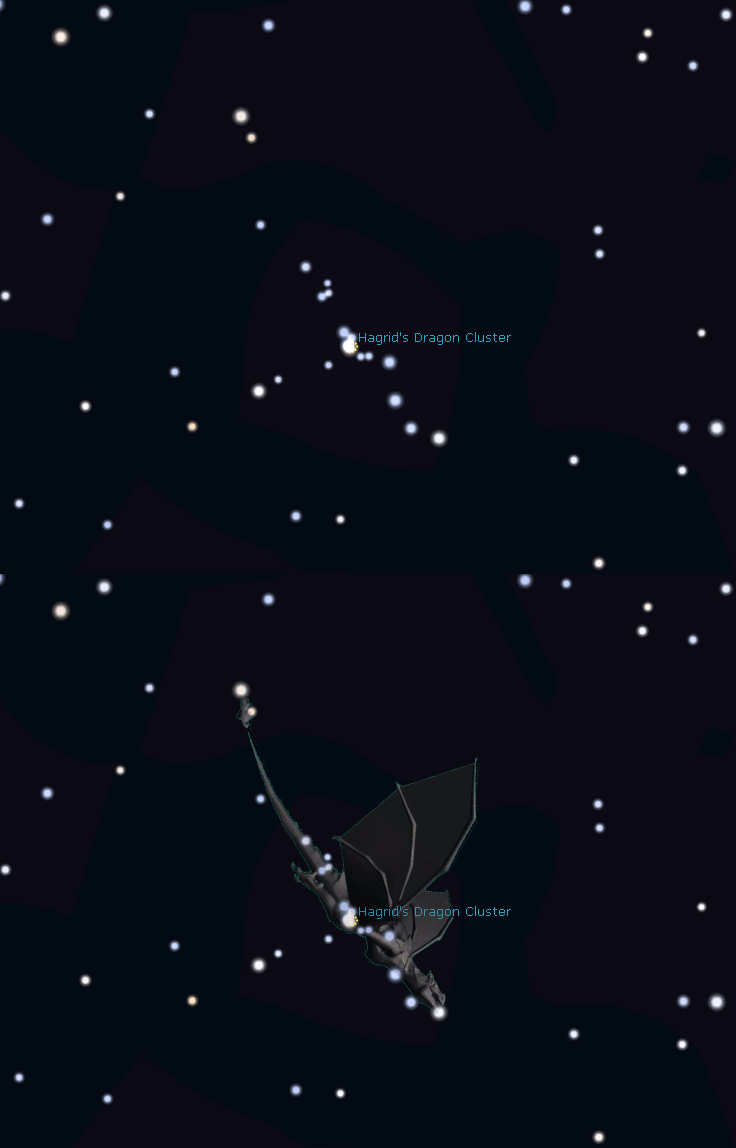
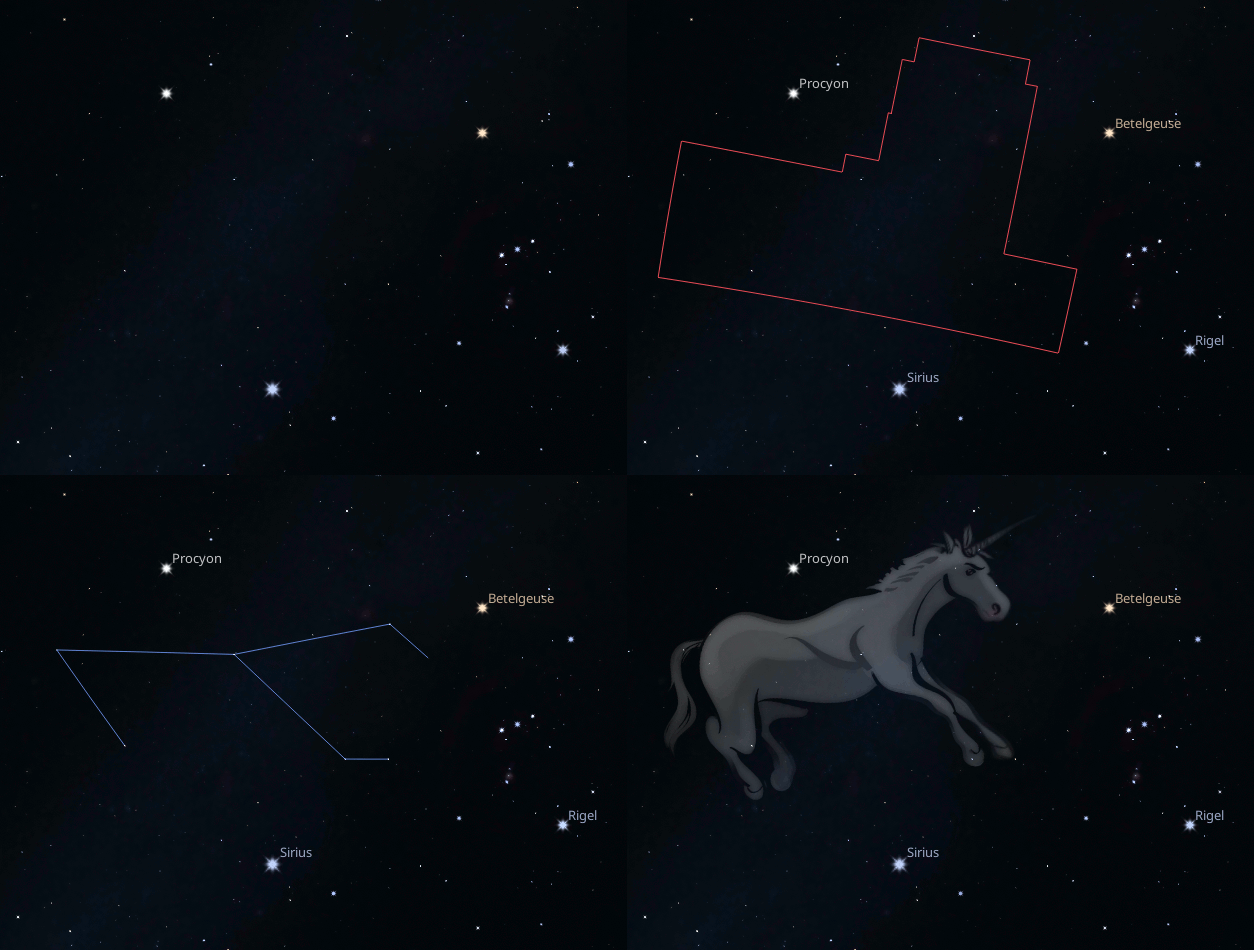
Among all the constellations in the sky of animals real and mythical, there is also a unicorn. It’s called Monoceros, and inhabits the southeastern sky at 8 p.m. mostly bounded by Orion on the right, Canis Major, the great dog below and Canis Minor, the little dog to the left and above. Unfortunately for observers without a telescope Monoceros, is devoid of any but the faintest stars. Maybe that’s why no one sees unicorns anymore. Though it lacks bright stars Monoceros is full of wonders revealed by telescopes and photography. A feast of faint nebulae or clouds of gas and dust, the birthplace of stars, including the red rose of the Rosette Nebula, and the more recently named Hagrid’s Dragon Cluster (NGC 2301).
The astronomical event times given in this blog are for the Traverse City/Interlochen area of Michigan (Lat 44.7° N, Long 85.7° W; EST, UT – 5 hours) unless stated otherwise. Times will be different for other locations.
Addendum
Ephemeris: 02/20/2025 – Can you find the celestial unicorn?
This is Bob Moler with Ephemeris for Thursday, February 20th. Today the Sun will be up for 10 hours and 43 minutes, setting at 6:18, and it will rise tomorrow at 7:33. The Moon, at last quarter today, will rise at 3:06 tomorrow morning.
Among all the constellations in the sky of animals real and mythical, there is also a unicorn. It’s called Monoceros, and inhabits the southeastern sky at 8 p.m. mostly bounded by Orion on the right, Canis Major, the great dog below and Canis Minor, the little dog to the left and above. Unfortunately for observers without a telescope Monoceros, is devoid of any but the faintest stars. Maybe that’s why no one can find unicorns anymore. It has many faint stars because the Milky Way runs through it. For the astrophotographer it is a feast of star clusters and faint nebulae or clouds of gas and dust, the birthplace of stars, including the red rose of the Rosette Nebula. It also contains a beautiful telescopic triple star system, Beta (β) Monocerotis.
The astronomical event times given are for the Traverse City/Interlochen area of Michigan (EST, UT – 5 hours). Times will be different for other locations.
Addendum
Ephemeris: 03/07/2024 – There’s a unicorn in there somewhere
This is Bob Moler with Ephemeris for Thursday, March 7th. Today the Sun will be up for 11 hours and 30 minutes, setting at 6:39, and it will rise tomorrow at 7:06. The Moon, 3 days before new, will rise at 6:35 tomorrow morning.
The constellation of Monoceros the unicorn is located in an area of sky to the left of Orion so it’s in the south at 8 pm, inside the Winter Triangle of stars, Betelgeuse in Orion; Sirius in the Great Dog, Canis Major; and Procyon in Canis Minor. If you don’t see anything there, it’s OK. Nobody sees real unicorns any more anyway. Are there any real unicorns? Anyway, there’s a great number of nebulae here in the Milky Way that runs through it, which unfortunately are too faint to be seen with amateur telescopes. However, it is a gold mine for amateur astronomers who are also astrophotographers using time exposures to record the faint nebulae here, including the famous Rosette Nebula!
The astronomical event times given are for the Traverse City/Interlochen area of Michigan (EST, UT –5 hours). They may be different for your location.
Addendum
02/24/2022 – Ephemeris – The celestial unicorn
This is Ephemeris for Thursday, February 24th. Today the Sun will be up for 10 hours and 55 minutes, setting at 6:23, and it will rise tomorrow at 7:27. The Moon, 1 day past last quarter, will rise at 3:57 tomorrow morning.
Among all the constellations in the sky of animals real and mythical, there is also a unicorn. It’s called Monoceros, and inhabits the south-southeastern sky at 8 p.m. mostly bounded by Orion on the right, Canis Major, the great dog below and Canis Minor, the little dog to the left and above. Unfortunately for observers without a telescope, Monoceros, is devoid of any but the faintest stars. Maybe that’s why no one sees unicorns anymore. It has many faint stars because the Milky Way runs through it. To the telescopic observer and astrophotographer it is a feast of faint nebulae or clouds of gas and dust, the birthplace of stars, including the red rose of the Rosette Nebula* (NGC 2237), and Hagrid’s Dragon Cluster (NGC 2301), which sounds suspiciously like it was recently, and unofficially, named. Monoceros also contains a beautiful telescopic triple star system, Beta (β) Monocerotis.
The astronomical event times given are for the Traverse City/Interlochen area of Michigan (EST, UT – 5 hours). They may be different for your location.
* The Rosette nebula surrounds the star cluster NGC 2244. This sparse star cluster is visible visually in telescopes. I’ve never been able to spot the nebula in a telescope, but it shows up, faintly, in my wide angle photographs of the area.
Addendum
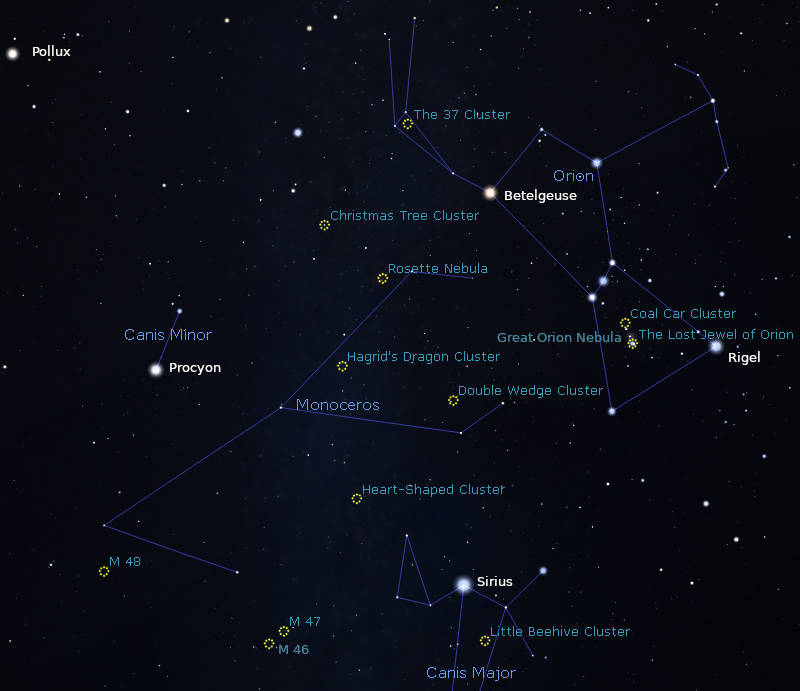
Deep Sky Objects in and around Monoceros. Deep Sky Objects are telescopic objects that lie beyond the solar system. Click on the image to enlarge. Created using Stellarium.
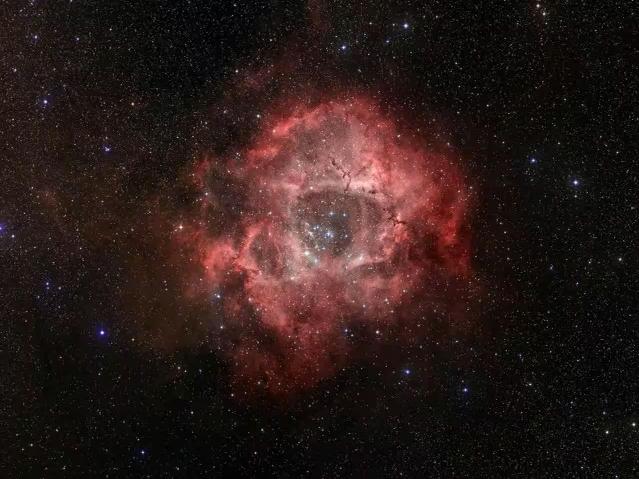
Rosette Nebula in the infrared from the Spitzer Space Telescope. Credit: NASA/JPL/Caltech
The brighter stars of NGC 2301 (Hagrid’s Dragon Cluster, AKA Great Bird Cluster and Copeland’s Golden Worm). It’s also in two other catalogs: Cr 119 and Mel 54. Created using Stellarium and GIMP. The dragon image is from “Dragon Flying Cycle” on YouTube by Simon Hussey.
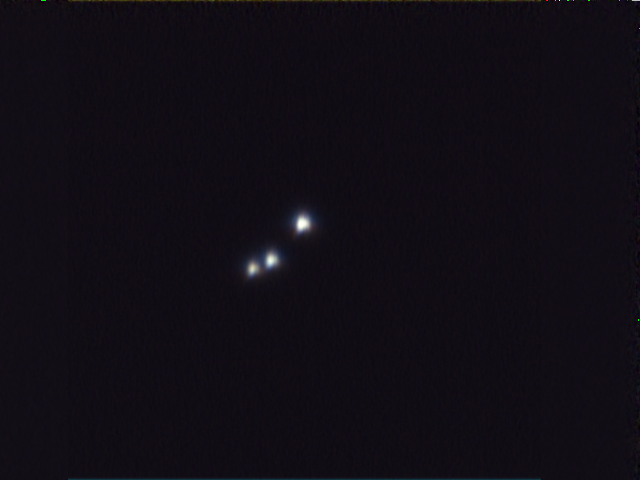
Telescopic Beta Monocerotis. William Hershel, discoverer of Uranus, said that it was “One of the most beautiful sights in the heavens.” Credit: F. Ringwald, Fresno State.
022/21/2020 – Ephemeris – The almost invisible unicorn
Ephemeris for Friday, February 21st. Today the Sun will be up for 10 hours and 44 minutes, setting at 6:19, and it will rise tomorrow at 7:32. The Moon, 2 days before new, will rise at 7:27 tomorrow morning.
Among all the constellations in the sky of animals real and mythical, there is also a unicorn. It’s called Monoceros, and inhabits the southern sky at 9 p.m. bounded by Orion on the right, Canis Major, the great dog below and Canis Minor, the little dog to the left. Unfortunately for observers without optical aid Monoceros, though large, is devoid of any but the faintest stars. Maybe that’s why no one sees unicorns anymore. It has many faint stars because the Milky Way runs through it. To the telescope it is a feast of faint nebulae or clouds of gas and dust, the birth place of stars, including the red rose of the Rosette Nebula, and the strange and tiny Hubble’s Variable Nebula. It contains no bright stars, but a wealth of wonders below naked eye visibility.
The times given are for the Traverse City/Interlochen area of Michigan. They may be different for your location.
Addendum
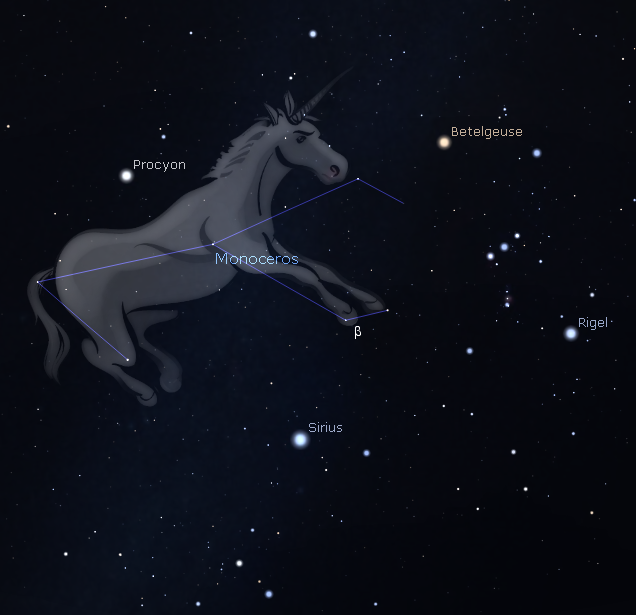
Monoceros the unicorn seen mostly inside the Winter Triangle of Betelgeuse, Sirius and Procyon. Note the star in the unicorn’s right hoof denoted with a funny B. That’s Beta Monocerotis,a triple star visible in small telescopes. Created using Stellarium with additions.
Rosette Nebula in the infrared from the Spitzer Space Telescope. Credit: NASA/JPL/Caltech
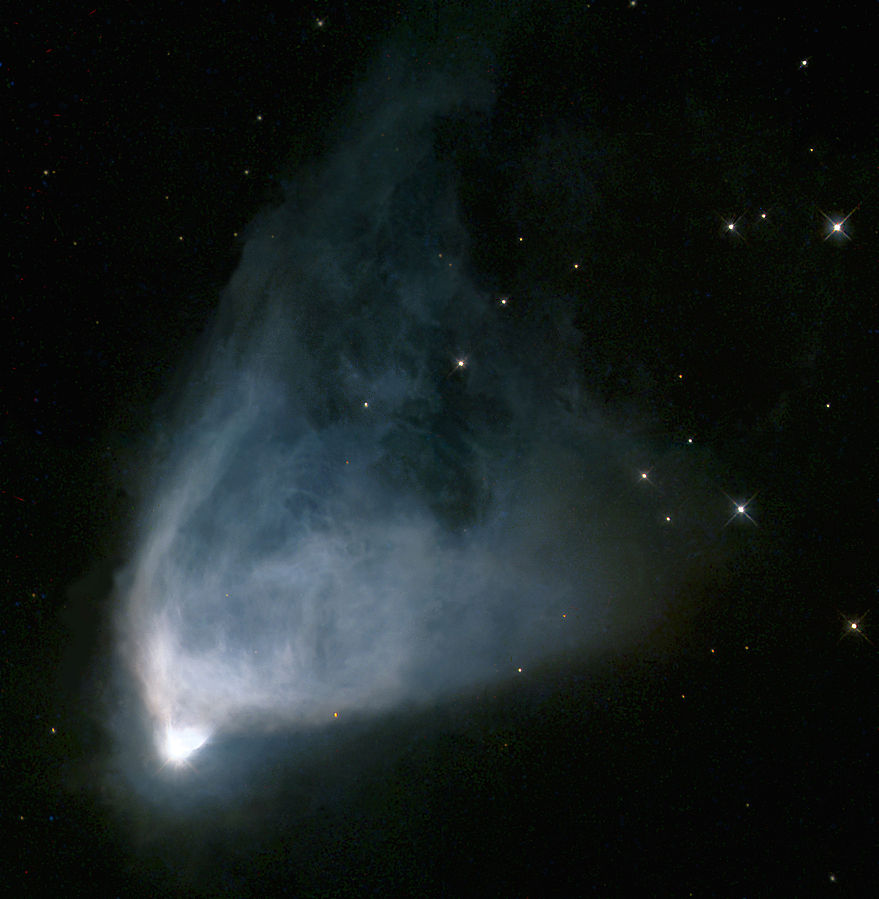
Hubble’s Variable Nebula photographed appropriately enough by the Hubble Space Telescope. Credit: NASA/ESA and The Hubble Heritage Team (AURA/STScI).
Telescopic Beta Monocerotis. William Hershel, discoverer of Uranus, said that it was “One of the most beautiful sights in the heavens.” Credit: F. Ringwald, Fresno State.
01/28/2019 – Ephemeris – The celestial unicorn
Ephemeris for Monday, January 28th. Today the Sun will be up for 9 hours and 39 minutes, setting at 5:45, and it will rise tomorrow at 8:05. The Moon, 1 day past last quarter, will rise at 2:52 tomorrow morning.
Within a triangle bounded by stars Betelgeuse in Orion, Sirius in Canis Major and Procyon in Canis Minor, called the Winter Triangle appears a nearly starless patch of sky to the naked eye. In here is the constellation Monoceros, the unicorn. Unfortunately for observers without optical aid Monoceros, though large, is devoid of any but the faintest stars. Maybe that’s why no one sees unicorns anymore. It has many faint stars because the Milky Way runs through it. To the telescope it is a feast of faint nebulae or clouds of gas and dust, the birth place of stars, including the red rose of the Rosette Nebula, and the strange and tiny Hubble’s Variable Nebula. It also contains beautiful telescopic triple star system, Beta (β) Monocerotis.
The times given are for the Traverse City/Interlochen area of Michigan. They may be different for your location.
Addendum
Monoceros finder chart animation. Created using Stellarium and GIMP.
Rosette Nebula in the infrared from the Spitzer Space Telescope. Credit: NASA/JPL/Caltech
Hubble’s Variable Nebula photographed appropriately enough by the Hubble Space Telescope. Credit: NASA/ESA and The Hubble Heritage Team (AURA/STScI).
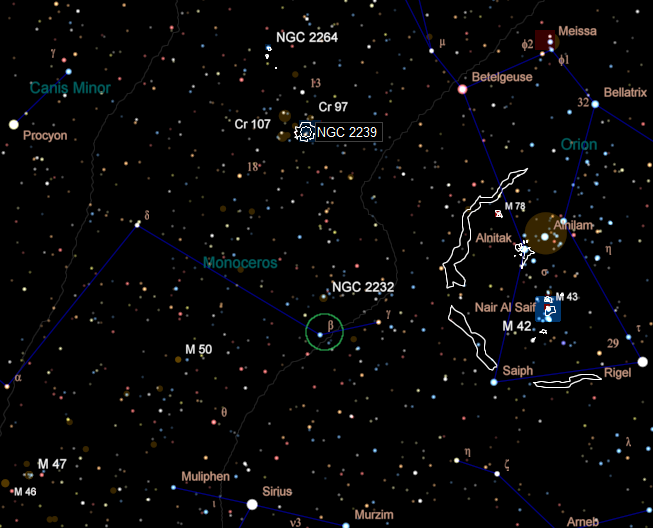
Looking at some faint objects in Monoceros. NGC 2239 is the star cluster in the center of the Rosette Nebula. The nebula itself is extremely faint. It shows in photographs, but I’ve never seen it visually. The green circle shows Beta Monocerotis, the triple star. All these stars are extremely blue-white hot. Created using Cartes du Ciel (Sky Charts).
Telescopic Beta Monocerotis. William Hershel, discoverer of Uranus, said that it was “One of the most beautiful sights in the heavens.” Credit: F. Ringwald, Fresno State.
02/06/2018 – Ephemeris – Monoceros the Unicorn
Ephemeris for Tuesday, February 6th. The Sun will rise at 7:55. It’ll be up for 10 hours and 2 minutes, setting at 5:58. The Moon, 1 day before last quarter, will rise at 1:09 tomorrow morning.
Among all the constellations in the sky of animals real and mythical, there is also a unicorn. It’s called Monoceros, and inhabits the southeastern sky at 9 p.m. bounded by Orion on the right, Canis Major, the great dog below and Canis Minor, the little dog to the left. Unfortunately for observers without optical aid Monoceros, though large, is devoid of any but the faintest stars. Maybe that’s why no one sees unicorns anymore. It has many faint stars because the Milky Way runs through it. To the telescope it is a feast of faint nebulae or clouds of gas and dust, the birth place of stars, including the red rose of the Rosette Nebula, and the strange and tiny Hubble’s Variable Nebula. It also contains beautiful telescopic triple star system, Beta (β) Monocerotis.
The times given are for the Traverse City/Interlochen area of Michigan. They may be different for your location.
Addendum
Monoceros finder chart animation. Created using Stellarium and GIMP.
Rosette Nebula in the infrared from the Spitzer Space Telescope. Credit: NASA/JPL/Caltech
Hubble’s Variable Nebula photographed appropriately enough by the Hubble Space Telescope. Credit: NASA/ESA and The Hubble Heritage Team (AURA/STScI).
Looking at some faint objects in Monoceros. NGC 2239 is the star cluster in the center of the Rosette Nebula. The nebula itself is extremely faint. It shows in photographs, but I’ve never seen it visually. The green circle shows Beta Monocerotis, the triple star. All these stars are extremely blue-white hot. Created using Cartes du Ciel (Sky Charts).
Also in the chart above is the semicircular Barnard’s Loop, a supernova remnant a great long exposure photography target.
01/30/2017 – Ephemeris – Can you really see a unicorn?
Ephemeris for Monday, January 30th. The Sun will rise at 8:03. It’ll be up for 9 hours and 45 minutes, setting at 5:49. The Moon, 3 days past new, will set at 8:58 this evening.
Among all the constellations in the sky of animals real and mythical, there is also a unicorn. It’s called Monoceros, and inhabits the southern sky at 9 p.m. bounded by Orion on the right, Canis Major, the great dog below and Canis Minor, the little dog to the left. Unfortunately for observers without optical aid Monoceros, though large, is devoid of any but the faintest stars. Maybe that’s why no one sees unicorns anymore. It has many faint stars because the Milky Way runs through it. To the telescope it is a feast of faint nebulae or clouds of gas and dust, the birth place of stars, including the red rose of the Rosette Nebula, and the strange and tiny Hubble’s Variable Nebula. It contains no bright stars, but a wealth of wonders below naked eye visibility.
Times are for the Traverse City/Interlochen area of Michigan. They may be different for your location.
Addendum
Monoceros finder chart animation. Created using Stellarium and GIMP.
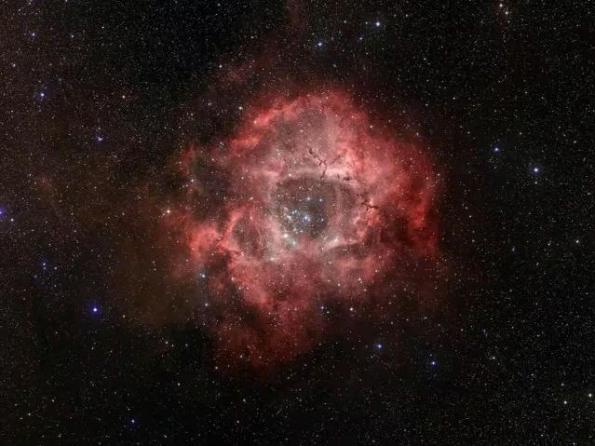
Rosette Nebula in the infrared from the Spitzer Space Telescope. Credit: NASA/JPL/Caltech.
I’ve never seen it visually through a telescope. However the inner star cluster, NGC 2244 is visible. The nebula is NGC 2239.
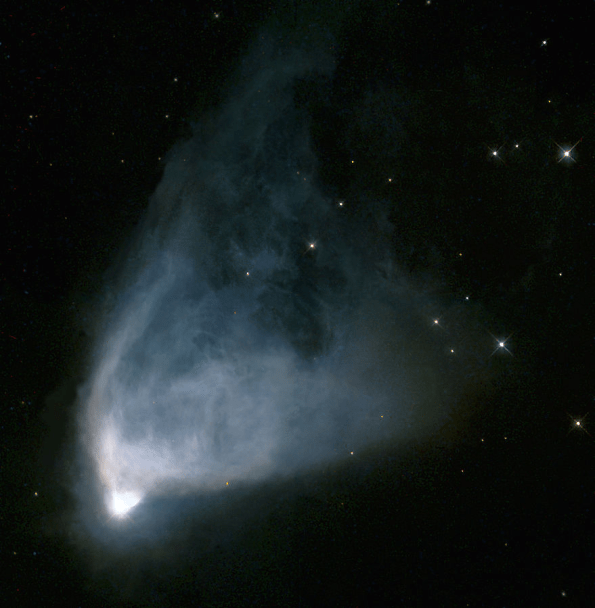
Hubble’s Variable Nebula NGC 2261 photographed appropriately enough by the Hubble Space Telescope. Credit: NASA/ESA and The Hubble Heritage Team (AURA/STScI).

Another nebula: The Cone Nebula, NGC 2264, as seen with the Hubble Space Telescope. Kind of looks like eggs in an eagle’s nest Credit ESA/Hubble.
The mentioned NGC objects can be found with a good star atlas or the free program Cartes du Ciel via the link on the right.
02/08/2016 – Ephemeris – The celestial unicorn
Ephemeris for Monday, February 8th. The Sun will rise at 7:53. It’ll be up for 10 hours and 6 minutes, setting at 6:00. The Moon is new today, and won’t be visible.
Among all the constellations in the sky of animals real and mythical, there is also a unicorn. It’s called Monoceros, and inhabits the southeastern sky at 9 p.m. bounded by Orion on the right, Canis Major, the great dog below and Canis Minor, the little dog to the left. Unfortunately for observers without optical aid Monoceros, though large, is devoid of bright stars. Maybe that’s why no one sees unicorns anymore. It has many faint stars because the Milky Way runs through it. To the telescope it is a feast of faint nebulae or clouds of gas and dust, the birth place of stars, including the red rose of the Rosette Nebula whose central star cluster can be seen in a telescope but the nebulosity requires a camera to capture and store its light.
Times are for the Traverse City/Interlochen area of Michigan. They may be different for your location.
Addendum
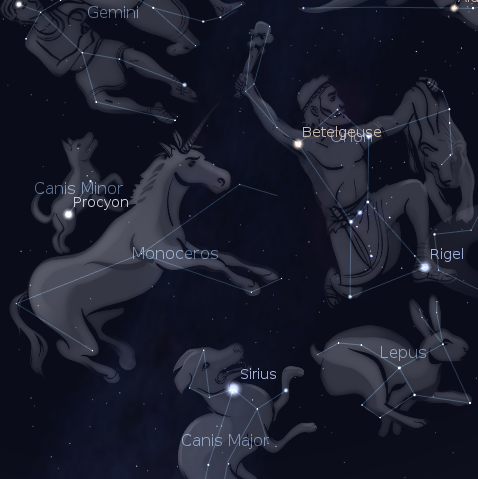
Monoceros the unicorn. Created using Stellarium.
Rosette Nebula in the infrared from the Spitzer Space Telescope. Credit: NASA/JPL/Caltech
02/17/2015 – Ephemeris – There are no unicorns except in the heavens
Ephemeris for Fat Tuesday, Tuesday, February 17th. The sun will rise at 7:40. It’ll be up for 10 hours and 33 minutes, setting at 6:13. The moon, 1 day before new, will rise at 7:07 tomorrow morning.
Among all the constellations in the sky of animals real and mythical, there is also a unicorn. It’s called Monoceros, and inhabits the southeastern sky at 9 p.m. bounded by Orion on the right, Canis Major, the great dog below and Canis Minor, the little dog to the left. Unfortunately for observers without optical aid Monoceros, though large, is devoid of any but the faintest stars. Maybe that’s why no one sees unicorns anymore. It has many faint stars because the Milky Way runs through it. To the telescope it is a feast of faint nebulae or clouds of gas and dust, the birth place of stars, including the red rose of the Rosette Nebula, and the strange and tiny Hubble’s Variable Nebula. It contains no bright stars, but it has wonders for the telescope.
Times are for the Traverse City/Interlochen area of Michigan. They may be different for your location.
Addendum
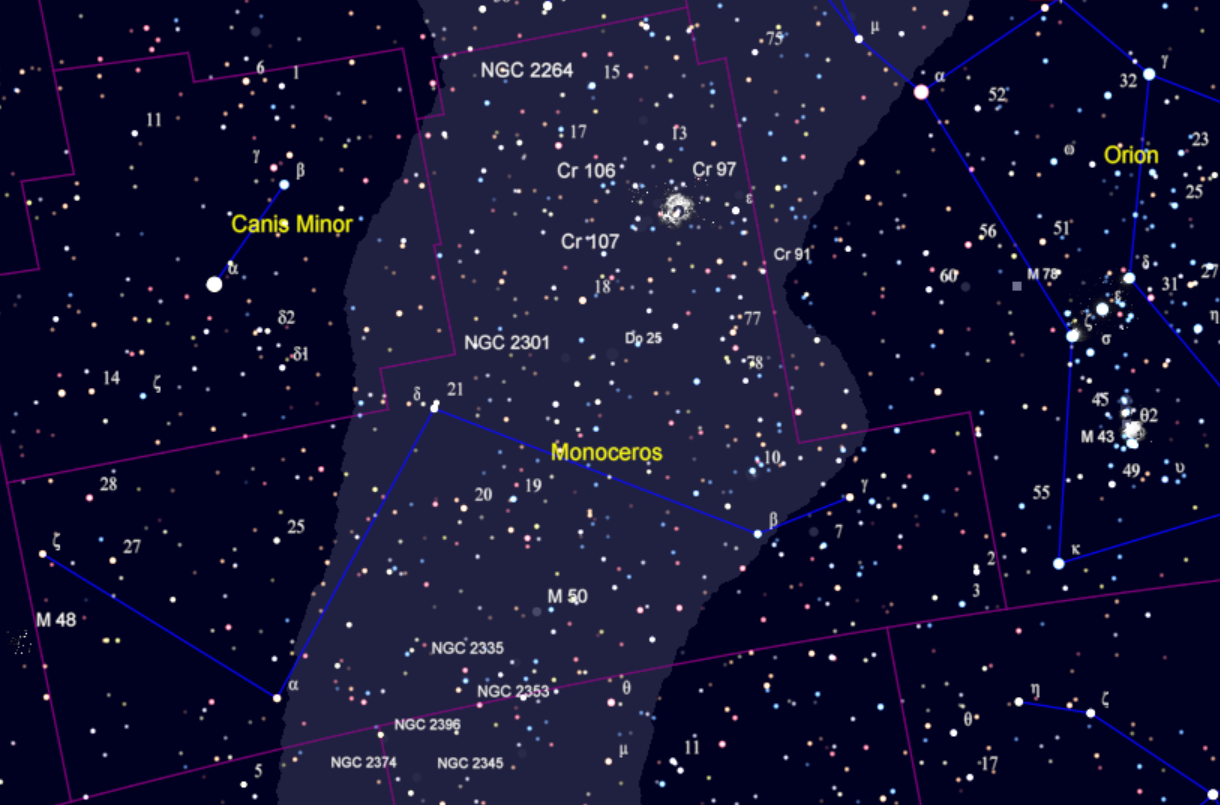
The constellation Monoceros the unicorn. Created using Cartes du Ciel (Sky Charts). Click to enlarge.
Can you see a unicorn here? Me neither.
One thing I didn’t mention in the program is the star labeled β. It is a triple star in telescopes.
Universe Today has a great post on Monoceros by Tammy Plotner, who by sad coincidence passed away a few days ago.
 Bob Moler's Ephemeris Blog