Archive
07/16/2019 – Ephemeris – 50 years ago today the Apollo mission left for the Moon
Ephemeris for Tuesday, July 16th. Today the Sun will be up for 15 hours and 12 minutes, setting at 9:25, and it will rise tomorrow at 6:13. The Moon, at full today, will rise at 9:30 this evening.
50 years ago today at 11:32 a.m. Eastern Daylight Time the most powerful rocket ever built roared into life. The Saturn V, a three stage rocket, 363 feet tall, which in turn launched two spacecraft, the Command and Service modules, and the Lunar Module, and three astronauts on their journey to destiny, Neil Armstrong, Edwin (Buzz) Aldrin, and Michael Collins. It was the start of the Apollo 11 mission. It happens that tonight the namesake of the rocket, the planet Saturn is to the right of the Moon. At launch the Moon was two days old, a thin crescent in the west that evening. Four days later they would be orbiting the Moon, and Armstrong and Aldrin would be descending to the Moon’s surface.
The times given are for the Traverse City/Interlochen area of Michigan. They may be different for your location.
Addenda
Apollo 11
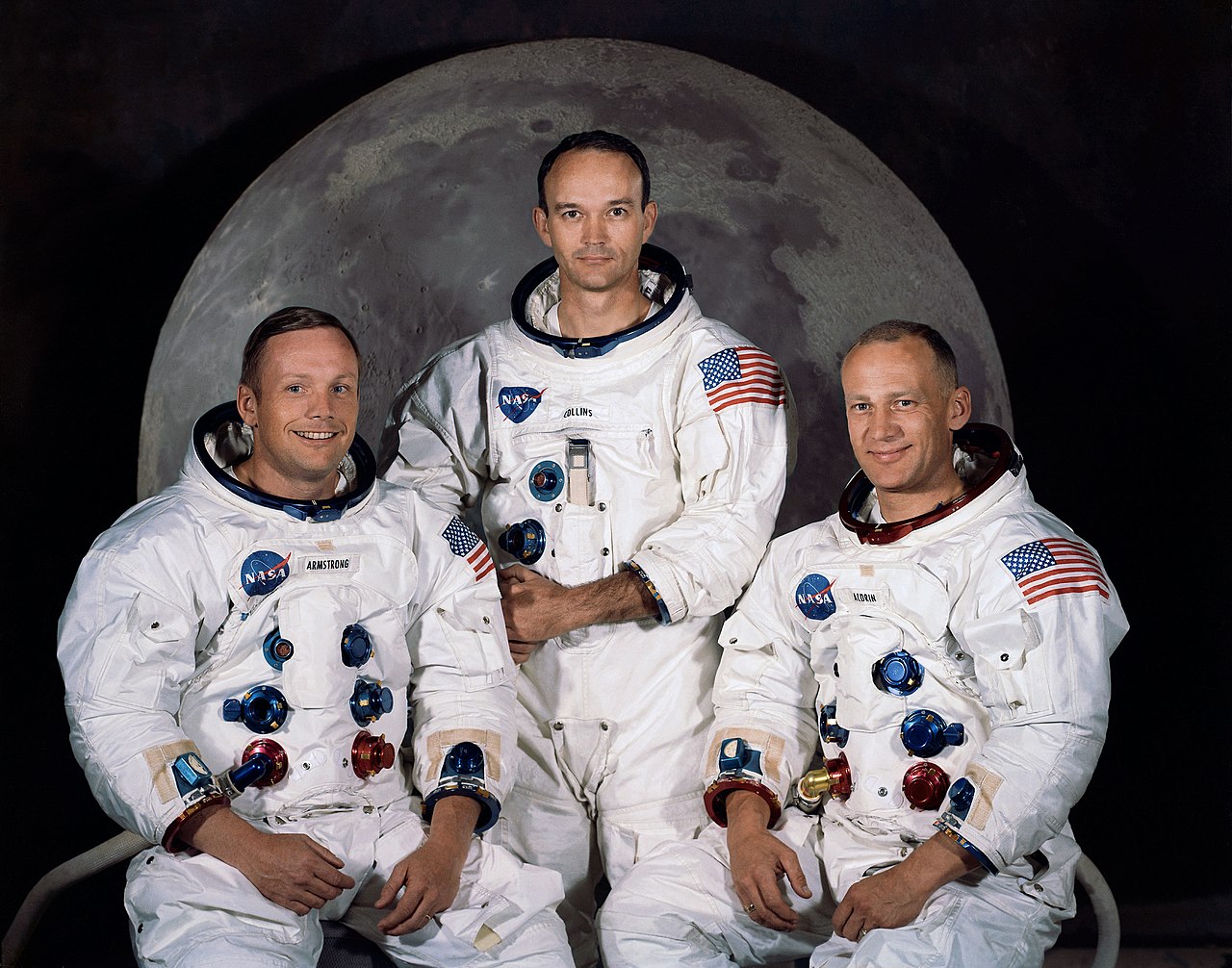
Left to right Neil Armstrong, Mission Commander; Michael Collins, Command Module Pilot; and Buzz Aldrin, Lunar Module Pilot. Credit: NASA.
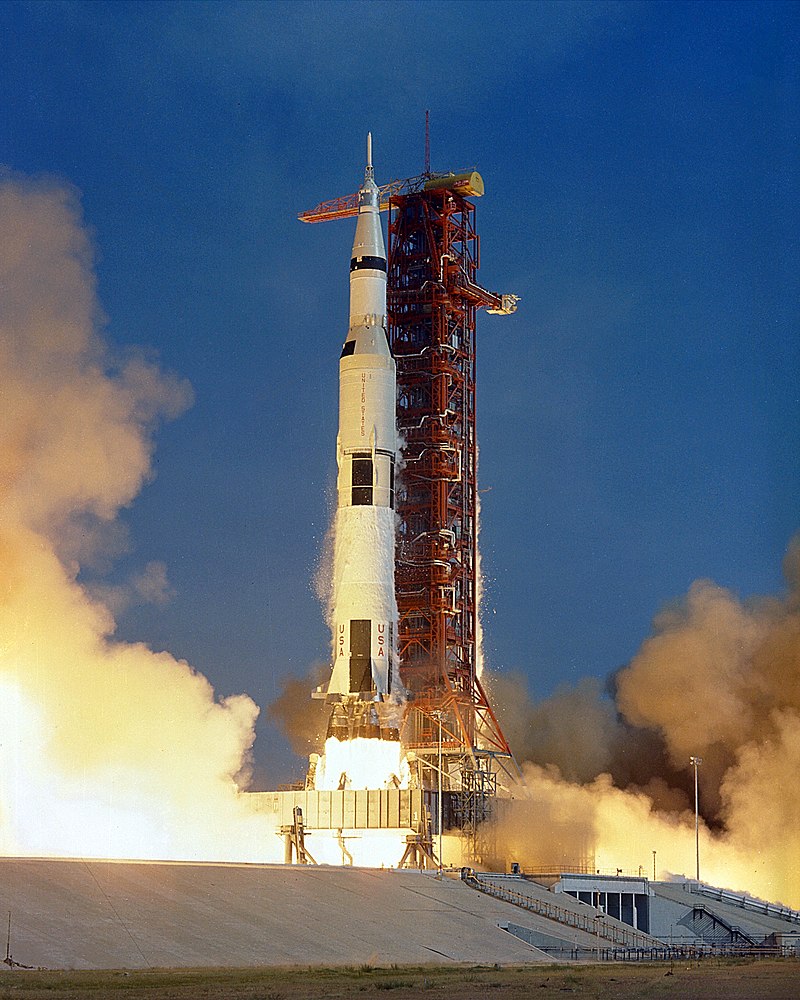
The Saturn V for the Apollo 11 mission lifts of from Pad 39A. Credit: NASA.
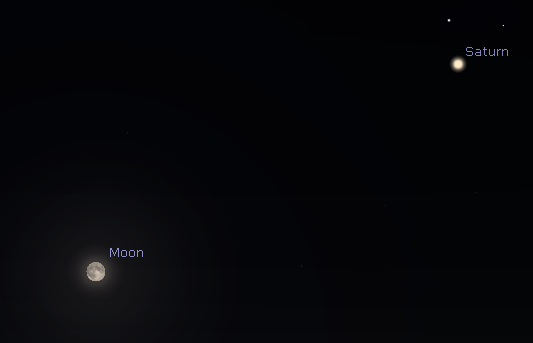
The Moon and Saturn tonight, 11 p.m. July 16, 2019. In reality the Moon will be so bright that Saturn will be almost overwhelmed. Created using Stellarium.
Here’s an excellent podcast series from the BBC: 13 Minutes to the Moon.
Partial Lunar Eclipse
The partial lunar eclipse today is not mentioned in the program because it is not visible locally.
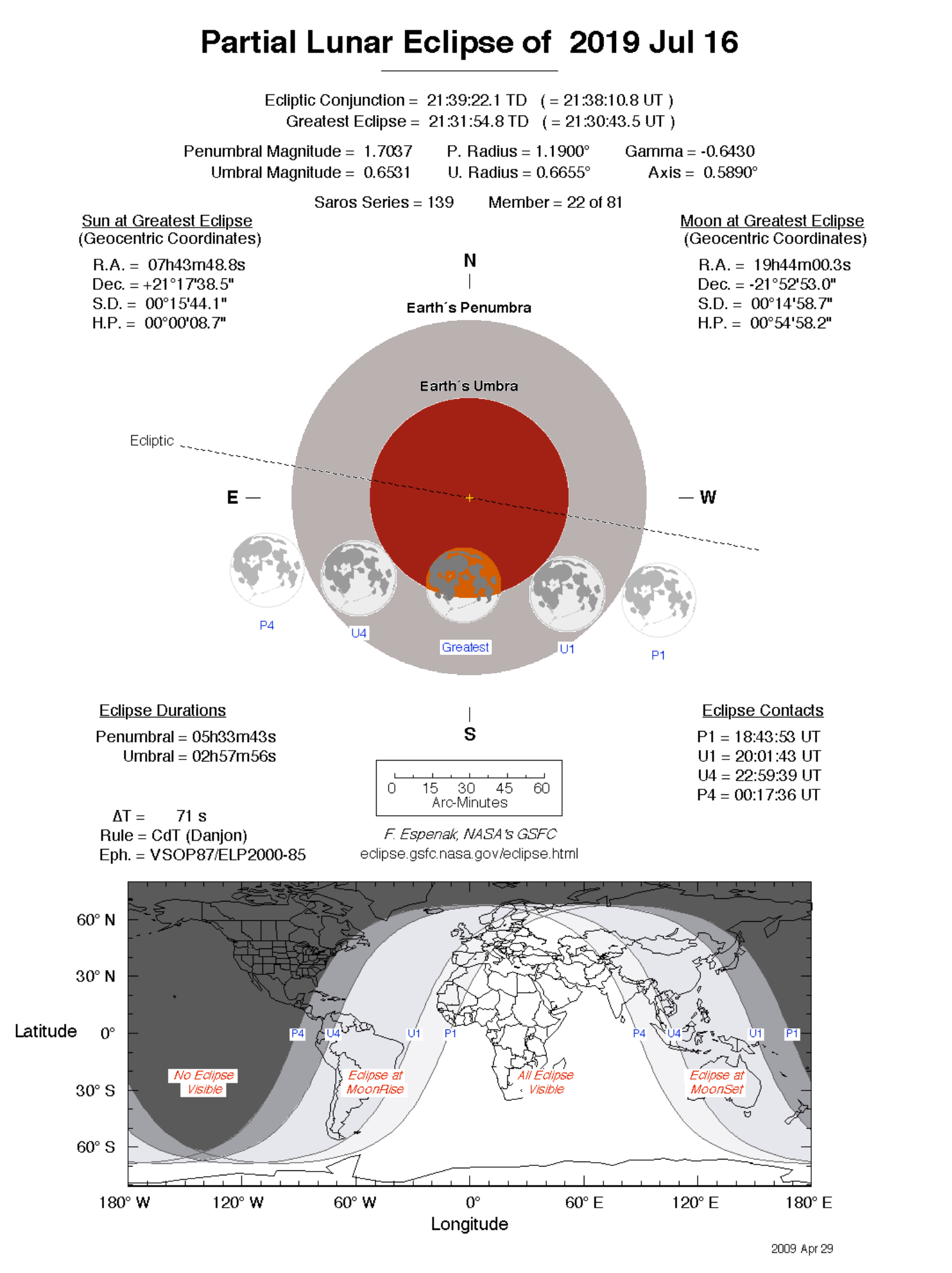
Partial Lunar Eclipse of July 16, 2019. Click on image to enlarge. Credit NASA/GSFC/F. Espenak.
05/13/2019 – Ephemeris – The Moon Rockets
Ephemeris for Monday, May 13th. Today the Sun will be up for 14 hours and 44 minutes, setting at 9:01, and it will rise tomorrow at 6:15. The Moon, 2 days past first quarter, will set at 4:26 tomorrow morning.
In the race to the Moon in the 1960s we never really knew what the Soviet Union was doing, or of how far they progressed. We knew that we seemed to be behind because we would get glimpses of their progress when they pulled off some first, some long duration record, or the first woman in space. We never heard of their failures until after the Soviet Union fell in 1991. Their answer to the Saturn V rocket was the N-1, the first test of which was several months before Apollo 11 was launched. In all four N-1 launch attempts were made, none successful. However their counterpart to the Apollo Command and Service Modules still lives after 5 decades, it’s call the Soyuz, used to carry cosmonauts and astronauts to the International Space Station.
The times given are for the Traverse City/Interlochen area of Michigan. They may be different for your location.
Addendum
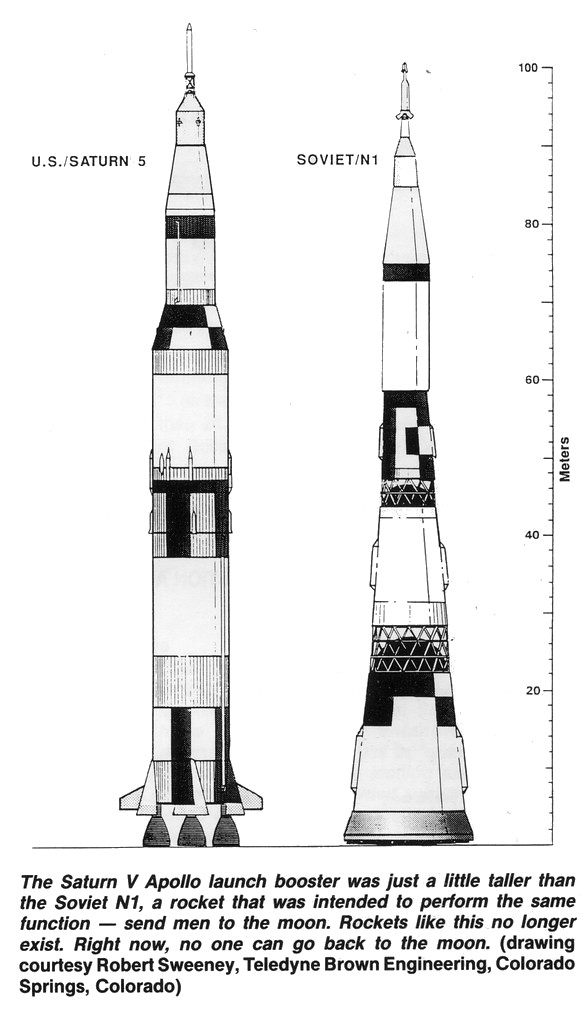
Comparison between The United States Saturn V and the Soviet N-1. Credit: Griffith Observer, the magazine of Griffith Observatory.
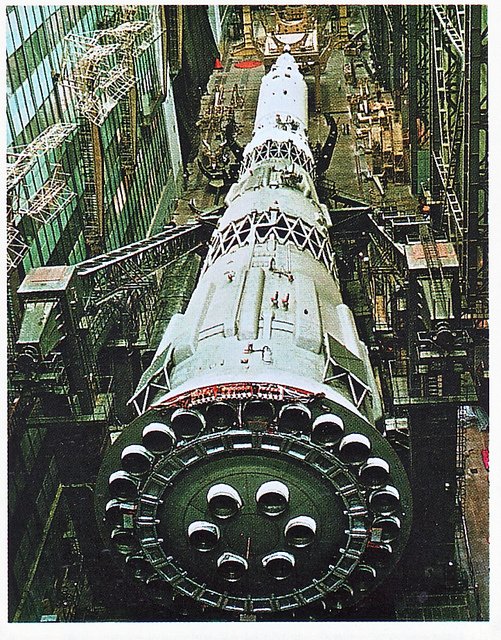
Base of the N-1 and its 36 rocket engines. The N-1 is assembled horizontally while the Saturn V was assembled vertically.
 Bob Moler's Ephemeris Blog