Archive
Ephemeris: 06/21/2024 – Saturn’s rings are almost edge-on this year
This is Ephemeris for Friday, June 21st. Today the Sun will be up for 15 hours and 34 minutes, setting at 9:32, and it will rise tomorrow at 5:57. The Moon, at full today, will rise at 9:57 this evening.
Saturn’s rings change their aspect or their tilt to us over a period of nearly 30 years, the time it takes Saturn to orbit the Sun. Saturn has an axial tilt like the Earth does in its case it is 27° compared to the Earth’s 23 1/2 degrees. So as Saturn moves around the Sun and us we see those rings at different tilts to us. Currently, the angle of the rings to us is nearing zero degrees, meaning that they are going edge on to us. And being perhaps less than 100 meters thick, they will disappear entirely in telescopes from the Earth. That will happen on March 23rd next year. However, they will not go edge on to the Sun until May 6th. So between March 23rd and May 6th we will be we will be looking at the unlit or dark side of the rings. Since we’re not at in line with the Sun and Saturn, the Sun will still be illuminating the rings slightly, but we will be looking at the dark side of the rings.
The astronomical event times given are for the Traverse City/Interlochen area of Michigan (EDT, UT–4 hours). They may be different for your location.
Addendum
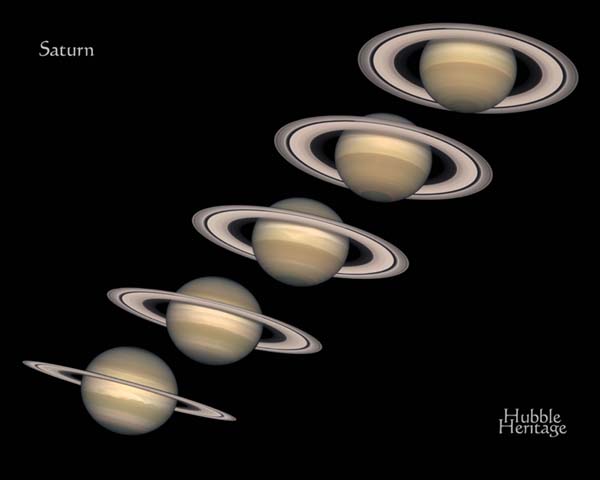
Ephemeris: 01/16/2024 – Watch Saturn’s rings continue to narrow this year.
This is Ephemeris for Tuesday, January 16th. Today the Sun will be up for 9 hours and 12 minutes, setting at 5:29, and it will rise tomorrow at 8:15. The Moon, 1 day before first quarter, will set at 12:12 tomorrow morning.
After the Moon, the next targets for the small telescope are the planets. Saturn is getting pretty low in the southwest now so there’s only about another month when it’s really visible in steady skies. Of course Saturn has those beautiful rings which are now getting very thin and by the end of March next year they will be edge on to us and then begin to open up through the rest of 2025. One’s first impression of Saturn is generally that besides the rings it’s really tiny. It averages almost a billion miles from the Earth, and even though it’s the second-largest planet it looks very tiny at that distance. Saturn’s largest moon Titan can be seen near the planet it is the second-largest moon in the solar system.
The astronomical event times given are for the Traverse City/Interlochen area of Michigan (EST, UT –5 hours). They may be different for your location.
Addendum
Ephemeris: 08/29/2023 – Saturn’s rings disappear every 15 years
This is Ephemeris for Tuesday, August 29th. Today the Sun will be up for 13 hours and 23 minutes, setting at 8:25, and it will rise tomorrow at 7:02. The Moon, 1 day before full, will set at 6:05 tomorrow morning.
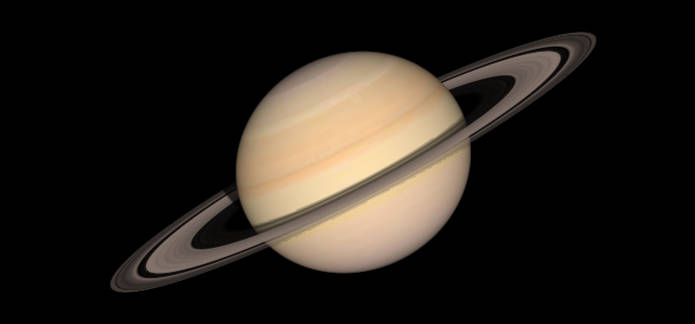
As seen in even low powered telescopes Saturn’s rings are visible. Currently, the rings are closing towards that edge on point which will they reach on March 23rd 2025 and then begin to open up again. The rings orbit Saturn’s equator, and Saturn has a nearly 27 degree inclination of its axis to its orbit, like the Earth’s 23 1/2 degrees and that means that near the equinoxes Saturn’s rings turn out to be nearly edge on to the Sun and the Earth, since we orbit much closer to the Sun than Saturn. Near the solstices on Saturn the rings are open to their widest extent. This occurs about 7 ½ years after the rings go edge on, and 7 ½ years before the next time. The next time the rings go edge on Saturn will be too close to the direction of the Sun to spot, but when they do go edge-on, they disappear. They are 150,000 miles in diameter and less than 70 feet thick.
The astronomical event times given are for the Traverse City/Interlochen area of Michigan (EDT, UT –4 hours). They may be different for your location.
Addendum
Ephemeris: 08/28/2023 – Observing Saturn’s rings
This is Ephemeris for Monday, August 28th. Today the Sun will be up for 13 hours and 26 minutes, setting at 8:26, and it will rise tomorrow at 7:01. The Moon, 2 days before full, will set at 4:38 tomorrow morning.
The most striking feature of the planet Saturn are its rings. It is not the only planet with rings. Jupiter Uranus and Neptune all have rings, plus some asteroids. And at least one Kuiper belt objects has rings, but Saturn has the grandest of all the ring systems. The broad rings are easily seen in small telescopes. They are labeled A, B and C, A being the outermost of the bright rings B is the center most and C is just barely seen inside the B ring. The diameter of these rings to the outside of the A ring is 150,000 miles, a bit more than the average distance from the Earth to our Moon, and a little less than 70 feet thick so when they go edge on to us as they do about every 15 or so years they completely disappear.
The astronomical event times given are for the Traverse City/Interlochen area of Michigan (EDT, UT –4 hours). They may be different for your location.
Addendum
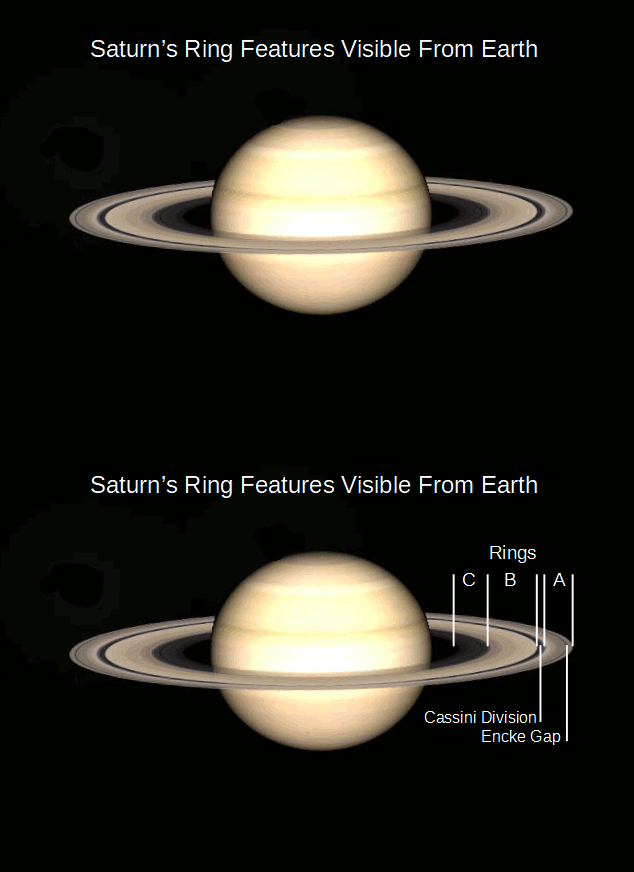
Saturn’s rings are much more complex than what can be seen in a small telescope. Observing Saturn through a small telescope, the A and B rings are evident, though the Cassini Division, of nearly 5,000 miles in width, may be elusive. The C, or Crêpe, ring is very hard to see, and is best seen as a dusky shadowlike feature against the planet. This image of Saturn was created by Stellarium, annotations were created in LibreOffice Draw, assembled and output using GIMP.
More on Saturn’s rings tomorrow.
08/06/2020 – Ephemeris – Looking at Saturn through a small telescope
This is Bob Moler with Ephemeris for Thursday, August 6th. Today the Sun will be up for 14 hours and 25 minutes, setting at 9:01, and it will rise tomorrow at 6:36. The Moon, 3 days past full, will rise at 10:55 this evening.
The planet Saturn is just to the left or east of Jupiter in the southeastern evening sky. In steadily held binoculars Saturn is not star-like, but it’s not round either. It’s a small oval dot. The oval or ellipse is due to its rings of small icy bodies that orbit the planet over its equator. A telescope in needed to appreciate those rings to their fullest extent. Saturn’s largest moon Titan will be visible tonight in line with the eastern extent of the rings. Saturn, like the Earth has an axial tilt. In its case it’s 26 degrees. And the rings orbit over Saturn’s equator. So as Saturn orbits the Sun in it’s nearly 30 year orbit the aspect of the rings change over that period. The ellipse shape of the rings are getting thinner now, and in 5 years they will be seen to disappear for a bit.
The event times given are for the Traverse City/Interlochen area of Michigan. They may be different for your location.
Addendum
How the appearance of the rings change as Saturn orbits the Sun. The rings were at their widest in 2017. They are closing and will be edge-on again in 2025. When edge-on the rings literally disappear. Despite being 150,000 miles wide as we look at the planet, they are generally less than 66 feet (20 meters) in thickness. Credit: NASA Hubble.
07/06/2017 – Ephemeris – Saturn will appear near the Moon tonight
Ephemeris for Thursday, July 6th. Today the Sun will be up for 15 hours and 25 minutes, setting at 9:29, and it will rise tomorrow at 6:05. The Moon, 3 days before full, will set at 5:02 tomorrow morning.
The waxing gibbous Moon and the planet Saturn will appear together tonight. They are said to be in conjunction. The brightness of the Moon may make it hard to pick out Saturn which is right under the Moon by about seven Moon diameters. The Moon is very bright in binoculars or a telescope and looking at it destroys the dark adaption in the eye or eyes that look at it, at least for a while. So when viewing both Saturn and the Moon, concentrate of Saturn first. In a telescope Saturn’s rings are glorious. With a good telescope and enough magnification one might see the split in the rings, just inside the outer edge of them called Cassini’s Division, after it’s discoverer. The large moon Titan is off the western extremity of the rings tonight.
The times given are for the Traverse City/Interlochen area of Michigan. They may be different for your location.
Addendum
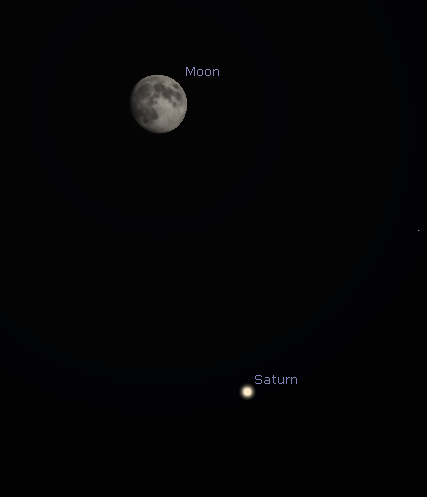
The Moon and Saturn at 10:30 p.m., July 6, 2017, as it would be seen from northern Michigan. Created using Stellarium.
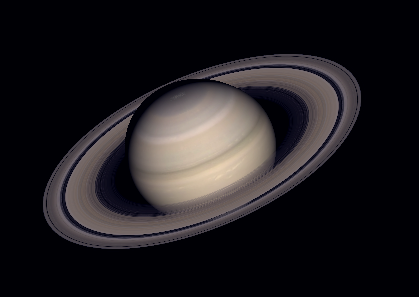
Saturn and its rings with Cassini’s Division. Created using Stellarium.
Ring particles at the distance of Cassini’s Division from Saturn orbit the planet twice in the time the satellite Mimas, nicknamed the Death Star, orbits the planet once. Ring particles are thus tugged by Mimas’ gravity away from Saturn in the same place every other orbit, which pulls them out of that particular orbital resonance.
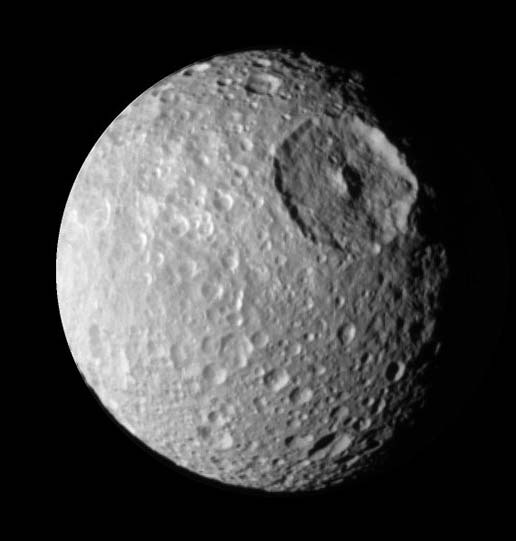
“That’s no moon!” Yes it is. Saturn’s moon Mimas, It’s diameter is 123 miles (198 km). The huge crater is named Herschel, after the moon’s discoverer William Herschel. Credit: NASA / JPL-Caltech / Space Science Institute.
05/26/2015 – Ephemeris – Saturn’s Rings
Ephemeris for Tuesday, May 26th. Today the Sun will be up for 15 hours and 11 minutes, setting at 9:15. The Moon, 1 day past first quarter, will set at 3:01 tomorrow morning and tomorrow the Sun will rise at 6:03.
The feature that makes Saturn so special are its rings. While astronomers have found rings around Jupiter Uranus and Neptune plus an asteroid, none are a grand a Saturn’s rings. Saturn’s rings are made of ice or icy particles, and have a higher reluctance (albedo) than the planet. Each of the ring particles has a separate orbit over Saturn, and the many collisions have restricted the ring particles to Saturn’s equator. While the rings are 170 thousand miles wide they are only 30 feet thick. Saturn has an axial tilt of 26 degrees close to the Earth’s 23 ½ degrees, so over Saturn’s nearly 30 year orbit of the sun, the rings go edge on about every 15 years. That last time was 2009.
Times are for the Traverse City/Interlochen area of Michigan. They may be different for your location.
Addendum
How the appearance of the rings change as Saturn orbits the Sun. Credit: NASA Hubble.
06/13/2014 – Ephemeris – Saturn’s Rings and the Cassini Division
Ephemeris for Friday, June 13th. Today the sun will be up for 15 hours and 31 minutes, setting at 9:28. The moon, at full today, will rise at 9:54 this evening. Tomorrow the sun will rise at 5:56.
Saturn rings are the wonder of the solar system. While we know that Saturn isn’t the only planet with rings. Jupiter, Uranus, and Neptune have them plus at least one asteroid. Nowhere are they as grand as at Saturn. The rings actually outshine the planet. Now they are opening to their widest extent, and will continue to open a bit more until 2017, before closing again for 7 ½ years. Last Friday during the star party at Northwestern Michigan College’s Rogers Observatory, I was able to spot the break in the rings called Cassini’s Division. It’s caused by the orbital resonance of the moon Mimas and the ring particles at that distance from Saturn. Mimas orbits Saturn once to the ring particles at the division orbiting twice.
Times are for the Traverse City/Interlochen area of Michigan. They may be different for your location.
Addendum
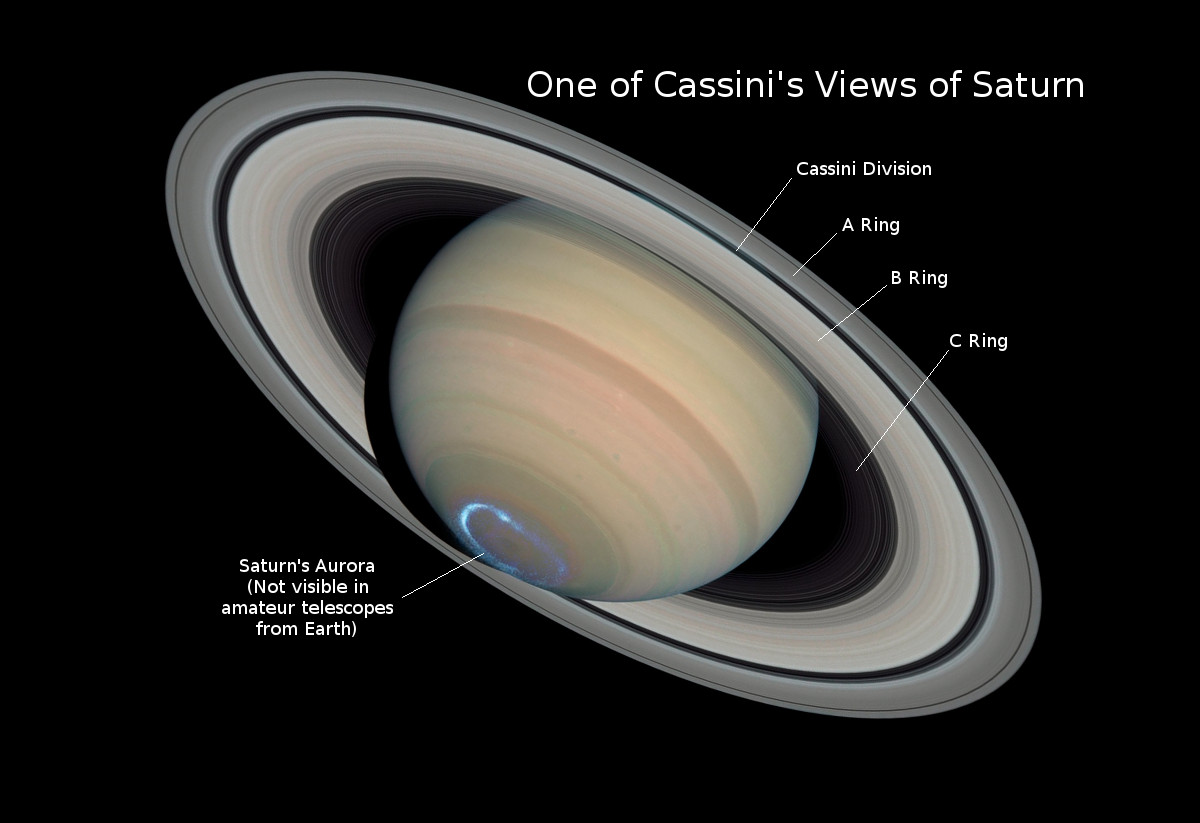
Saturn and rings from the Cassini spacecraft, plus the aurora oval in ultraviolet. Credit: NASA/JPL/Space Science Institute
06/03/2014 – Ephemeris – Observing Saturn’s rings over the years
Ephemeris for Tuesday, June 3rd. Today the sun will be up for 15 hours and 22 minutes, setting at 9:22. The moon, 2 days before first quarter, will set at 1:11 tomorrow morning. Tomorrow the sun will rise at 5:59.
The planet Saturn is now well placed to see with a telescope. It’s located in the southeast. The brightest star in that direction. It takes a telescope of only 20 power magnification to spot the rings. A bit more power and the planet can be detected apart from the rings. Most of the light reflected by Saturn comes from the rings. The rings are still opening up, and will be for the next 3 years. The rings orbit the planet over its equator, and Saturn has an axial tilt of some 26 degrees. Over Saturn’s nearly 30 year journey around the sun, its seasonal changes go from solstice when the rings are open wide, to equinox where the rings, only about 90 feet [30 meters] thick on average, seem to disappear.
Times are for the Traverse City/Interlochen area of Michigan. They may be different for your location.
Addendum
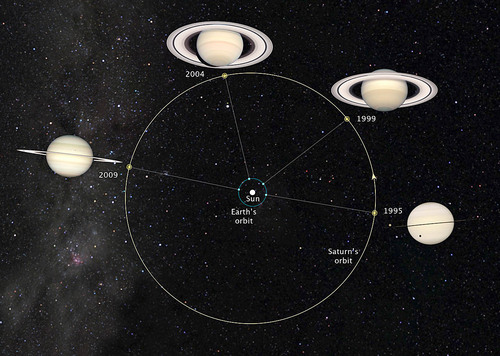
Saturn’s ring appearances over that last Saturnian half-year from the equinox in 1995 through southern hemisphere spring and summer to the equinox 2009. Illustration Credit: NASA, ESA, and Z. Levay (STScI)
05/08/2012 – Ephemeris – Observing Saturn’s Rings
Ephemeris for Tuesday, May 8th. The sun rises at 6:22. It’ll be up for 14 hours and 33 minutes, setting at 8:56. The moon, 3 days past full, will rise at 12:09 tomorrow morning.
The planet Saturn is a wonderful sight in telescopes now. In a little as 20 power a spotting scope with show Saturn’s rings, but may not distinctly separate the planet out. At 50 power the planet is easily separated from the rings. It you have a telescope with eyepieces of differing focal lengths and/or a Barlow lens that doubles the magnification of your eyepieces, you can experiment with using higher powers. I like a crisp image at lower powers rather than a fuzzy image at higher powers. Saturn’s rings are its best known feature. They are about 170 thousand miles wide and perhaps only a hundred feet thick. They aren’t solid but billions of small icy particles each orbiting Saturn at their own speed, and kept in line by collisions with its ring mates.
Times are for the Traverse City/Interlochen area of Michigan. They may be different for your location.
Addendum
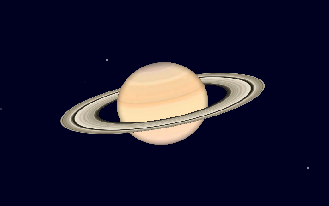
Image of Saturn created with Cartes di Ciel showing current ring tilt.
The rings as they appear from earth. The outside ring is the A ring. Then the dark Cassini’s Division, which is sometimes hard to spot. Then the broad and bright B ring. The inner C ring is hard to spot.
 Bob Moler's Ephemeris Blog