Archive
09/17/2018 – Ephemeris – The Moon Tonight and the Jade Rabbit
Ephemeris for Monday, September 17th. The Sun will rise at 7:24. It’ll be up for 12 hours and 25 minutes, setting at 7:49. The Moon, 1 day past first quarter, will set at 1:03 tomorrow morning.
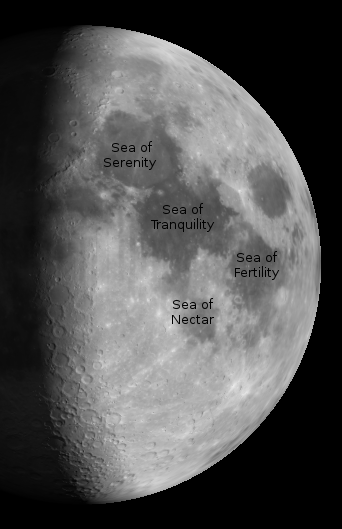
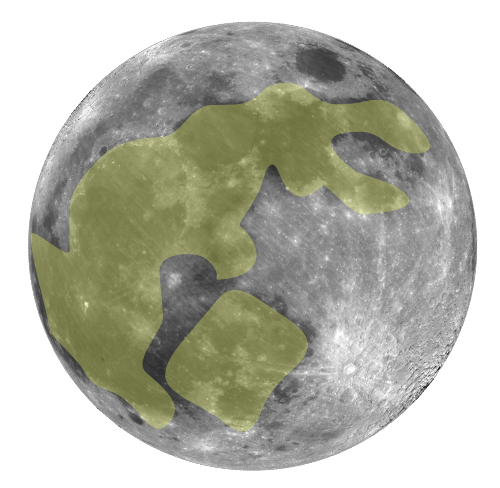
Now is a good time to point that small telescope or binoculars toward the Moon. The gray seas on the right side of the moon depict the neck, head and ears of the Jade Rabbit. It’s curled up body is on the night side of the Moon to the left. The rabbit is upside down as we see him with the naked eye or binoculars. The Sea of Serenity is the upper part of his body, the head is the Sea of Tranquility. A bay south of Tranquility and the Sea of Nectar is one ear and the Sea of Fertility is the other ear. The Jade Rabbit is related to the Chinese Mid-Autumn Festival which occurs at our Harvest Moon. It’s on September 24th this year. Another amateur astronomer and myself brought telescopes to the local festival last year to view the Jade Rabbit on the Moon.
The times given are for the Traverse City/Interlochen area of Michigan. They may be different for your location.
Addendum
09/25/2017 – Ephemeris – Lets look at the Moon tonight
Ephemeris for Monday, September 25th. The Sun will rise at 7:33 a.m. It’ll be up for 12 hours exactly, setting at 7:33 p.m. The Moon, 2 days before first quarter, will set at 10:52 this evening.
Let’s take a look at the crescent Moon tonight. It will be fairly low in the southwestern sky this evening. Four of the gray lava plains called seas are now visible in binoculars or small telescopes. Nearest the right limb of the Moon is the Sea of Crises, next nearest if the Sea of Fertility. A small sea next to that is the Sea of Nectar. Above that, mostly exposed to sunlight is the Sea of Tranquility. The Sun is just rising at Tranquility Base, where Apollo 11 landed, where the Lunar Module’s descent stage still lies, forlorn and empty. Below that is the beautiful crater Theophilus with its central peak. It is 61 miles (101 km) in diameter, and its crater walls rise over 13,000 feet (4,400 meters) above the crater floor.
The times given are for the Traverse City/Interlochen area of Michigan. They may be different for your location.
Addendum
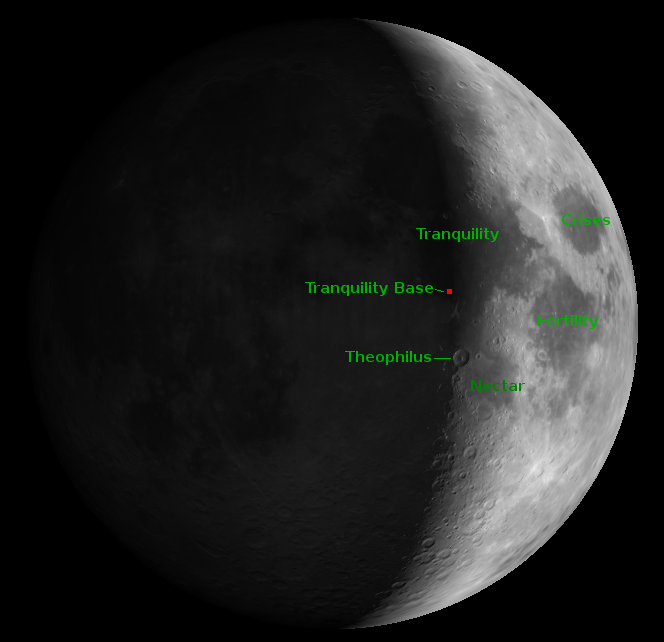
The annotated crescent moon tonight, September 25, 2017. Created using Virtual Moon Atlas. Click on the image to enlarge.
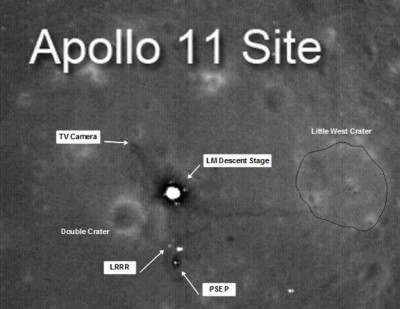
The Apollo 11 landing site in one photograph by the Lunar Reconnaissance Orbiter. There are many with varying Sun angles in the Internet. Search for: Apollo 11 LRO images. Credit NASA.
05/12/2016 – Ephemeris – The Moon tonight
Ephemeris for Thursday, May 12th. Today the Sun will be up for 14 hours and 44 minutes, setting at 9:01. The Moon, 1 day before first quarter, will set at 2:26 tomorrow morning. Tomorrow the Sun will rise at 6:16.
The moon tonight is a fat crescent. In binoculars the small Sea of Crises is prominently located as a gray patch at the edge of the moon. The Sea of Fertility is below it, while the sea of Tranquility is between them and near the terminator, the sunrise line on the moon. In telescopes there are three craters south of Tranquility, most prominent of which is Theophilus. With its prominent central peak. Farther to the north of Crises and near the partially exposed Sea of Serenity is the crater Posidonius, larger than Theophilus, but has a double crater wall on one side. Larger telescopes can see cracks in its floor . It has no central peak, and shows its age of maybe three and a half billion years.
Times are for the Traverse City/Interlochen area of Michigan. They may be different for your location.
Addendum
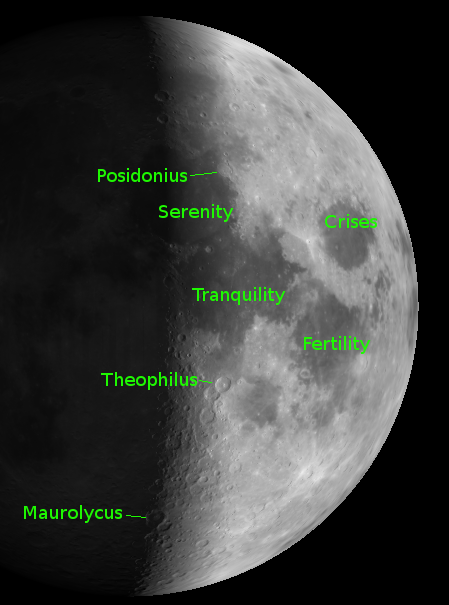
The Moon at 10 p.m. May 12, 2016. Created using Virtual Moon Atlas.
01/17/2014 – Ephemeris – The Moon tonight
Ephemeris for Friday, January 17th. The sun will rise at 8:14. It’ll be up for 9 hours and 16 minutes, setting at 5:30. The moon, 2 days past full, will rise at 7:23 this evening. | Let’s take a look at the moon as it’s still dominates the evening sky. The terminator, now that it’s after full moon is the sunset line. It is just starting to encroach on the small distinctive sea at the moon’s upper right edge called the Sea of Crises or Mare Crisium. Where is is situated on the edge of the spherical moon it appears to be elongated north to south. However if you saw it from overhead it would actually be elongated somewhat east to west. On the terminator at the moon’s equator is a large crater called Langrenus with a central peak on the edge of the Sea of Fertility or Mare Fecunditatis, that should be an easy binocular and a great telescopic crater some 80 miles in diameter. The smallest ting you can see on the moon in a small telescope is 2 miles in diameter.
Times are for the Traverse City/Interlochen area of Michigan. They may be different for your location.
Addendum
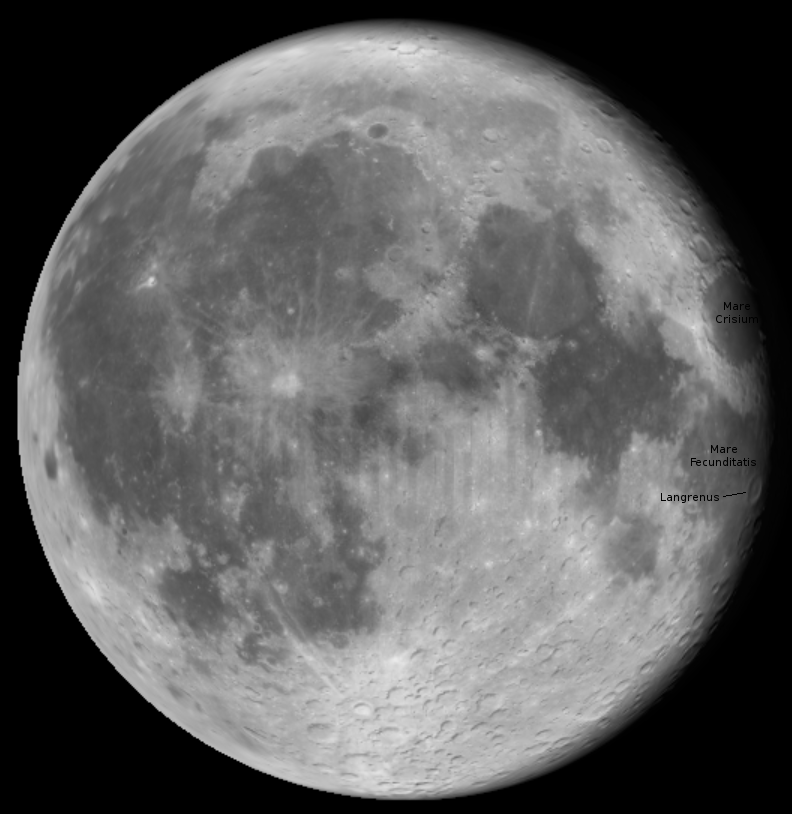
The Moon at 9 p.m., January 17, 2014. Created using Virtual Moon Atlas.
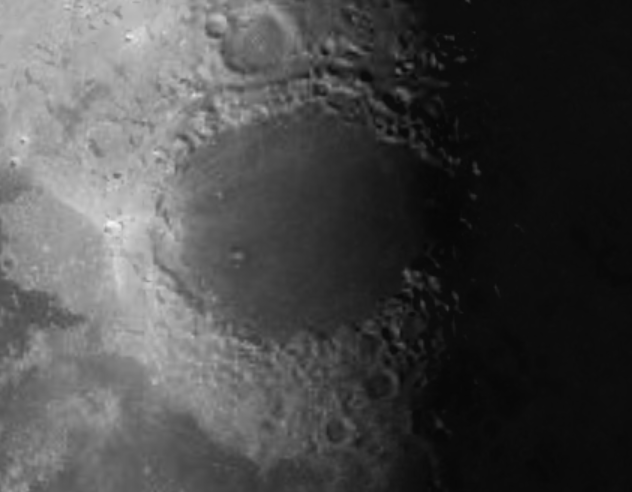
Mare Crisium as seen from overhead at 9 p.m., January 17, 2014. Created using Virtual Moon Atlas.
This last image cannot be seen without a spacecraft. The image was created using data from the Clementine spacecraft.
 Bob Moler's Ephemeris Blog