Archive
06/02/2023 – Ephemeris – A South Pole adventure and a comet collision presentation – Tonight!
This is Bob Moler with Ephemeris for Friday, June 2nd. Today the Sun will be up for 15 hours and 22 minutes, setting at 9:22, and it will rise tomorrow at 5:59. The Moon, 1 day before full, will set at 5:14 tomorrow morning.
An Antarctic Odyssey: Winter-Over at South Pole Station will be the presentation by John W. Briggs, via Zoom, at tonight’s meeting of the Grand Traverse Astronomical Society at Northwestern Michigan College’s Rogers Observatory at 9 pm. John was a team member building a 24-inch infrared telescope and related experiments that were set up at the South Pole in time for him and colleagues to observe the July 1994, explosive crash of fragmented comet Shoemaker-Levy 9 into the planet Jupiter. There are two ways to attend: In person at the observatory, south of Traverse City on Birmley Road, or via Zoom with a link provided by the society’s website gtastro.org just prior to the meeting.
The astronomical event times given are for the Traverse City/Interlochen area of Michigan (EDT, UT –4 hours). They may be different for your location.
Addendum

About the Program
An Antarctic Odyssey: Winter-Over at South Pole Station
A presentation via Zoom by John W. Briggs
Abstract:
In a lavishly illustrated presentation, John W. Briggs of New Mexico will describe his year-long experience living at the Geographic South Pole while working for the Center for Astrophysical Research in Antarctica. In preparation for this at Yerkes Observatory of the University of Chicago, John was a team member building a 24-inch infrared telescope and related experiments that were set up at the Pole in time for him and colleagues to observe the July 1994, explosive crash of fragmented comet Shoemaker-Levy 9 into the planet Jupiter.
John weathered the “winter-over” with 26 other members of the U.S. Antarctic Program in an experience that many believe approximates what life will be like someday at a lunar or Martian outpost. Once begun, South Pole winter-over is an irreversible commitment, since the Program’s special LC-130 ski planes can’t land in the winter temperatures — in 1994, sometimes as low as 107 degrees F. below zero (with windchill, as low as -180 degrees). John will delight the audience with his perspective on the total South Pole experience — the strange natural environment, the odd social atmosphere, and the challenging, ongoing science.
12/10/2019 – Ephemeris – The Moon’s natural resource more precious than gold
Ephemeris for Tuesday, December 10th. Today the Sun will be up for 8 hours and 53 minutes, setting at 5:02 the earliest sunset, and it will rise tomorrow at 8:09. The Moon, 2 days before full, will set at 7:22 tomorrow morning.
The Moon is attracting the attention of NASA and the Chinese for crewed landings. The attraction is a natural resource the Moon has. It’s water, or rather ice. There are known water reserves in the Moon’s south polar craters, whose floors never see sunlight. That means they’re very cold. Cold traps they’re called. The Moon has a very little axial tilt so the crater floors are forever cold. They would collect water vapor from passing and colliding comets over the millennia. 10 years ago the second stage of the rocket that placed the Lunar Reconnaissance Orbiter in lunar orbit was crashed into one of the south polar craters followed by a satellite to analyze the ejecta. Water vapor was kicked up by the impact in Cabeus crater.
The times given are for the Traverse City/Interlochen area of Michigan. They may be different for your location.
Addendum
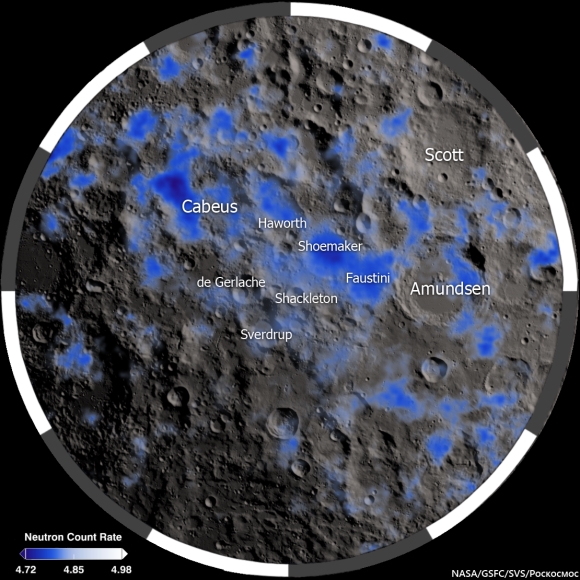
The south pole of the Moon where the presence of water ice is detected by the absorption of neutrons by the hydrogen atoms in the ice. Credit NASA/GSFC/SVS/Roscosmos.
You’ll notice that the craters on the the Moon’s south pole are named for Antarctic explorers. Besides water other volatiles were found: methane, ammonia, hydrogen gas, carbon dioxide and carbon monoxide.
04/15/2019 – Ephemeris – Why land at the Moon’s south pole?
Ephemeris for Tax Deadline Day Monday, April 15th. Today the Sun will be up for 13 hours and 28 minutes, setting at 8:27, and it will rise tomorrow at 6:57. The Moon, 3 days past first quarter, will set at 5:53 tomorrow morning.
The hottest piece of real estate on the Moon is the south pole. Unlike the Earth’s south pole and the rest of the Moon, except the north pole, there are mountain tops that are always in sunlight. The Moon has a very small axial tilt, only a degree an a half, compared to the Earth’s 23 and a half degrees which plunges the earth’s poles into a 6 month’s night. Another benefit of the small tilt is that the floors of craters at of near the poles never see sunlight, so are hundreds of degrees below zero and can be cold traps for water vapor from passing or colliding comets. Yes, thar’s water in them thar craters. It’s more valuable than gold, providing oxygen to breathe and hydrogen and oxygen for rocket fuel.
The times given are for the Traverse City/Interlochen area of Michigan. They may be different for your location.
Addendum
The south pole of the Moon where the presence of water ice is detected by the absorption of neutrons by the hydrogen atoms in the ice. Credit NASA/GSFC/SVS/Roscosmos.
01/12/2015 – Ephemeris – The world’s faorite constellation: Orion
Ephemeris for Monday, January 12th. The sun will rise at 8:18. It’ll be up for 9 hours and 6 minutes, setting at 5:24. The moon, 1 day before last quarter, will rise at 1:02 tomorrow morning.
For people the world over who look up and recognize the brighter constellations Orion is perhaps the odd on favorite. The Big Dipper, a favorite in the northern hemisphere, cannot be easily seen south of the equator. The Southern Cross cannot be easily be seen north of the equator. Orion, or parts of him can be seen from pole to pole because he straddles the equator of the sky. It has 7 bright stars like the Big Dipper, but those seven are brighter than those in the big Dipper. In the early evening Orion is seen is the southeast. The three stars of his belt now tipped diagonally from upper right to lower left. They are in the center of a left leaning rectangle of stars with bright red Betelgeuse to the upper left and bright blue-white Rigel to the lower right.
Times are for the Traverse City/Interlochen area of Michigan. They may be different for your location.
Addendum
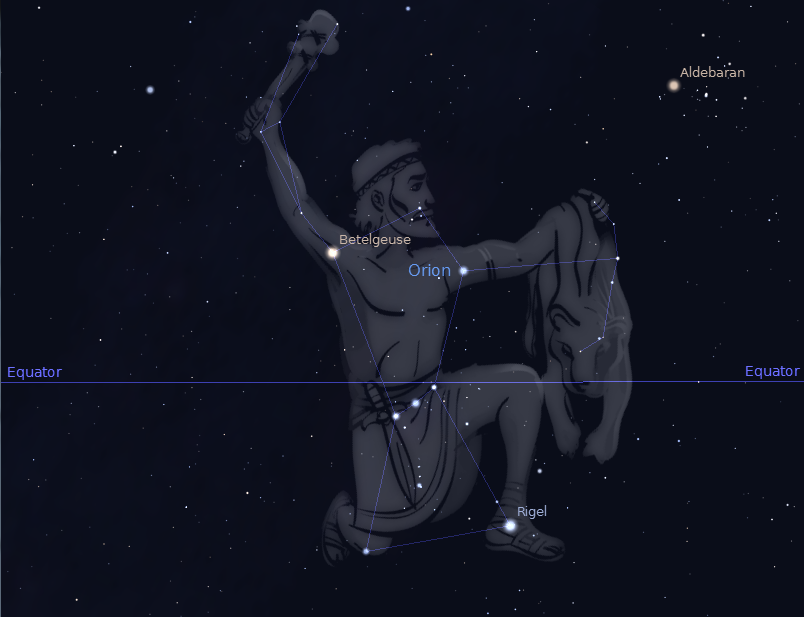
Orion from mid latitudes north of the equator. Orion would be upside down if viewed south of the equator. Created using Stellarium.
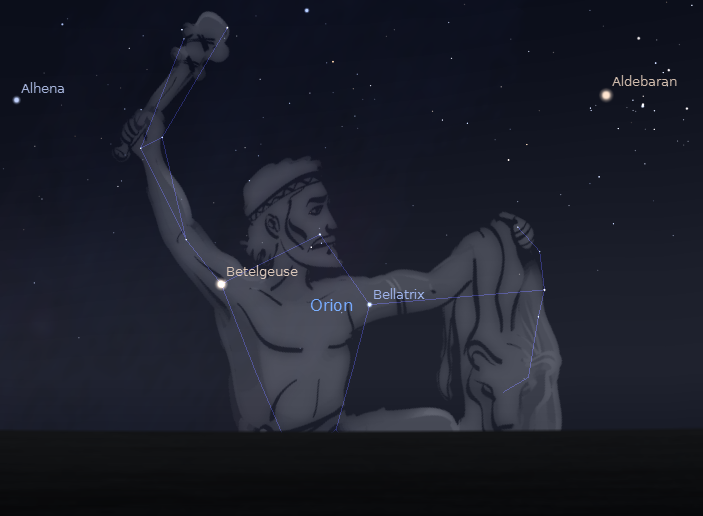
Orion from near the north pole. Created using Stellarium.
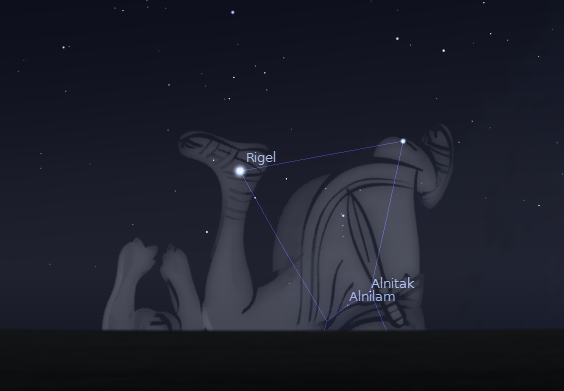
Orion from near the south pole. Created using Stellarium.
 Bob Moler's Ephemeris Blog