Archive
Ephemeris: 12/23/2025 – An alternate possibility of the Star of Bethlehem
This is Bob Moler with Ephemeris for Tuesday, December 23rd. Today the Sun will be up for 8 hours and 48 minutes, setting at 5:06, and it will rise tomorrow at 8:18. The Moon, halfway from new to first quarter, will set at 8:40 this evening.
Many writers of the early church place Jesus’ birth around 2 BC, which had to be before Herod the Great’s death, which I suggest was in 1 BC marked by a total lunar eclipse, rather than the 4 BC partial lunar eclipse, normally accepted. In 3 and again in 2 BC there were star-like conjunctions or apparent joining of the planets Jupiter and Venus against the backdrop of the constellation of Leo the Lion. A lion is related to Judah, son of Jacob by a blessing the latter gave his sons in Genesis. The first conjunction occurred in the morning sky of August, 3 BC. In June the next year the two planets got together again, in the evening sky, just after Jesus would have been born in the lambing season, when shepherds would be guarding their flocks at night.
The astronomical event times given in this blog are for the Traverse City/Interlochen area of Michigan (Lat 44.7° N, Long 85.7° W; EST, UT – 5 hours) unless stated otherwise. Times will be different for other locations.
Addendum
Ephemeris: 12/22/2025 – The most popular astronomical explanation for the Star of Bethlehem
This is Ephemeris for Monday, December 22nd. Today the Sun will be up for 8 hours and 48 minutes, setting at 5:05, and it will rise tomorrow at 8:18. The Moon, 3 days past new, will set at 7:30 this evening.
This year we have a bright evening Christmas star, Jupiter in the east. But what about the one described in the Bible, in the Gospel of Matthew? We will look today at the first of two events that may have been recorded as the Star of Bethlehem. In 7 BCE there was a rare event over 6 months when three times the planet Jupiter passed Saturn against the stars of the constellation Pisces. Could the Persian astrologer priests, called Magi, have read into the event enough significance to start the journey to Jerusalem in search of the newborn King of the Jews? It was the scribe’s readings that sent them to Bethlehem. Jupiter, Saturn and Pisces all may have had significance to the Magi.
The astronomical event times given in this blog are for the Traverse City/Interlochen area of Michigan (Lat 44.7° N, Long 85.7° W; EST, UT – 5 hours) unless stated otherwise. Times will be different for other locations.
Addendum
Ephemeris: 12/24/2024 – Looking at another possibility for the Star of Bethlehem
This is Ephemeris for Christmas Eve, Tuesday, December 24th. Today the Sun will be up for 8 hours and 48 minutes, setting at 5:07, and it will rise tomorrow at 8:18. The Moon, 2 days past last quarter, will rise at 3:10 tomorrow morning.
Many writers of the 2nd and 3rd centuries CE place Jesus’ birth, via Roman events, around 2 BCE. So the Star of Bethlehem could appear several years later than the triple conjunction of Jupiter and Saturn in 7 BCE that’s been popular. In 3 and again in 2 BCE there were star-like conjunctions or apparent joining of the planets Jupiter and Venus against the backdrop of the constellation of Leo the Lion. A lion is related to Judah, son of Jacob, by a blessing the latter gave his 12 sons in Genesis. The first conjunction occurred in August in the morning sky. On June 16th of the next year the two planets got together again, this time in the evening sky, a month or more after Jesus would have been born in the vulnerable spring lambing season when shepherds would most likely be out at night guarding the flocks, not December 25th.
The astronomical event times given are for the Traverse City/Interlochen area of Michigan (EST, UT – 5 hours). Times will be different for other locations.
Addendum
An edited excerpt from this year’s Star of Bethlehem presentation I gave to the Grand Traverse Astronomical Society on December 6th.
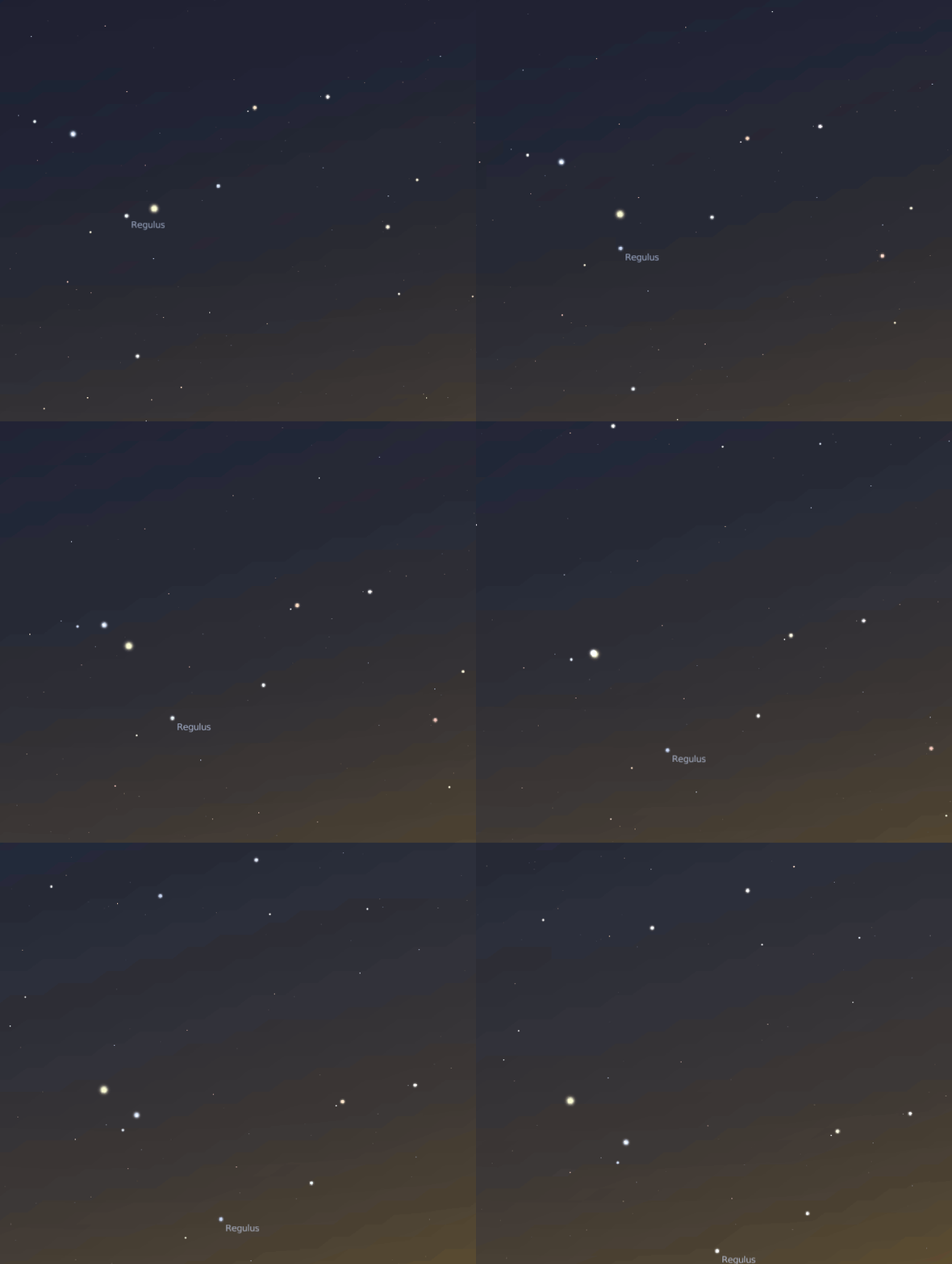
The triple conjunction of Jupiter and Saturn in 7 BCE is the generally accepted Star of Bethlehem, with Jesus being born in 6 or 5 BCE and Herod’s death being in 4 BCE after a lunar eclipse. What if the lunar eclipse in question was in 1 BCE? If so, there is that other possibility. It involves the constellation Leo, which is a lion. There is a passage in Genesis in which Jacob, who, by this time, is called Israel, is blessing his sons, each the heads of the twelve tribes of Israel. In Genesis 49 9-10 He compares him to a lion cub, the king of beasts, from whom the leaders of Israel will come. We can make a connection between Judah and the celestial lion, Leo. Let’s take a look at the celestial happenings against the constellation of Leo with Jupiter and Venus in 3 and 2 BCE.
On August 12th of 3 BCE Jupiter and Venus appeared to come together so close as to be separable only in telescopes. This may have been the Star at its rising mentioned to Herod. Could this predawn celestial mating of Jupiter, who the Babylonians saw as the god Marduk and Venus as Ishtar, the goddess of fertility, to bring forth a powerful king? The Magi, I’m pretty sure, would have known that 10 months later, a little longer than the human gestation period, by the way, that the two planets would again come together.
Ten months after the first conjunction of Jupiter and Venus, perhaps as the Magi neared Jerusalem, they saw Jupiter and Venus approaching each other again. Later as they left Herod’s palace on the evening of June 16th, 2 BCE the conjunction was at its tightest. They saw the “Star” again, as Matthew relates. Telescopes, which wouldn’t be invented for another sixteen hundred years, could have seen this extremely close conjunction of Jupiter and Venus. Venus, near its greatest eastern elongation from the Sun, would appear half illuminated. But even to the best naked eye observer, Jupiter and Venus would merge into a single star. Venus was much brighter than Jupiter than it appears here. In fact, it was nearly twelve times brighter, so Jupiter’s added brightness wouldn’t contribute much to the combined brightness. Jupiter would seem to disappear at their closest.
Also, there was a conjunction of Jupiter with the “Little King” star Regulus on September 14th 3 BCE, one or two days after the beginning of the Jewish New Year. Was this another sign that a new King of the Jews would be born? It is actually the first of three conjunctions Jupiter has with Regulus in the next 9 months. Yes, another triple conjunction. Jupiter passed Regulus the second time on February 17, of 2 BCE and for a final time on May 9th. During this time Venus had moved back toward the Sun and entered the evening sky where Jupiter met it once again.
Ephemeris: 12/06/2024 – Historical search for the Star of Bethlehem tonight
This is Ephemeris for Friday, December 6th. Today the Sun will be up for 8 hours and 56 minutes, setting at 5:02, and it will rise tomorrow at 8:06. The Moon, 2 days before first quarter, will set at 10:31 this evening.
Tonight at 8 p.m. I will be giving a talk investigating what the Star of Bethlehem may have been. This will be at Northwestern Michigan College’s Rogers Observatory located south of Traverse City on Birmley Road. The talk is a scientific treatment of the matter, rather than a religious one. We’ll look at the usual suspects for what the star may have been. And we’ll see what the Gospel writers may have gotten right and possibly wrong. We’ll look at historical writings and recorded Chinese observations of the heavens around that time. I will augment this with computer simulations of what might be important celestial events visible around that time. There is no admission charge. There will be viewing of the skies afterward if it’s clear.
The astronomical event times given are for the Traverse City/Interlochen area of Michigan (EST, UT – 5 hours). Times will be different for other locations.
Addendum
Ephemeris: 12/19/2024 – Jupiter is our bright evening Christmas star but what about 7 BC?
This is Bob Moler with Ephemeris for Tuesday, December 19th. Today the Sun will be up for 8 hours and 48 minutes, setting at 5:04, and it will rise tomorrow at 8:16. The Moon, at first quarter today, will set at 1:06 tomorrow morning.
This year Jupiter is our bright evening Christmas star. But what about the one described in the Bible, in the Gospel of Matthew? We will look today at the first of two events that may have been recorded as the Star of Bethlehem. In 7 BC there was a rare event over 8 months when three times the planet Jupiter passed Saturn against the stars of the constellation Pisces. Could the Persian astrologer priests called Magi, have read into the event enough significance to start the journey to Jerusalem in search of the newborn King of the Jews? It was the scribe’s readings that then sent them to Bethlehem. It is thought that Pisces was associated with the Hebrews, Jupiter with the Messiah or world ruler, and Saturn with the peoples of Palestine.
The astronomical event times given are for the Traverse City/Interlochen area of Michigan (EST, UT –5 hours). They may be different for your location.
Addendum
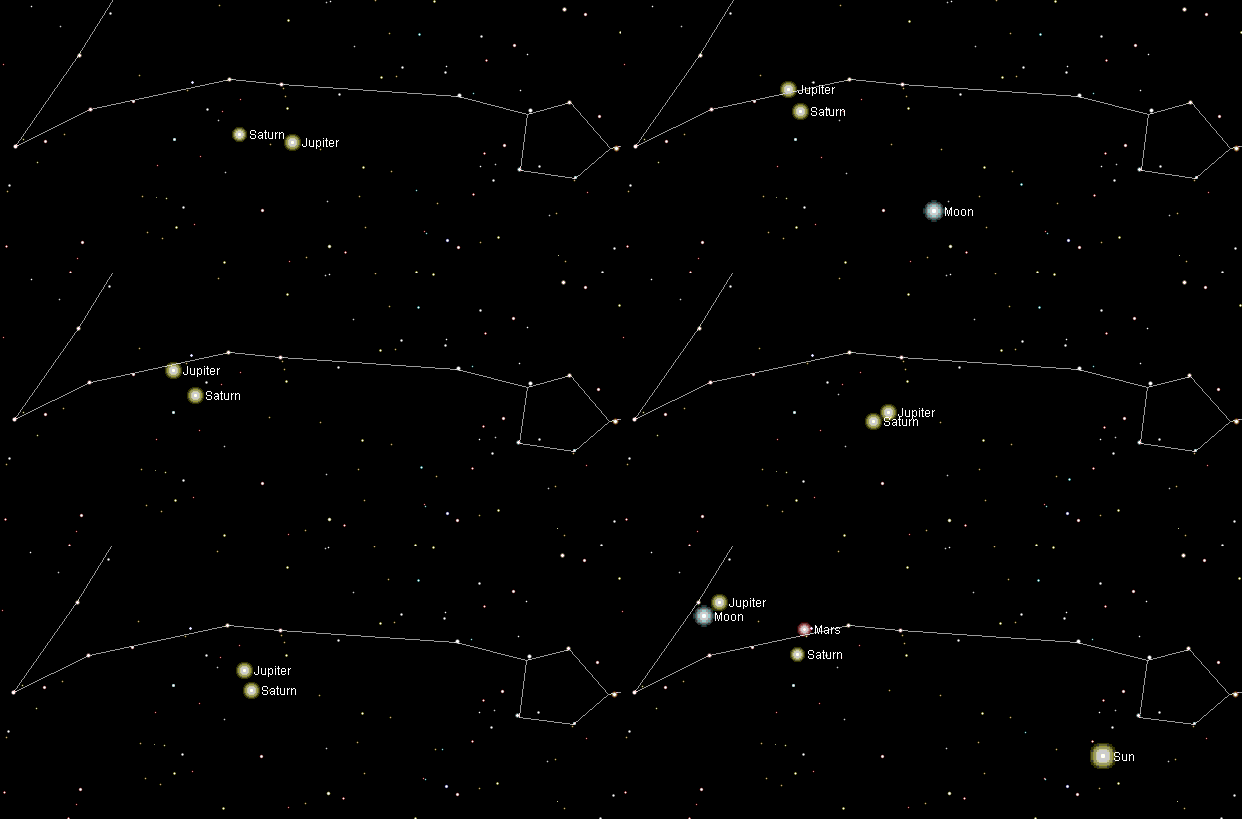
The normal motion of the sun, moon and planets in the sky is to the east, or to the left in this diagram. Jupiter takes a bit less than 12 years to orbit the sun while Saturn takes a bit less than 30 years, so Jupiter will pass Saturn about every 20 years. However, when they are both at opposition of the sun when they do that and closest to the earth, they will appear to move backwards for a time. This is called retrograde motion from their normal eastward motion. Jupiter being closest to us and closer to the Earth’s speed makes a bigger retrograde loop than Saturn does. So when they’re both at opposition when they cross paths we get a triple conjunction like this.
12/23/2022 – Ephemeris – Hunting for the Star of Bethlehem: Venus and Jupiter appear to merge… twice!
This is Ephemeris for Friday, December 23rd. Today the Sun will be up for 8 hours and 48 minutes, setting at 5:06, and it will rise tomorrow at 8:18. The Moon is new today, and won’t be visible.
My favorite astronomical solution to the puzzle of the Star of Bethlehem are two conjunctions of Jupiter and Venus that occurred against the stars of the constellation of Leo the lion 10 months apart on August 12th 3 BCE and June 16th 2 BCE. Leo at that time was associated with Jacob’s son Judah and the land of Judea. The first conjunction occurred in morning twilight. The second in the evening. The first conjunction was close, though someone with excellent eyesight might pick them apart, but the second, would be impossible to separate without a telescope, which wouldn’t be invented for another 16 centuries. And Jesus would have been born in the spring during lambing season when shepherds would have been out all night with their flocks, protecting them. The eclipse that Herod died after would have been on January 10th, 1 BCE, which occurred three months before Passover, enough time for all the palace intrigue* to happen between the lunar eclipse and Passover.
The astronomical event times given are for the Traverse City/Interlochen area of Michigan (EST, UT –5 hours). They may be different for your location.
* See yesterday’s post for more information here.
Addendum
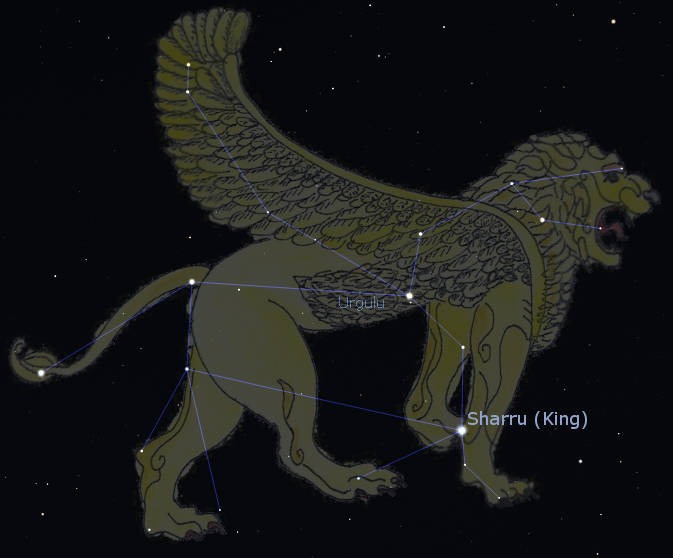
The Babylonian concept of the constellation Leo. They called it Urgulu, meaning lion. It represented their god Latarak. The star they called Sharru, meaning King we know as Regulus, which is the diminutive of king.
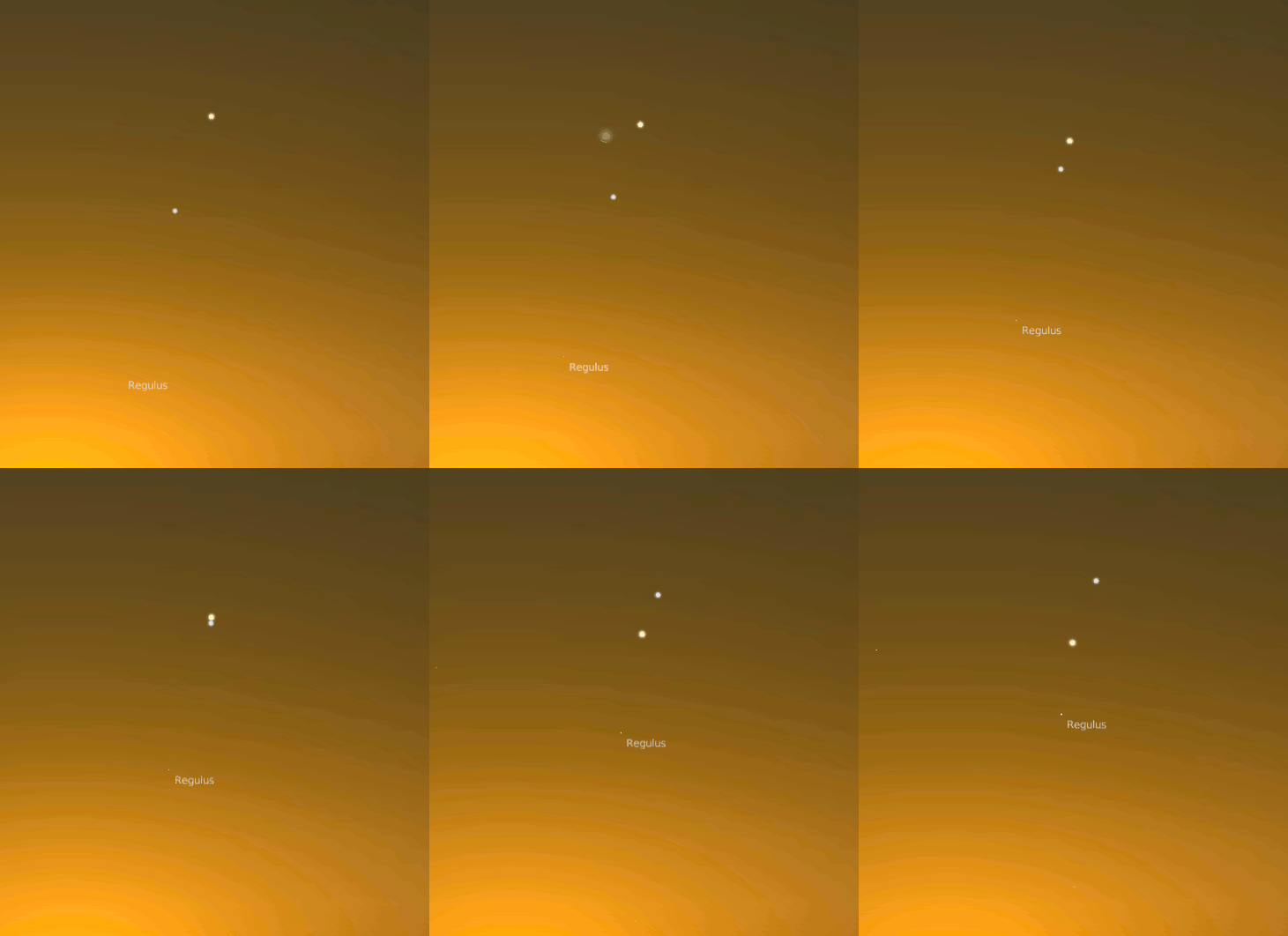
Here is an animation created using Stellarium of Jupiter and Venus, the brighter of the two seeming to coalesce on August 12, 3 BC in the early morning twilight. That ghost object that flashed on for one date was the Moon. Created using Stellarium and GIMP.
On June 16th 2 BC, this time in the evening, Venus and Jupiter seem to coalesce as one, at least to the naked eye. Created using Stellarium and GIMP.
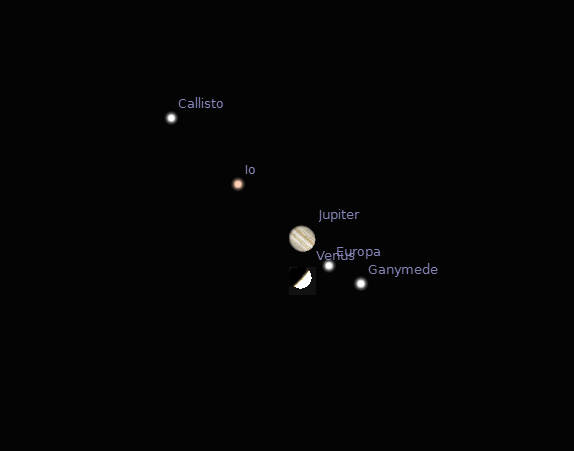
Venus appeared among Jupiter’s moons on June 16, 2 BC. Of course, no one had a telescope back then. The telescope wouldn’t be invented for another 16 centuries. Stellarium cannot create the real brightness difference between Jupiter and Venus. Venus would be simply dazzling compared to Jupiter, being 12 times brighter. Venus, being an inner planet, shows phases like the Moon. At this time, Venus would have been near its greatest eastern elongation or separation from the Sun, so it would appear as a tiny first quarter moon. Galileo discovered that Venus had phases and orbited the Sun, in the early 17th century. Created using Stellarium.
Merry Christmas!
12/22/2022 – Ephemeris – Hunting for the Star of Bethlehem: When did Herod the Great Die – Part 2
This is Ephemeris for Thursday, December 22nd. Today the Sun will be up for 8 hours and 48 minutes, setting at 5:05, and it will rise tomorrow at 8:17. The Moon, 1 day before new, will rise at 8:56 tomorrow morning.
According to the Gospel of Matthew, Jesus was born in the last years of the reign of Herod the Great, and the Jewish historian Josephus puts Herod’s death shortly after an eclipse of the Moon. There may have been an error in the Josephus history that has been propagated since the middle of the 16th century, that when corrected shifts the eclipse in question forward three years to 1 BCE. The conjunctions of Jupiter and Saturn of 7 BCE would be four years too early. Under this scenario, Jesus would have been born in the spring of 2 BCE, the time of year when shepherds would indeed be out at night with their flocks, because this was lambing season. What the Magi would have seen was, on two occasions, the planets Venus and Jupiter appear to merge into a single star.
The astronomical event times given are for the Traverse City/Interlochen area of Michigan (EST, UT –5 hours). They may be different for your location.
Addendum
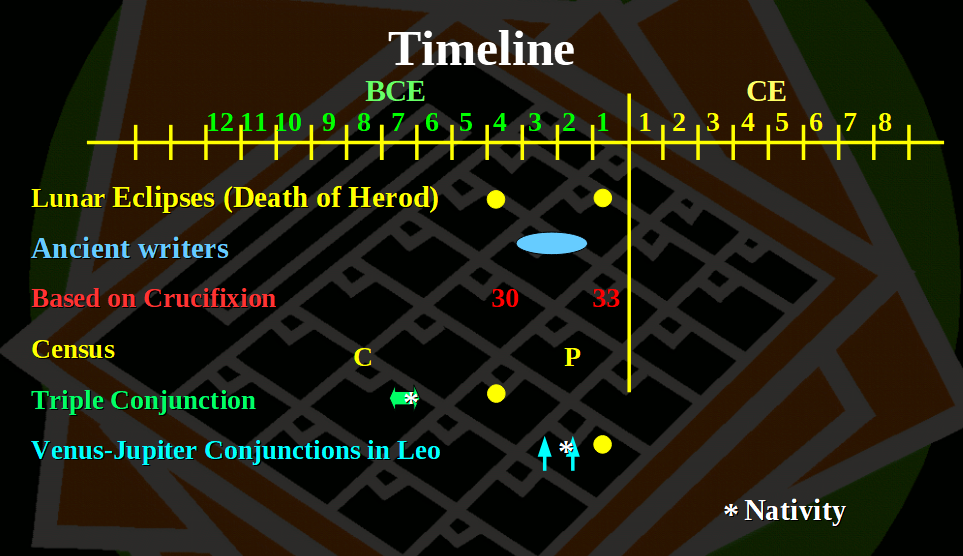
This is a timeline I developed of the events surrounding the Birth of Jesus. On the top line in yellow are the two eclipses of the Moon that occurred in the time period we’re interested in: 4 BCE and 1 BCE. One of then was the eclipse Josephus mentions that occurred shortly before the death of Herod the Great, who was alive to greet the Magi, who came to Jerusalem seeking the newborn King of the Jews. The second line highlights 3 and 2 BCE that the early Christian writers Irenaeus, Tertullian and Clement of Alexandria based Jesus’ birth year to Roman events which can be pegged to the Roman Calendar which has a direct relationship to our own calendar. The next line contains hits based on the Crucifixion of Jesus at age 33, where the Last Supper was a Seder on the first day of Passover. The next line with C and P are two censuses of Augustus in our time period. The next to the last line shows the relation of the triple conjunction in 7 BCE with Jesus’ birth and Herod’s death. The bottom line related the two Venus-Jupiter conjunctions with Jesus’ birth and Herod’s death.
Where the lunar eclipse of March 13 of 4 BCE was a slight partial eclipse. The lunar eclipse of January 10 of 1 BCE was total, which occurred three or four months before Passover. Herod’s death and the chaos that ensued, according to Josephus, before Passover also means the March 13, 4 BCE eclipse, occurring 1 month before Passover does not provide the length of time for all these events to transpire:
- Josephus mentions an eclipse of the moon.
- Herod went beyond the river Jordan to the warm baths at Callirrhoe by the Dead Sea.
- He knew he was near death as the treatments failed, so he returned to Jericho.
- Before he did, he had his soldiers paid a bonus.
- He ordered all the principal men of the Jews to meet with him under penalty of death. Those who did come, were imprisoned at the Hippodrome to be killed upon his death.
- Herod then attempted suicide.
- Herod’s son Antipater attempted to take the throne, and was executed.
- Five days later, Herod died.
- Herod had bequeathed the kingdom to another son, Archlaus, who then organized the funeral for Herod.
- The funeral procession could have taken up to 25 days.
- Then there were 7 days of mourning after that.
- Archlaus sent his generals to Caesar on his behalf to have him declared King.
- The people were beginning to demand lighter taxes and the release of those whom Herod had imprisoned.
- At that point, Josephus mentioned that Passover was approaching.
- Finally, it was Passover.
Obviously, all these events could not be squeezed into one 29 to 30 lunar month in 4 BCE. Defenders of the 4 BCE death of Herod would say that the Passover mentioned was the next year’s Passover, giving 12 or 13 months for the events to occur. In that case, why mention Passover at all?
Missing from the timeline above is Luke’s mention of Quirinius being Governor of Syria. However, there is a problem. Luke states the at the time of Jesus’ birth that Quirinius was Governor of Syria. The problem is that he wasn’t Governor of Syria until 6 and 7 CE, at least 8 years after the events of the Nativity. And the question of who was Governor of Syria wouldn’t have mattered until 6 CE, when Judea actually became part of the Province of Syria. In the period we’re looking at, Quintilius Varus was Syria’s governor. Could the two names be switched due to a copyist error? Anyway, this was before Judea became part of Syria, so it wouldn’t have mattered who was governor of Syria when Jesus was born. Luke’s account is not much help in dating the year of Jesus’ birth.
Tomorrow, I’ll finish up with the two conjunctions of Jupiter and Venus against the stars of Leo, which was the celestial sign of Judah and the land of Judea.
12/20/2022 – Ephemeris – Hunting for the Star of Bethlehem: When did Herod the Great Die – Part 1
This is Ephemeris for Tuesday, December 20th. Today the Sun will be up for 8 hours and 48 minutes, setting at 5:04, and it will rise tomorrow at 8:16. The Moon, 3 days before new, will rise at 6:20 tomorrow morning.
In looking for the year Jesus was born and the appearance of the Star of Bethlehem, we look to the latter years of Herod the Great’s reign. Jewish historian Josephus recounts that Herod died shortly after an eclipse of the Moon occurred. The date of that eclipse, according to many historians, was March 13th, of 4 BCE and before Passover, a month later. The Greek text of Matthew states that Herod’s visitors, looking for the newborn King of the Jews, were Magi. Magi were priest-astrologers of the Zoroastrian Religion of Persia. That being the case, the Star could have been the triple conjunction of Jupiter and Saturn against the constellation of Pisces, when three times Jupiter passed Saturn between the end of May and early December of 7 BCE.
The astronomical event times given are for the Traverse City/Interlochen area of Michigan (EST, UT –5 hours). They may be different for your location.
Addendum
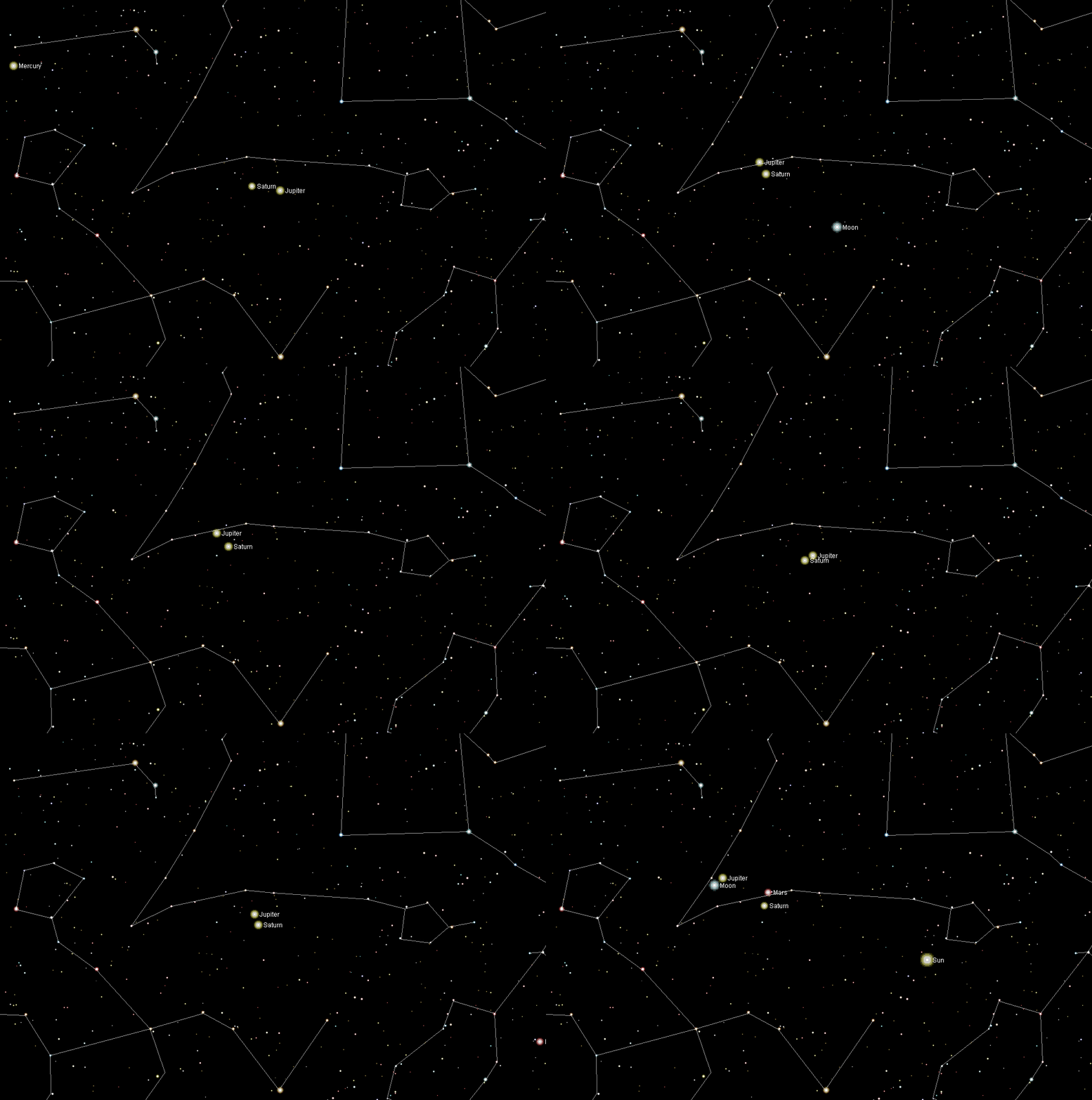
The Jupiter-Saturn triple conjunction of 7 BC. Click on the image to enlarge and animate. This animation is at 5-day intervals. The conjunctions took place against the stars of Pisces the fish, a constellation thought, in those days, to be associated with the Jews. The Moon will be popping in and out of the view. It ends in February of 6 BC, when Mars and the Moon enters the picture. Click on the image to enlarge it. Created using Cartes du Ciel and GIMP.
Above is an animation of the triple conjunction of Jupiter and Saturn of 7 BCE in 5 day steps. The body popping in and frame is the Moon. The first conjunction was on May 29th. Both planets stopped their eastward motion around July 6th. Astrologically, they became stationary and began their westward or retrograde motion. The second conjunction was on October 11th. Both planets stopped their westward or retrograde motion on November 1st. Again they were stationary to resume their normal eastward motion. The third and last conjunction was on December 8th. Two months later, on February 21st, of 6 BCE, Mars joined the group as they all move off to the western sky in the evening. Using this triple conjunction as the Star of Bethlehem, Jesus would have been born in the late autumn of 7 BCE or early winter of 6 BCE.
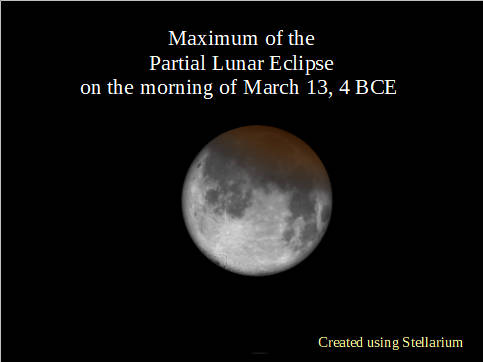
This lunar eclipse candidate for the eclipse that heralded the death of Herod the Great, and the favorite, since the time of Johannes Kepler, is the lunar eclipse of March 13, 4 BCE. It was a partial eclipse, only visible in the predawn hours. This eclipse occurred one lunar month before Passover.
Too little time for all the events Josephus describes. A better lunar eclipse occurred a bit less than three years later. Those defending the 4 BCE eclipse sometimes suggest that the Passover mentioned by Josephus was the next year’s Passover of 3 BCE. If it was the next year’s Passover, why mention Passover at all?
Tomorrow I’ll take a break to look to the naked eye planets, and to the winter solstice. Winter begins tomorrow! Thursday I’ll look to a better lunar eclipse and begin to explore another Bethlehem Star candidate.
12/19/2022 – Ephemeris – Hunting for the Star of Bethlehem: What it wasn’t
This is Ephemeris for Monday, December 19th. Today the Sun will be up for 8 hours and 48 minutes, setting at 5:04, and it will rise tomorrow at 8:16. The Moon, 3 days past last quarter, will rise at 4:59 tomorrow morning.
In these last days before Christmas, I’d like to explore what in the sky could have been the Star of Bethlehem from an astronomical point of view. If it had to do with the arrangement of planets, tracing back two thousand years would be simple. If it was some sudden appearance of an actual star or comet, we would have to rely on contemporary accounts. Those would have to come from the Chinese and Koreans. The state of astronomy around the Mediterranean and the Middle East was pretty stagnant due to the fact that they thought that the heavens were perfect and changeless, so things like comets and novae or “New Stars” meant change, so were not really part of the heavens. So we must look for something more mundane.
The astronomical event times given are for the Traverse City/Interlochen area of Michigan (EST, UT –5 hours). They may be different for your location.
Addendum
Probably the first person to kick off the search for the Star of Bethlehem was Johannes Kepler. (These are slides from this year’s Searching for the Star of Bethlehem presentation I gave to the Grand Traverse Astronomical Society. The captions are from the text of the presentation)
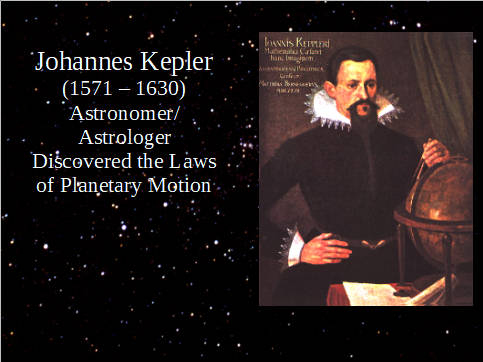
The search for the Star really started with Johannes Kepler, who lived from 1571 to 1630. He was an astronomer, although he cast horoscopes for the odd prince or duke, which is how he made a living. His mother was even charged for being a witch, but nothing came of it. And after much trial and error discovered his Three Laws of Planetary Motion. His story is a fascinating one.
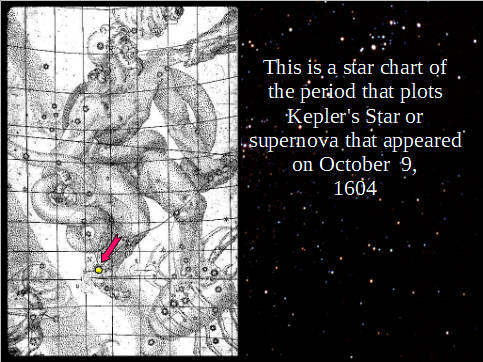
Kepler also discovered a supernova, the last one seen in the Milky Way. This is an old star chart that records Kepler’s Star,
a supernova, or super bright new star, he discovered on October 9, 1604. I colored it yellow and have an arrow pointed to it, in Ophiuchus’ right ankle.
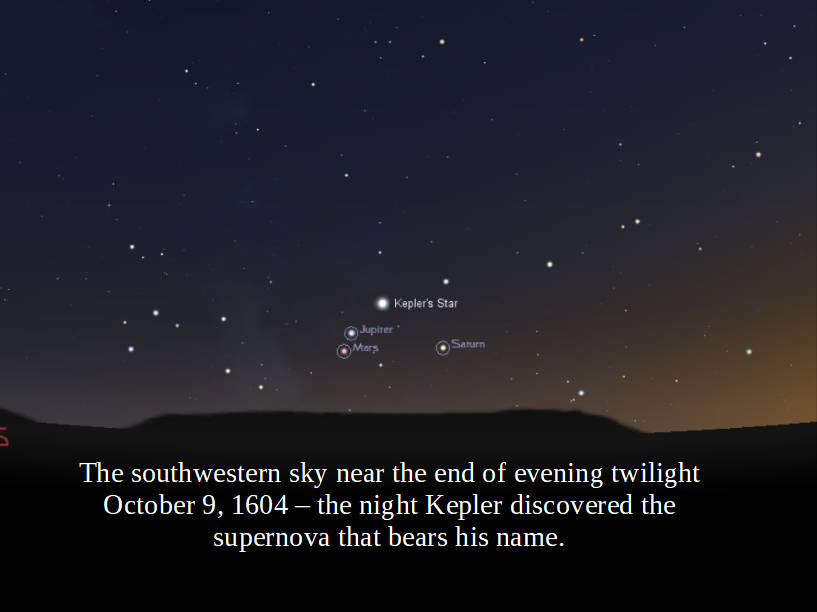
Here is a Stellarium recreation of the sky the night of his discovery. It’s the southwestern sky near the end of evening twilight, October 9, 1604, the night Kepler discovered the supernova that bears his name. It got him to thinking, could a similar grouping of a nova and planets be the Star of Bethlehem?
He knew of no nova being reported back then, though no one in the western world probably would have. That would be a change in the officially changeless heavens, so it couldn’t possibly have been a real heavenly object. And being the mathematical genius he was, (he did discover the Three Laws of Planetary Motion), found a very interesting conjunction of Jupiter and Saturn, with Mars piling on later, that occurred in 7 BCE. (Click on the image to enlarge it.)
12/02/2022 – Ephemeris – Astronomical events tonight and tomorrow in Traverse City
This is Ephemeris for Friday, December 2nd. Today the Sun will be up for 9 hours and 2 minutes, setting at 5:03, and it will rise tomorrow at 8:02. The Moon, 2 days past first quarter, will set at 3:07 tomorrow morning.
We have a big astronomy and space weekend starting tonight at 8 pm I’ll be giving a talk about the Star of Bethlehem at Northwestern Michigan College’s Rogers Observatory located south of Traverse City on Birmley Road, with observing at 9 pm, clouds permitting. This is part of the December meeting of the Grand Traverse Astronomical Society. Tomorrow is NASA Family Day at the Dennos Museum Center. There are fun activities at 1 pm, making comets and exploring the phases of the Moon. At 2 pm, Dr. Jerry Dobek from NMC and the GTAS will be giving a talk at the Milliken Auditorium. Museum admission is waived for the event, which is to celebrate the Museum’s having a NASA Kiosk through the end of the month.
The astronomical event times given are for the Traverse City/Interlochen area of Michigan (EST, UT –5 hours). They may be different for your location.
 Bob Moler's Ephemeris Blog