Archive
Ephemeris: 12/28/2023 – Next year in rockets and space
This is Ephemeris for Thursday, December 28th. Today the Sun will be up for 8 hours and 49 minutes, setting at 5:09, and it will rise tomorrow at 8:19. The Moon, 2 days past full, will rise at 6:35 this evening.
Let’s take a look at 2024 in space exploration. The Artemis 2 mission of sending a crew of four around the Moon and back will take place no earlier than November, so it could be pushed back into 2025 if there are any difficulties. SpaceX early next year will attempt the third flight of their gigantic Starship rocket. Hopefully this time it will reach near orbit. Blue Origin, sort of in competition to SpaceX, but have never put anything into orbit yet, is expected to launch their New Glenn rocket, which uses 7 BE4 engines next year. Also United Launch Alliance will be expected to launch their new Vulcan Centaur rocket, perhaps as early as January next year. It uses two Blue Origin BE4 engines as its main engines plus solid rocket boosters.
The astronomical event times given are for the Traverse City/Interlochen area of Michigan (EST, UT –5 hours). They may be different for your location.
Ephemeris: 12/26/2023 Some astronomical/space events of 2023
This is Ephemeris for Tuesday, December 26th. Today the Sun will be up for 8 hours and 48 minutes, setting at 5:07, and it will rise tomorrow at 8:19. The Moon, at full today, will rise at 4:30 this evening.
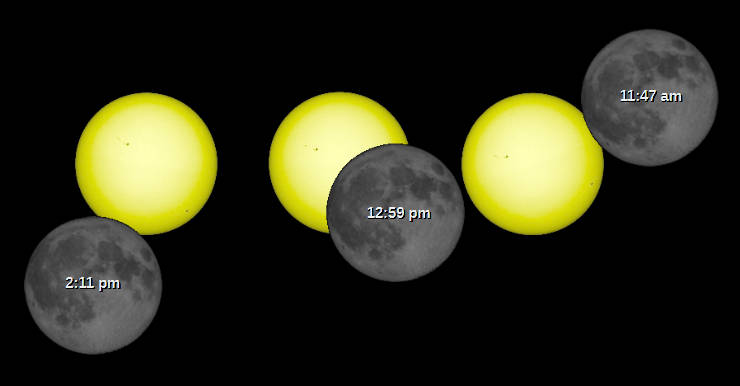
Looking back at 2023 in astronomy: an important event that was visible locally was the partial eclipse of the Sun on October 14th. For most of us it was mostly cloudy. I happened to be in Thompsonville at the Betsie Valley District Library to talk about eclipses and to view that one. We got about 15 minutes of clear skies to see the Sun near the middle of the eclipse, so it wasn’t a total washout. Of course the big event is next year on April 8th, a total solar eclipse whose path is going to be passing quite close to us. The James Webb Space Telescope astronomers have reported their first year findings, some of which have contradicted previous assumptions, or seem to have. The second of SpaceX’s Starship launches came within 4,000 kilometers an hour of achieving orbit.
The astronomical event times given are for the Traverse City/Interlochen area of Michigan (EST, UT –5 hours). They may be different for your location.
Addendum
04/20/2021 – Ephemeris – SpaceX gets NASA contract for Human Landing System for the Artemis (Moon) Program
This is Bob Moler with Ephemeris for Tuesday, April 20th. Today the Sun will be up for 13 hours and 44 minutes, setting at 8:34, and it will rise tomorrow at 6:47. The Moon, at first quarter today, will set at 4:24 tomorrow morning.
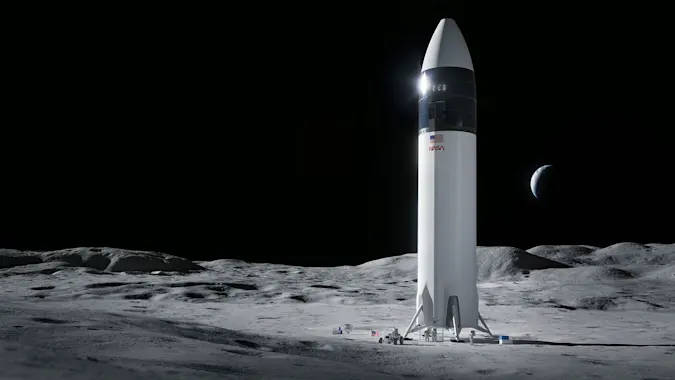
Late last week NASA announced that it had selected SpaceX to provide the Human Lander System for the Artemis program. That lander is the lunar variant of the Starship SpaceX is currently testing near Boca Chica, Texas, just north of the mouth of the Rio Grande. A Starship consists of two stages: a booster called Super Heavy and the Starship upper stage. The Super Heavy returns to the launch site, while the Starship must be refueled several times in orbit to be able to head on out to the Moon. The astronauts would be launched as planned in an Orion capsule with the Space Launch System, then transfer the astronauts to the Starship waiting in lunar orbit or from the Lunar Gateway also in lunar orbit for the trip down to the lunar surface.
The astronomical event times given are for the Traverse City/Interlochen area of Michigan. They may be different for your location.
Addendum
NASA’s Source Selection Document (the rationale for their selection): https://www.nasa.gov/sites/default/files/atoms/files/option-a-source-selection-statement-final.pdf
 Bob Moler's Ephemeris Blog