Archive
Ephemeris: 01/24/2025 – 100th anniversary of the last total solar eclipse visible in Northern Michigan
This is Ephemeris for Friday, January 24th. Today the Sun will be up for 9 hours and 31 minutes, setting at 5:40, and it will rise tomorrow at 8:08. The Moon, 3 days past last quarter, will rise at 5:22 tomorrow morning.
100 years ago this morning, Saturday, January 24th, 1925 the partial phase of a solar eclipse was already in progress as the Sun rose at 8:12 AM in the Grand Traverse region. I found no record of the weather that day, but being January, I don’t expect it was clear. So after sunrise instead of the daylight getting brighter as the Sun rose, it got darker. This was the last time Northern Michigan experienced a total solar eclipse. Totality was around 9:03 AM. After that the daylight gradually became brighter with the eclipse ending at 10:15 AM. If it was clear that morning the sight would have been spectacular with the eclipsed Sun’s corona shining low in the southeastern sky, off to the right were a group of three planets: Venus, Mercury and Jupiter in a tight line.
The astronomical event times given are for the Traverse City/Interlochen area of Michigan (EST, UT – 5 hours). Times will be different for other locations.
Addenda
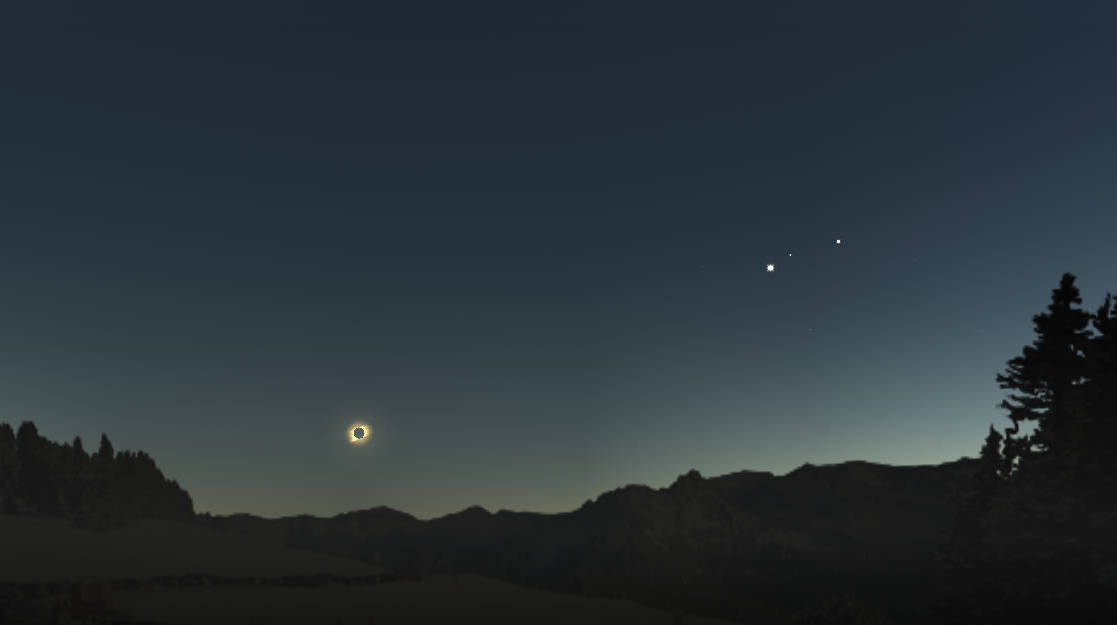
My article in this January’s Stellar Sentinel, newsletter of the Grand Traverse Astronomical Society
Last year’s total solar eclipse was fantastic. Those of us in Northern Michigan had to travel to neighboring states or even further to experience it. When was the last time that someone in Northern Michigan didn’t have to leave home to see a total solar eclipse?
That was 100 years ago this January. On the morning of Saturday, January 24th, 1925 the partial phase of the eclipse was already in progress as the Sun rose at 8:12 AM. I found no record of the weather that day, but being January, I don’t expect that it was clear. So after sunrise instead of the daylight getting brighter as the Sun rose, it got darker. Totality began at 9:02 AM, midi-eclipse was at 9:03, and totality ended at 9:04. After that the daylight gradually became brighter with the eclipse ending at 10:15 AM. And things got back to normal. If it were clear that day, it would have been a spectacular sight with the corona shining brightly around the blacked out Sun only 7° above the southeastern horizon. A little off to the right would be 3 planets: Venus, Mercury and Jupiter within 4° of each other. That scene is reproduced in the image above, created using Stellarium.
The eclipse made especially big news because the path of totality clipped New York City. In fact the northern half of Central Park got to experience totality while the southern part did not.
Most of the then 48 states of the United States got to see at least part of the eclipse, although the path of totality started in northern Minnesota, crossed northern Wisconsin, western UP, and northern lower Michigan. It went across southern Ontario and across New York State, Connecticut, Massachusetts and Rhode Island, then into the Atlantic Ocean. The path of totality ended north of Scotland. Its path of totality crossed the path of last April’s total eclipse at Niagara Falls.
As I was preparing for this article I got to thinking that I saw the total solar eclipse in Bottineau, North Dakota on February 26, 1979. The 1925 eclipse was on January 24th. A one-month difference. Subtracting 1925 from 1979 is a difference of 54 years. I had seen this eclipse before. Eclipses nearly the same character reoccur in a period of 18 years 10 or 11 1/3rd days. The period is called a saros which was discovered by the Babylonians a long time ago. The third of a day is a kicker. Each eclipse of the saros series occurs 120° in longitude west of the previous one so in three saros periods you get 360°, a whole circle, back to the same longitude again. The Greeks had a word for it, exeligmos, meaning ’turning of the wheel’.
So, when is our next chance for a stay-at-home total solar eclipse? On average any particular place on the Earth can see a total solar eclipse about once in 375 years. Traverse City will see its next total solar eclipse on October 26, 2144. That’s cheating on the average, with only 219 years, and only 120 years away If you can’t wait that long, there is a total eclipse in the UP in 2106. There is a much sooner annular eclipse visible from Northern Michigan on June 11, 2048. It’s an exeligmos from the annular eclipse that clipped the southeast corner of Michigan on May 10, 1994, which I viewed from Genoa, Ohio.
We will have a total lunar eclipse this year. Its partial phase begins just after midnight March 14th. Next year we will have another total lunar eclipse in March and a little nibble of a solar eclipse in August.
Ephemeris: 12/30/2024 – Two great astronomical events of 2024
This is Ephemeris for Monday, December 30th. Today the Sun will be up for 8 hours and 51 minutes, setting at 5:11, and it will rise tomorrow at 8:20. The Moon is new today, and won’t be visible.
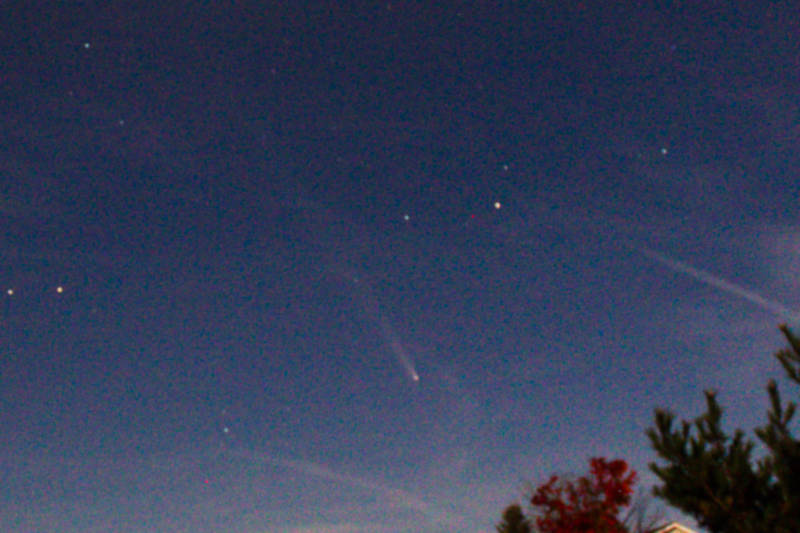
Speaking of new moons, the most spectacular astronomical event of 2024 was the total solar eclipse of April 8th. The path of totality came fairly close to us here in Northern Michigan just clipping the southeastern corner of the state. It was my sixth observation of a total solar eclipse out of six tries and probably my last, because our next total solar eclipse in the contiguous 48 states will be twenty-one years from now in 2045. The other event of 2024 was the appearance of the Comet Tsuchinshan-ATLAS which graced our skies for a few days in mid-October. I have no reports of anybody seeing it with the naked eye, however it was visible in binoculars and easily photographed with a few seconds exposure with a camera. It had a very prominent tail.
The astronomical event times given are for the Traverse City/Interlochen area of Michigan (EST, UT – 5 hours). Times will be different for other locations.
Addendum
Ephemeris: 04/16/2024 – A quick look at the April 8th 2024, total solar eclipse
This is Ephemeris for Tuesday, April 16th. Today the Sun will be up for 13 hours and 34 minutes, setting at 8:29, and it will rise tomorrow at 6:54. The Moon, 1 day past first quarter, will set at 4:42 tomorrow morning.
I saw the total solar eclipse last week Monday. This is the first chance I have to report on it. My target area ran from southwestern Indiana to Northern Ohio and decided early to stay in Lafayette IN overnight to give us a shot at going in either direction. We ended up going to southwestern Indiana to a little town called Linton, about 7 miles from the center line of the eclipse. There was relatively mild traffic going down and relatively few folks there at Humphrey’s park. Totality was glorious and the Sun’s corona was silvery and there was a red prominence sticking out of the bottom of the dark moon’s silhouette. Venus and Jupiter were also visible in the dark blue sky. I’ll have a fuller account on my blog in a few days.
The astronomical event times given are for the Traverse City/Interlochen area of Michigan (EDT, UT–4 hours). They may be different for your location.
Addendum
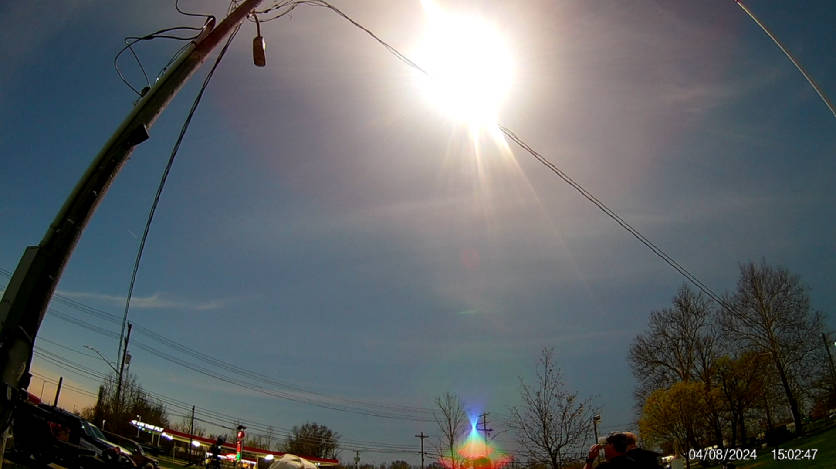
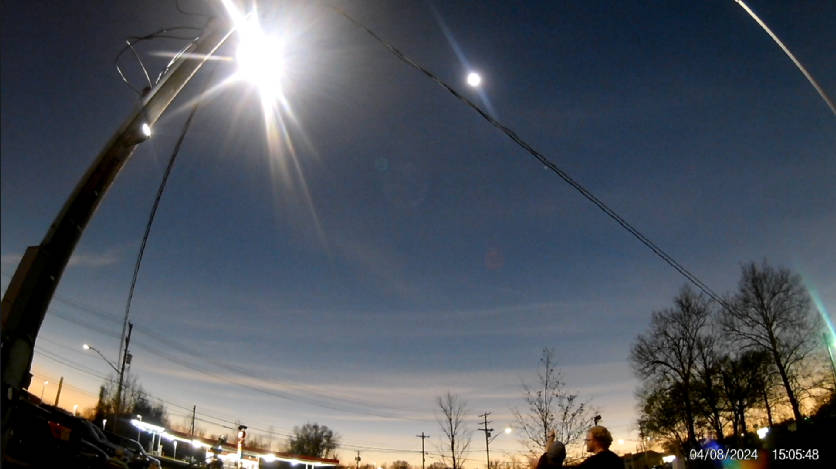
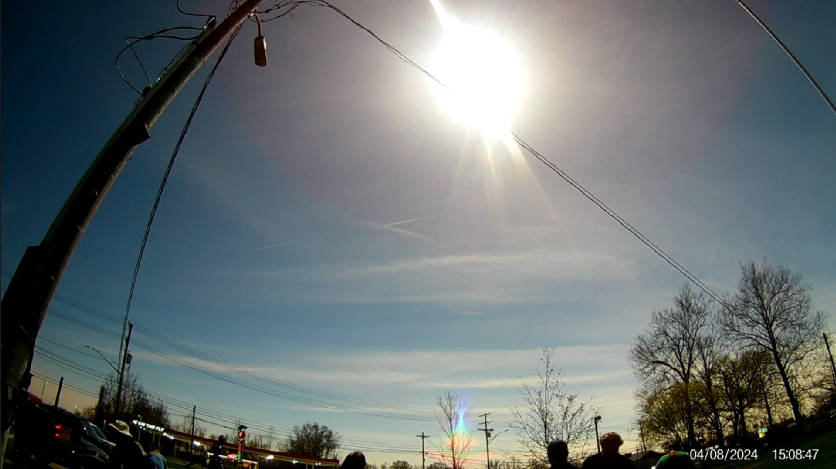
The following are three frames from the video I made with a GoPro-like camera around totality to get a view of the sky conditions. In 61 years and six total solar eclipses I spent the first four just looking at the Sun. The latter two I’ve tried to soak in the ambiance of the world around me during totality. I’ve been extremely lucky in total solar eclipses in that I was never completely clouded out. The main reason for that is mobility, and not going where everyone else is going. With these six 6 eclipses I have accumulated a total of 15 minutes basking in the shade of the Moon.
Ephemeris: 03/25/2024 – Your subsequent opportunities for total solar eclipses in the U.S. if you miss the April 8th one
This is Ephemeris for Monday, March 25th. Today the Sun will be up for 12 hours and 26 minutes, setting at 8:02, and it will rise tomorrow at 7:33. The Moon, at full today, will rise at 8:39 this evening.
The Moon was officially full at 3:00 this morning. At that time it was in a penumbral eclipse. If you didn’t see it you didn’t miss much. Deep penumbral eclipses only show that the moon has a proverbial 5 o’clock shadow. This means that for the next new moon we’ll have a total solar eclipse. It’s in exactly 2 weeks. The eclipse totality path, in the United States, will run from Texas to Maine, and through Indiana and northwestern Ohio. The next total solar eclipse for the U.S. will occur in 2044, a sunset eclipse visible from parts of Montana and North Dakota. The next great eclipse for North America and the U.S. will be on August 12th of 2045, twenty years from now. The totality path will pass from Northern California all the way through to Florida.
The astronomical event times given are for the Traverse City/Interlochen area of Michigan (EDT, UT–4 hours). They may be different for your location.
Addendum
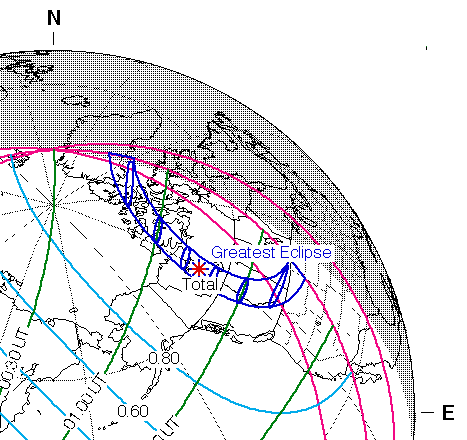
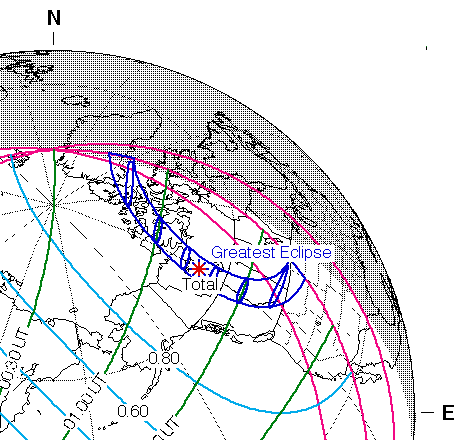
The eclipse will be visible in the area underneath the red lines. Within the dark blue lines is where totality will be visible. In United States that only includes parts of North Dakota and Montana at sunset. the funny three line teardrop in the right is where the eclipse will be in progress at sunset . Adapted from an eclipse map from NASA/GSFC, Fred Espenak.
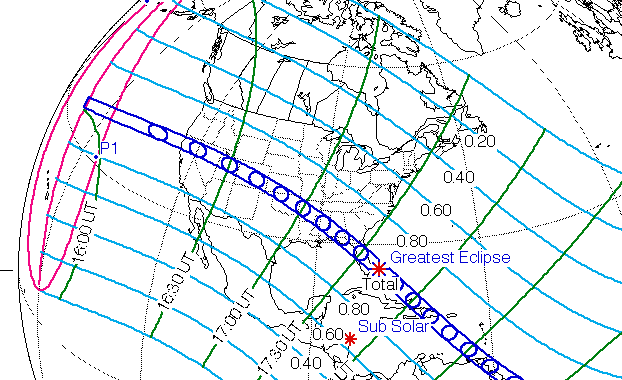
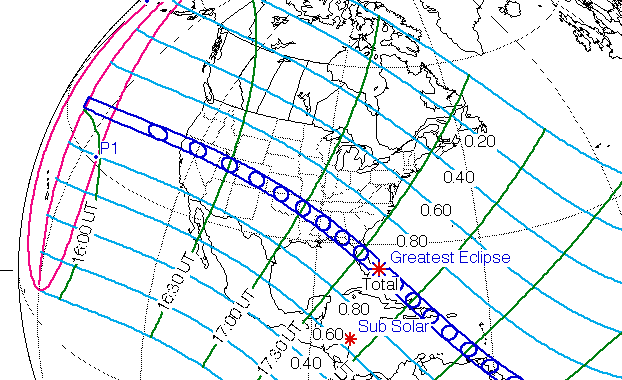
This is the next Great American Eclipse after the April 8th eclipse . The path runs from Northern California to Florida . It is generally parallel to and south of the eclipse path of the August 21st 2017 eclipse. Adapted from an eclipse map from NASA/GSFC, Fred Espenak.
Ephemeris: 02/09/2024 – Two lunar months until the total solar eclipse!
This is Ephemeris for Friday, February 9th. Today the Sun will be up for 10 hours and 9 minutes, setting at 6:02, and it will rise tomorrow at 7:50. The Moon is new today, and won’t be visible.
Today marks two lunar months before the April 8th total eclipse of the Sun. It will be partial here when nearly 90% of the Sun will be blocked by the Moon. The best place to see the total part of the eclipse is on the line from Texas through Indiana, Ohio and ending in Maine. We will not have another total eclipse visible in the continental United States until 2044 and again in 2045. The 2044 total eclipse path will only touch North Dakota and Montana at sunset, after descending south from Canada*. The eclipse of 2045 will have a path across the United States much like, but south of, the path in of the August 21st 2017 eclipse. This time passing from Northern California to Northern Florida. So it’s going to be a long drought of total solar eclipses unless one travels to other continents or go on an eclipse cruise.
The astronomical event times given are for the Traverse City/Interlochen area of Michigan (EST, UT –5 hours). They may be different for your location.
* On the radio program I have the Moon’s shadow going the other way. This is a rare eclipse where the Moon umbral shadow (the part that produces totality) starts and ends at local sunset.
Addendum
I will have Ephemeris Extra posts soon about how to observe the eclipse safely.
Ephemeris Extra: 01/02/2024 – Two remarkable astronomical events for 2024
Ephemeris Extra posts are freestanding posts not tied to a specific Ephemeris radio program on Interlochen Public Radio
Total Solar Eclipse, April 8th
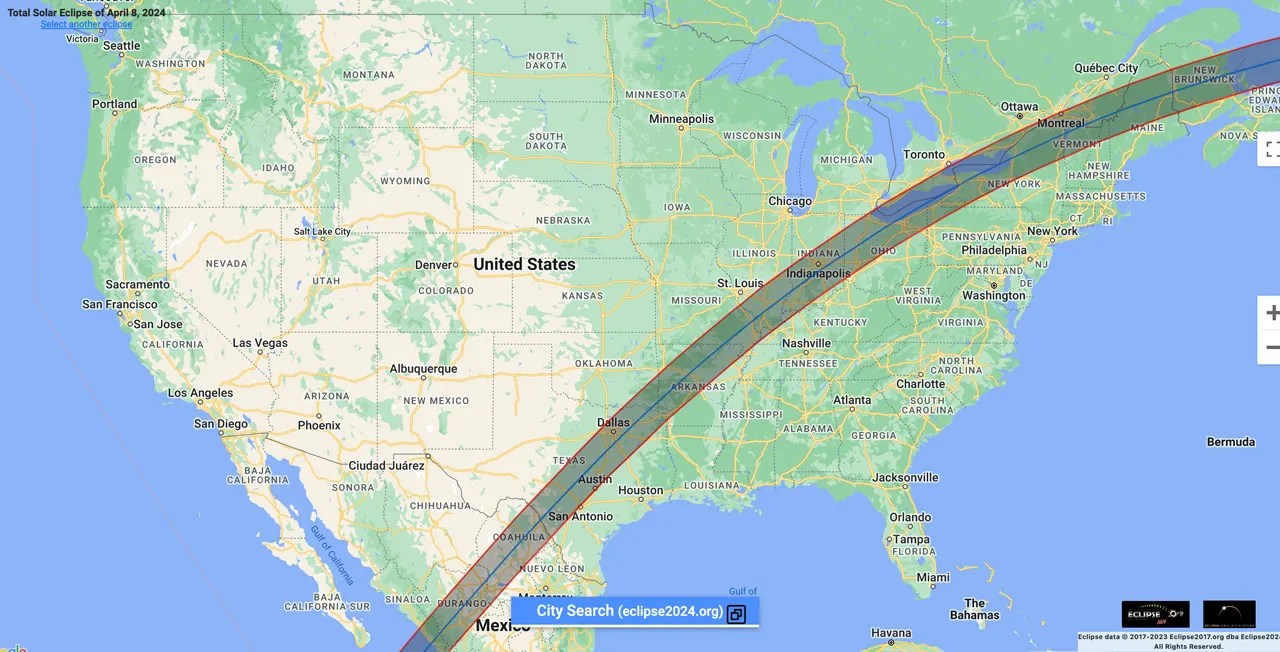
The big astronomical event of 2024, for us in Michigan, will be the total eclipse of the Sun, on the afternoon of Monday, April 8th. The path of totality will just clip the southeastern corner of Michigan by a few miles, so if you want to see the best of totality you need to leave the state. Totality is when the Moon completely covers the brilliant face of the Sun and allows the Sun’s silvery corona to be seen. Totality is the only part of the eclipse that can be viewed without eye protection or by projection.
Two relatively nearby large cities that will see totality are Indianapolis and Cleveland. Parts of Indianapolis will get to see more than 4 minutes of totality. Cleveland will see a little less. The closer you are to the center line of that path the longer totality will last.
For an interactive map of the eclipse path on the Internet, go to eclipse2024.org/eclipse_cities/statemap.html
Weather is always a concern for eclipses. In general the farther south one goes the better the chances there are for clear skies. But all bets are off for eclipse day: It’s gonna be is what it’s gonna be. My current inclination is to head southwest along the eclipse path.
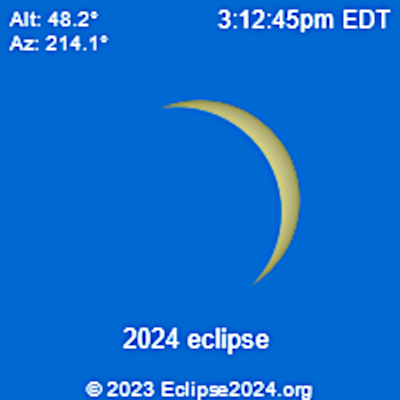
For those staying home and not chasing the shadow of the Moon will see a partial eclipse here with up to 87% of the Sun being blocked by the Moon.
Comet Tsuchinshan-ATLAS
We expect to see a new bright comet in October: C/2023 A3 (Tsuchinshan-ATLAS), otherwise known in this article as A3 for short. It may be the brightest comet to appear in our Northern Michigan skies since Comet Hale-Bopp in 1997, and a good deal brighter than 2020’s Comet NEOWISE. At least we’re hoping.
This comet was discovered last January by the station Xi Yi of the Purple Mountain Observatory in China, and a month later by the ATLAS search program on Maui. ATLAS is an acronym for the apocalyptic sounding Asteroid Terrestrial-Impact Last Alert System.
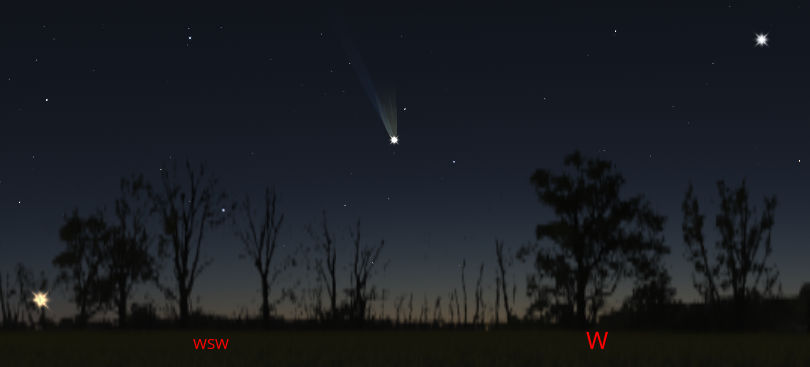
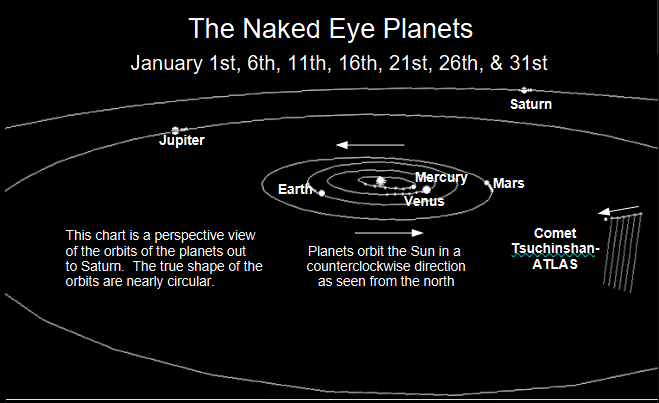
A3 will best be visible from Northern Michigan toward mid-October in the evening, not long after sunset. The comet is expected to reach magnitude 0 at it’s closest to the Sun in late September. However, we will be seeing it best as it’s leaving the vicinity of the Sun. By mid-October its magnitude will have dropped to magnitude 1 which is still pretty bright, and it will be moving at a high angle away from the setting Sun, so it will rapidly increase its distance from the Sun and the horizon faster than it fades in the latter part of October. That is, if it behaves itself. Comets are notoriously fickle in their brightness so we won’t know until we actually see it how bright it’ll be, or how bright or long its tail will be. As of this writing (Mid-December) A3’s brightness is tracking as predicted, at about 16th magnitude. As of January 1st its distance from the Sun was 4.24 AU, about 1 AU inside Jupiter’s orbit. 1 AU (Astronomical Unit) is the mean distance between the Earth and the Sun. The comet can be followed on Seiichi Yoshida’s Weekly Information about Bright Comets webpage: http://www.aerith.net/comet/catalog/2023A3/2023A3.html
Ephemeris: 12/29/2023 – Two great celestial events for 2024
This is Ephemeris for Friday, December 29th. Today the Sun will be up for 8 hours and 50 minutes, setting at 5:10, and it will rise tomorrow at 8:19. The Moon, 3 days past full, will rise at 7:43 this evening.
The year 2024 should give us two great events. The first is a total solar eclipse whose path will pass close to Michigan. It actually clip it by a few miles in the southeast corner of our state on April 8th. The eclipse will be even better here than the August 21st, 2017 eclipse by several percent. About 87% of the Sun will be covered by the Moon in Northern Michigan. In the US the path of totality will run from Texas to Maine, and will pass over the cities of Indianapolis and Cleveland. Then in October a new comet will be in our evening sky, and it might be quite bright. It’s Comet Tsuchinshan-ATLAS. If, and it’s a big IF, its brightness tracks as it has been since its discovery, nearly a year ago, it will rival the average first magnitude star, like Betelgeuse by October, and be easily visible in the west after sunset by mid-month. It won’t be as bright as Comet Hale-Bopp, for those old enough to have seen it in 1997, but hopefully brighter than Comet NEOWISE in the summer of 2020.
The astronomical event times given are for the Traverse City/Interlochen area of Michigan (EST, UT –5 hours). They may be different for your location.
Addendum
05/05/2023 – Ephemeris – Learn about the upcoming total solar eclipse tonight
This is Ephemeris for Cinco de Mayo, Friday, May 5th. Today the Sun will be up for 14 hours and 25 minutes, setting at 8:52, and it will rise tomorrow at 6:25. The Moon, at full today, will rise at 9:13 this evening.
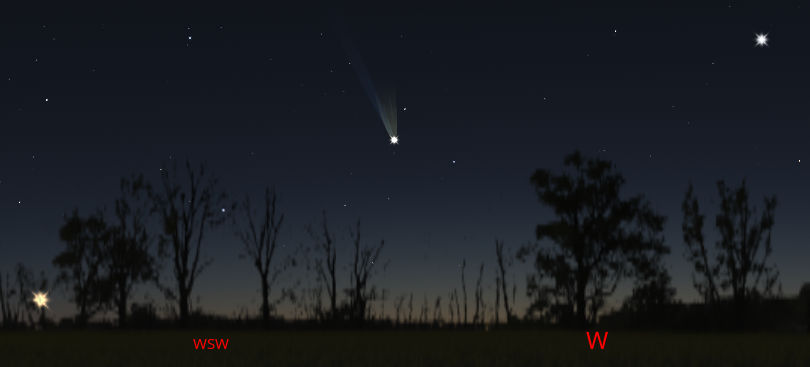
Eleven months is not too early to plan for a total solar eclipse. On April 8th next year there will be such an eclipse whose path of totality clips the southeastern corner of Michigan. Indianapolis, Toledo and Cleveland also lie in the path of totality. The path runs from Texas to Maine. Member Dan Dall’Olmo will have all the particulars at this month’s meeting of the Grand Traverse Astronomical Society, starting at 8 pm tonight at Northwestern Michigan College’s Joseph H. Rogers Observatory. For those staying home, the Sun for this eclipse will be a bit more covered by the Moon than the 2017 August solar eclipse. We’ll also have another partial solar eclipse to practice on this October 14th.
The astronomical event times given are for the Traverse City/Interlochen area of Michigan (EDT, UT –4 hours). They may be different for your location.
Addendum
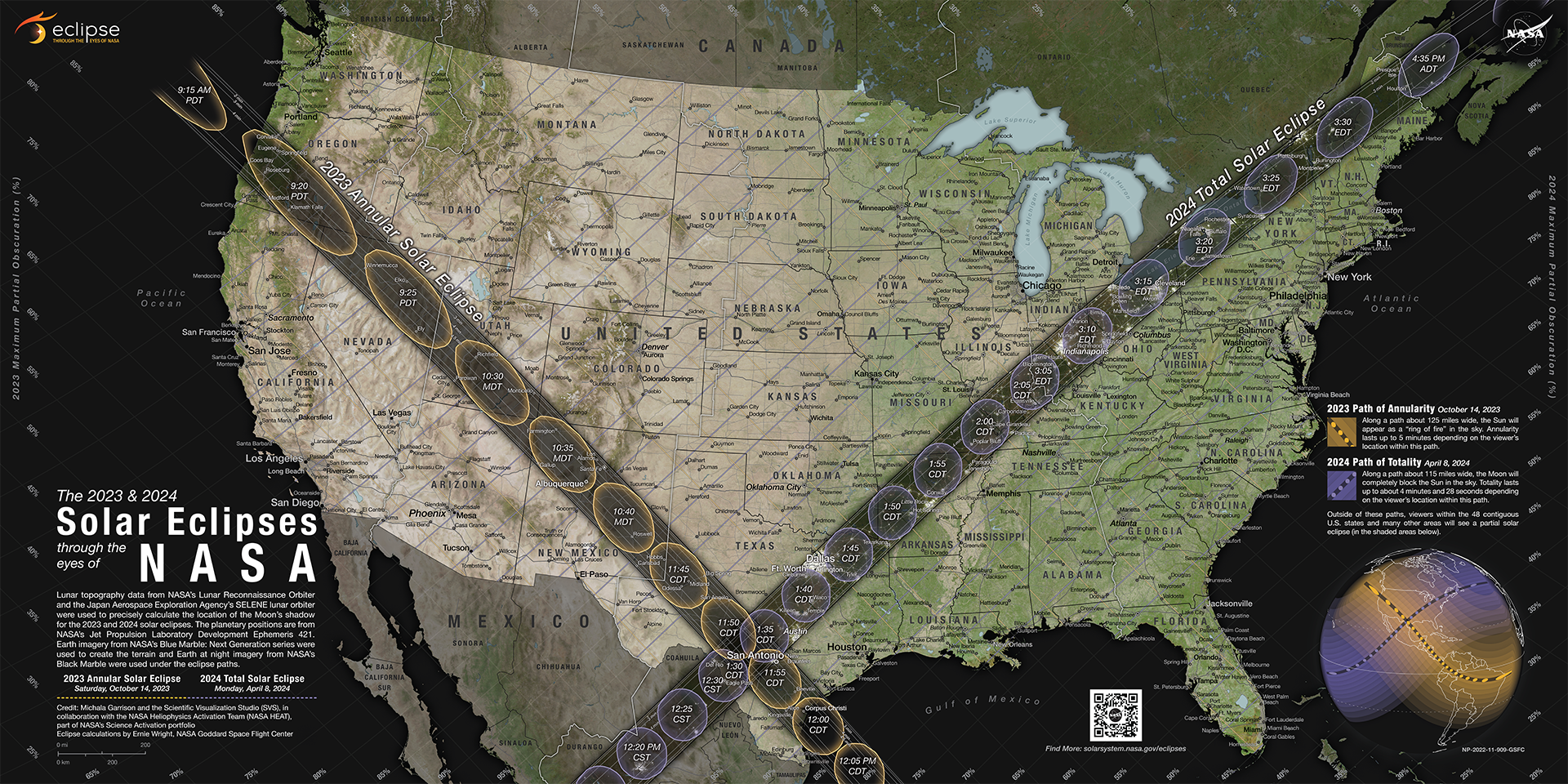
The paths of maximum eclipse of the October 14, 2023, and April 8, 2024. Click or tap on the image to enlarge it. Credit: NASA/Scientific Visualization Studio/Michala Garrison; eclipse calculations by Ernie Wright, NASA Goddard Space Flight Center.
05/16/2022 – Ephemeris – More eclipses in our future
This is Ephemeris for Monday, May 16th. Today the Sun will be up for 14 hours and 52 minutes, setting at 9:05, and it will rise tomorrow at 6:12. The Moon, at full today, will rise at 10:13 this evening.
Last night’s eclipse was the only eclipse that was visible in our area this year. However, in the next two years we will have a chance, weather permitting, to see two partial solar eclipses, the second of which will be even better than the partial solar eclipse seen here in August 2017. On October 14, 2023, there will be an annular eclipse. An annular eclipse is where the Moon is too far away to completely cover the face of the Sun. It leaves a ring of bright sun around the Moon. The technical term for a ring like that is annulus. The path of annularity will run from Oregon to Texas. For the Grand Traverse Area of Michigan, the Moon will cover less than half the face of the Sun. On April 8, 2024, the total eclipse path will run from Texas to Maine and just nip the Southeast corner of Michigan covering, for us in the Grand Traverse Area, about 85 percent of the Sun.
The astronomical event times given are for the Traverse City/Interlochen area of Michigan (EDT, UT – 4 hours). They may be different for your location.
Addendum
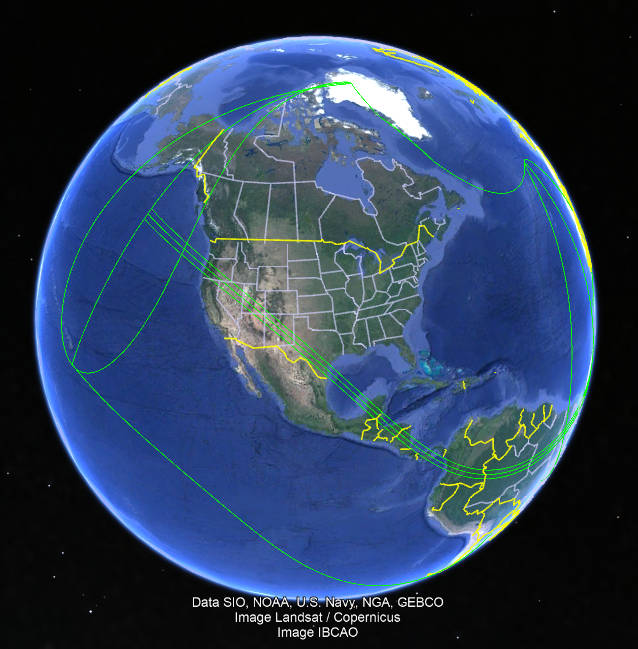
The areas where the October 14, 2023 solar eclipse can be seen are bounded by the outer green lines. The path where the annular part of the eclipse is visible is denoted by the triple green lines. Plotted on Google Earth using a file created by Occult4 software from the International Occultation Timing Association.
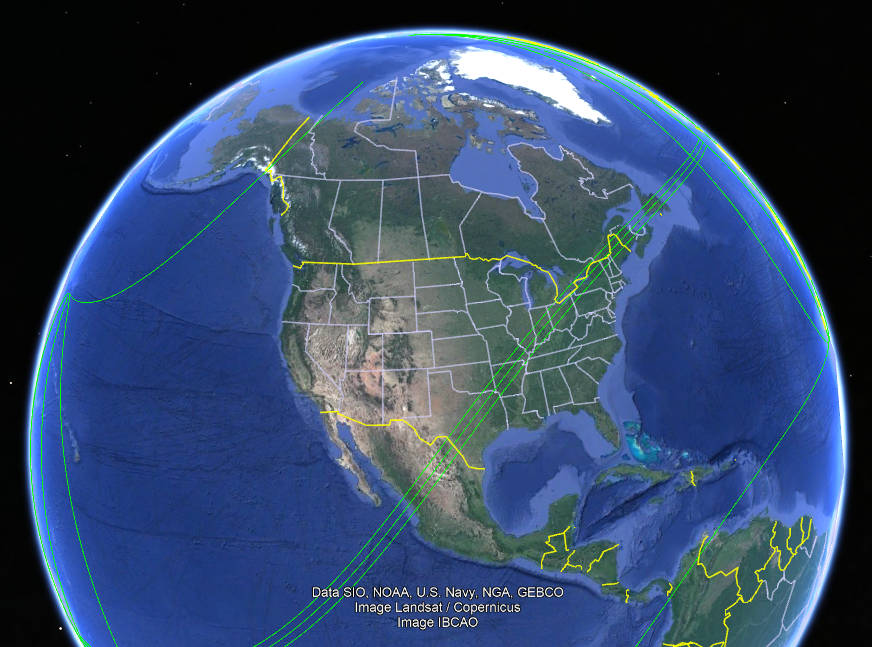
The areas across the U.S. where the April 8, 2024 solar eclipse can be seen are bounded by the outer green lines. The path where the total part of the eclipse is visible is denoted by the triple green lines. Plotted on Google Earth using a file created by Occult4 software from the International Occultation Timing Association.
12/14/2020 – Ephemeris – A total solar eclipse will occur today
This is Ephemeris for Monday, December 14th. Today the Sun will be up for 8 hours and 49 minutes, setting at 5:02, and it will rise tomorrow at 8:13. The Moon is new today, and won’t be visible.
Some lucky folks in South America, specifically located in a narrow path crossing Chile and Argentina will see a total eclipse of the Sun in a few hours. For us, the Moon is too far south to cover the Sun. This is the last eclipse of the year. We will get to see part of the next solar eclipse to occur. On the morning of June 10th, next year the Sun will rise as it is partially eclipsed for Michigan, with the Moon already leaving the Sun’s disk. That eclipse will not be total, but an annular eclipse, with the Moon too far away to cover the Sun completely, leaving a bright ring or annulus of the Sun, what some describe as a ring of fire. That effect will be seen in western Ontario, through the arctic, ending in Siberia.
The event times given are for the Traverse City/Interlochen area of Michigan. They may be different for your location.
Addendum
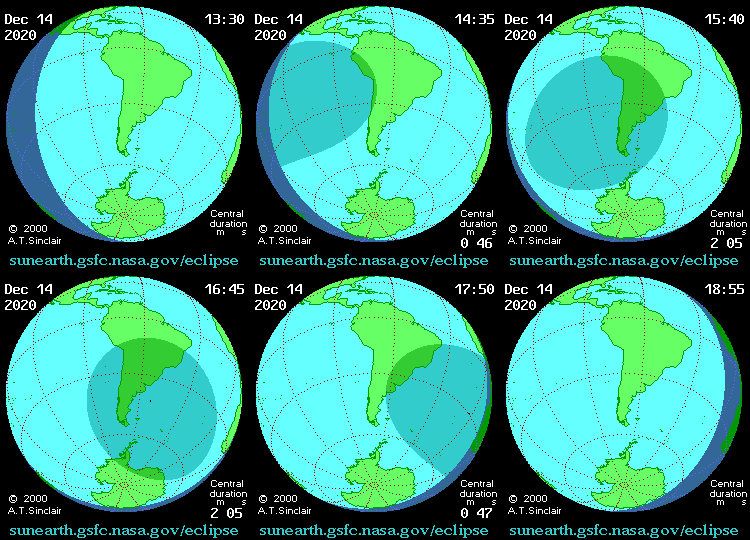
Animation of the path of the December 14, 2020, total solar eclipse. The penumbra of the Moon’s shadow is shown in gray, where the Sun will be partially eclipsed. The black dot near the center of the penumbra is the Moon’s umbra, where the face of the Sun is totally eclipsed. Credit: NASA/Goddard Space Flight Center.
 Bob Moler's Ephemeris Blog