Archive
Ephemeris: 04/14/2026 – My virtual flight with the Artemis II crew
This is Ephemeris for Tuesday, April 14th. Today the Sun will be up for 13 hours and 26 minutes, setting at 8:26, and it will rise tomorrow at 6:58. The Moon, 3 days before new, will rise at 5:55 tomorrow morning.
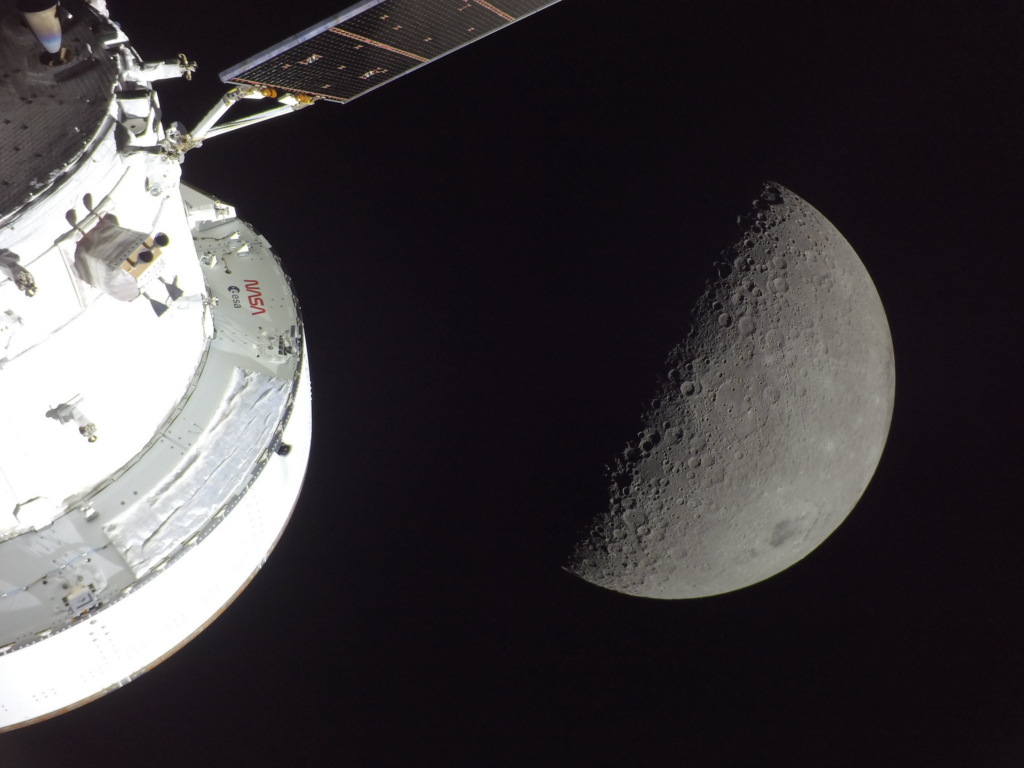
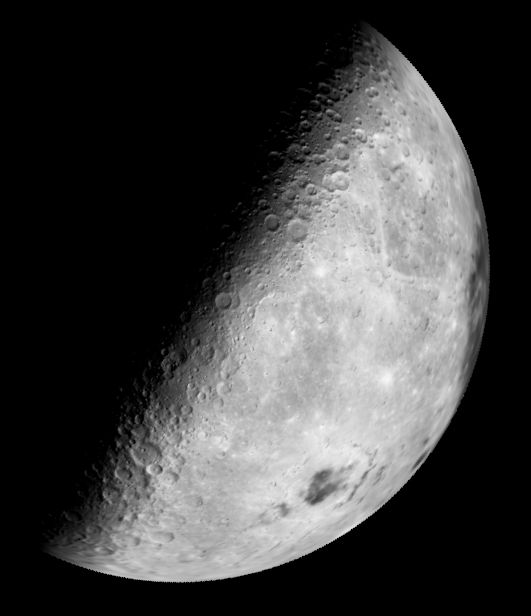
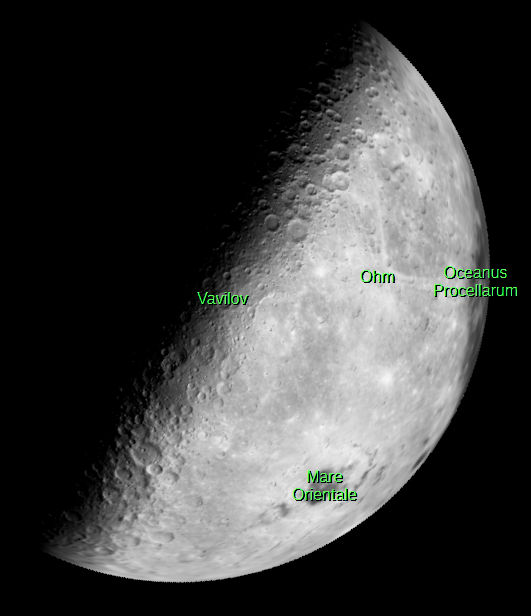
I hadn’t enjoyable time last week Monday afternoon listening to Artemis 2 astronauts talking with the science team on Earth about what they were seeing Moon’s far side. I have the program called Virtual Moon Atlas which allows one to see the entire Moon with the phase and shadows. And I was able to rotate it and get the phase right so it appeared pretty much as it did to the astronauts. So I was able to follow along with their discussions of the far side features that they were seeing and photographing. I could zoom in to craters and features they were talking about, but nowhere near the detail they were seeing. So I consider it to be a really great time of, in essence, flying along with the astronauts.
The astronomical event times given in this blog are for the Traverse City/Interlochen area of Michigan (Lat 44.7° N, Long 85.7° W; EST, UT – 5 hours) unless stated otherwise. Times will be different for other locations.
Addendum
Ephemeris: 04/16/2024 – A quick look at the April 8th 2024, total solar eclipse
This is Ephemeris for Tuesday, April 16th. Today the Sun will be up for 13 hours and 34 minutes, setting at 8:29, and it will rise tomorrow at 6:54. The Moon, 1 day past first quarter, will set at 4:42 tomorrow morning.
I saw the total solar eclipse last week Monday. This is the first chance I have to report on it. My target area ran from southwestern Indiana to Northern Ohio and decided early to stay in Lafayette IN overnight to give us a shot at going in either direction. We ended up going to southwestern Indiana to a little town called Linton, about 7 miles from the center line of the eclipse. There was relatively mild traffic going down and relatively few folks there at Humphrey’s park. Totality was glorious and the Sun’s corona was silvery and there was a red prominence sticking out of the bottom of the dark moon’s silhouette. Venus and Jupiter were also visible in the dark blue sky. I’ll have a fuller account on my blog in a few days.
The astronomical event times given are for the Traverse City/Interlochen area of Michigan (EDT, UT–4 hours). They may be different for your location.
Addendum
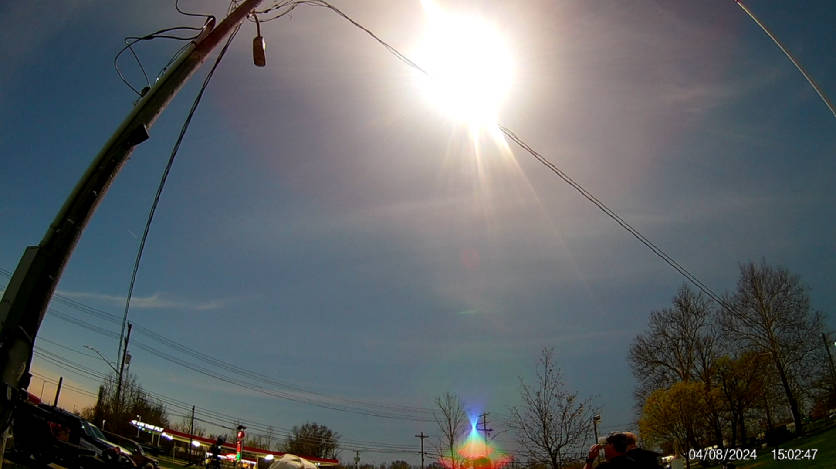
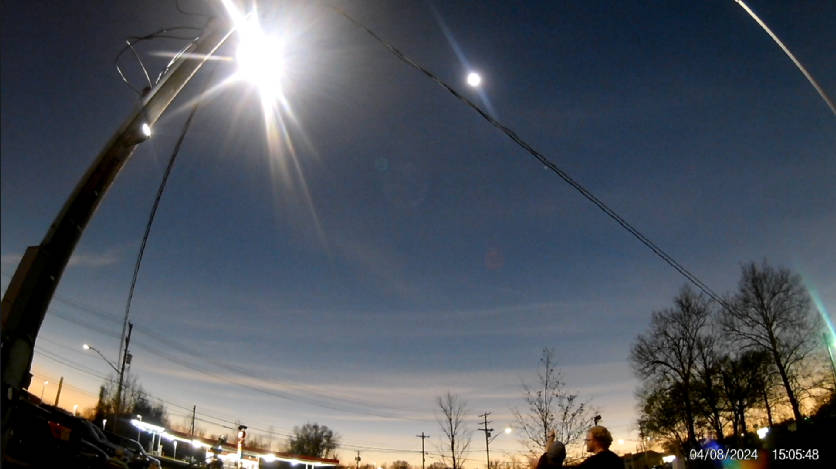
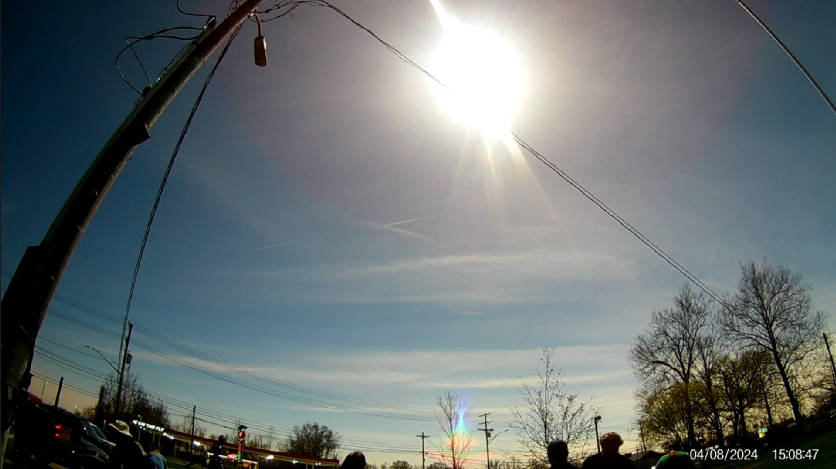
The following are three frames from the video I made with a GoPro-like camera around totality to get a view of the sky conditions. In 61 years and six total solar eclipses I spent the first four just looking at the Sun. The latter two I’ve tried to soak in the ambiance of the world around me during totality. I’ve been extremely lucky in total solar eclipses in that I was never completely clouded out. The main reason for that is mobility, and not going where everyone else is going. With these six 6 eclipses I have accumulated a total of 15 minutes basking in the shade of the Moon.
07/13/2021 – Ephemeris – Virgin Galactic had a successful full crew flight to the edge of space
This is Bob Moler with Ephemeris for Tuesday, July 13th. Today the Sun will be up for 15 hours and 16 minutes, setting at 9:26, and it will rise tomorrow at 6:10. The Moon, halfway from new to first quarter, will set at 11:59 this evening.
This past Sunday was Virgin Galactic’s first test passenger flight to what the United States calls space, past 50 miles altitude, in their VSS Unity spaceship. The four passengers for this test flight were all basically Virgin Galactic employees, including its founder, Richard Branson. The international definition of where space begins is 100 kilometers or 62 miles altitude. At either altitude, a suborbital spacecraft at its peak altitude would be traveling so slowly that the atmospheric effects are negligible. However, if a spacecraft were to pass through that altitude on reentry at over 17 thousand miles an hour, that’s an entirely different story. On July 20th Jeff Bezos will ride his New Shepard rocket up past 62 miles.
The astronomical event times given are for the Traverse City/Interlochen area of Michigan (EDT, UT – 4 hr). They may be different for your location.
Addendum

Virgin Galactic’s Spaceship VSS Unity ignites its hybrid rocket engine after being dropped from its carrier aircraft Eve on a prior test flight to the edge of space. Credit Sky News.
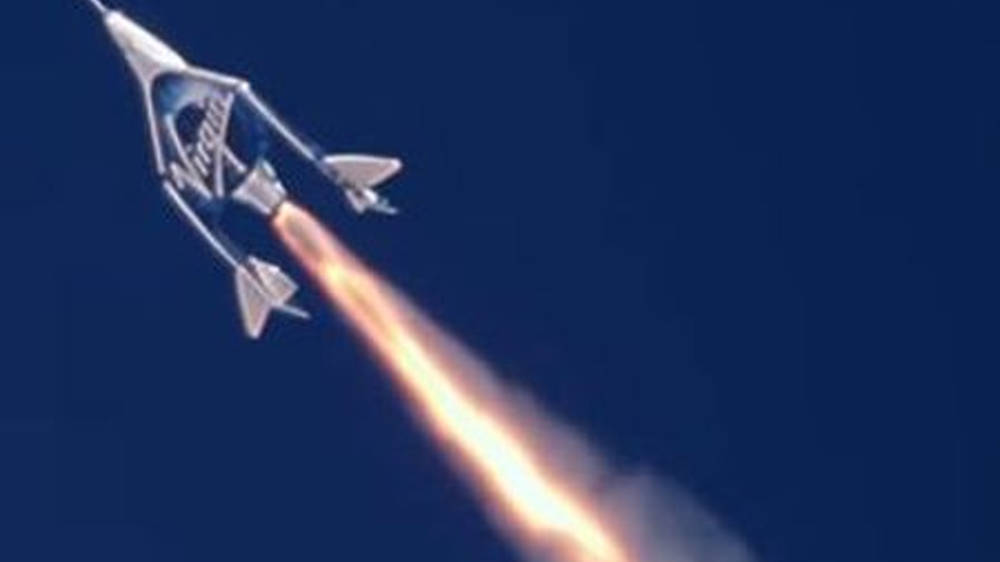
VSS Unity under power with its hybrid rocket motor. The fuel is a solid rubbery compound, with a nitrous oxide as the oxidizer. Powered flight lasts only 60 seconds to reach 56 miles in altitude. This is from a prior flight. Click on the image to enlarge it. Credit: Virgin Galactic.
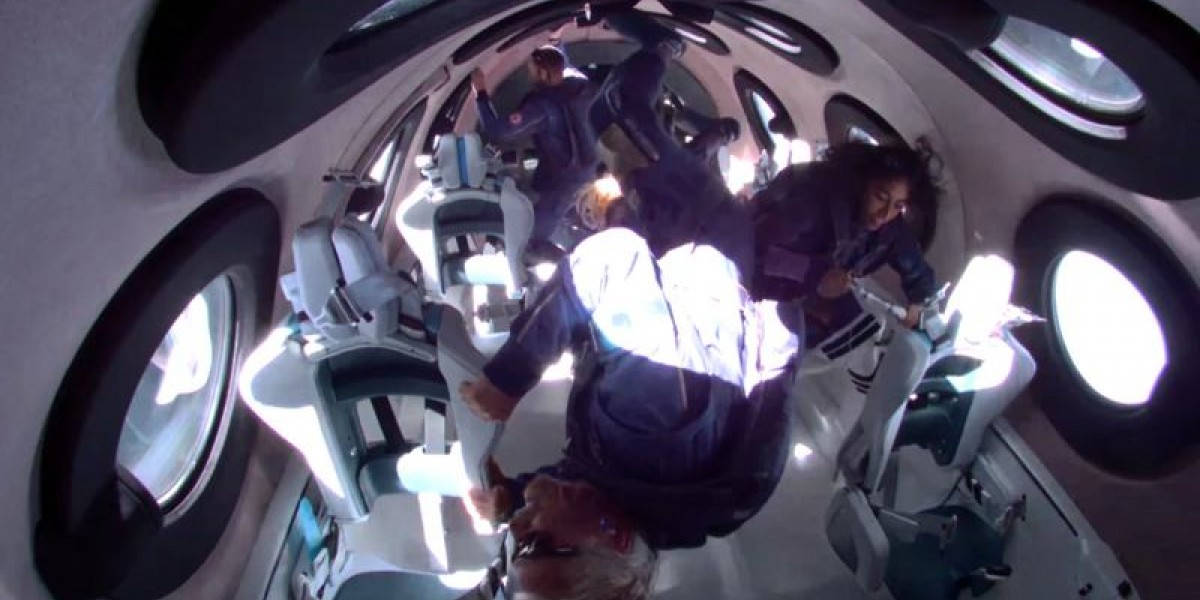
Floating in zero G in VSS Unity 22. I can imagine the announcement: “The seat belt sign has been turned off. You may float about the cabin.” At least for 5 minutes. Click on the image to enlarge it. Credit: Virgin Galactic video.
06/24/2021 – Ephemeris – SpaceX Inspiration 4 mission
This is Bob Moler with Ephemeris for Thursday, June 24th. Today the Sun will be up for 15 hours and 34 minutes, setting at 9:32, and it will rise tomorrow at 5:58. The Moon, at full today, will rise at 9:59 this evening.
If all goes as planned, SpaceX will send four civilians, two men and two women, into orbit for a three-day mission aboard the Crew Dragon “Resilience” spacecraft, sent up by a Falcon 9 rocket in mid-September. It’s called the Inspiration 4 Mission to raise awareness and funds for the St. Jude Children’s Hospital. Their orbit will be higher, at 340 miles (540 kilometers) altitude, than that of the International Space Station. The mission commander will be Jared Isaacman, who is paying for the whole thing. Dr. Sian Proctor will be the pilot. Also, on the crew will be Hayley Arceneaux, a St. Jude childhood cancer survivor and now a Physician’s Assistant at St. Jude, and Christopher Sembroski. The crew has been in training since their selection in early April.
The astronomical event times given are for the Traverse City/Interlochen area of Michigan (EDT, UT-4). They may be different for your location.
Addendum
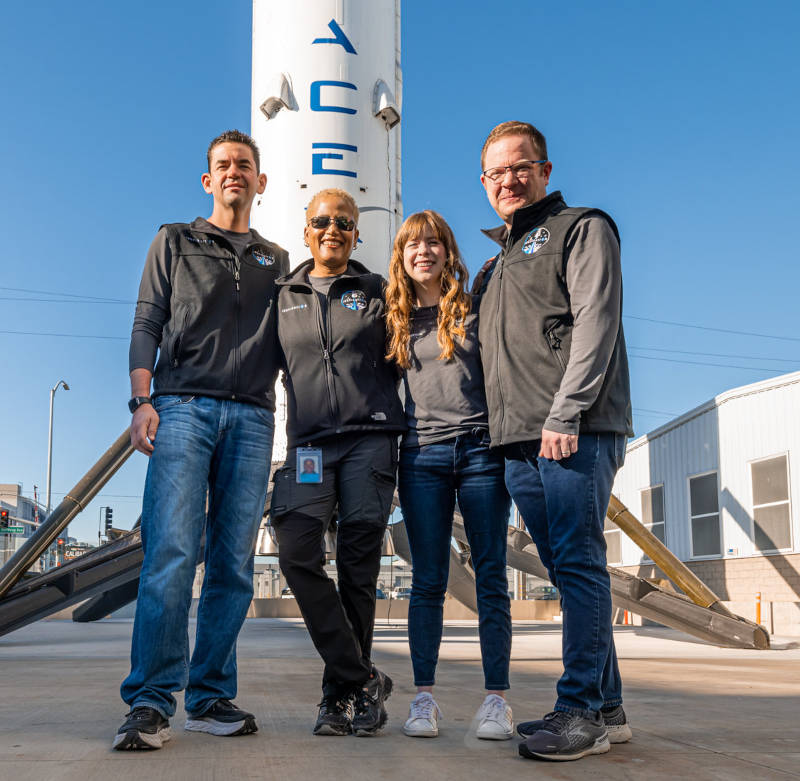
The Inspiration 4 Crew. Left to right: Jared Isaacman, Commander who financed the mission, and flies military jets for fun; Dr Sian Proctor, Pilot who is an entrepreneur, educator and trained pilot; Hayley Arceneaux, who is a physician assistant at St. Jude Children’s Research Hospital; and Christopher Sembroski. Credit: Inspration4 Photos.
03/08/2021 – Ephemeris – 45 years ago today I saw and photographed Comet West!
This is Bob Moler with Ephemeris for International Women’s Day, Monday, March 8th. Today the Sun will be up for 11 hours and 32 minutes, setting at 6:40, and it will rise tomorrow at 7:05. The Moon, 3 days past last quarter, will rise at 5:34 tomorrow morning.
On this day 45 years ago, in 1976, during the first year of these Ephemeris programs I was able to report on, observe and photograph the brightest comet I had seen up till that time: Comet West. It was not supposed to be a bright comet, but as it rounded the Sun, it began to brighten spectacularly. Later I found out that it’s nucleus broke into several fragments, liberating a great quantity of gas and dust. It turned out to be a very dusty comet which ended up in a broad and bright tail. It was going to be visible before sunrise, and this was the first morning in a while it was clear. Even before the head of the comet rose, the tail could be seen rising in the east. I was able to get several photographs of this wonderful comet!
The astronomical event times given are for the Traverse City/Interlochen area of Michigan. They may be different for your location.
Addendum
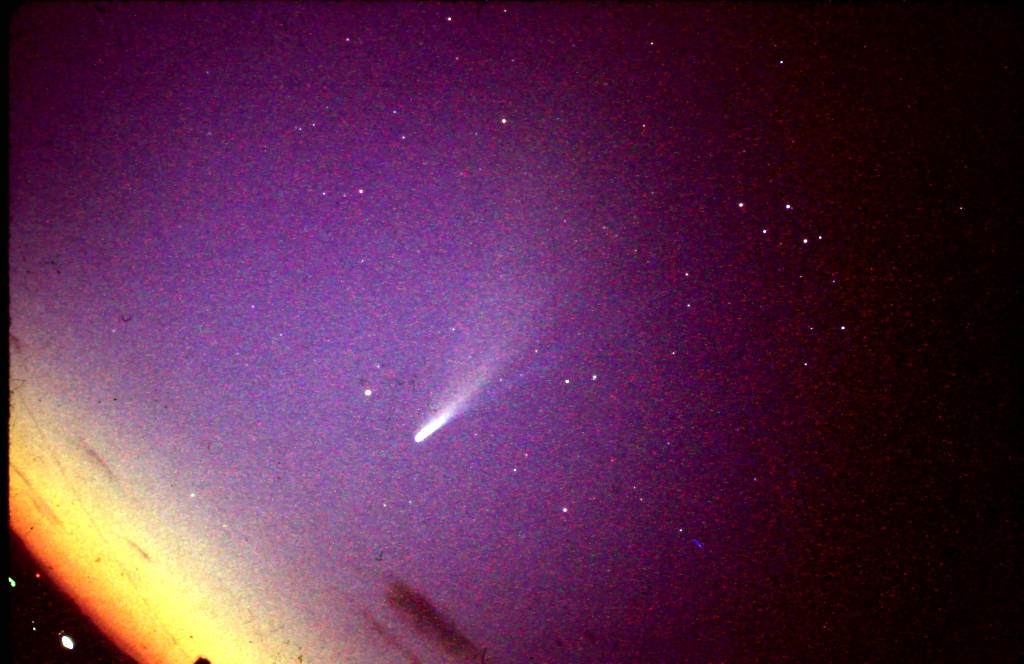
Comet West, C/1975 V1, as photographed by me at about 6 am, March 8, 1976. The wide, curved dust tail is most prominent with the narrow blue ion tail pointed more directly at the rising Sun. The small summer constellation of Delphinus the dolphin is to the upper right. The diamond shape of stars at the front of the dolphin’s body is an asterism called Job’s Coffin.
In the image above is tilted about 45 degrees to the horizon in the lower left due to the fact that it was on an equatorial mount, where up and down is north and south in the sky, horizontally is east and west. It’s cocked 45 degrees to the horizon because we are at 45 degrees latitude. Actually the angle is 90 – your latitude which around here is 90 – 45 = 45.
I got up early in the morning of March 8th 1976. I had my telescope mount outside because it takes awhile to set it up to true north and everything. The telescope and camera that mounts on it were taken inside. I just left it there covered with a tarp and wasn’t observing too much that winter. When I got up in wee hours of the morning of the eighth I found out that my telescope mount was buried in the middle of a snowdrift, so I had to dig it out. As I was digging it out I looked to the east and saw the tail of the comet rising before the head did. I then redoubled my efforts and got everything set up so I could take photographs of the comet.
I had built a small telescope a few years before for a solar eclipse as a kind of contingency camera in case my automatic cameras I had built didn’t work. It was a 108 mm f/6 reflecting telescope that I attached a camera back to and took some minute or two long exposures that way. I then realized that the sky was getting brighter, so I quickly switched, and took a couple of wide angle pictures with the 50 mm lens with tracking. That’s one of them above that shows the lovely comet with the long tail.
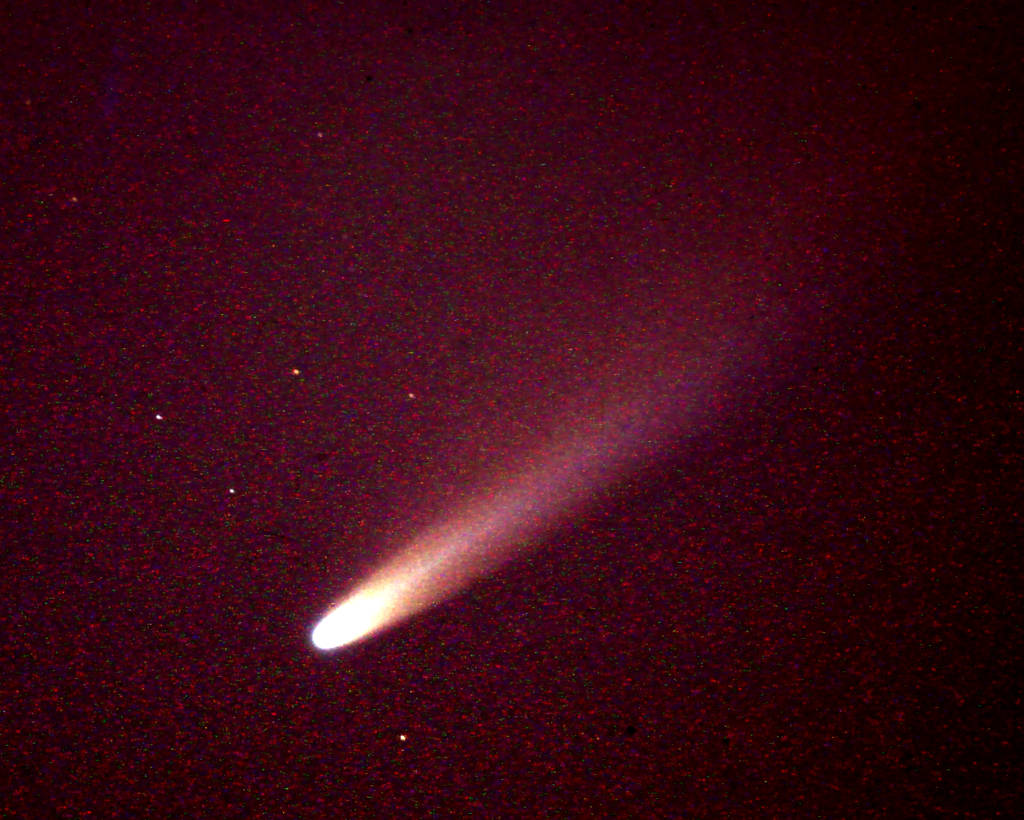
Comet West taken through the 108 mm f/6 telescope around 5:30 am, March 8, 1976 by a much younger me.
04/28/2020 – Ephemeris – My life with the pandemic so far (A rare personal program)
This is Bob Moler with Ephemeris for Tuesday, April 28th. Today the Sun will be up for 14 hours and 8 minutes, setting at 8:44, and it will rise tomorrow at 6:34. The Moon, 2 days before first quarter, will set at 2:20 tomorrow morning.
The stay at home order from the Governor issued last week to stay home until at least May 15th was not a surprise to me. I’m at the vulnerable age group… old. Most of what I do is done at home anyway, though will I miss being an instructor for the Inland Seas Educational Association. I am usually on the schooner Manitou in the spring. My stroke in January would have precluded me sailing this spring anyway even if there was no virus to shut things down. Maybe this fall? I’m getting my garden ready. What’s an astronomer doing with all this earth bound stuff? Well it just happens that the Earth’s a planet too. I tend to think of it as spaceship Earth, hurtling around the Sun at 67,000 miles per hour (107,000 kph).
The event times given are for the Traverse City/Interlochen area of Michigan. They may be different for your location.
My 9/27/2015 lunar eclipse experience
This is an elaboration of an email sent to a fellow amateur astronomer who was completely clouded out and asked how we did.
From mid-eclipse, about 10:45, to the end of totality it was almost perfectly clear, We had light clouds after that to the end of the partial phase. Then it clouded up again. My impressions of the eclipse brightness at totality was that it was a bit darker than usual, but I may be wrong. However, I have had wretched luck in being able to view lunar eclipses. We were virtually wiped out by clouds with the two lunar eclipses last year, and we’ve had the same luck for the many eclipses occurring before. I may be out of practice.
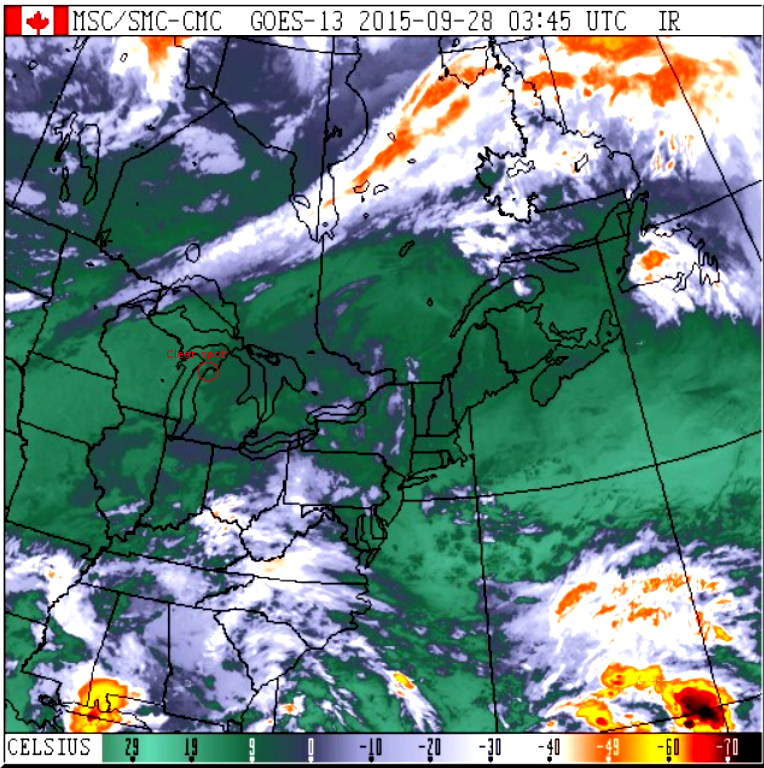
From the animation of the satellite images from Sunday night. The red circle points to the hole, really a notch in the clouds that allowed us to see the last part of the lunar eclipse. Our low clouds were warm in the infrared, so show as a very light gray. Credit NOAA/Environment Canada.
12/25/2014 – Ephemeris – My recollections of spotting the Southern Cross for the first time.
Merry Christmas. This is Ephemeris for Christmas Day, Thursday, December 25th. The sun will rise at 8:17. It’ll be up for 8 hours and 49 minutes, setting at 5:07. The moon, 3 days before first quarter, will set at 9:50 this evening.
My one and only sighting of the constellation the Southern Cross came two and a half years ago from a cruise ship traveling between the Hawaiian island of Maui and Hilo on the Big Island. I had plotted it out before the trip. Our ship would be traveling in a south-southeasterly direction and at 3 a.m., the Southern Cross would be low above the southern horizon from our latitude which I surmised would be about 20 degrees north. The southern cross would be visible from the bow of the ship. The only really dark location to view it was on Deck 14 with an unobstructed view with some subdued lights behind me. I easily found it, and verified it with the fifth star of the cross. Nearby was Alpha Centauri the closest star to the sun.
Times are for the Traverse City/Interlochen area of Michigan. They may be different for your location.
Addendum
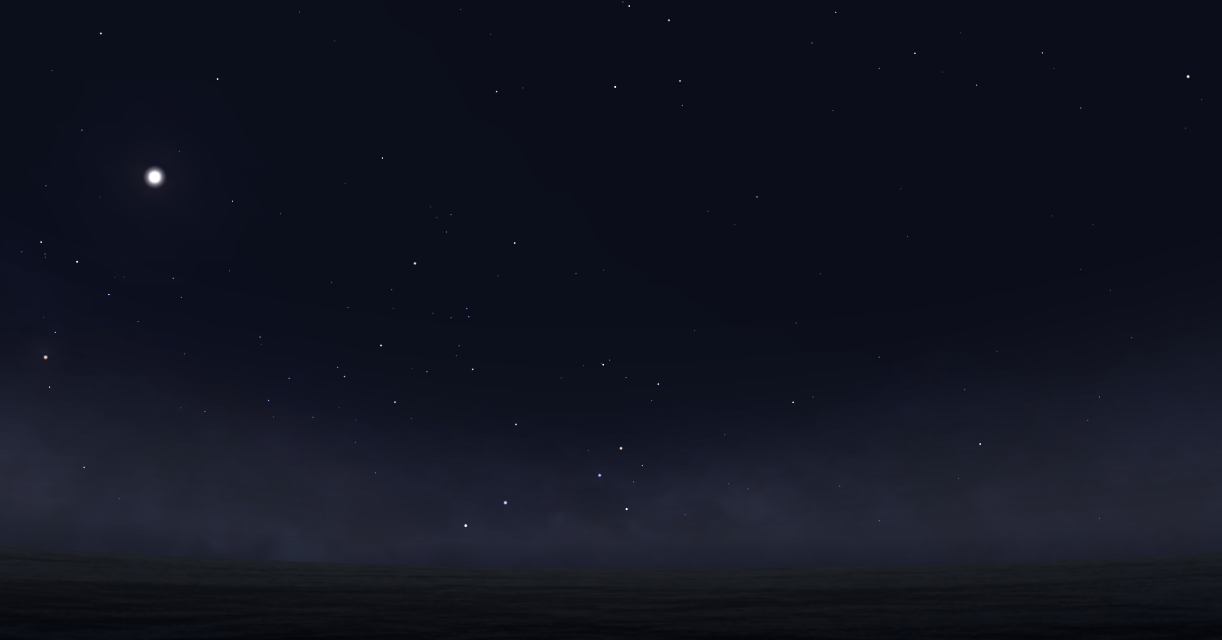
The approximate sky that I saw from the bow of the ship at 3:15 a.m. HST February 14, 2012. The moon was a slight gibbous phase. Recreated using Stellarium.
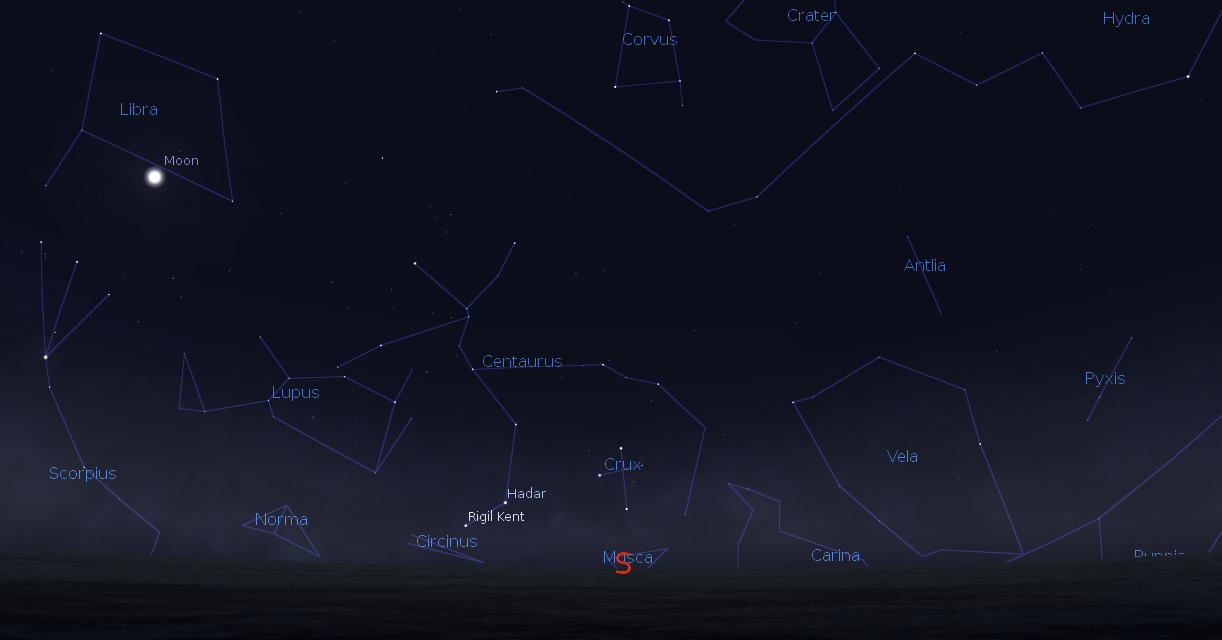
The approximate sky that I saw from the bow of the ship at 3:15 a.m. HST February 14, 2012, annotated. The moon was a slight gibbous phase. Recreated using Stellarium.
Note that the star named Rigil Kent is truncated. It’s Rigil Kentaurus, better known by its catalog name Alpha Centauri. The fifth star of the cross, my check star, is on the right side of the cross, just below the crosspiece. The Southern Cross’s real name is Crux, which simply means cross. The Northern Cross is not an official constellation. It’s part of Cygnus the swan.
I’ve heard folks say the Beta Centauri is Alpha Centauri’s companion star. That is not true. Beta Centauri is Hadar, seen near Alpha in the sky, but is much farther away. There are three stars in the Alpha Centauri system: Alpha Centauri A, Alpha Centauri B, and Proxima Centauri, a telescopic red dwarf, a bit away from the other two. Alpha Centauri A & B are a wide double, visible in a telescope. I saw and photographed them when on Key Largo in April 1986 for Halley’s Comet’s closest approach to the Earth. Note it wasn’t all that close, some 40 million miles, and it had a tail disconnection that week. Bummer.
10/09/2014 – Ephemeris – The next lunar eclipses and recollections of what happened with yesterday’s eclipse
Ephemeris for Thursday, October 9th. The sun will rise at 7:50. It’ll be up for 11 hours and 18 minutes, setting at 7:08. The moon, 1 day past full, will rise at 8:01 this evening.
With the two total lunar eclipses done for this year, we can look forward to two more next year. The April 4th, 2015 eclipse won’t appear total here because the moon will set before totality. However the September 28th, 2015 lunar eclipse will be an evening eclipse. These 4 eclipses make a rare tetrad of total lunar eclipses that won’t be repeated until 2032 and 2033. After September 28th the next total lunar eclipse visible from northern Michigan will be in 2021. On the solar eclipse side there’s one on the 23rd of this month, a partial eclipse at sunset. I’ll have more on that later. After that is the big event, the total solar eclipse on August 21, 2017. The path of totality will run from coast to coast, running just south of St. Louis Missouri, and just north of Nashville Tennessee.
Times are for the Traverse City/Interlochen area of Michigan. They may be different for your location.
Addendum
What follows is my recollection of the October 8th lunar eclipse. Originally relayed in an email to Pat Stinson, freelance writer and author of the wonderful article in the Grand Traverse Insider about the activities of Space Week and the astronomical events in October:
The skies were trending clearer at midnight and again at 2:30 a.m. when I took a shower to prepare for the eclipse. After that it got slowly worse. That afternoon Ranger Marie Scott of the Sleeping Bear Dunes National Lakeshore said she’d go to our site, Platte River Point, clouds or not, and I was willing. In setting up the eclipse observing sites,earlier in the year, this site was the one place that if it were clear, we could see either the moon or the sun set onto the Lake Michigan horizon for the three eclipses this year. I loaded my van with my two telescopes, the C8 and an 11″ Dobsonian and lots of coffee.
I got to the site at 4:30 and began to set up. Marie arrived a few minutes later and another Grand Traverse Astronomical Society member Don Flegel arrived shortly after that. They had some rain in Kingsley, where he lived that morning. We had a strong, cold northwest wind. When we’re at the Point we commandeer the small parking lot to the north of the road that’s up against a hill. That hill and my van offered some protection from the wind. I got the C8 set up just in time to spot the moon emerging from the clouds a few minutes after first contact. We were able to follow the eclipse intermittently until about 5:45 when a large cloud covered the moon big time. We could see the glint of the moon off the water until after totality.
This was our situation until about 7:30 when the clouds began to break up, By then the moon was so low that the foreshortened breaks weren’t all that open. Then about 10 minutes before moon set it did peek out at intervals. Unlike the Cheshire Cat’s smile, the moon (cat) had a frown because the upper edge of the moon was coming back into sunlight. 5 minutes later the moon finally disappeared for good in a cloud bank as the puffy clouds overhead caught the sun’s golden sunrise rays.
Marie Scott counted 18 folks that at one time or another came out to witness the event. Marie also posted some pictures she took of the eclipse on the park’s Facebook page.
Our May 20th, 2012 solar eclipse experiences
We knew seeing the eclipse would be a close thing. We members of the Grand Traverse Astronomical Society had a full day of events. It started with a full day at Northwestern Michigan College at their annual fund raising Barbecue. Gary and Eileen Carlisle, Ron and Jan Uthe, Richard Kuschell, and myself had telescopes aimed at the sun. Joe Brooks our meteor man was holding forth in one of the classrooms with his meteorite collection. This went from 10 a.m. setup to 5 p.m. take down.
I immediately headed 30 miles westward to the Sleeping Bear Dunes National Lakeshore, and Pierce Stocking Scenic Drive and the Lake Michigan Overlook and our planned eclipse viewing party with the park rangers. The rest of our group except Joe followed a bit later. The sky was milky all day, and we had puffy clouds in Traverse City at the barbecue. Watching the cloud animations on weatherunderground.com gave me some hope that the cloud bank we knew was over Wisconsin might just hold off so we could get the major part of what we projected would be the first 50 minutes of the eclipse before sunset. There was also a spear of thunderstorms coming northward up the lake from the south. The sky was so milky that we had no idea how high the cloud bank we knew was there actually was.
When I arrived at the entrance to the scenic drive the rangers told me that they may change our location due to blowing sand. When I got to the overlook the sand was indeed being blown by gusts of wind coming from the southwest.

Lake Michigan Overlook Looking South
The above picture is from my scouting trip the week before. We set up near that dune, which sheltered us pretty well from the wind. However when I got home, I was full of sand, especially my hair.
It wasn’t until about 10 minutes before the start of the eclipse that the cloud bank was revealed. It then was a race between the moon and the cloud bank. The moon won by about 5 minutes. My old friend John Russell, a professional photographer, was there and has posted an eclipse image on his Facebook page.
About 10 minutes later we found that the clouds were getting ugly, and approaching rapidly.

Looking in vain for the sun. Isn’t that a thunderhead on the left?
That was it for the eclipse. The rangers counted about 200 people who attended.
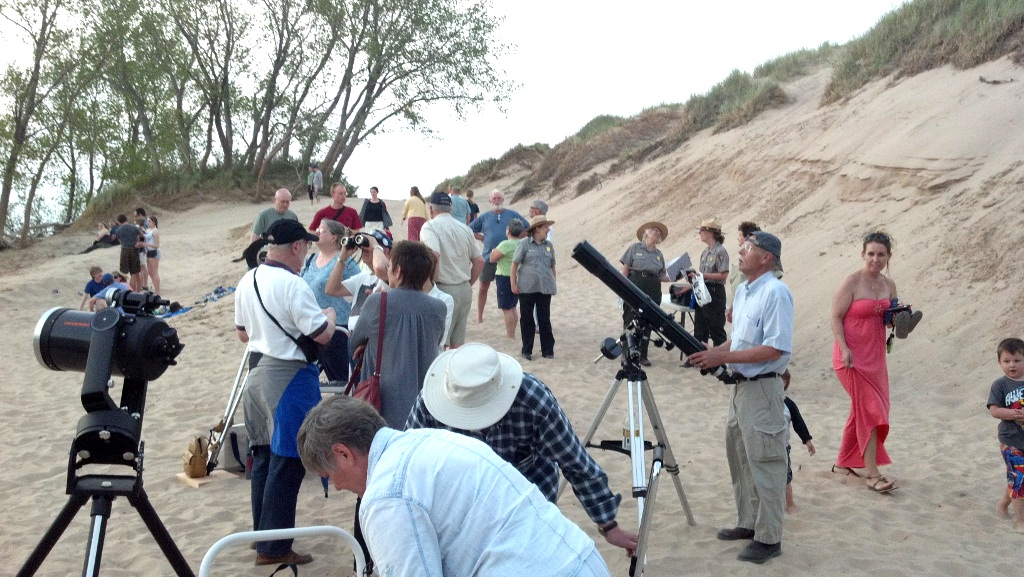
Gary Carlisle with binoculars and Richard Kuschell look for Venus above the cloud bank.
Gary Carlisle, who has a knack for finding planets in twilight, spotted Venus above the cloud bank and pointed his Celestron 8 telescope toward it. Richard Kuschell located it too with his 4″ refractor to give the folks remaining a bonus view of the thin crescent of Venus.
We then packed up and headed back home with lightning to the south and a smattering of rain.

