Archive
11/11/2019 – Ephemeris – Mercury is passing across the face of the Sun today
Ephemeris for Veteran’s Day, Monday, November 11th. Today the Sun will be up for 9 hours and 45 minutes, setting at 5:19, and it will rise tomorrow at 7:35. The Moon, 1 day before full, will set at 7:24 tomorrow morning.
Today we are bring treated by a rare event. The planet Mercury is crossing the face of the Sun. It’s called the transit of Mercury. The last one visible from around here was 3 ½ years ago, and the next one will be visible here in 2049. The transit starts at sunrise when Mercury starts to cross the Sun from the lower left from sunrise and will cross the Sun until 1:04 p.m. where it will leave the Sun at the upper right. The best way to see it will be to project the Sun’s image on a white card using binoculars or a telescope. Do not look through them at the Sun. Solar eclipse glasses will not work because Mercury is too small. Do not use eclipse glasses with binoculars. The Sun’s heat will melt the filters and cause blindness.
The times given are for the Traverse City/Interlochen area of Michigan. They may be different for your location.
Addendum
One or more members of the Grand Traverse Astronomical Society mayl be out in the parking lot of Mari Vineyards 8175 Center Road on Old Mission Peninsula, but only if it’s clear. Be advised that there is a winter storm warning for the Grand Traverse Area from 1 a.m. to 6 p.m. today. That means that chances are slim that we’ll have a big enough clear spot to observe through. But I’ll be on the look out., and am a half an hour away.
I found a source for streaming video fo the transit from Griffith Observatory in Los Angeles: https://www.youtube.com/watch?v=rYZKNhTJmOI.
Being on the west coast they will miss part of the transit. They’ll go live at 9:15 a.m. our time. Sunrise over there is at 9:22 our time. There’s more information on: http://www.griffithobservatory.org/events/Transit_of_Mercury_2019.html.
More information about viewing the transit is on: https://spaceweather.com/
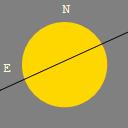
Path of Mercury across the Sun. The planet will move from lower left to upper right. The passage will be from lower left to upper right. Credit: Occult 4.
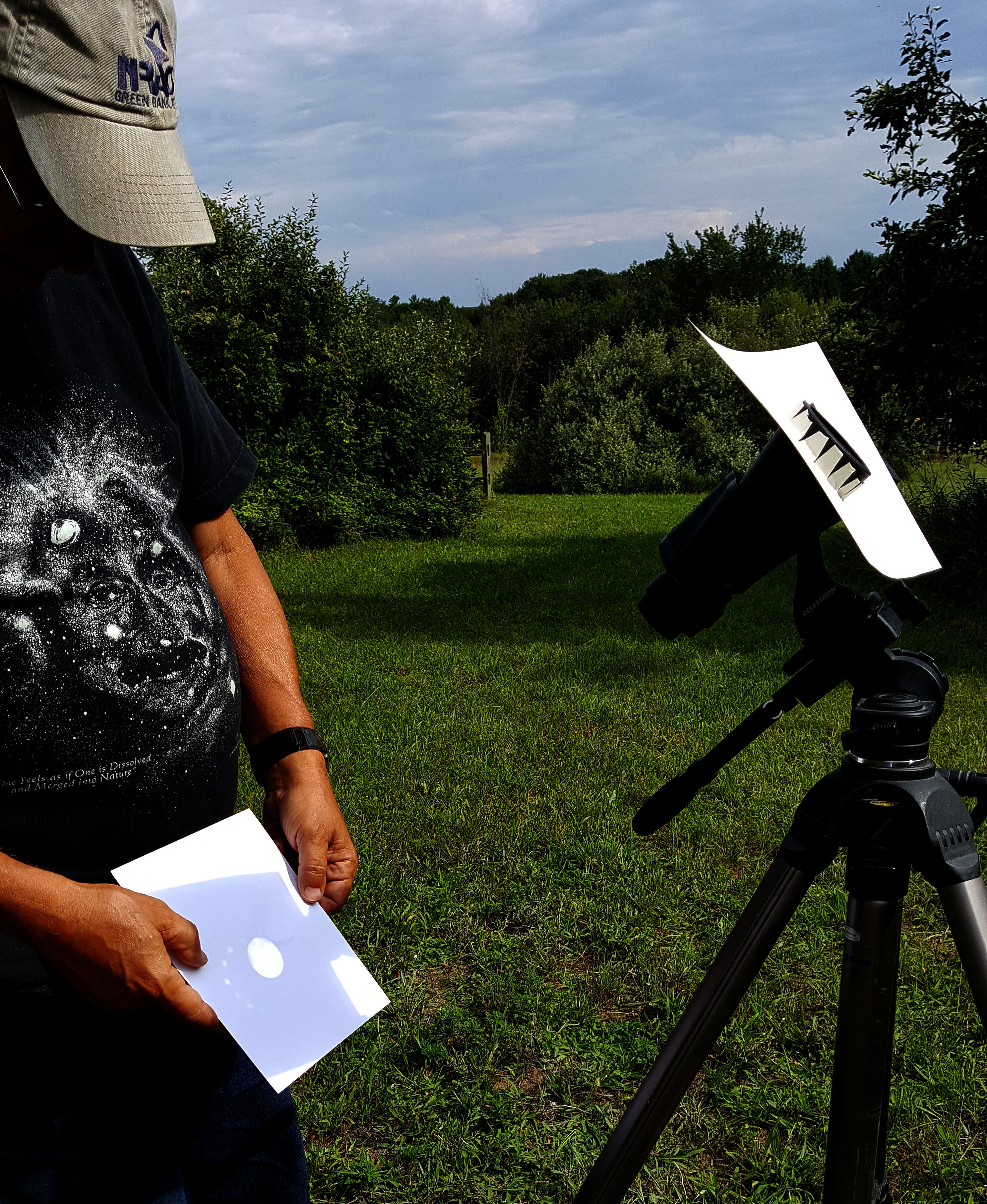
I’m demonstrating using binoculars to project the Sun. Photo by Bea Farrell (granddaughter).
Mercury Inferior Conj.  (Transit)
Transit of Mercury on 2019 Nov 11 (TT)
     Geocentric Event      UTC          EST          P.A.
                           h  m  s                      o
[1]  Exterior Ingress      12 35 27    7:35.27 a.m.  110.0
[2]  Minimum Separation    15 19 48   10:19:48 a.m.
[3]  Exterior Egress       18  4 14    1:04:14 a.m.  298.6

Minimum sepn 75.9";  Radii - Sun 969.3", Mercury 5.0"
delta T =  70.2 secs,  Ephemeris = DE0
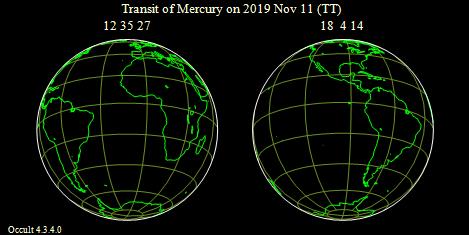
The Sun facing side of the Earth at the start and end of the transit. If you can see your location on either of these maps the transit or part of it will be visible from your location. Credit Occult 4.
11/08/2019 – Ephemeris – On Monday tiny Mercury will cross the face of the Sun
Ephemeris for Friday, November 8th. Today the Sun will be up for 9 hours and 52 minutes, setting at 5:22, and it will rise tomorrow at 7:31. The Moon, half way from first quarter to full, will set at 4:14 tomorrow morning.
Monday we will be treated by a rare event. The planet Mercury will cross the face of the Sun. It’s called the transit of Mercury. The last one visible from around here was 3 ½ years ago, and the next one will be in 2049. Mercury will start across the Sun from the lower left from sunrise at 7:35 and will cross the Sun until 1:04 p.m. where it will leave the Sun at the upper right. The best way to see it will be to project the Sun’s image on a white card using binoculars or a telescope. Do not look through them at the Sun. Solar eclipse glasses will not work because Mercury is too small. Do not use eclipse glasses with binoculars. The heat will melt the glasses and cause blindness. I’ll have more information Monday.
The times given are for the Traverse City/Interlochen area of Michigan. They may be different for your location.
Addendum
Path of Mercury across the Sun. The planet will move from lower left to upper right. The passage will be from lower left to upper right. Credit: Occult 4.
I’m demonstrating using binoculars to project the Sun. Photo by Bea Farrell (granddaughter).
Mercury Inferior Conj.  (Transit)
Transit of Mercury on 2019 Nov 11 (TT)
     Geocentric Event      UTC          EST          P.A.
                           h  m  s                      o
[1]  Exterior Ingress      12 35 27    7:35.27 a.m.  110.0
[2]  Minimum Separation    15 19 48   10:19:48 a.m.
[3]  Exterior Egress       18  4 14    1:04:14 a.m.  298.6

Minimum sepn 75.9";  Radii - Sun 969.3", Mercury 5.0"
delta T =  70.2 secs,  Ephemeris = DE0
11/01/2019 – Ephemeris – Previewing November Skies and a GTAS meeting
Ephemeris for Friday, November 1st. The Sun will rise at 8:20. It’ll be up for 10 hours and 11 minutes, setting at 6:31. The Moon, 3 days before first quarter, will set at 10:13 this evening.
Let’s take a look at November skies. The time change back to standard time will set us back an hour on sunrise and sunset times, so it’ll be brighter in the morning and darker in the evening this Sunday. Out east in New York, the Sun is already setting before 5 p.m. It will never set that early here. The Sun is up for 10 hours 11 minutes today and that will dwindle down to 9 hours and 5 minutes at month’s end. The Sun reaches 30 and a half angular degrees above the southern horizon at local apparent solar noon, which is 12:25 p.m. this month.
The big event this month will be the transit of the planet Mercury across the face of the Sun on the morning of November 11th. Mercury is too small to be seen with eclipse glasses from left over from the eclipse of two years ago. Project the Sun’s image using a telescope or binoculars on a white card. Don’t look through the instruments or finders. The event starts at sunrise at 7:35 and runs to 1:04 p.m. I’ll have more on it next week.
Tonight there will be the monthly meeting of the Grand Traverse Astronomical Society at 8 p.m. followed by a star party at 9 p.m, if it’s clear at Northwestern Michigan College’s Rogers Observatory on Birmley Road.
The times given are for the Traverse City/Interlochen area of Michigan. They may be different for your location.
Addendum
November Evening Star Chart
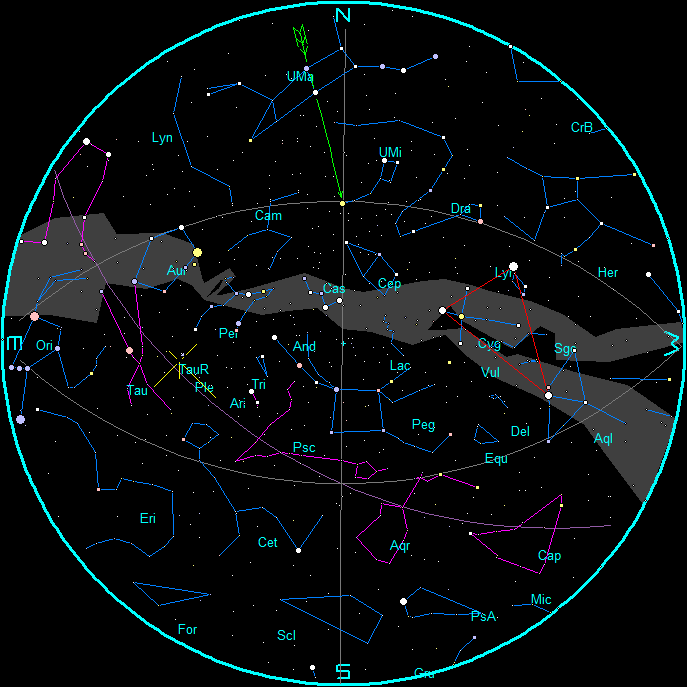
Star Chart for November 2019 (9 p.m. EST November 15, 2019). Click on image to enlarge.Created using my LookingUp program. Click on image to enlarge.
The planets and stars are plotted for the 15th at 9 p.m. EST in the evening and 6 a.m. for the morning chart. These are the chart times. Note that Traverse City is located approximately 45 minutes behind our time meridian, West 75° longitude. (An hour 45 minutes behind our daylight saving time meridian during EDT).
November Morning Star Chart
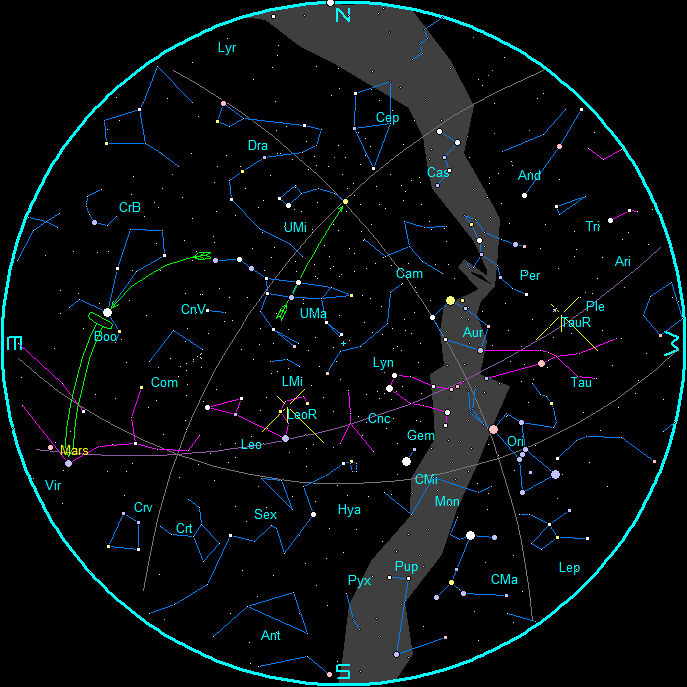
Star Chart for November mornings 2019 (6 a.m. EST November 15, 2019). Click on image to enlarge. Created using my LookingUp program.
For a list of constellation names to go with the abbreviations click here.
- Pointer stars at the front of the bowl of the Big Dipper point to Polaris the North Star.
- Follow the arc of the handle of the Big Dipper to the star Arcturus
- The Summer Triangle is in red.
- TauR on the evening star chart can be used as the radiant for the North and South Taurid meteor showers.
- LeoR on the morning star chart is the radiant of the Leonid meteor shower which peaks between the 16th to 21st.
Twilight Limits, Nautical and Astronomical
| EDT | |||||||
| Traverse City | Morning twilight | Evening twilight | Dark night | Moon | |||
| Date | Astro. | Nautical | Nautical | Astro. | Start | End | Illum. |
| 2019-11-01 | 6h46m | 7h20m | 19h40m | 20h13m | 22h13m | 6h46m | 0.26 |
| 2019-11-02 | 6h48m | 7h22m | 19h38m | 20h12m | 23h10m | 6h48m | 0.36 |
| EST | |||||||
| 2019-11-03 | 5h49m | 6h23m | 18h37m | 19h11m | 23h09m | 5h49m | 0.46 |
| 2019-11-04 | 5h50m | 6h24m | 18h36m | 19h10m | – | 5h50m | 0.56 |
| 2019-11-05 | 5h51m | 6h25m | 18h35m | 19h09m | 0h10m | 5h51m | 0.65 |
| 2019-11-06 | 5h52m | 6h26m | 18h33m | 19h08m | 1h12m | 5h52m | 0.74 |
| 2019-11-07 | 5h54m | 6h28m | 18h32m | 19h06m | 2h13m | 5h54m | 0.82 |
| 2019-11-08 | 5h55m | 6h29m | 18h31m | 19h05m | 3h14m | 5h55m | 0.89 |
| 2019-11-09 | 5h56m | 6h30m | 18h30m | 19h04m | 4h15m | 5h56m | 0.94 |
| 2019-11-10 | 5h57m | 6h31m | 18h29m | 19h03m | 5h16m | 5h57m | 0.98 |
| 2019-11-11 | 5h58m | 6h33m | 18h28m | 19h02m | – | – | 0.98 |
| 2019-11-12 | 5h59m | 6h34m | 18h27m | 19h02m | – | – | 1 |
| 2019-11-13 | 6h01m | 6h35m | 18h26m | 19h01m | – | – | 1 |
| 2019-11-14 | 6h02m | 6h36m | 18h25m | 19h00m | – | – | 0.97 |
| 2019-11-15 | 6h03m | 6h37m | 18h25m | 18h59m | 18h59m | 19h45m | 0.92 |
| 2019-11-16 | 6h04m | 6h38m | 18h24m | 18h58m | 18h58m | 20h41m | 0.85 |
| 2019-11-17 | 6h05m | 6h40m | 18h23m | 18h57m | 18h57m | 21h46m | 0.76 |
| 2019-11-18 | 6h06m | 6h41m | 18h22m | 18h57m | 18h57m | 22h56m | 0.66 |
| 2019-11-19 | 6h07m | 6h42m | 18h21m | 18h56m | 18h56m | – | 0.55 |
| 2019-11-20 | 6h08m | 6h43m | 18h21m | 18h55m | 18h55m | 0h09m | 0.43 |
| 2019-11-21 | 6h10m | 6h44m | 18h20m | 18h55m | 18h55m | 1h24m | 0.31 |
| 2019-11-22 | 6h11m | 6h45m | 18h19m | 18h54m | 18h54m | 2h39m | 0.21 |
| 2019-11-23 | 6h12m | 6h47m | 18h19m | 18h54m | 18h54m | 3h55m | 0.12 |
| 2019-11-24 | 6h13m | 6h48m | 18h18m | 18h53m | 18h53m | 5h11m | 0.05 |
| 2019-11-25 | 6h14m | 6h49m | 18h18m | 18h53m | 18h53m | 6h14m | 0.01 |
| 2019-11-26 | 6h15m | 6h50m | 18h17m | 18h52m | 18h52m | 6h15m | 0 |
| 2019-11-27 | 6h16m | 6h51m | 18h17m | 18h52m | 18h52m | 6h16m | 0.02 |
| 2019-11-28 | 6h17m | 6h52m | 18h17m | 18h52m | 18h59m | 6h17m | 0.06 |
| 2019-11-29 | 6h18m | 6h53m | 18h16m | 18h51m | 19h54m | 6h18m | 0.12 |
| 2019-11-30 | 6h19m | 6h54m | 18h16m | 18h51m | 20h54m | 6h19m | 0.19 |
Twilight calendar was generated using Cartes du Ciel (Sky Charts).
See my blog post: Twilight Zone for the definitions of the different periods of twilight here: https://bobmoler.wordpress.com/2018/09/27/.
NASA Calendar of Planetary Events
     Date   Time   Event
Nov  1 Fr          Venus: 20.8° E
     1 Fr  4:40 pm Moon Descending Node
     1 Fr  7:33 pm Moon South Dec.: 23° S
     2 Sa  2:31 am Moon-Saturn: 0.6° N
     4 Mo  5:23 am First Quarter
     5 Tu  6:41 pm South Taurid Meteor Shower: ZHR = 10
     7 Th  3:37 am Moon Apogee: 405100 km
     9 Sa  2:18 pm Venus-Antares: 3.9° N
     9 Sa  6:05 pm Mars-Spica: 2.8° N
    11 Mo 10:17 am Mercury Inferior Conjunction (Transit)
    12 Tu  8:34 am Full Moon
    12 Tu  5:57 pm North Taurid Meteor Shower: ZHR = 15
    16 Sa  3:48 am Moon Ascending Node
    16 Sa  8:52 am Moon North Dec.: 23.2° N
    18 Mo 12:15 am Leonid Meteor Shower: ZHR = 15
    18 Mo  5:11 am Moon-Beehive: 0.9° S
    19 Tu  4:11 pm Last Quarter
    23 Sa  2:54 am Moon Perigee: 366700 km
    24 Su  4:02 am Moon-Mars: 4.4° S
    24 Su  7:17 am Venus-Jupiter: 1.4° N
    26 Tu 10:06 am New Moon
    28 Th  4:59 am Mercury Greatest Elongation: 20.1° W
    28 Th  5:49 am Moon-Jupiter: 0.8° S
    28 Th  1:50 pm Moon-Venus: 2° S
    28 Th 11:13 pm Moon Descending Node
    29 Fr  5:36 am Moon South Dec.: 23.2° S
    29 Fr  4:12 pm Moon-Saturn: 1° N
Dec  1 Su          Venus: 27.9° E
All event times are given for UTC-4 hr: Eastern Daylight Saving Time or UTC-5 Eastern Standard Time starting the 3rd.
Sky Events Calendar by Fred Espenak and Sumit Dutta (NASA’s GSFC),
http://eclipse.gsfc.nasa.gov/SKYCAL/SKYCAL.html.
If you go to the above site you can print out a list like the above for the entire year or calendar pages for your time zone.
Sun and Moon Rising and Setting Events
     LU                  Ephemeris of Sky Events for Interlochen/TC
     November, 2019    Local time zone: EDT
     +-----------------------------------------------------------------------+
     | DATE |  SUN     SUN  DAYLIGHT|   TWILIGHT*    |MOON  RISE OR    ILLUM |
     |      |  RISE    SET    HOURS |  END    START  |PHASE SET** TIME FRACTN|
     +=======================================================================+
     |Fri  1| 08:20a  06:31p  10:11 | 07:36p  07:15a |      Set  10:13p   27%|
     |Sat  2| 08:21a  06:30p  10:08 | 07:35p  07:16a |      Set  11:09p   36%|
     +------+-----------------------+----------------+-----------------------+
     | EST  |      Time Change      |                |                       |
     |Sun  3| 07:23a  05:29p  10:05 | 06:34p  06:17a |      Set  11:09p   46%|
     |Mon  4| 07:24a  05:27p  10:03 | 06:32p  06:19a |F Qtr Set  12:10a   55%|
     |Tue  5| 07:25a  05:26p  10:00 | 06:31p  06:20a |      Set  01:12a   65%|
     |Wed  6| 07:27a  05:25p  09:57 | 06:30p  06:21a |      Set  02:13a   73%|
     |Thu  7| 07:28a  05:23p  09:55 | 06:29p  06:22a |      Set  03:13a   81%|
     |Fri  8| 07:30a  05:22p  09:52 | 06:28p  06:24a |      Set  04:14a   88%|
     |Sat  9| 07:31a  05:21p  09:50 | 06:27p  06:25a |      Set  05:16a   93%|
     +------+-----------------------+----------------+-----------------------+
     |Sun 10| 07:32a  05:20p  09:47 | 06:26p  06:26a |      Set  06:19a   97%|
     |Mon 11| 07:34a  05:19p  09:45 | 06:25p  06:27a |      Set  07:24a  100%|
     |Tue 12| 07:35a  05:17p  09:42 | 06:24p  06:28a |Full  Rise 05:45p  100%|
     |Wed 13| 07:36a  05:16p  09:40 | 06:23p  06:30a |      Rise 06:18p   98%|
     |Thu 14| 07:38a  05:15p  09:37 | 06:22p  06:31a |      Rise 06:57p   94%|
     |Fri 15| 07:39a  05:14p  09:35 | 06:21p  06:32a |      Rise 07:45p   88%|
     |Sat 16| 07:40a  05:13p  09:33 | 06:21p  06:33a |      Rise 08:41p   80%|
     +------+-----------------------+----------------+-----------------------+
     |Sun 17| 07:42a  05:12p  09:30 | 06:20p  06:34a |      Rise 09:46p   70%|
     |Mon 18| 07:43a  05:12p  09:28 | 06:19p  06:36a |      Rise 10:56p   60%|
     |Tue 19| 07:44a  05:11p  09:26 | 06:18p  06:37a |L Qtr Rise 12:09a   49%|
     |Wed 20| 07:46a  05:10p  09:24 | 06:18p  06:38a |      Rise 01:24a   37%|
     |Thu 21| 07:47a  05:09p  09:22 | 06:17p  06:39a |      Rise 02:39a   27%|
     |Fri 22| 07:48a  05:08p  09:20 | 06:16p  06:40a |      Rise 03:55a   17%|
     |Sat 23| 07:49a  05:08p  09:18 | 06:16p  06:41a |      Rise 05:10a    9%|
     +------+-----------------------+----------------+-----------------------+
     |Sun 24| 07:51a  05:07p  09:16 | 06:15p  06:42a |      Rise 06:26a    4%|
     |Mon 25| 07:52a  05:06p  09:14 | 06:15p  06:43a |      Rise 07:41a    1%|
     |Tue 26| 07:53a  05:06p  09:12 | 06:14p  06:45a |New   Set  05:27p    0%|
     |Wed 27| 07:54a  05:05p  09:10 | 06:14p  06:46a |      Set  06:10p    2%|
     |Thu 28| 07:56a  05:05p  09:08 | 06:13p  06:47a |      Set  06:59p    7%|
     |Fri 29| 07:57a  05:04p  09:07 | 06:13p  06:48a |      Set  07:54p   13%|
     |Sat 30| 07:58a  05:04p  09:05 | 06:13p  06:49a |      Set  08:54p   20%|
     +-----------------------------------------------------------------------+
     * Nautical Twilight
     ** Moonrise or moonset, whichever occurs between sunrise and sunset
Generated using my LookingUp for DOS program.
Some views of the festivities at the Sleeping Bear Dunes National Lakeshore Dune Climb for the transit of Mercury earlier today
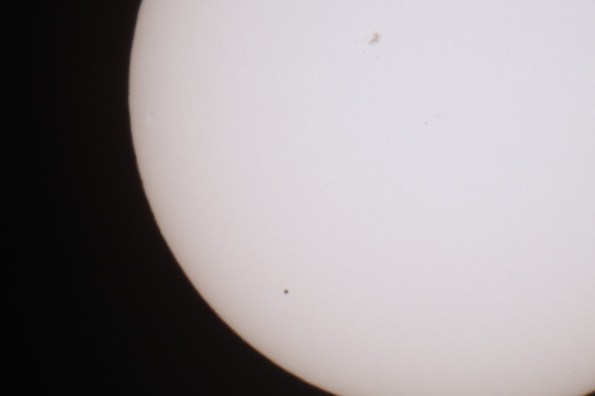
Mercury and some sunspots at 8:30 a.m. through my telescope. Thought I’d take a shot before we had visitors. C8 Cassigrainian focus, ISO 100, 1/100 second.
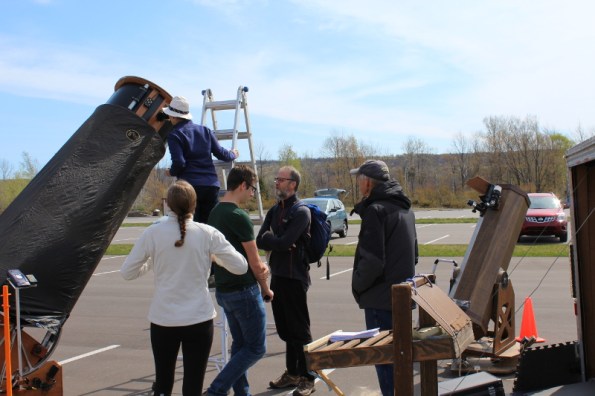
Checking the transit via the “Dobinator” through the Grand Traverse Astronomical Society’s (GTAS) 25 inch Dobsonian stopped down with an 8″ solar filter.
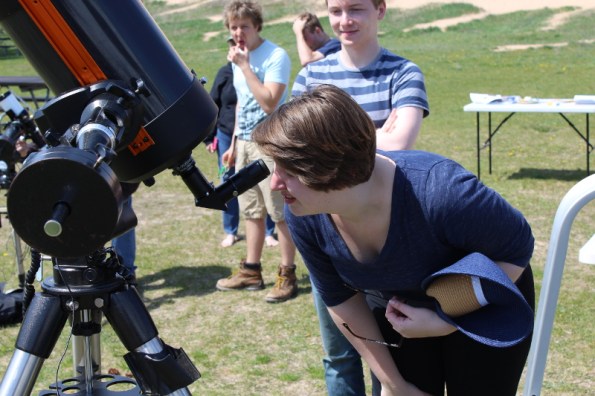
Viewing the transit through my Celestron C8.

Kids viewing the transit through the society’s Lunt hydrogen alpha solar telescope.

Youngster viewing the transit through Emmett Holmes’ 13″ homemade Dobsonian telescope and Poncet tracking mount.
Credit: Bob Moler
05/09/2016 – Ephemeris – The transit of Mercury is today!
Ephemeris for Monday, May 9th. The Sun rises at 6:21. It’ll be up for 14 hours and 36 minutes, setting at 8:58. The Moon, 3 days past new, will set at 12:12 tomorrow morning.
In less than an hour from now the planet Mercury will begin to cross the face of the Sun. It starts at 7:12 a.m. The transit will end at 2:42 this afternoon. Mercury is a tiny planet making a tiny dot against the face of the Sun, and smaller than any sunspot. If it’s clear or when its clear come out and view part of the transit. The Northwestern Michigan College’s Rogers Observatory will be open for that period. Also telescopes with be stationed at the Dune Climb at the Sleeping Bear Dunes National Lakeshore by yours truly to view the transit. The event is not visible to the naked eye and dangerous to even attempt. If you miss this transit, there will be another in 2019, 3 ½ years from now. After that, a Mercury transit visible from here will have to wait until 2049.
Times are for the Traverse City/Interlochen area of Michigan. They may be different for your location.
Addendum
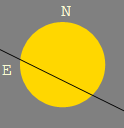
The track of Mercury across the face of the Sun. Mercury will travel from upper left to lower right. Mercury will not be visible until it impinges upon the disk of the Sun. Credit IOTA’s program Occult4.
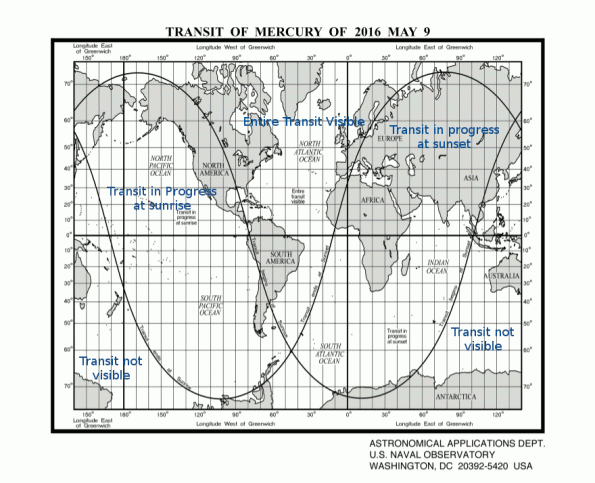
Transit visibility map with added captions to make it more readable. Credit United States Naval Observatory, The Astronomical Almanac Online.
For more information see my prior day’s posts.
Ephemeris Extra – Transit of Mercury
Transit of Mercury – May 9, 2016*
Monday, May 9th the planet Mercury will cross in front the Sun in an event called a transit. Transits of Mercury are not as rare as those of Venus. No one alive who saw that last transit of Venus, will see the next in 2117. The last transit of Mercury was in 2006, and the next will be in 2019, though it’s a long jump to the transit after that in 2032.
Occult4’s geocentric ingress time is 7:12 a.m. (11:12 UT) at position angle 83.1° Farthest penetration onto the Sun’s face is 10:57 a.m. (14:57 UT) Egress time is 2:42 p.m. (18:42 UT) at position angle 224.4°. Position angle is measured from the North point on the Sun counterclockwise.
The track of Mercury across the face of the Sun. Mercury will travel from upper left to lower right. Mercury will not be visible until it impinges upon the disk of the Sun. Credit IOTA’s program Occult4.
Looking at the Sun normally from northern Michigan, Mercury’s ingress point is close to the 8 o’clock point on its edge, since the Sun will rise tilted to the left nearly 45°. Mercury is tiny, 6.8 seconds of arc in diameter, and will be very hard to spot, smaller than most sunspots. Venus was nearly 58 seconds of arc in diameter when it transited the Sun in 2012.
Since Mercury is invisible before the transit starts. Checking out the Sun in the telescope and moving it in right ascension and declination or altitude and azimuth and altitude so the ingress point can be determined. Newtonian telescopes give an upside down image, actually rotated 180°. Refractors and Schmidt or Maksutov telescopes generally give a mirror reversed image due to the diagonal mirror that the eyepiece is placed into. The image is right side up or upside down depending on the rotation of the diagonal.
The use of a Hydrogen Alpha solar telescope allows an early peek at the transit. These telescopes look at the Sun’s chromosphere, a layer of gas 6,000 miles thick directly above the photosphere. Since the chromosphere is twice as thick as the diameter of Mercury. This should give you a few minutes heads up before white light telescopes can spot the start of the transit. I noticed the effect with the transit of Venus in 2012.
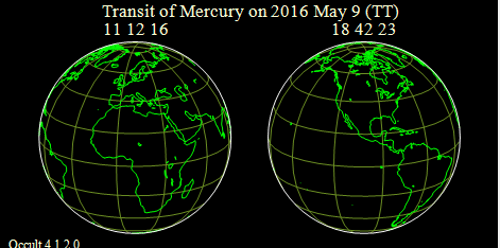
Parts of the Earth facing the Sun at the start of the transit (Left) and the end of the transit (Right). At the start of the transit Michigan is near the limb of the Earth at the upper left. The transit starts about 51 minutes after sunrise in norther Michigan. From Occult 4.
The only way to view the transit in white light is with a telescope with a front mounted solar filter. Using an eyepiece to project an unfiltered telescope image with an eyepiece may work, but Mercury is very small and projecting the Sun’s image in the ambient light doesn’t give a contrasty image.
To help everyone out the Grand Traverse Astronomical Society will have telescopes in two locations: The NMC Rogers Observatory and the Dune Climb at the Sleeping Bear Dunes National Lakeshore. Since the transit lasts 6 ½ hours the usual cancellation rules won’t be in effect. If it’s cloudy at the start, it could clear up later on. I’ll be stationed at the Dunes and will be there for the duration, so if we have an all day rain I’ll still be out there, hoping it’ll clear up. Check bobmoler.wordpress.com for the latest on viewing conditions there.
* Based on my article in the May 2016 edition of the Stellar Sentinel, the monthly publication of the Grand Traverse Astronomical Society.
05/06/2016 – Ephemeris – Learn about Monday’s transit of Mercury tonight
Ephemeris for Friday, May 6th. The Sun rises at 6:25. It’ll be up for 14 hours and 29 minutes, setting at 8:54. The Moon is new today, and won’t be visible.
Learn more about next Monday’s transit of Mercury across the Sun at tonight’s meeting of the Grand Traverse Astronomical Society at 8 p.m. at the Northwestern Michigan College’s Rogers Observatory, on Birmley Road, South of Traverse City. Afterward at 9 p.m., there will be another program and weather permitting there will be viewing of Jupiter, and later Mars. On Monday the Society will host transit viewing at two locations. The transit runs 6 ½ hours from 7:12 a.m. to 2:42 p.m. The Rogers Observatory will be open for that period. Also telescopes with be stationed at the Dune Climb at the Sleeping Bear Dunes National Lakeshore by yours truly to view the transit. The event is not visible to the naked eye and dangerous to even attempt it.
The program will also preview the coming opposition of Mars and closest approach since 2003 on the 30th.
Times are for the Traverse City/Interlochen area of Michigan. They may be different for your location.
Addendum
I posted these yesterday, but here they are again:
Transit visibility map with added captions to make it more readable. Credit United States Naval Observatory, The Astronomical Almanac Online.
The track of Mercury across the face of the Sun. Mercury will travel from upper left to lower right. Mercury will not be visible until it impinges upon the disk of the Sun. Credit IOTA’s program Occult4.
From IOTA’s Occult4 program
Transit of Mercury on 2016 May 9 (TT)
   {'+' => next day; '-' => previous day }
                                           Overhead at
     Geocentric Event      UTC         P.A.  Long  Lat
                         h  m  s       o      o    o
[1]  Exterior Ingress   11 12 16     83.1     11   17
[2]  Minimum Separation 14 57 38             -45   18
[3]  Exterior Egress    18 42 23    224.4   -102   18

Minimum sepn 318.5";  Radii - Sun 950.4", Mercury 6.0"
delta T =  68.2 secs,  Ephemeris = DE0
Note: These timings are geocentric. Occult4 has timings for various cities of the world. Occult4.0.2 can be downloaded here. They can vary by several minutes for different cities due to parallax.
I will post more information on the transit in an Ephemeris Extra tomorrow.
05/05/2016 – Ephemeris – Previewing Monday’s transit of Mercury
Ephemeris for Thursday, May 5th. The Sun rises at 6:26. It’ll be up for 14 hours and 26 minutes, setting at 8:53. The Moon, 1 day before new, will rise at 6:38 tomorrow morning.
Next Monday, the 9th, the tiny planet Mercury will be seen to cross that face of the Sun. Astronomers call such an event a transit. The last time a planet crossed the face of it Sun, it was Venus on June 5th, 2012, almost 4 years ago. Very few, who were alive in 2012 will be around to see the next transit of Venus in 2117. Transits of Mercury are more frequent. Mercury will cross the face of the Sun from 7:12 a.m. to 2:42 p.m. on Monday. Mercury is too small to see with eclipse filters or with the naked eye. The latter could cause blindness. Only telescopes with solar filters that fit over the front of the telescope are safe to use. Mercury will be a tiny black dot, smaller than most sunspots. Tomorrow I’ll have information about where to go to see it.
Times are for the Traverse City/Interlochen area of Michigan. They may be different for your location.
Addendum
Transit visibility map with added captions to make it more readable. Credit United States Naval Observatory, The Astronomical Almanac Online! 2016
The track of Mercury across the face of the Sun. Mercury will travel from upper left to lower right. Mercury will not be visible until it impinges upon the disk of the Sun. Credit IOTA’s program Occult4.
From IOTA’s Occult4 program
Transit of Mercury on 2016 May 9 (TT)
   {'+' => next day; '-' => previous day }
                                           Overhead at
     Geocentric Event      UTC         P.A.  Long  Lat
                         h  m  s       o      o    o

[1]  Exterior Ingress   11 12 16     83.1     11   17
[2]  Minimum Separation 14 57 38             -45   18
[3]  Exterior Egress    18 42 23    224.4   -102   18

Minimum sepn 318.5";  Radii - Sun 950.4", Mercury 6.0"
delta T =  68.2 secs,  Ephemeris = DE0
Note: These timings are geocentric. Occult4 has timings for various cities of the world. Occult4.0.2 can be downloaded here. They can vary by several minutes for different cities due to parallax.
04/29/2016 – Ephemeris – Let’s preview the merry skies of May
Ephemeris for Arbor Day, Friday, April 29th. The Sun rises at 6:34. It’ll be up for 14 hours and 10 minutes, setting at 8:45. The Moon, at last quarter today, will rise at 3:01 tomorrow morning.
Sunday starts the month when the promise of spring is finally fulfilled. Daylight hours in the Interlochen/Traverse City area will increase from 14 hours and 16 minutes Sunday to 15 hours 20 minutes on the 31st. The altitude, or angle, of the Sun above the southern horizon at local noon will ascend from 60 degrees Sunday to 67 degrees at month’s end. The altitude of the sun in the Straits area will be a degree lower than that but your daylight will be a few minutes longer. The big event of May will be the transit of the tiny planet Mercury across the face of the Sun on May 9th. I’ll have more on that next week. Also Mars will be in opposition from the Sun on the 22nd which due to its elliptical orbit will actually be closest to us 8 days later on the 30th at 46.779 million miles (75.284 million km).
Times are for the Traverse City/Interlochen area of Michigan. They may be different for your location.
Addendum
May Star Chart
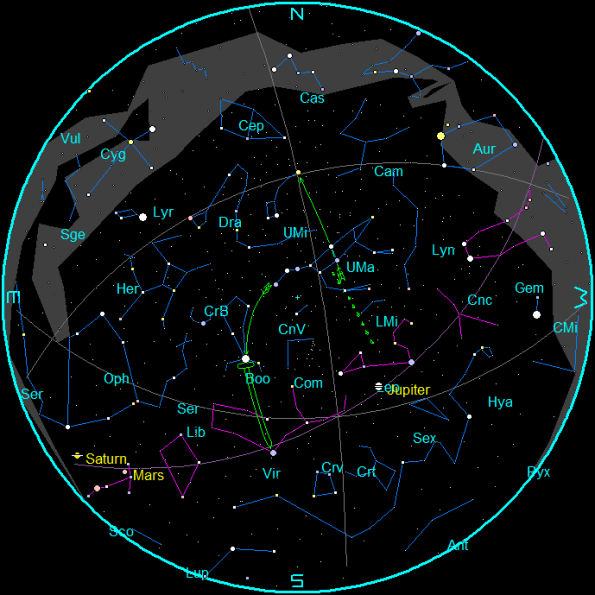
Star Chart for May 2016. Created using my LookingUp program. To enlarge in Firefox Right-click on image then click View Image.
The planets and stars are plotted for the 15th at 11 p.m. EDT. That is chart time. Note, Traverse City is located approximately 45 minutes behind our time meridian. (An hour 45 minutes behind our daylight saving time meridian.) To duplicate the star positions on a planisphere you may have to set it to 1:45 earlier than the current time.
Evening nautical twilight ends at 10:00 p.m. EDT on the 1st, increasing to 10:43 p.m. EDT on the 31st.
Morning nautical twilight starts at 5:20 a.m. EDT on the 1st, and decreasing to 4:38 a.m. EDT on the 31st.
Add a half hour to the chart time every week before the 15th and subtract a half hour for every week after the 15th. Before the 13th also subtract an hour for Standard Time.
For a list of constellation names to go with the abbreviations click here.
- Pointer stars at the front of the bowl of the Big Dipper point to Polaris the North Star
- A leaky Big Dipper drips on Leo
- Follow the arc of the handle of the Big Dipper to the star Arcturus
- Extend the ac to a spike to point to Spica
Calendar of Planetary Events
Credit: Sky Events Calendar by Fred Espenak and Sumit Dutta (NASA’s GSFC)
To generate your own calendar go to http://eclipse.gsfc.nasa.gov/SKYCAL/SKYCAL.html
Times are Eastern Time. Some additions made to aid clarity.
    Date   Time      Event
May 01 Su            Venus: 9.8° W
    02 Mo  9:27 p.m. Moon Descending Node
    04 We  2:45 p.m. Eta Aquarid Shower: ZHR = 60
    06 Fr 12:14 a.m. Moon Perigee: 357800 km
    06 Fr  3:30 p.m. New Moon
    08 Su  4:21 a.m. Moon-Aldebaran: 0.5° S
    09 Mo  7:12 a.m. Mercury transit begins
    09 Mo 10:57 a.m. Mercury mid-transit
    09 Mo  2:42 p.m. Mercury transit ends
    09 Mo  5:54 p.m. Moon North Dec.: 18.4° N
    13 Fr  1:02 p.m. First Quarter
    14 Sa  3:06 a.m. Moon-Regulus: 2.5° N
    15 Su  5:30 a.m. Moon-Jupiter: 2.2° N
    15 Su  4:39 p.m. Moon Ascending Node
    18 We  6:06 p.m. Moon Apogee: 405900 km
    21 Sa  5:15 p.m. Full Moon
    22 Su  7:15 a.m. Mars Opposition
    22 Su  5:59 a.m. Moon-Saturn: 3.5° S
    24 Tu  7:16 a.m. Moon South Dec.: 18.5° S
    29 Su  8:12 a.m. Last Quarter
    30 Mo 12:45 a.m. Moon Descending Node
    30 Mo  5:36 p.m. Mars closest to the Earth 0.50321 AU
Jun 01 We            Venus: 1.5° W
Transit of Mercury
May 9, 2016 7:12 a.m. (11:21 UT) to 2:42 p.m. (18:42 UT)
The track of Mercury across the face of the Sun. Mercury will travel from upper left to lower right. Mercury will not be visible until it impinges upon the disk of the Sun. Credit IOTA’s program Occult4.

The map showing where the transit is visible in whole or in part. If using Firefox enlarge the map by right clicking on it and select View Image.
12/31/2015 – Ephemeris – Next year’s big astronomical event
Ephemeris for New Years Eve, Thursday, December 31st. The Sun will rise at 8:20. It’ll be up for 8 hours and 51 minutes, setting at 5:11. The Moon, 2 days before last quarter, will rise at 11:56 this evening.
The big astronomical event of 2016 will be the passage of the planet Mercury across the face of the Sun on May 9th. This type of event is called a transit. Back in 2012 we saw the transit of Venus, an extremely rare event that won’t be repeated for over 100 years. Transits of Mercury are not so rare. The next will be in three years. It also will not be as impressive as a transit of Venus because Mercury is a tiny planet and looks smaller than a small sunspot on the Sun. It cannot be seen without a solar filtered telescope. The actual Transit will last about 7 ½ hours. Should it be clear for all or part of that time members of the Grand Traverse Astronomical Society will be at two locations to show the event.
Times are for the Traverse City/Interlochen area of Michigan. They may be different for your location.
Addendum
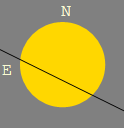
Path of Mercury across the face of the Sun from east to west. Credit IOTA/Occult4
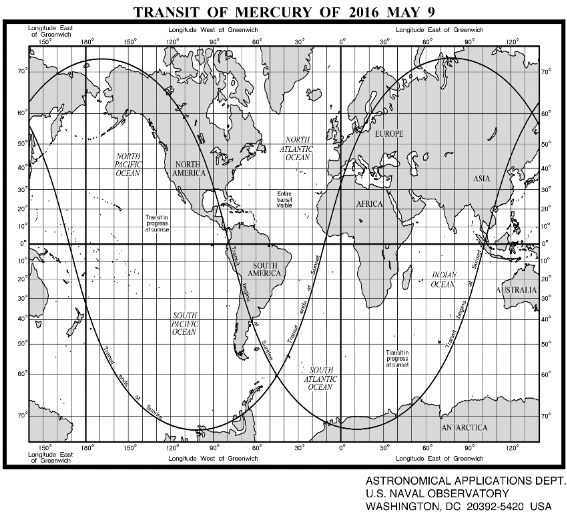
Transit of Mercury visibility map. Click on the Image to view a higher resolution pdf. Credit; Astronomical Almanac Online/USNO
       TRANSIT OF MERCURY GEOCENTRIC PHASES
                                              Position
                                   UT          Angle
                               d  h  m   s        °
Ingress, exterior contact  May 9 11 12 17.6     83.2
Ingress, interior contact      9 11 15 29.5     83.5
Least angular distance         9 14 57 25.3    153.8
Egress, interior contact       9 18 39 12.8    224.1
Egress, exterior contact       9 18 42 24.8    224.4

Least angular distance from the center of the Sun: 5' 18".5
Position angle:  Contact point measured counterclockwise from the north
   point on the face of the Sun.
UT = Universal time A.K.A. Greenwich Mean Time (GMT or Zulu).
   Subtract 4 hours to obtain Eastern Daylight Time (EDT) for
   most of Michigan.  In short the transit will span from
   7:12 a.m. to 2:42 p.m.
Above time-table is from Astronomical phenomena for 2016 Credit: USNO/UKHO
 Bob Moler's Ephemeris Blog