Archive
02/15/2022 – Ephemeris – The Moon’s splashiest crater
This is Ephemeris for Tuesday, February 15th. Today the Sun will be up for 10 hours and 28 minutes, setting at 6:11, and it will rise tomorrow at 7:41. The Moon, 1 day before full, will set at 8:09 tomorrow morning.
The Moon at 8 pm tonight will be only 16 hours before being full. As down as I am about full moons due to the fact that they light up the sky and flood out the dimmer objects, I once in a while stop and view it. Being less than a day from full, we see it tonight from very nearly the direction of the Sun, so there will be few shadows to be had. The crater Tycho is near the bottom or south end of the moon and has long rays of tiny ejecta craters. The full moon is the best time to see these rays, which are easily visible in binoculars, through which Tycho itself looks like a bright dot. In telescopes, Tycho looks like a small, bright crater with a dark ring around it. The full moon is super bright. It’s daytime over there.
The astronomical event times given are for the Traverse City/Interlochen area of Michigan (EST, UT – 5 hours). They may be different for your location.
Addendum
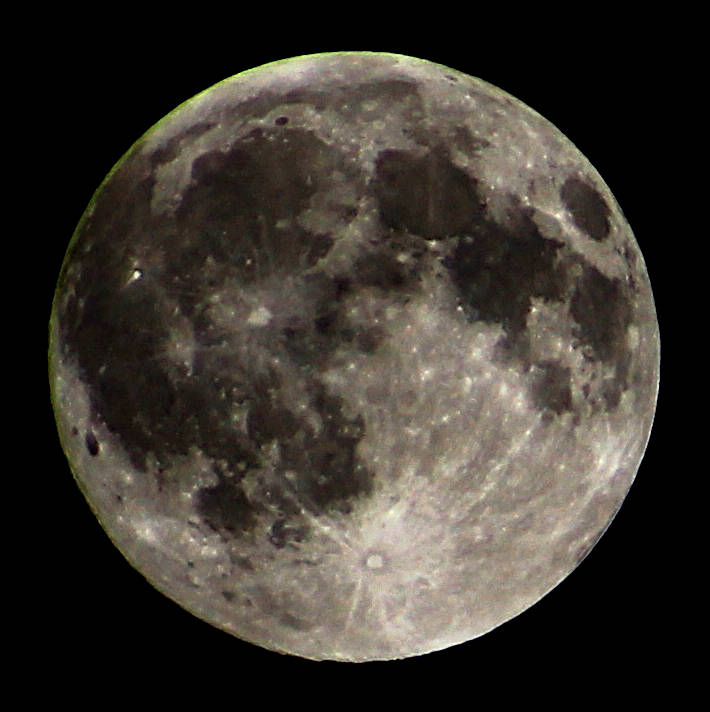
An image I took of the full moon in August 2016 and processed for maximum contrast to show the crater Tycho with its dark ring, near the bottom (south) of the Moon and its rays that stretch for hundreds of miles across the face of the Moon. The image is fairly low resolution, taken with a 300 mm telephoto lens. Click on the image to enlarge it a bit.
04/26/2021 – Ephemeris – There’s a full supermoon tonight
This is Ephemeris for Monday, April 26th. Today the Sun will be up for 14 hours and 2 minutes, setting at 8:41, and it will rise tomorrow at 6:38. The Moon, at full today, will rise at 8:19 this evening.
The full moon tonight is the full Pink Moon, and a supermoon. As down as I am about full moons due to the fact that they light up the sky and flood out the dimmer objects in the sky, I once in a while stop and view it. The time of the full moon is 11:31 tonight, so when it rises tonight we will be looking at the moon from very nearly the direction of the Sun, so there will be few shadows to be had. The crater Tycho is near the bottom or south end of the moon and has long rays of tiny ejecta craters. The full moon is the best time to see these rays, which are easily visible in binoculars, through which Tycho itself looks like a bright dot. In telescopes Tycho looks like a small bright crater with a dark ring around it. The full moon is super bright. It’s daytime over there.
The astronomical event times given are for the Traverse City/Interlochen area of Michigan. They may be different for your location.
Addendum
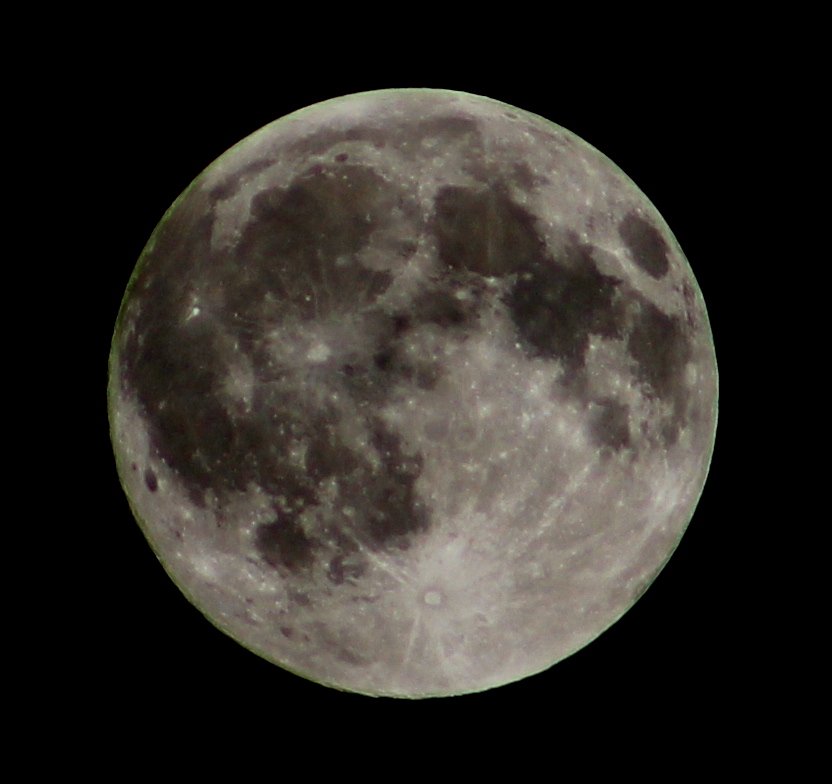
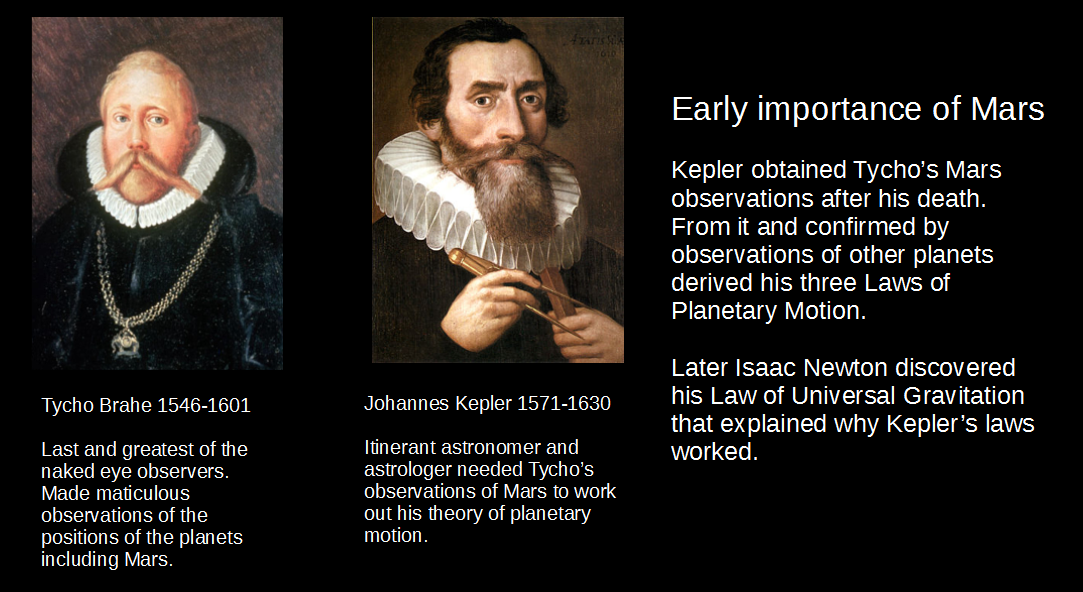
Tycho Brahe and Johannes Kepler are inexorably linked in astronomical history. Tycho was famously stingy with the results of his observations. It was only after his death that Kepler was able to have access to them. Mars was the planet that was hardest to model in both the Ptolemaic geocentric and Copernican heliocentric universes, since both assumed the planetary orbits were circular. So both resorted to epicycles in an attempt to tweak their models in an attempt to fit with observational reality.
Both Tycho and Kepler have craters named for them on the Moon. Tycho gets a splashy crater on the southern part of the Moon. Kepler, however, gets a small crater on the plains of Oceanus Procellarum west of the crater Copernicus on the left side of the Moon, as we see it
01/25/2018 – Ephemeris – The Moon tonight: Copernicus on the terminator
Ephemeris for Thursday, January 25th. The Sun will rise at 8:09. It’ll be up for 9 hours and 32 minutes, setting at 5:41. The Moon, 1 day past first quarter, will set at 2:48 tomorrow morning.
Let’s take a look at our slightly gibbous moon, just a day past first quarter with binoculars or a small telescope. The terminator, in this case the sunrise line will appear to cross the crater Copernicus to the right of the Moon’s center if you’re viewing it right side up. To the North across the Sea of Showers, or Mare Imbrium is the large flat floored crater Plato. South of Copernicus is a recently named sea, Mare Cognitum, the Known Sea, after the first successful close photography by the Ranger 7 spacecraft in 1964. South of the is Mare Nubium, the Sea of Clouds. South of that are the lunar highlands with the stark crater Tycho and the huge crater Clavius with an arc of craters of decreasing size within it.
The times given are for the Traverse City/Interlochen area of Michigan. They may be different for your location.
Addendum
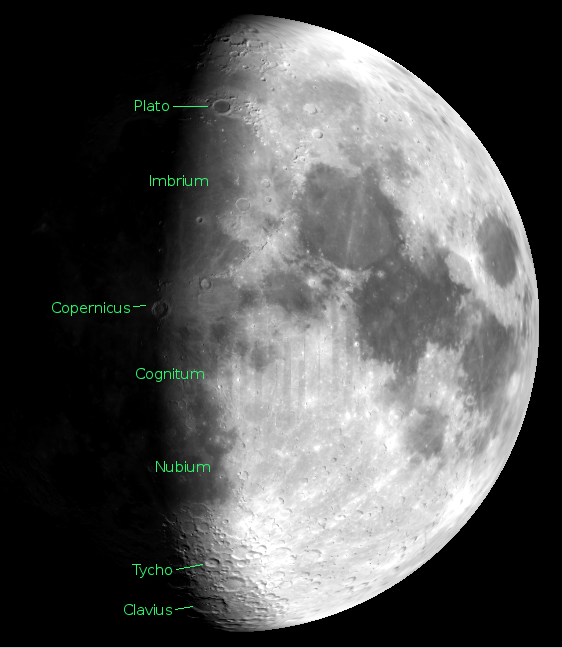
The waxing gibbous Moon tonight at 8 p.m., January 25, 2018. Created using Virtual Moon Atlas.
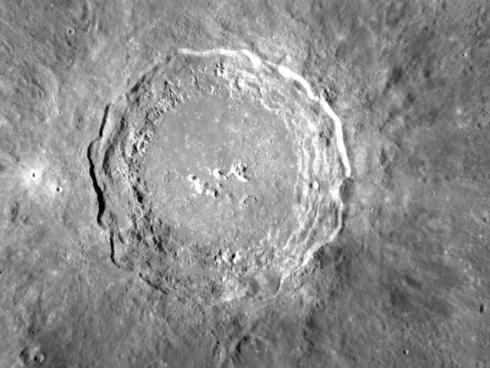
The crater Copernicus. Credit: NASA/GSFC/Arizona State University.
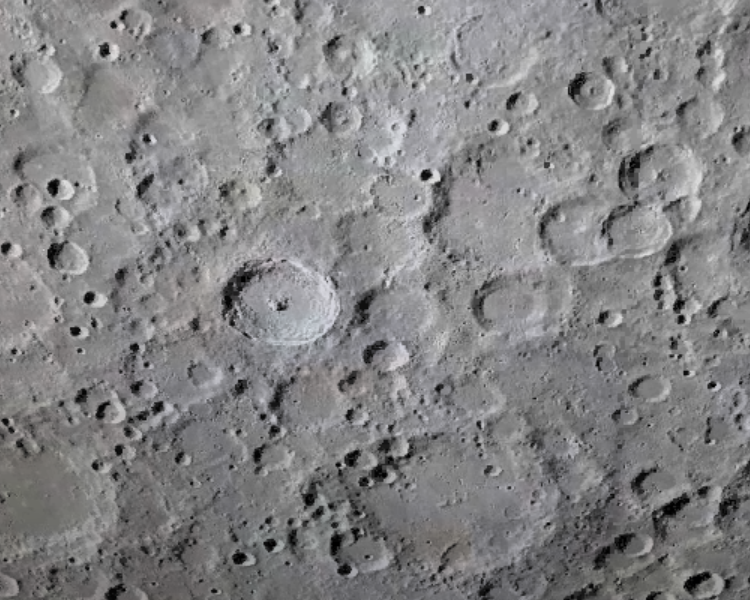
The Lunar highlands near the crater Tycho showing a surface saturated with craters. Credit: Virtual Moon Atlas with the texture from NASA’s Lunar Reconnaissance Orbiter. The lunar phase was omitted.
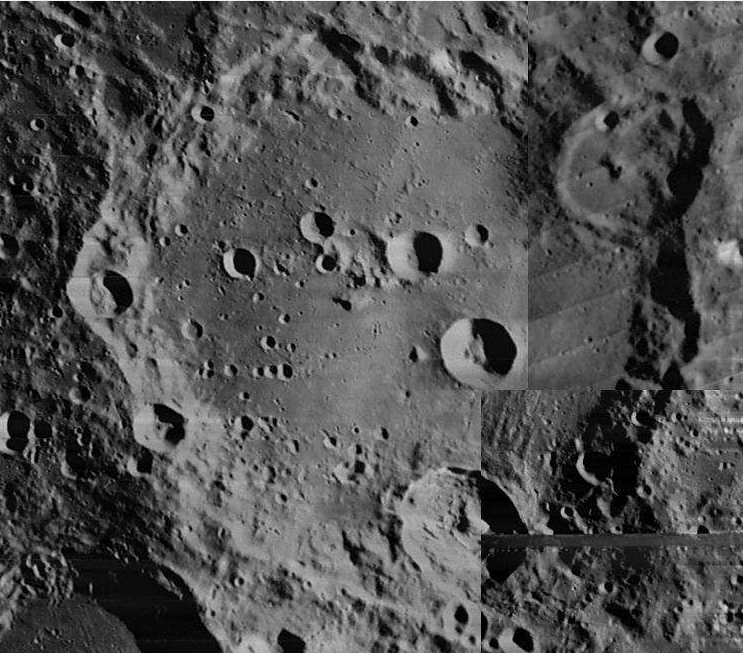
Clavius as photographed by one of the Lunar Orbiter spacecraft in the 1960s From Digital Lunar Orbital Photographic Atlas. Credit Jeff Gillis, Lunar and Planetary Institute.
10/02/2014 – Ephemeris – The gibbous Moon tonight
Ephemeris for Thursday, October 2nd. The sun will rise at 7:41. It’ll be up for 11 hours and 39 minutes, setting at 7:21. The moon, 1 day past first quarter, will set at 1:50 tomorrow morning.
Tonight the moon will be featuring some of my favorite lunar landmarks, and if you spend any time looking at the moon with a small telescope, they become yours. The place to look is at the terminator, the sunrise line on the moon. In the north not far from the terminator is the walled plain called Plato. A bit farther away is a gash in the lunar Alps mountains caller the Alpine Valley. Near the center of the terminator and split by it is the fabulous crater Copernicus with a triple central peak which should poke into sunlight. Near the south pole is the large crater Clavius with an arc of decreasingly smaller craterlets on its floor. A bit north of that is the crater Tycho, which is more prominent when the moon is full than it is now.
Times are for the Traverse City/Interlochen area of Michigan. They may be different for your location.
Addendum
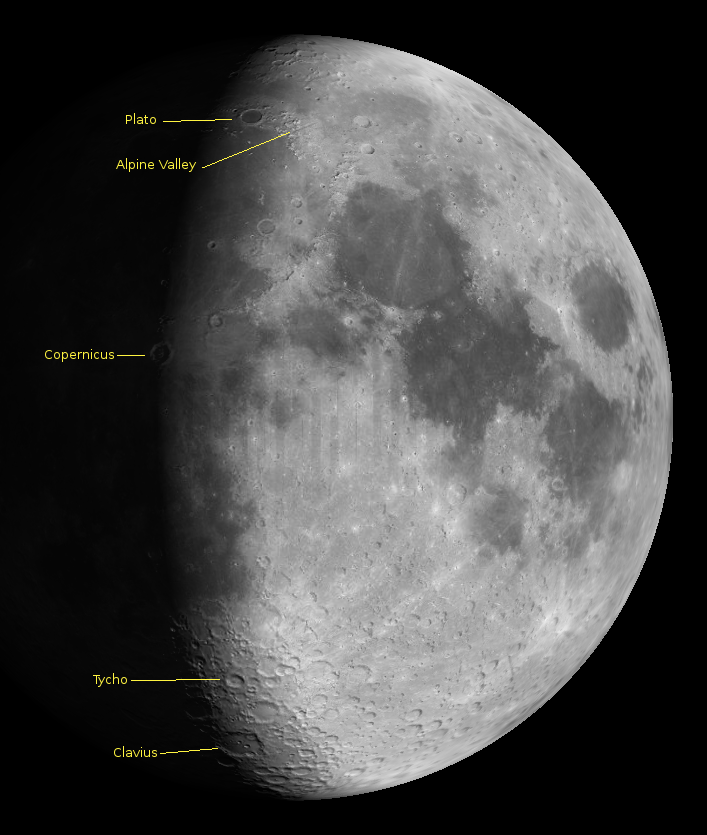
The gibbous Moon one day after first quarter at 9 p.m. October 2, 2014. Created using Virtual Moon Atlas.
10/29/2012 – Ephemeris – The full Hunters Moon and Tycho’s rays
Ephemeris for Monday, October 29th. The sun will rise at 8:16. It’ll be up for 10 hours and 18 minutes, setting at 6:34. The moon, at full today, will rise at 6:24 this evening.
The full moon tonight is the full Hunters Moon. As down as I am about full moons due to the fact that they light up the sky and flood out the dimmer objects in the sky, I once and a while stop and view it. The time of the full moon is about 3 this afternoon, so when it rises tonight we will be looking at the moon from very nearly the direction of the sun, so there will be few shadows to be had. Last week I talked about the crater Tycho near the bottom or south end of the moon and its long rays of ejecta. The full moon is the best time to see these rays, which are easily visible in binoculars, through which Tycho itself looks like a bright dot. In telescopes Tycho looks like a small bright ring. The full moon is super bright. It’s daytime there.
Times are for the Traverse City/Interlochen area of Michigan. They may be different for your location.
Addendum
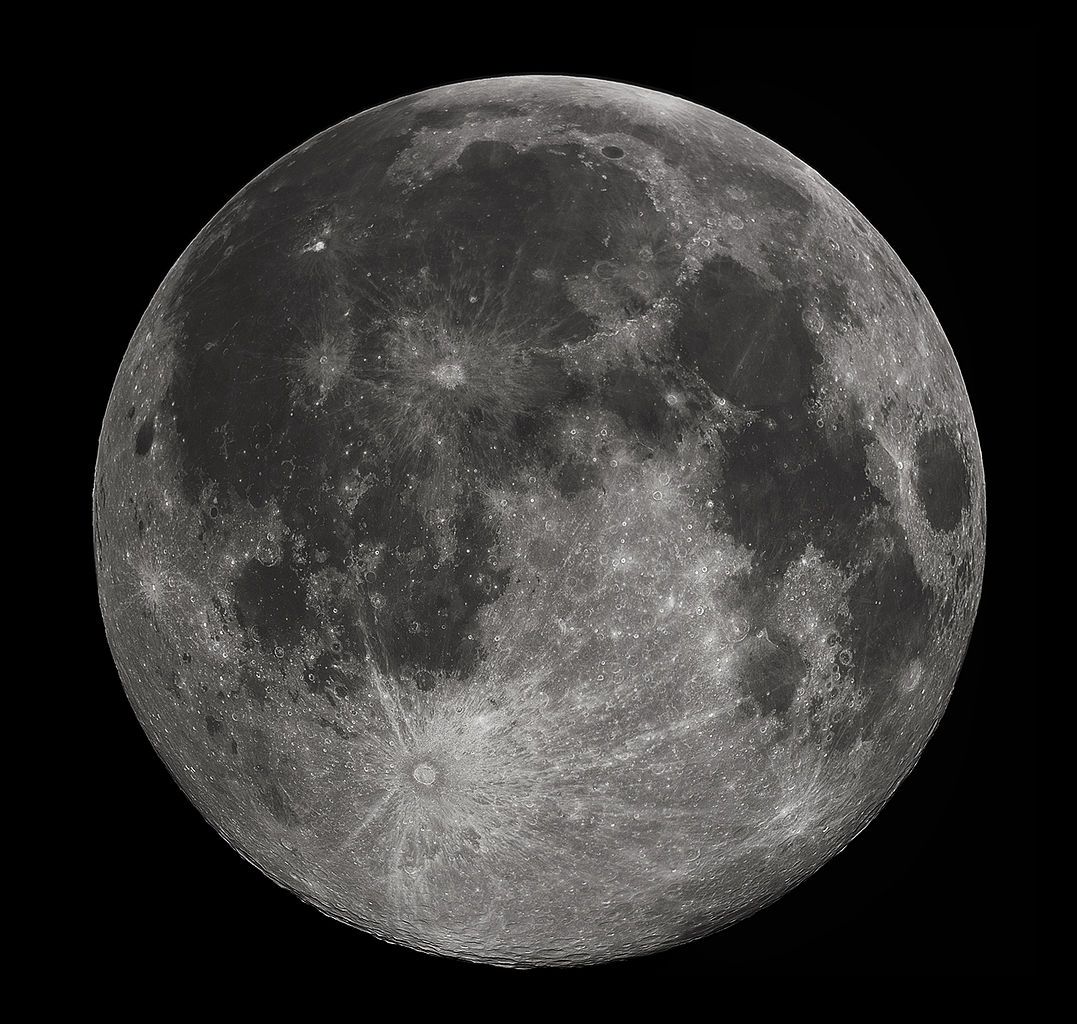
Photographed with a Celestron 9.25 Schmidt-Cassegrain telescope. Acquired with a Canon EOS Rebel T1i (EOS 500D), 20 images stacked to reduce noise. 200 ISO 1/640 sec. Gregory H. Revera
Tycho and its rays are prominent in the photo above. I found this image in the article Moon in Wikipedia.
10/23/2012 – Ephemeris – The remarkable lunar crater Tycho
Ephemeris for Tuesday, October 23rd. The sun will rise at 8:08. It’ll be up for 10 hours and 35 minutes, setting at 6:44. The moon, 2 days past first quarter, will set at 2:52 tomorrow morning.
Tonight the moon’s advancing sunrise line will reveal a young crater near the bottom of the moon. That crater is Tycho. In binoculars or a telescope it’s features appear sharper, and its floor deeper than the surrounding craters. Its age is in the range of hundreds of thousands of years rather than billions. Tycho has an extensive ray system that extends thousands of miles across the face of the moon. That is best seen at full moon, and the rays are probably a huge number of craterlets. They are normally shadow filled but at full moon are fully illuminated accentuating the brightness of the rays. The crater was named for 16th Century Danish astronomer Tycho Brahe, the greatest observational astronomer before the invention of the telescope. [ His observations allowed Kepler to formulate his three laws of planetary motion.]
Times are for the Traverse City/Interlochen area of Michigan. They may be different for your location.
Addendum
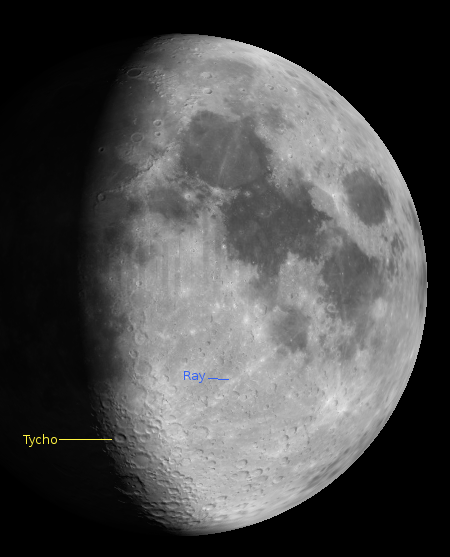
The crater Tycho and one of its rays at 9 p.m. on October 23 2012. Created using Virtual Moon Atlas.
05/29/2012 – Ephemeris – The moon tonight
Ephemeris for Tuesday, May 29th. Today the sun will be up for 15 hours and 16 minutes, setting at 9:18. The moon, 1 day past first quarter, will set at 2:38 tomorrow morning. Tomorrow the sun will rise at 6:01.
The moon tonight is a wonderful sight for binoculars or a small telescope. There are some very nice craters now revealed near the terminator, the line between day and night on the moon. The terminator in the two weeks between new and full is the sunrise line on the moon. From the top or north on the moon is the flat floored crater Plato Then about midway down the moon and right on the terminator is the beautiful crater Copernicus. Then to the south end of the moon is the bright and crisp crater Tycho. Its splash marks called rays will be better revealed at full moon. At the bottom of the moon, just coming into light is the huge crater Clavius. A telescope will reveal smaller craters within.
Times are for the Traverse City/Interlochen area of Michigan. They may be different for your location.
Addendum
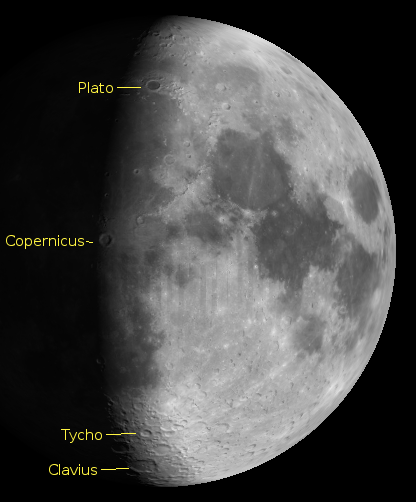
The moon on 5/29/2012 showing large craters on the terminator. Created using Virtual Moon Atlas.
 Bob Moler's Ephemeris Blog